What You Need to Know About Paralegal Job Information
If you're researching paralegal job information, here's a quick snapshot of the most important facts:
| Category | Key Facts |
|---|---|
| Median Annual Pay | Competitive |
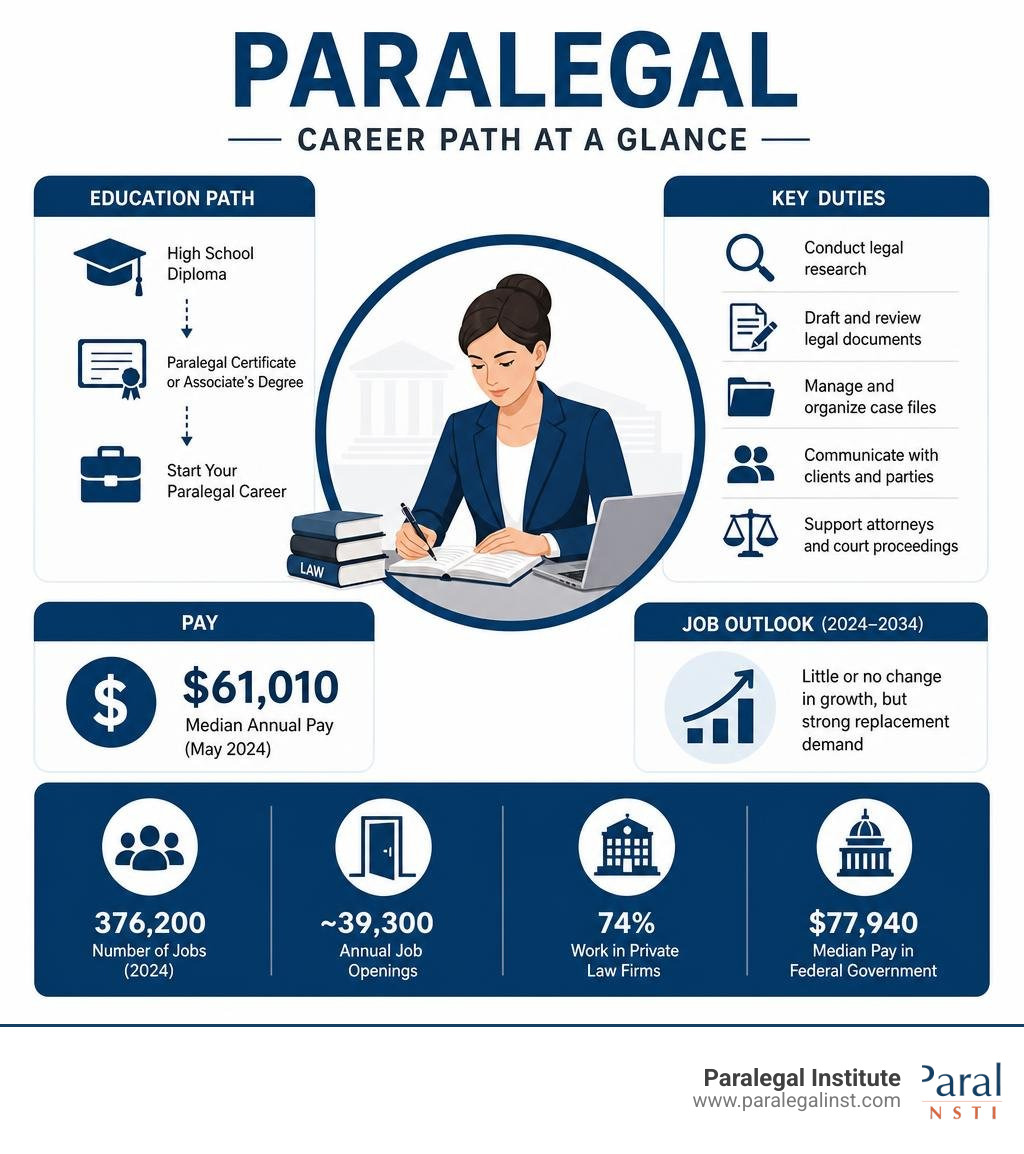
| Number of Jobs | About 404,900 (2025) |
| Annual Job Openings | ~40,800 per year |
| Entry-Level Education | Paralegal certificate |
| Largest Employer | Private law firms (74% of jobs) |
| Job Outlook (2025–2035) | Little or no change in growth, but strong replacement demand |
| Top-Paying Industry | Federal government |
Paralegals are a vital part of the legal system. They conduct legal research, draft documents, manage cases, and support attorneys — all without holding a law license. It's skilled, meaningful work that sits right at the heart of how law firms and legal departments get things done.
The good news? You don't need a college degree or a law school diploma to enter this field. A focused, practical paralegal certificate can get you career-ready faster than most people expect.
This guide covers everything — from day-to-day duties and pay to education paths, practice areas, and how to land your first role.
I'm Matt Pfau, a practicing attorney who has hired and trained paralegals throughout my career and now teaches at Paralegal Institute — so I bring a real insider perspective to this paralegal job information guide. Having seen what employers actually look for, I'll walk you through exactly what you need to know to make a confident career move.
Essential Paralegal Job Information: Roles and Responsibilities
When people ask us what a paralegal does, we often tell them that they are the engine room of a law firm. While attorneys are the ones who stand up in court and sign off on legal strategy, paralegals perform the substantive legal work that makes those actions possible.
Under the direct supervision of a licensed attorney, a paralegal handles tasks that would otherwise have to be done by the lawyer. This relationship is crucial: to avoid the unauthorized practice of law, all of a paralegal's work must be reviewed and approved by an attorney. Within those boundaries, however, experienced paralegals enjoy an incredible amount of professional responsibility. You can learn more about typical duties to see how these professionals spend their days, or read the complete guide on what paralegals do for an in-depth breakdown.
Core Duties and Daily Tasks
If you step into a busy law office, you will find paralegals managing a wide variety of responsibilities. Their daily schedules are highly dynamic and usually include:
- Conducting Legal Research: Using specialized legal databases to look up past case law, statutes, and regulations that apply to a current case.
- Document Preparation: Drafting initial versions of contracts, corporate agreements, pleadings, and discovery requests.
- Trial Support: Organizing evidence, preparing trial binders, indexing exhibits, and coordinating witness schedules.
- Client Communication: Serving as a primary point of contact for clients, gathering factual details, and keeping them updated on case milestones.
Because these tasks directly impact case outcomes, employers look for candidates who understand how a case moves from initial consultation to final resolution. For a complete breakdown of what hiring managers expect, take a look at our Paralegal Job Description Guide.
Key Practice Areas and Employment Settings
Paralegals are not restricted to one type of law. Depending on your interests, you can specialize in several distinct practice areas:
- Litigation: Supporting civil lawsuits by managing the discovery process, drafting motions, and helping during trial preparation.
- Family Law: Helping clients navigate sensitive matters like divorces, child custody agreements, and adoptions.
- Corporate Law: Preparing incorporation documents, drafting shareholder agreements, and assisting with mergers and acquisitions.
- Real Estate: Reviewing title documents, drafting lease agreements, and coordinating commercial closings.
- Criminal Law: Working for defense firms or government agencies to index evidence, draft legal notices, and interview witnesses.
Whether you want to work in a litigation firm in downtown Las Vegas or support an in-house corporate team, understanding these specialties is key to finding your niche. Explore our Paralegal Career Information page to learn more about where this career path can take you.
How Paralegals Differ from Lawyers and Legal Secretaries
It is common for those outside the legal industry to confuse the roles of lawyers, paralegals, and legal secretaries. However, these positions have distinct educational paths, daily responsibilities, and legal limitations.
| Feature | Lawyer | Paralegal | Legal Secretary |
|---|---|---|---|
| Education Required | Juris Doctor (JD) | Paralegal Certificate | High School Diploma / Vocational |
| Must Pass Bar Exam? | Yes | No | No |
| Can Give Legal Advice? | Yes | No | No |
| Can Represent Clients in Court? | Yes | No | No |
| Primary Work Focus | Legal strategy, court advocacy, fee setting | Substantive legal drafting, research, case prep | Administrative tasks, scheduling, filing |
| Time Billable to Clients? | Yes (High hourly rate) | Yes (Moderate hourly rate) | No (Administrative overhead) |
To get a clearer picture of how these roles interact in a real office, you can explore paralegal roles and responsibilities.
Paralegal vs. Lawyer
The primary difference between a paralegal and a lawyer comes down to licensing and ultimate legal responsibility. A lawyer must earn an undergraduate degree, complete three years of law school to earn a Juris Doctor, and pass a rigorous state bar exam. Lawyers are authorized to give legal advice, set legal fees, accept new clients, and represent individuals in a court of law.
Paralegals, while highly skilled, do not have a law license and cannot perform these specific actions. Doing so would constitute the unauthorized practice of law. Instead, they work behind the scenes to prepare the materials that lawyers use to advise clients and argue cases.
Paralegal vs. Legal Secretary
A legal secretary (or legal assistant in some traditional firms) focuses primarily on administrative and clerical tasks. Their responsibilities include answering phones, scheduling appointments, maintaining calendar deadlines, and filing pre-formatted documents with the court. Their time is generally considered administrative overhead and is not billed directly to clients.
A paralegal, on the other hand, performs substantive legal work that requires independent judgment and specialized training. Because of this, a paralegal's working hours are billed directly to clients, making them a direct source of revenue for law firms. If you want to understand where you might fit best in a legal team, check out our paralegal positions guide.
Education, Skills, and Career Pathways

Many people assume that entering the legal field requires spending years in college. Fortunately, the path to becoming a paralegal is highly accessible, especially if you choose a focused training model.
While some individuals pursue multi-year college degrees, an accelerated paralegal certificate program is often the smartest and most practical route. These programs strip away general education requirements and focus entirely on the hands-on, practical skills that law firms actually value. Why spend years studying theory when you can learn how to draft a motion or conduct legal research in a matter of weeks?
If you are wondering how to make the leap, we have put together a guide on how to get a paralegal job to help you get started.
Educational Requirements and the Paralegal Certificate
At Paralegal Institute, we offer a 15-week paralegal certificate program designed specifically for rapid, career-ready entry into the workforce. Our curriculum is built and taught by practicing legal professionals — including active attorneys — which means you learn exactly what is happening in local law firms today.
We offer our classes in two convenient formats:
- Online with live instruction(giving you real-time interaction with instructors and peers)
- In-person classes at our physical campus
This accelerated, practical training is ideal for career changers or adults who need a cost-effective, fast path into a stable field. Even if you have no background in law, you can confidently transition into the workforce. For more details on taking this step, check out our Guide to starting without experience.
Essential Skills for Success
To thrive as a paralegal, you need a mix of technical knowledge and strong soft skills. The most successful paralegals possess:
- Rigorous Research Skills: The ability to navigate legal databases and quickly find relevant case law.
- Clear Writing: Drafting precise, grammatically perfect documents and professional correspondence.
- Impeccable Organization: Managing multiple case files, tracking strict court deadlines, and maintaining order under pressure.
- Technology Proficiency: Comfort with modern office productivity suites, digital filing systems, and online research platforms.
- Attention to Detail: Spotting minor errors in contracts or court filings before they cause major legal issues.
Job Outlook, Work Environments, and Career Prospects

The legal industry relies heavily on paralegals to keep costs manageable for clients. Because paralegals perform vital legal tasks at a lower hourly rate than attorneys, law firms and corporate legal departments continuously seek to maximize their use of paralegal support.
According to data from the U.S. Bureau of Labor Statistics Occupational Outlook, the demand for these professionals remains steady. While overall employment growth is projected to show little change through 2035, there are still tens of thousands of job openings created every single year due to workers retiring or transitioning into other roles. You can review paralegal job prospects to see how this translates to long-term career stability.
Understanding Paralegal Job Information on Employment Growth
With roughly 40,800 projected annual openings across the country, the career outlook for well-trained paralegals is highly resilient. Firms are constantly looking to replace retiring staff or expand their legal support teams to handle larger caseloads. This constant turnover means there is a steady stream of entry-level opportunities for individuals who hold a practical paralegal certificate. For a deeper dive into these industry dynamics, visit our Paralegal career information page.
Navigating Your Search with Paralegal Job Information
If you are looking for employment in the Las Vegas metropolitan area, there are several local resources you can use to jumpstart your career.
First, make sure your resume highlights your practical skills — such as your ability to draft pleadings, organize discovery, and conduct legal research. Once your resume is ready, you can explore excellent local job boards and listings:
- Check out the 69 Legal Paralegal jobs in Las Vegas Metropolitan Area - LinkedIn to see active corporate and private firm openings.
- Review the Recent Jobs - Paralegal - State Bar of Nevada's Career Center for positions vetted by the state's legal community.
- If you are interested in stable, government-based roles, look at the Clark County - Government Jobs portal for local public sector opportunities.
For broader strategies on finding work in our state, explore our Paralegal Jobs Nevada Complete Guide, see listings on Paralegal Jobs in Las Vegas Nevada, and browse general Legal Jobs Las Vegas listings.
If you are just getting started, read our Tips for entry-level paralegal jobs and learn How hard is it to get an entry-level job to set realistic expectations and prepare for success.
Frequently Asked Questions About Paralegal Careers
We hear many of the same questions from prospective students who are considering a career transition. Here are some of the most common inquiries we receive:
What is the fastest way to become a paralegal?
The fastest and most efficient way to enter the field is by earning an accelerated paralegal certificate. While traditional college degrees take several years, our 15-week program focuses exclusively on practical legal skills, allowing you to enter the workforce in under four months. For an idea of what employers look for in these starting roles, read our Entry-level paralegal job description.
Can paralegals work remotely?
Yes! Many modern law firms, corporate legal departments, and virtual practices offer remote or hybrid work arrangements. Paralegals can handle document drafting, legal database research, and client communications online from a home office. If you are interested in these flexible environments, check out our guide on Remote entry-level paralegal jobs.
What are the pros and cons of being a paralegal?
Like any career, working as a paralegal has its unique advantages and challenges:
- Pros: High demand for support staff, intellectually stimulating work, clear pathways for specialization, and eligibility for overtime pay (as most paralegals are classified as non-exempt under the Fair Labor Standards Act).
- Cons: The work can be demanding, and managing tight court deadlines can occasionally be stressful.
If you want an honest look at what to expect, read our Paralegal career advice page.
Conclusion
Choosing a career as a paralegal is a smart investment in your future. It is a stable, respected, and intellectually rewarding profession that does not require years of expensive university tuition.
With Paralegal Institute’s 15-week accelerated program, you get live, practical instruction from real legal professionals who know exactly what it takes to succeed in today's law offices. Whether you choose our interactive online classes or learn in-person with us, you will graduate with the career-ready skills that local employers are actively looking for.
Ready to take the first step toward your new career? Launch your career with our Paralegal Job Description Complete Guide and discover how quickly you can make your mark in the legal world.