The Comprehensive Career Outlook for Paralegals in 2026 and Beyond
When evaluating the job market, headline numbers rarely tell the whole story. As a practicing attorney and instructor at Paralegal Institute, I see firsthand that examining the current paralegal industry trends reveals a dynamic landscape characterized by high demand for job-ready support staff. Law firms and corporate legal departments continuously adapt to shifting caseloads, regulatory requirements, and technological transformation, creating ongoing hiring needs.
According to data highlighted in the U.S. Bureau of Labor Statistics Occupational Outlook, legal services continue to employ the overwhelming majority of legal support professionals nationwide. Rather than shrinking, the demand for competent legal professionals has shifted toward efficiency. Attorneys rely heavily on their paralegals to manage substantive casework, coordinate discovery schedules, and interface directly with clients.
Job Growth Projections and Market Stability
The cornerstone of job stability in the legal sector lies in annual replacement openings. With roughly 39,300 positions opening annually across the country due to retirements, career promotions, and personnel transitions, firms are constantly searching for capable talent. Understanding these paralegal job prospects allows candidates to position themselves effectively in front of hiring partners.
Law firms are actively expanding their substantive support teams to manage operational overhead. When a firm brings in a skilled legal support professional who can draft initial pleadings, organize discovery files, and manage trial exhibits, the firm increases its capacity to handle complex litigation without overburdening its attorneys. This dynamic ensures sustained hiring stability across boutique firms, regional practices, and large corporate departments alike.
How AI and Automation Are Transforming Legal Roles
The emergence of generative artificial intelligence and workflow automation is not eliminating legal support roles; it is elevating them. In modern law offices, routine and repetitive data entry tasks are increasingly automated. However, automated systems cannot replace human judgment, contextual legal analysis, or the nuanced verification of court records.
Today's top-tier legal support professionals act as process managers. They leverage modern tools for initial document categorization, e-discovery processing, and preliminary draft generation. Yet, as practicing attorneys know, automated text generation can invent citations or misinterpret jurisdiction-specific local rules. The modern paralegal oversees prompt generation, performs rigorous citation checks, protects client confidentiality, and validates that every document submitted to court conforms strictly to procedural rules.
Paralegal Compensation and Geographic Demand Breakdown
Compensation for legal support staff varies significantly based on practical skill, depth of legal knowledge, and the complexity of casework handled. Those who step into a firm with hands-on drafting abilities and a working grasp of court rules naturally position themselves for top-tier compensation bands within their markets. You can review detailed earning factors and progression metrics in our certificate in paralegal studies salary guide.
As firms seek ways to improve operational efficiency, substantive support professionals who handle drafting, trial preparation, and e-discovery workflows take on higher-value responsibilities. According to Robert Half Legal Hiring Research, law office managers place a heavy premium on practical competencies, critical thinking, and technical agility over theoretical classroom study.
Factors Driving the Career Outlook for Paralegals Across Metros
Regional demand is driven by local economic drivers, court structures, and business density. In major metropolitan areas, commercial litigation, real estate transactions, and corporate compliance generate a constant stream of legal filings.
In dynamic markets like Las Vegas, Nevada, the legal market experiences sustained demand fueled by commercial development, personal injury litigation, hospitality sector legal operations, and expanding corporate entities. Support professionals who understand Nevada civil procedure, local district court electronic filing systems, and complex discovery workflows remain highly sought after by local law firms and corporate legal departments.
Industry-Specific Earnings from Corporate Legal to Litigation
Different practice environments offer distinct career structures and compensation levels:
- Private Law Firms: Private practice accounts for the majority of legal support roles, spanning civil litigation, family law, criminal defense, and estate planning. Roles in litigation often emphasize trial preparation, witness coordination, and motion drafting.
- Corporate Legal Departments: In-house teams inside corporations focus heavily on contract lifecycle management, regulatory compliance, risk mitigation, and corporate governance.
- Government and Public Entities: Municipal, state, and federal agencies employ legal support specialists to handle administrative hearings, public records requests, and regulatory enforcement proceedings.
| Legal Sector | Core Focus Areas | Typical Casework Responsibilities | Market Demand Level |
|---|---|---|---|
| Civil Litigation | Discovery, pleadings, trial exhibits | Managing discovery disputes, deposition summaries, drafting motions | Very High |
| Corporate Law | Compliance, governance, transactions | Drafting board minutes, contract review, entity formation filings | High |
| Real Estate & Business | Transactions, zoning, title reviews | Closing coordination, lease reviews, entity filings | Moderate to High |
| Public Sector & Government | Regulatory compliance, enforcement | Administrative casework, record verification, hearing prep | Steady |
Essential Skills, Education Paths, and In-Demand Specializations

To succeed in today's legal environment, technical proficiency must be paired with sharp analytical abilities. Our comprehensive paralegal careers guide 2026 outlines the primary core competencies legal employers seek:
- Substantive Legal Research and Writing: Locating relevant statutory authorities, analyzing binding precedent, and drafting clear legal memoranda.
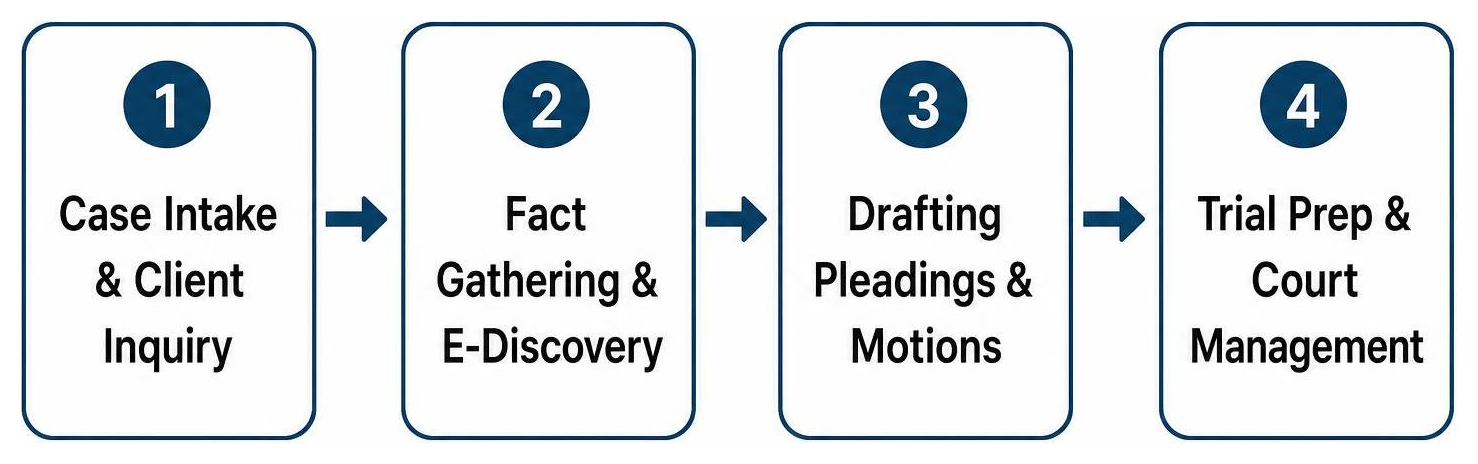
- Civil Discovery Management: Drafting interrogatories, requests for production, requests for admissions, and organizing responses.
- Pleadings and Motion Practice: Preparing initial complaints, summonses, answers, and standard procedural motions according to local court rules.
- Trial Preparation: Compiling trial notebooks, marking exhibits, preparing witness binders, and managing courtroom logistics.
- Ethics and Confidentiality: Safeguarding attorney-client privilege, identifying conflicts of interest, and maintaining strict confidentiality across digital communication channels.
Education Pathways: Online with Live Instruction vs. In-Person Classes
Aspiring legal professionals historically faced slow, expensive multi-year degree routes filled with general education filler courses that did little to prepare them for actual casework. Today, the legal industry prioritizes applied practical training over generic credentials.
At Paralegal Institute, we offer focused 15-week programs designed specifically for immediate workforce entry. We offer two delivery options: online with live instruction and in-person classes. Our online programs are delivered strictly through live instruction, ensuring students interact directly with practicing attorneys in real-time, ask questions, and receive hands-on feedback on real casework assignments.
Compared to prolonged multi-year academic programs, an accelerated, practical curriculum provides:
- Faster Career Entry: Master real-world legal workflows in months rather than years.
- Affordable Tuition: Focus your investment purely on relevant legal skills without paying for non-legal academic electives.
- Practicing Professional Faculty: Learn directly from attorneys who actively practice law and understand current courtroom standards.
- Job-Ready Practical Training: Draft real legal pleadings, motions, and discovery demands rather than reading abstract legal theory.
Specialization Impact on the Long-Term Career Outlook for Paralegals
Developing expertise in specific practice areas is one of the most reliable ways of achieving long-term career goals as a paralegal. Focused domains frequently experience elevated demand:
- Litigation and E-Discovery: Managing complex document productions, managing electronic document reviews, and assisting attorneys inside the courtroom during trial.
- Corporate and Contract Law: Handling corporate formations, annual filings, mergers, and tracking contract execution.
- Personal Injury and Torts: Coordinating medical records collection, drafting settlement demand packages, and managing case liens.
- Estate Planning and Probate: Drafting wills, living trusts, power of attorney documents, and filing probate administration petitions.

Frequently Asked Questions About Paralegal Careers
What is the typical entry-level salary for paralegals?
Starting compensation varies widely based on geographic location, employer size, and specific practice area. Candidates entering the legal field who possess direct, practical training in drafting pleadings, conducting legal research, and managing discovery files typically secure higher starting compensation than those without hands-on casework experience. Employers consistently reward candidates who can handle immediate file work on day one without requiring basic remedial training.
How is artificial intelligence changing daily paralegal responsibilities?
Artificial intelligence is automating routine administrative tasks and speeding up preliminary document analysis. However, it requires skilled human oversight. Legal support professionals use these tools to build initial drafts and sort through voluminous records, but they must carefully review every output for accuracy, confirm legal citations against valid precedent, protect confidential information, and verify compliance with procedural court rules.
Can you enter the paralegal profession with an accelerated certificate?
Yes. Legal employers hire based on competency and applied capability. Hiring attorneys prioritize candidates who can immediately draft motions, coordinate discovery responses, communicate with clients, and file court documents correctly. Utilizing actionable paralegal career advice, graduates from practical, accelerated certificate programs transition smoothly into active legal roles by showcasing a portfolio of real legal writing and casework competencies.
Conclusion: Stepping Into the Next Era of Legal Support
The legal industry will always need dedicated, detail-oriented, and tech-savvy support professionals to keep cases moving forward. While the macroeconomic numbers reflect steady stability, real career growth belongs to those who develop concrete, job-ready skills in legal research, discovery management, and motion drafting.
At Paralegal Institute, our mission is to equip you with the exact competencies attorneys look for when building their teams. Through our accelerated 15-week paralegal certificate program—available via in-person classes or online with live instruction —you learn directly from practicing attorneys who teach you how to handle real-world casework with confidence.
To take the first step toward launching or advancing your career in the legal field, explore comprehensive paralegal career information and discover how our practical training can help you build a resilient professional future.