
Where Paralegal Demand Actually Stands
Yes, though not in the way most people assume. Overall paralegal employment isn't expected to grow much over the next ten years. Turnover is what keeps the door open: people retire, move up, or change careers, and firms have to replace them. Here's what the latest Bureau of Labor Statistics numbers show:
Key Job Market Facts:
- Projected growth: 0% from 2025 to 2035, which BLS calls little or no change (the average for all jobs is 3%)
- Annual openings: about 40,800 a year on average, mostly to replace people who retire or leave the field
- National median pay: $62,890 a year, or $30.24 an hour (BLS, May 2025). Half of paralegals earned more and half earned less, and pay in Nevada and other states varies.
- Top Industries: Legal services, federal government, finance, corporate legal departments
- Where the jobs are: about 75% are in legal services (law firms), with most of the rest in government and finance and insurance
So it isn't a boom. It's a large, stable occupation (about 404,900 jobs in 2025) where tens of thousands of seats open up every year. If you're new to the field and can show real skills, those openings are what count.
As a law firm owner who regularly hires paralegals and develops legal curriculum, I've seen which candidates get hired and which don't. I'm Matthew Pfau, and my experience has given me deep insights into what makes candidates successful in this field.
The Current State of Paralegal Job Prospects
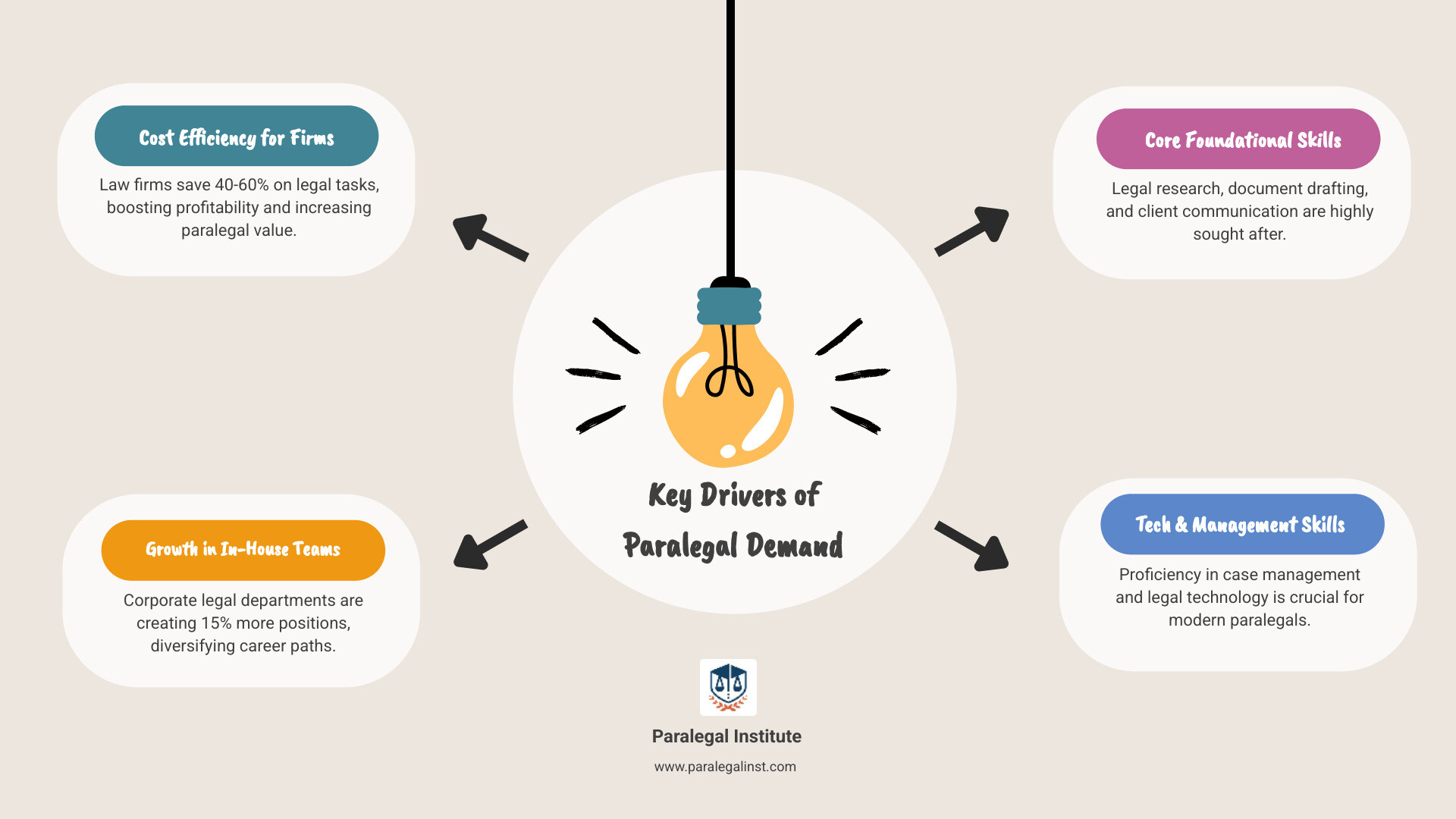
Firms still need paralegals, and the reason is mostly economic. Law firms need to cut costs while delivering top-notch service, and paralegals are the solution. Attorneys are expensive, but they need support with legal research, document drafting, and case organization. Skilled paralegals handle these crucial tasks at a fraction of the cost, which is fantastic news for anyone considering this career.
The Bureau of Labor Statistics projects about 40,800 openings for paralegals and legal assistants each year, on average, from 2025 to 2035. Total employment is expected to stay roughly flat (0%), so most of those openings come from replacing people who retire or change careers, not from new positions. BLS also says AI and other technology could make paralegals more efficient and hold demand down.

What Keeps Firms Hiring Paralegals
Paralegals are no longer just filling administrative roles; they're becoming the backbone of legal operations. By handling complex legal research, drafting motions, and managing client communications, they support lawyers and free them up to focus on strategy. This partnership makes the entire team more effective.
The economics are simple: reducing costs while maintaining quality is every law firm's goal, and paralegals make it possible. Clients get excellent support without paying attorney rates for every task, and firms can take on more cases.
What's truly exciting is that expanding responsibilities are changing the paralegal role. Tasks once handled by junior attorneys, like summarizing depositions or managing case files under attorney supervision, are now often in the paralegal's domain.
In-house legal teams are another option. Companies with their own legal departments need paralegals who understand both law and business.
Finally, there's an increased need for legal services across industries. From healthcare compliance to tech regulations, our complex world keeps legal teams busy, and that includes paralegals.
Analyzing the Current Paralegal Job Prospects by Industry
Certain industries consistently offer the best opportunities for paralegals.
Legal services remains the powerhouse, employing about 75% of all paralegals in settings from small practices to massive corporate firms.
The federal government provides stable, well-compensated positions in areas like regulatory compliance and administrative law, often with excellent benefits.
Corporate legal departments hire paralegals too. In finance and insurance, the BLS median for paralegals was $80,120 in May 2025, well above the $61,770 median in law firms. If this path interests you, exploring Entry Level Corporate Paralegal Jobs can open doors to exciting opportunities.
The finance and insurance sector offers specialized roles in regulatory compliance and contract review, often with competitive salaries.
Healthcare is another area worth a look, with paralegals handling HIPAA compliance, medical malpractice cases, and more.
Geographic Hotspots and Their Impact on Paralegal Job Prospects
Location significantly impacts your paralegal job prospects and earning potential. While every city needs legal services, some areas are goldmines for paralegal careers.
Top-paying states like Washington D.C., California, and New York offer the highest salaries, driven by a high concentration of law firms, corporate headquarters, and government agencies.
Major metropolitan areas like New York, Los Angeles, and Chicago offer the most diverse opportunities, from boutique firms to international practices.
Don't overlook mid-sized cities. Smaller legal markets can mean fewer applicants for each opening and lower living costs, though pay varies a lot from one area to the next.
The rise of remote work has been a game-changer. Many firms now offer flexible or fully remote positions, opening up possibilities to work for a firm in a major city while living in a more affordable area. Check out Remote Entry Level Paralegal Jobs to see what's possible.
Earning Potential and Career Growth in the Paralegal Field
A paralegal role isn't just a job; it's the start of a career. The path offers higher earning potential, increased responsibility, and professional satisfaction. Dedication and continuous learning can transform an entry-level role into a thriving, long-term career. Experienced paralegals can move into senior and specialist roles, and pay generally rises with experience.

Factors Influencing Your Earning Potential
The Bureau of Labor Statistics puts the national median at $62,890 a year (May 2025). The lowest-paid 10% earned under $44,740 and the top 10% earned over $101,500. Where someone lands in that range depends on things like these, and pay in Las Vegas or any other market depends on local employers:
- Experience Level: A paralegal just starting out earns less than one with years of experience. As your skills and responsibilities grow, so does your salary.
- Geographic Location: As mentioned, where you work matters. States and cities with higher costs of living and competitive legal markets tend to offer higher salaries.
- Firm Size: Larger law firms and corporations generally pay more than smaller firms, as they handle more complex cases and have more structured compensation.
- Area of Specialization: Specializing in a high-demand area of law can significantly boost your earning potential due to the need for specific knowledge.
- Type of Employer (Corporate vs. Law Firm): In May 2025 the BLS median was $81,470 in the federal government and $80,120 in finance and insurance, compared with $61,770 in legal services (law firms).
How Specialization Boosts Your Career
Just as a brain surgeon earns more than a general practitioner, specializing in a particular area of law can dramatically improve your paralegal job prospects and salary. Specialization makes you an expert, allowing you to handle more complex tasks and contribute at a higher level.
Here are some popular and often lucrative areas of specialization:
- Corporate Law: Assisting with mergers, corporate governance, and contracts in large firms or in-house departments.
- Litigation: Supporting attorneys through the entire litigation process, a common and always in-demand specialization.
- Intellectual Property (IP): Working with patents, trademarks, and copyrights. A good fit if you like technology and detail work.
- Real Estate: Handling property transactions, zoning laws, and development.
- Family Law: Assisting with divorce, child custody, and adoption.
- Niche Areas: Emerging fields like cybersecurity law, cannabis law, and healthcare compliance offer exceptional opportunities.
U.S. News ranks paralegals highly, at #7 in Best Social Services Jobs and #74 in 100 Best Jobs, highlighting their job satisfaction and advancement opportunities. This is partly due to the ability to specialize. You can explore more at U.S. News career rankings.
Pathways for Career Advancement
Paralegal job prospects aren't just about getting in the door; they're about opening many doors for your future. A paralegal career offers numerous avenues for advancement.
One common path is advancing to a Senior Paralegal role, which involves more complex cases and mentoring junior staff. From there, you might become a Paralegal Manager, overseeing a team and contributing to firm strategy.
Your skills are also transferable to other roles, such as:
- Legal Analyst: Providing deeper insights into legal trends.
- Office Manager: Managing the operations of a law firm.
- Compliance Officer: Ensuring organizations adhere to regulations.
- E-Discovery Specialist: Focusing on electronic data for litigation.
We focus on practical skills that are directly applicable to these advanced roles. The key is continuous professional development. For more insights, see Enhancing Paralegal Career Prospects with Online Education.
Skills and Education: How to Secure Your Future in the Legal Field
Openings come up every year, but you'll be competing for them. So how do you land one? The answer lies in developing the right practical skills, getting hands-on training, and understanding how technology is reshaping the legal field. With the right approach, you can set yourself up for success.

Essential Skills for a Successful Paralegal Career
A successful paralegal is a versatile and reliable professional. Employers want someone who can support their legal team and add immediate value. Here are the key skills:
- Legal research is foundational. It involves digging through case law, statutes, and regulations to find crucial information. Our Legal Research Guide for Paralegals can help you master this.
- Document drafting brings your legal knowledge to life. You'll craft pleadings, motions, and contracts with precision and clarity.
- Client communication skills make you the bridge between attorneys and clients, explaining complex procedures in simple terms.
- Organization is your superpower for juggling multiple cases, deadlines, and documents.
- Tech proficiency is non-negotiable. Mastery of legal software, case management systems, and e-discovery platforms is essential.
- Attention to detail can make or break a case. A single typo can have serious consequences, so accuracy is paramount.
- Critical thinking and problem-solving set great paralegals apart. You'll analyze complex situations and help develop strategic solutions.
The Impact of Technology and AI on the Modern Paralegal
BLS is direct about AI: it expects these tools to make paralegals faster at research and document prep, and says that may reduce demand for these workers. That doesn't make the job disappear. The routine parts shrink, and judgment, accuracy, and client work matter more. It handles tedious tasks like document review and accelerates legal research, freeing you to focus on more interesting, strategic work.
By automating routine tasks, AI allows you to spend more time on strategic analysis, complex problem-solving, and meaningful client interactions. Instead of being buried in paperwork, you'll work alongside attorneys as a true strategic partner.
This shift makes tech-savvy paralegals incredibly valuable. Those who understand how to leverage AI tools, master e-discovery platforms, and use case management software will have a significant competitive advantage. Since BLS expects these tools to limit how many paralegals firms need, the people who use them well are the ones firms will want to keep.
Your Educational Pathway: Earning a Paralegal Certificate
If you want to compete for those openings, a paralegal certificate is one of the quickest ways in. BLS lists a certificate in paralegal studies, alongside an associate's degree, as the typical way people enter the field. It's a focused, practical educational pathway designed to get you workforce-ready quickly.
Unlike lengthy degree programs, a paralegal certificate program is your fast-track to the legal field. These programs focus exclusively on the hands-on skills employers are seeking, without wasting time on abstract theory.
Our 15-week program exemplifies this practical skills focus. Every lesson is designed around real-world scenarios. This hands-on training means you'll be practicing with actual legal documents and software. You'll graduate with confidence and immediately applicable skills, making you attractive to employers.
If you're ready to jumpstart your legal career, exploring Accelerated Paralegal Certificate Programs is your best next step. Once you have your certificate, we have guidance on How to Get a Paralegal Job.
Frequently Asked Questions about the Paralegal Profession
Thinking about becoming a paralegal? You're not alone. Let's explore some of the most common questions we hear to help you make a smart career decision.
Is the paralegal field still a good career choice?
For a lot of people, yes. It's not a growth field right now (BLS projects 0% change from 2025 to 2035), but it's a big, stable one, with about 40,800 openings a year and a national median of $62,890 (May 2025). If you're detail-oriented and like legal work, that's a realistic way in. Just expect real competition for entry-level roles.
The roles are also evolving. Paralegals are taking on more substantive work and becoming essential partners in the legal process. With opportunities for specialization and clear career growth, you're not just getting a job—you're starting a journey with immense potential.
How is technology, like AI, affecting the future of paralegal jobs?
Honestly, it cuts both ways. BLS expects AI to make paralegals faster at research and drafting, and says that may reduce demand. Think of AI as a tool you need to be good at, not a reason to skip the field. It's fantastic at handling repetitive tasks like document review and legal research, which once took days or weeks.
By taking over these routine tasks, AI frees paralegals to focus on work that requires critical thinking, complex analysis, and strategic planning. You'll have more opportunities to interact with clients and contribute to case direction. The paralegals who thrive will be those who learn to partner with technology, making them more effective and valuable than ever.
What are the biggest pros and cons of being a paralegal?
Every career has its ups and downs. Here's a realistic look at what to expect.
On the pros side, the work is intellectually stimulating, with new challenges every day. Openings come up every year, mostly through turnover. Many find the career rewarding because you have a direct impact on people's lives, helping them solve important problems. You are directly involved in the legal process.
Now for the cons. The field can be high-stress. Legal work involves high stakes and demanding clients. The legal world also runs on tight deadlines, which can mean long hours and significant time pressure. Finally, it's important to know that all your work will be supervised by an attorney. You will perform substantive legal work, but you cannot give legal advice or represent clients in court. Your role is to support attorneys, not replace them.
Conclusion: Take the Next Step in Your Legal Career
Here's where things stand. Paralegal employment isn't projected to grow, but about 40,800 openings a year still have to be filled, and they tend to go to people who can do the work from day one.
Technology is changing the work, and specialties like corporate, litigation, and healthcare compliance give you ways to stand out. The ability to specialize means you can carve out a niche that matches your interests.
From my years in the field, I've learned that success comes down to practical skills. Employers need paralegals who can contribute immediately—conducting legal research, drafting documents, and using legal technology with confidence.
That's why we designed our program the way we did. Our 15-week program focuses entirely on hands-on skills that translate directly to real-world legal work. You'll learn by doing, practicing with the same tools and documents you'll use in your career. Our graduates succeed because they arrive with practical experience, not just theoretical knowledge.
If that sounds like you, the openings are there. The training is the part you control.
Ready to transform your career? Start your paralegal career in Las Vegas, NV and take the first step toward joining the profession.