
Defining the Role: What Is a Healthcare Law Paralegal?
When practicing attorneys step into the complex world of health sector jurisprudence, they depend heavily on substantive legal team members who understand specialized statutory environments. A healthcare law paralegal is a legal professional who performs delegated, substantive legal casework under the direct supervision of a licensed attorney, specifically tailored to the operational, transactional, and regulatory demands of medical systems, healthcare practitioners, and managed care entities.
While a general litigation or corporate legal assistant might focus broadly on standard pleadings, civil discovery requests, or general business formations, a specialized healthcare legal assistant operates within heavily regulated administrative systems. They must balance standard procedural rules with stringent state and federal healthcare statutes. Mastering core paralegal roles and responsibilities allows these professionals to act as an indispensable bridge connecting executive leadership, medical staff, government regulators, and supervising legal counsel.
| Practice Dimension | Law Firm Healthcare Practice Group | In-House Healthcare System Legal Department |
|---|---|---|
| Primary Focus | Client advocacy, transactional due diligence, regulatory defense, and billable casework | Risk mitigation, day-to-day regulatory compliance, policy drafting, and enterprise contract management |
| Client Interaction | Diverse third-party clients (hospital networks, private practices, medical device makers) | Internal enterprise stakeholders (hospital administration, chief medical officers, compliance directors) |
| Work Structure | Driven by billable hour targets, client project deadlines, and transaction closings | Driven by operational milestones, internal audit schedules, and institutional policy rollouts |
| Key Deliverables | Closing binders, formal regulatory filings, legal research memoranda, discovery motions | Business Associate Agreements (BAAs), vendor agreements, provider credentialing filings, internal audit logs |
Key Duties and Practice Focus of a Healthcare Law Paralegal
The daily routine of a healthcare legal specialist varies significantly based on current organizational priorities, but core substantive assignments remain consistent. To review how these duties align with industry standards, consult our comprehensive paralegal job description guide. Key day-to-day duties typically include:
- Drafting and Managing Healthcare Contracts: Preparing service agreements, medical director contracts, and employment covenants that comply with strict regulatory safe harbors.
- Administering Business Associate Agreements (BAAs): Ensuring third-party vendors handle protected health information (PHI) in strict compliance with federal privacy standards.
- Regulatory Filings and Submissions: Compiling and submitting licensure applications, national provider enrollments, and state agency notices.
- Subpoena Responses and Medical Record Discovery: Analyzing incoming legal demands for patient records, verifying patient authorization validity, and executing targeted discovery redactions.
- Internal Compliance Auditing: Assisting supervising counsel in reviewing internal clinical and financial workflows to identify potential statutory exposure before government regulators intervene.
Law Firm Practice vs. In-House Healthcare System Legal Teams
Choosing where to practice is one of the most important decisions for a healthcare legal professional. In a law firm setting—ranging from boutique health law practices to large Am Law 100 firms—paralegals often focus on external transactions, high-stakes government investigations, or specialized provider defense. The environment is , structured around client billable hours, and exposes the professional to a wide array of distinct legal problems across multiple healthcare organizations.
Conversely, working within an in-house legal department for a regional medical center or managed care organization shifts the focus toward long-term operational stability. In-house paralegals work closely with risk management officers, human resources, and clinical leadership. Rather than balancing disparate client matters, the in-house paralegal focuses on safeguarding the single corporate enterprise, overseeing contract lifecycle systems, managing internal policy updates, and coordinating routine state regulatory filings.
Core Regulatory Frameworks and Healthcare Transactions
Healthcare is among the most heavily regulated sectors in the United States. Attorneys advising medical clients require paralegals who can readily identify administrative agencies, locate relevant administrative code provisions, and organize documentation to demonstrate complete statutory compliance. Understanding complex statutory landscapes is essential when assisting counsel with healthcare legal services and regulatory compliance.
Navigating Medicare, Medicaid, HIPAA, and Provider Licensure
Paralegals working in healthcare law must routinely handle documentation governed by complex state and federal frameworks:
- HIPAA and the HITECH Act: Establishing federal standards to protect sensitive patient health information from unauthorized disclosure while governing electronic health record data security.
- Centers for Medicare & Medicaid Services (CMS) Regulations: Managing provider enrollment profiles, billing compliance documentation, and conditions of participation.
- The Stark Law (Physician Self-Referral Law): Prohibiting physician referrals for designated health services payable by Medicare to entities with which the physician has a financial relationship, unless specific exceptions apply.
- The Anti-Kickback Statute (AKS): Criminal statute prohibiting the knowing exchange of remuneration to induce or reward referrals for items or services reimbursable by federal healthcare programs.
- State Medical and Facility Licensing Boards: Maintaining centralized credentialing databases to monitor physician, nursing, and facility licenses across multiple jurisdictions.
Primary regulatory enforcement and oversight bodies include:
- U.S. Department of Health and Human Services (HHS)
- Office of Inspector General (OIG)
- Centers for Medicare & Medicaid Services (CMS)
- Office for Civil Rights (OCR)
- State Department of Health and Professional Licensing Divisions
Managing Healthcare M&A and Change of Ownership (CHOW) Filings
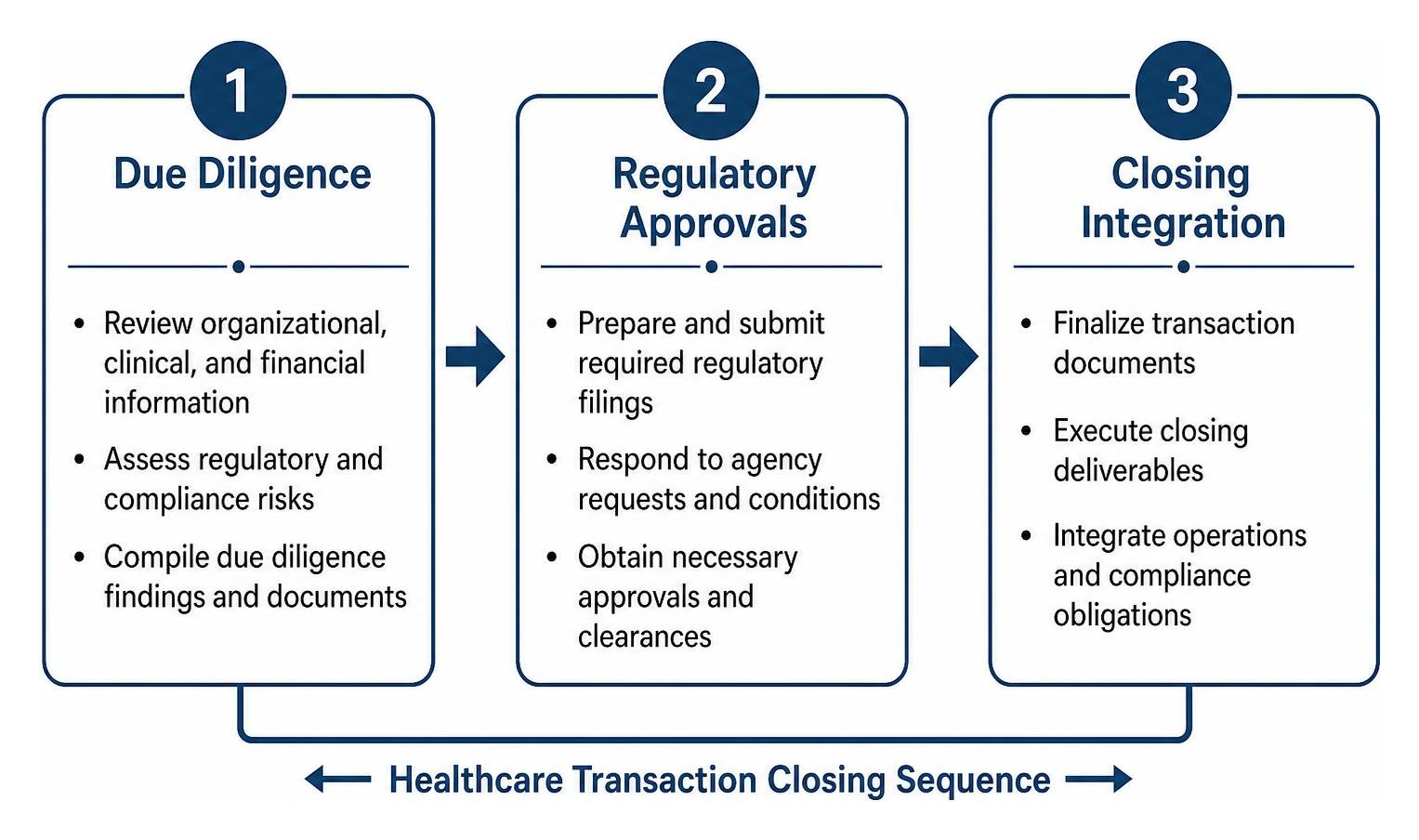
When hospitals, ambulatory surgery centers, or specialty practices merge or sell assets, the regulatory hurdles are extensive. Healthcare transactions involve far more than standard corporate asset purchase agreements; they require careful navigation of Change of Ownership (CHOW) regulations.
Paralegals support supervising attorneys through every phase of a healthcare transaction:
- Due Diligence Management: Collecting, indexing, and analyzing target facility documents, including clinical contracts, third-party payor agreements, regulatory compliance records, and historical billing audits.
- Certificate of Need (CON) and State Filings: Assembling detailed state regulatory submissions demonstrating community need and legal eligibility for facility transfers.
- CHOW Regulatory Notifications: Preparing timely notices to CMS, state Medicaid agencies, the Drug Enforcement Administration (DEA), and state pharmacy boards to ensure uninterrupted billing authorizations post-closing.
- Closing and Integration Coordination: Organizing transactional closing sets, overseeing signature execution across multiple entities, and assisting counsel with post-closing operational transitions.
Education, Certificate Pathways, and Legal Technology

Entering this demanding specialty requires a solid foundation in core legal procedures, legal writing, research methodologies, and document management. Aspiring legal professionals often explore various pathways, as outlined in our paralegal certificate programs guide.
While traditional multi-year degree pathways exist, career-focused adults frequently choose an accelerated path to secure entry-level legal roles faster and more economically. At the Paralegal Institute, we offer an accelerated 15-week paralegal certificate program designed and taught directly by practicing legal professionals. We emphasize live instruction for real-time learning, practical training for immediate job readiness, and comprehensive curriculum delivery without the unnecessary overhead and prolonged timelines of multi-year degree tracks.
Essential Qualifications and Specialized Legal Training
To thrive in healthcare practice, a legal professional must combine general procedural competence with sector-specific skills. Developing essential paralegal skills ensures that you can manage complex casework accurately and efficiently under attorney supervision.
Key competencies include:
- Medical and Legal Terminology: Comfortably reading medical charts, regulatory codes, and specialized provider agreements.
- Substantive Procedural Research: Conducting focused administrative and statutory investigations using advanced tools, supported by robust legal research skills training.
- Document Organization and Drafting: Preparing error-free transactional agreements, administrative petitions, and litigation discovery indices.
- Critical Thinking and Detail Orientation: Identifying missing compliance exhibits, expiring provider licenses, or inconsistencies across regulatory disclosures.
Leveraging AI Platforms, CLM Systems, and Legal Tech
Modern legal practice demands technical fluency. Healthcare legal teams manage vast volumes of contracts, clinical records, and compliance files, making legal technology an everyday operational necessity. Paralegals should stay informed on emerging paralegal industry trends to remain competitive in modern practice settings.
Modern legal teams utilize specialized platforms to streamline workflows:
- Generative AI Platforms (Harvey, Microsoft Copilot): Used under strict attorney oversight to synthesize voluminous administrative guidelines, draft initial contract clauses, and organize unstructured case data.
- Contract Lifecycle Management (CLM) Systems: Centralizing healthcare enterprise agreements, monitoring renewal windows, and tracking required Business Associate Agreements across enterprise vendors.
- Electronic Discovery and Document Review Tools: Managing secure redaction workflows for protected health information during civil discovery, investigations, or administrative audits.
- State Agency Filing Portals: Navigating state and federal administrative web portals for corporate entity filings and provider licensure renewals.
Adopting modern legal technology for paralegals enables support staff to automate routine administrative tasks and dedicate more time to substantive analysis and casework.
Compensation, Career Outlook, and Ethical Standards
The demand for skilled legal support continues to evolve alongside the broader legal services market. According to national workforce data, paralegals and legal assistants held approximately 376,200 jobs in 2024, with legal services employing 74% of all professionals in the field. An estimated 39,300 annual job openings are projected nationwide due to career transitions and workforce turnover.
Those seeking career growth can review comprehensive market dynamics in our paralegal career guide 2026. For regional opportunities in dynamic healthcare markets, explore current health law career opportunities.
2026 Salary Outlook for a Healthcare Law Paralegal
Compensation for healthcare paralegals varies based on experience, practice setting, geographic location, and technical specialization. Because healthcare law involves specialized federal regulatory frameworks and high-value corporate transactions, compensation in this niche frequently outpaces general entry-level support roles.
Workforce data illustrates the broad earning spectrum across the legal support field:
- National Legal Support Distribution: National baseline figures reflect a median annual wage that sits comfortably above many other administrative support occupations. Entry-level percentiles begin at more modest levels, while experienced senior paralegals in top tiers earn substantially higher compensation.
- Corporate & Managed Care Departments: In-house corporate departments within managed healthcare systems typically offer hourly wages above the national median for legal support professionals, reflecting the value placed on enterprise compliance and contract management skills.
- Large Law Firm Practice Groups: Senior healthcare paralegals handling complex regulatory compliance, corporate transactions, and healthcare M&A due diligence at major national law firms can secure compensation packages that rank among the highest in the paralegal profession.
Professional Ethics, Model Rules, and UPL Prevention
Every paralegal operates as an extension of their supervising attorney. Consequently, legal support staff must strictly adhere to professional ethics rules established by state bars and judicial systems. Foundational concepts covered during legal ethics in paralegal training establish clear boundaries for daily casework.
Key ethical duties include:
- Supervision Under Model Rules of Professional Conduct: Attorneys are required to maintain direct supervisory responsibility over non-lawyer assistants, ensuring the paralegal’s conduct aligns with professional obligations.
- Prevention of Unauthorized Practice of Law (UPL): A paralegal may not give legal advice, set legal fees, establish attorney-client relationships, or represent clients before judicial bodies unless explicitly authorized by administrative rule.
- Preserving Confidentiality and Privilege: Protecting sensitive attorney-client communications and proprietary healthcare corporate data from improper disclosure.
- Conflict of Interest Screening: Identifying and disclosing past casework or personal connections that could create an ethical conflict when onboarding new clients or healthcare entity targets.
Frequently Asked Questions about Healthcare Law Support
What is the difference between a healthcare paralegal and a legal nurse consultant?
A healthcare paralegal is trained in substantive legal procedures, statutory research, legal drafting, contract lifecycle management, and corporate filings. A legal nurse consultant is a registered nurse who evaluates medical charts, explains clinical standards of care, and identifies medical causation in personal injury or medical malpractice cases. Paralegals manage the legal casework and administrative processes, whereas nurse consultants provide clinical insight on medical records.
Is a paralegal certificate required to work in healthcare law?
Formal state licensure is generally not required for paralegals to work under attorney supervision. However, earning a recognized paralegal certificate demonstrates that you have completed structured training in legal research, document drafting, and procedural ethics. Law firms and hospital legal departments prioritize candidates who hold a verifiable paralegal certificate and demonstrate practical proficiency in legal software and healthcare compliance fundamentals.
What software and AI platforms do healthcare paralegals use daily?
Healthcare legal teams rely on a combination of enterprise contract lifecycle management (CLM) platforms, legal research engines like Westlaw and LexisNexis, secure e-discovery platforms, and administrative agency filing portals. Additionally, teams increasingly use supervised AI tools such as Harvey AI and Microsoft Copilot to assist in organizing large record volumes, summarizing regulatory changes, and streamlining contract review workflows.
Conclusion
The intersection of medicine, corporate transactions, and administrative oversight makes healthcare law one of the most rewarding areas of modern legal practice. Whether managing complex transaction due diligence binders, auditing Business Associate Agreements for HIPAA compliance, or submitting critical provider licensure filings, skilled paralegals are vital to the legal team's success.
At the Paralegal Institute, I prepare career-focused adults to enter the legal workforce with confidence. As a practicing U.S. attorney who teaches paralegal courses, I designed our accelerated 15-week paralegal certificate program to deliver the practical skills employers demand: legal research, substantive drafting, professional ethics, and modern legal technology. The program is offered online with live instruction or in-person classes, providing the flexibility you need with the accountability of real-time learning.
If you are ready to launch your career supporting healthcare attorneys and medical organizations, explore our programs today to discover the vital role of paralegals in law firms and take your first step toward professional success.