
Essential Paralegal Study Tips for Building a Sustainable Routine
Succeeding in legal studies requires deliberate planning rather than late-night cram sessions. When mastering procedural rules and substantive law, consistency always outperforms sporadic bursts of effort. Implementing structured time management for paralegal students allows you to absorb complex legal doctrines without compromising your existing professional and personal commitments.
A functional routine starts with a realistic assessment of your weekly commitments. Balancing family obligations, employment, and coursework requires an honest appraisal of your daily calendar. Successful students prioritize balancing work and paralegal schooling by establishing fixed, non-negotiable study windows rather than trying to fit study time into leftover hours.
Time-Blocking Strategies for Busy Professionals
Time-blocking treats your study sessions as mandatory professional appointments. Instead of aiming for vague goals like "studying civil litigation on Tuesday," assign specific legal tasks to defined calendar slots—such as "drafting discovery requests from 6:30 PM to 8:00 PM."
- Audit Your Peak Energy Hours: Schedule cognitively demanding topics, such as statutory analysis and legal writing, during your periods of peak mental alertness. Reserve administrative tasks, like organizing binder tabs, for lower-energy windows.
- Commit to Consistent Weekly Hours: Dedicate between 15 and 20 hours per week to your studies. This steady investment ensures comprehensive subject mastery and helps you discover how to avoid slipping behind in paralegal classes.
- Incorporate Buffer Blocks: Leave one or two short open windows each weekend to handle unexpected work demands or complex assignments without derailing your entire weekly agenda.
Designing an Optimal Study Environment for Online with Live Instruction and In-Person Classes
Your physical and digital learning environments directly influence cognitive retention. Whether you attend in-person classes or participate online with live instruction, your workspace must minimize friction and distractions.
- Establish a Dedicated Legal Workspace: Use a clutter-free desk designated solely for coursework. Keeping your phone in another room removes the silent distractions that break your concentration.
- Optimize Your Digital Setup: A dual-monitor configuration significantly streamlines legal research, allowing you to review statutory text on one screen while drafting notes or briefs on the other. Implementing proven tips for online learning in paralegal classes keeps your attention focused during real-time lectures.
- Prioritize Ergonomics and Organization: Invest in supportive seating and proper task lighting. Having physical statutes, legal dictionaries, and reference binders within arm's reach prevents workflow interruptions. Programs with structured paralegal classes help stay on track by reinforcing these organized habits through predictable, live instructional routines.
Active Learning and Note-Taking Strategies for Legal Material
Passive reading is ineffective when learning the law. Skimming hundreds of pages of legal text rarely produces actionable knowledge. You must actively engage with statutes, court opinions, and procedural rules to build practical skills. Establishing strong study habits for paralegal students means transforming complex text into clear, usable workflows.
| Note-Taking Method | Core Structure | Best Suited Legal Subject | Primary Practical Advantage |
|---|---|---|---|
| Cornell Method | Cue column (left), detailed notes (right), summary (bottom) | Legal Ethics & Professional Responsibility | Facilitates self-quizzing on specific model rules and ethical standards |
| Outline Method | Hierarchical alphanumeric structure (Roman numerals, letters, numbers) | Federal and State Civil Procedure | Clearly maps multi-step procedural sequences and jurisdictional rules |
| Mind Mapping | Central legal doctrine with branching causes, elements, and defenses | Torts and Contract Law | Visually links complex multi-element claims with their affirmative defenses |
Paralegal Study Tips for Mastering Complex Legal Terminology
The legal field operates on precise terminology. Confusing a motion to dismiss with a motion for summary judgment can alter the trajectory of a case.
- Leverage Spaced Repetition Systems (SRS): Use physical flashcard decks or digital spaced-repetition tools to review legal terminology at expanding intervals. This approach strengthens neural pathways and helps improve memory in paralegal studies.
- Construct Contextual Mnemonic Devices: Create memorable acronyms for multi-element legal tests (for example, using "MY LEGS" to remember categories covered by the Statute of Frauds).
- Apply the "Feynman Technique": Explain a legal doctrine out loud in plain, non-legal language to a peer or family member. If you cannot explain personal jurisdiction simply, you have identified a gap in your understanding. Applying these practical tips for online paralegal success turns passive memorization into practical recall.
Structuring Case Briefs and Hierarchical Legal Outlines
Briefing cases is a foundational skill for analyzing legal precedent. Every brief should follow the structured IRAC framework (Issue, Rule, Application, Conclusion) to extract essential principles efficiently.
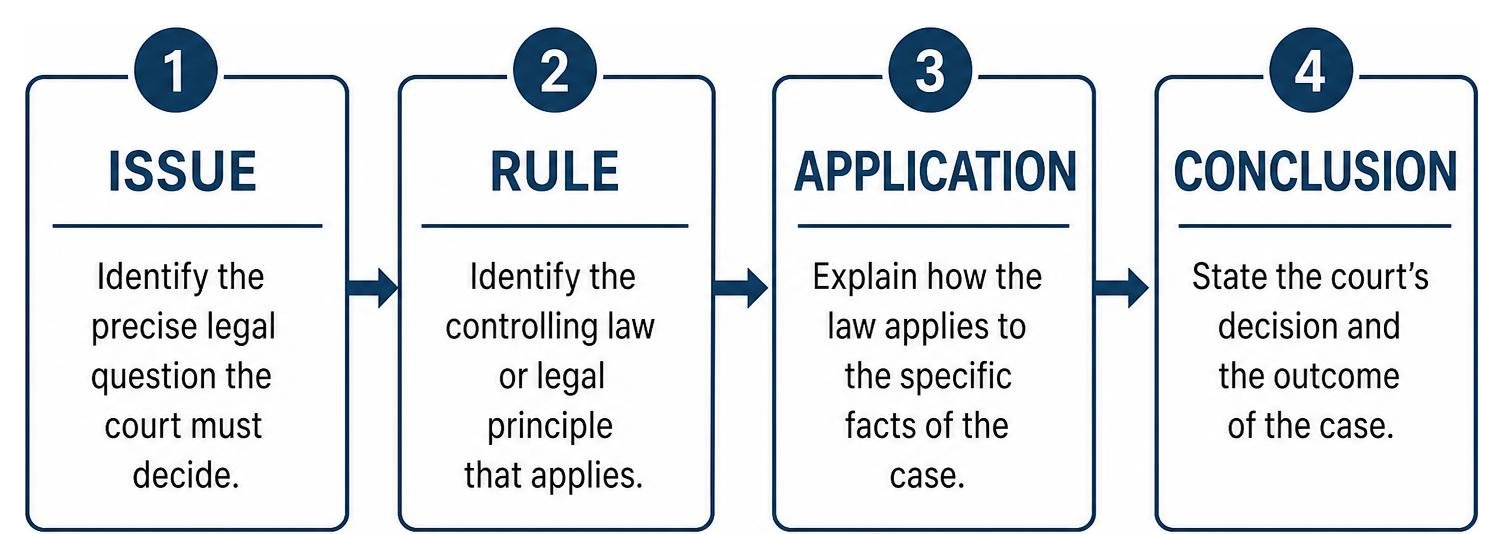
- Procedural History: Summarize how the case reached the current court (e.g., trial court verdict, appellate review).
- Legal Issue: State the precise legal question presented to the court as a direct yes-or-no question.
- Applicable Rule: Identify the controlling constitutional provision, statute, or common-law doctrine.
- Application / Analysis: Detail how the court applied the legal rule to the specific facts of the dispute.
- Holding & Disposition: State the final legal determination and whether the lower court's decision was affirmed, reversed, or remanded.
Organizing these briefs into hierarchical binders prevents dealing with information overload in paralegal courses. Synthesizing lengthy opinions into concise case briefs teaches you how to excel in paralegal schooling while building reference files for future casework.
Collaborative Learning and Maintaining Mental Stamina
Legal education is rigorous, but you do not have to tackle it alone. Law firms operate on collaboration between attorneys, paralegals, and administrative staff; your academic preparation should reflect that dynamic.

Collaborating with classmates provides accountability, exposes you to alternative interpretations of ambiguous statutes, and mirrors real-world legal practice. Proactively finding study groups for paralegal courses connects you with driven peers who share your commitment to mastering substantive law.
Maximizing Group Study Sessions for Complex Substantive Law
Unstructured study groups can easily turn into social hours. To keep sessions productive, apply standard professional meeting rules:
- Establish a Strict Agenda: Assign specific substantive topics to each meeting, such as "Drafting Interrogatories and Requests for Production under Rule 33 and 34."
- Rotate Teaching Responsibilities: Assign one member to lead the discussion on a challenging topic, such as the hearsay rule and its exceptions.
- Run Mock Issue-Spotting Drills: Review hypothetical fact patterns together, identify potential causes of action, and debate procedural hurdles. This dynamic analysis builds confidence and helps you learn how to stay motivated in paralegal courses.
Paralegal Study Tips for Beating Burnout and Managing Stress
Mental fatigue leads to analytical errors. When analyzing statutes or drafting legal documents, an overtired mind is prone to missing critical details. Research indicates that a well-rested mind performs 15% better on analytical legal questions than a fatigued one.
- Incorporate Strategic Micro-Breaks: Use the Pomodoro Technique—study for 25 to 50 minutes, followed by a mandatory 5-to-10-minute break away from all screens.
- Prioritize Sleep for Memory Consolidation: Complex legal synthesis requires REM sleep to move concepts from short-term memory into long-term recall. Pulling all-nighters degrades analytical reasoning.
- Manage Cognitive Load: Recognize early signs of exhaustion and practice handling stress during paralegal certificate preparation. Adopting these sustainable habits makes coping with workload in paralegal online classes manageable throughout your academic journey.
The 90-Day Blueprint for Legal Exam Preparation
Comprehensive paralegal exams evaluate your command of legal ethics, civil procedure, and core substantive law. Average pass rates for major standardized legal credential tests fluctuate between 70% and 75%, meaning approximately one in four candidates does not pass on their first attempt.
A structured, time-tested study roadmap ensures comprehensive preparation. Following a structured plan is central to effective exam prep for paralegal success.
Phased 90-Day Study Roadmap: Foundations to Application
A disciplined 90-day plan breaks large exam manuals down into manageable milestones:
- Month 1: Conceptual Foundations: Dedicate this phase to high-yield subjects. Ethics and professional responsibility typically make up about 25% of exam content, making mastery of unauthorized practice of law (UPL), client confidentiality, and conflicts of interest essential. Review procedural foundations, including federal court jurisdiction and guidelines maintained by United States Courts.
- Month 2: Substantive Deep Dive: Focus on substantive law subjects: contracts, torts, criminal law, and business organizations. Apply active recall techniques to statutory elements, procedural steps, and affirmative defenses.
- Month 3: Knowledge Application and Speed: Shift your attention from passive review to practice questions and full-length exam simulations, evaluating your pacing and accuracy under timed conditions.
The Simulation Method and Building Test Endurance
Standard exams can run anywhere from 2.5 to 4.5 hours. Sitting for an extended legal examination requires both knowledge and mental stamina.
- Replicate Exact Exam Conditions: Take at least four full-length, timed mock exams in Month 3. If your test allows roughly 1 minute and 20 seconds per question, practice maintaining that exact cadence.
- Align with Your Testing Schedule: Schedule your practice exams at the same time of day as your scheduled test appointment to train your focus around that testing window.
- Conduct Systematic Error Pattern Analysis: After every practice exam, review every incorrect question. Categorize your mistakes: was it a gap in legal knowledge, misreading the question stem, or rushing due to time pressure? Addressing these root causes is vital for dealing with exam anxiety in paralegal schools.
Test-Day Tactics, Open-Book Organization, and Final Logistics
Open-book legal exams test your ability to locate and apply legal authorities quickly, not your ability to read the textbook for the first time. Navigating hundreds of pages of material under strict time limits requires an organized reference system.

Students who learn to stay focused during paralegal schooling organize their reference materials well before test day.
Organizing Reference Materials and Open-Book Indices
- Create a Master Table of Contents: Place a detailed, multi-level table of contents at the front of every reference binder.
- Use Color-Coded Subject Dividers: Use color-coded tabs on the edges of your materials (for example: Blue for Civil Procedure, Red for Ethics, Green for Torts, Yellow for Contracts). This lets you turn directly to the relevant subject area in seconds.
- Build Concise Statute Cheat Sheets: Create single-page quick-reference sheets listing key statutory deadlines, jurisdictional thresholds, and rule numbers.
- Highlight Key Terms Strategically: Avoid highlighting entire paragraphs. Highlight only operational terms, exceptions (such as "unless," "except," "provided that"), and specific statutory timeframes.
The 48-Hour Pre-Exam Taper and Testing Center Protocols
During the final 48 hours before your exam, avoid high-intensity cramming to prevent mental fatigue.
- Implement the 48-Hour Neural Taper: Shift away from practice exams two days before the test. Limit your preparation to light reviews of your master outlines and ethics summaries. Treat your brain like an athlete treats their body before competition: rest is required for peak cognitive performance.
- Confirm Permitted Testing Items: Review testing center guidelines carefully. Bring government-issued identification, authorized reference binders without loose pages, and essential writing utensils.
- Read the Question Stem First: On test day, read the final sentence of each question stem before reviewing the factual background. This highlights the precise legal issue you need to evaluate, saving valuable seconds on every question.
Frequently Asked Questions About Paralegal Study
What is the simulation method and how does it prevent test anxiety?
The simulation method involves taking full-length, timed mock exams under conditions that match the actual testing environment. Replicating the exact time limits, question formats, and daily schedule desensitizes you to exam stress, builds mental stamina for multi-hour testing blocks, and trains you to maintain a steady pacing of 70 to 80 seconds per question.
Conclusion
Building strong study habits—from structured time-blocking and active IRAC briefing to organized reference indexing—lays the groundwork for academic and career success. The discipline, precision, and analytical rigor you develop during your studies translate directly into professional legal practice.
As a practicing attorney and instructor at the Paralegal Institute, I see every day how these foundational habits prepare students for real casework. At Paralegal Institute, we provide practical, accelerated training taught by practicing attorneys through in-person classes and online with live instruction. If you are ready to launch your career in the legal field, explore what paralegals do and career opportunities to take the next step toward your professional goals.