
Start Your Search for Corporate Paralegal Jobs With a Clear Plan
Corporate paralegal jobs are available in law firms and in-house legal departments across finance, real estate, healthcare, technology, and other business sectors. The fastest way to find a strong match is to focus your search on roles involving corporate governance, entity management, contracts, due diligence, and transaction support.
- Entry-level roles: Look for legal assistant, junior paralegal, contracts coordinator, and corporate administrative positions that build transactional experience.
- Mid-level roles: Target corporate paralegal openings that ask for 3 to 5 years of experience with entity filings, minute books, contracts, or mergers and acquisitions.
- Senior roles: Seek specialized work in securities, fund formation, corporate governance, real estate, or legal operations. These positions often require 5 or more years of focused experience.
- Where to look: Large markets such as New York, Chicago, San Francisco, New Jersey, and Maryland have active hiring, but employers nationwide also offer flexible split-schedule and occasional remote roles.
- What employers value: A paralegal certificate, strong organization, careful document handling, comfort with legal technology, and practical corporate or transactional experience.
The search can feel discouraging when postings ask for experience you are still working to gain. But corporate legal teams need detail-focused professionals who can keep records accurate, support contracts and closings, and help attorneys manage fast-moving business work.
I am Matthew Pfau, a practicing U.S. attorney who teaches paralegal courses at Paralegal Institute and has hired and trained paralegals in my law practice. Although I am not a paralegal, my experience working with legal support teams gives me a practical view of what employers seek in candidates for corporate paralegal jobs and how aspiring professionals can prepare for them.
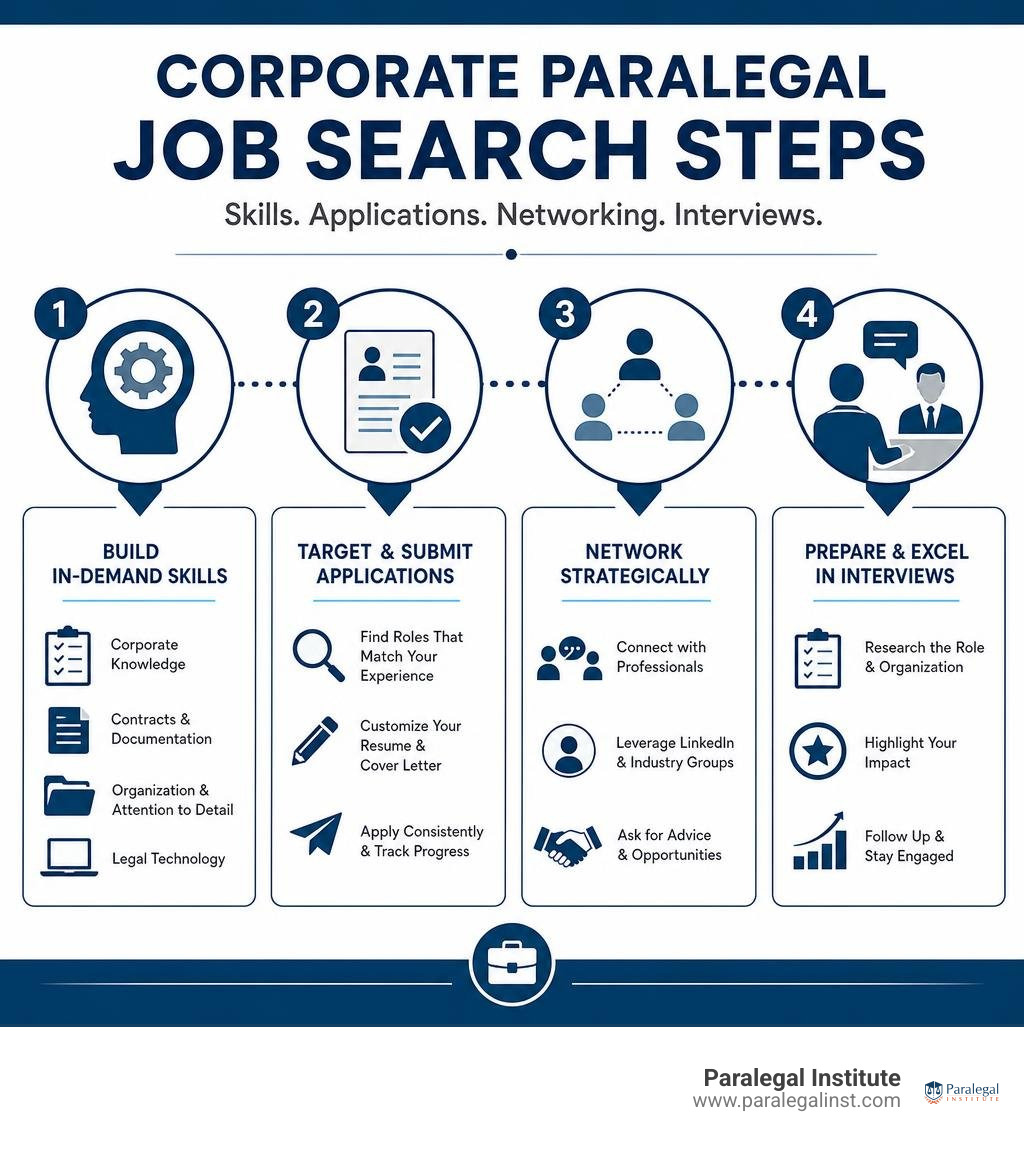
10 Practical Strategies to Motivate Your Search for Corporate Paralegal Jobs
Navigating the market for corporate paralegal jobs requires patience, discipline, and a clear tactical focus. When you send out multiple resumes without immediate callbacks, it is easy to feel fatigued. However, maintaining momentum comes down to treating your search like a structured corporate project. By taking deliberate, incremental steps every day, you maintain control over your career trajectory and systematically increase your visibility to corporate recruiters and hiring partners.
Define Clear Salary and Career Benchmarks for Corporate Paralegal Jobs
Before launching into daily job submissions, establish concrete expectations around compensation structures and professional progression. In corporate legal environments, base earnings and total rewards fluctuate based on role complexity, industry sector, and specialized technical knowledge. Rather than fixating on a single number, group potential roles into distinct compensation tiers ranging from entry-level transactional support up to senior corporate governance and legal operations management.
To better understand where your current skill set sits within the hiring landscape, review our comprehensive corporate paralegal salary guide 2026. Recognizing how specialized capabilities—such as managing complex entity structures or handling regulatory filings—elevate earning potential provides strong motivation to continually upgrade your technical skill set.
Focus Applications on Entry-Level and Specialized Credentials
When reviewing job boards, candidates frequently feel unqualified due to extensive lists of desired qualifications. To keep your search moving forward, differentiate between absolute baseline requirements and flexible preferences. Most corporate employers prioritize practical core competence: high attention to detail, fluent legal document drafting skills, and formal foundational education.
Earning a formal paralegal certificate demonstrates commitment and provides immediate credibility. At the Paralegal Institute, we equip students for immediate workforce entry through our accelerated 15-week program designed and taught by practicing legal professionals. We offer flexible learning formats, including online classes with live instruction as well as traditional in-person classes, ensuring you gain hands-on, job-ready training. If you are starting your career journey, explore targeted opportunities on our guide for entry level corporate paralegal jobs.
Track Job Openings Across Corporate Legal Departments and Law Firms
A common mistake on the job search is relying exclusively on broad, generalized job aggregation sites. Corporate paralegal jobs exist in two primary environments, each offering distinct workplace cultures and operational demands:
- Law Firm Corporate Practices: Law firm roles center on transactional billable work, due diligence for client mergers, venture funding rounds, and entity formations. Active openings can be tracked through practice-specific job search boards and specialized legal employment databases.
- In-House Corporate Legal Departments: In-house roles prioritize internal corporate governance, contract lifecycle administration, regulatory compliance, and cross-functional support for executive leadership. Job seekers should monitor specialized corporate listings, including positions like the Corporate Paralegal | Jobvectora posting or corporate announcements on Simplify Jobs.
Broaden your daily search routines by directly checking corporate career pages. For a detailed breakdown of organizational structures, visit our overview on corporate paralegals.
Master High-Demand Transactional and Entity Management Skills
Employers hire corporate paralegals to solve operational problems and maintain strict corporate compliance. If your job search stalls, redirect your energy toward mastering core high-demand skills that immediately stand out on a resume:
- Entity Formation and Maintenance: Understanding how to draft and file articles of incorporation, certificates of formation, annual reports, and foreign qualifications across state jurisdictions.
- Corporate Governance: Maintaining physical and digital corporate minute books, drafting board resolutions, tracking officer/director rosters, and preparing written consents.
- Transaction and Closing Support: Assembling virtual data rooms, performing Uniform Commercial Code (UCC) lien searches, ordering certificates of good standing, and compiling post-closing binders.
Gaining familiarity with transactional workflows—especially those supporting complex corporate restructuring—makes you an invaluable asset. Learn more about specialized transactional responsibilities with our guide on the role of a mergers and acquisitions paralegal.
Expand Skillsets into Legal Operations and AI Tools
The modern corporate legal department relies heavily on technology to manage high document volumes. Candidates who demonstrate tech fluency instantly rise to the top of applicant stacks. Expand your functional knowledge by learning the fundamentals of legal workflow technology:
- Contract Lifecycle Management (CLM): Understand how enterprise platforms automate contract drafting, routing, electronic signatures, and repository archiving.
- Entity Management Databases: Learn how corporate teams log ownership hierarchies, track state filing deadlines, and maintain organizational charts.
- Generative AI and Analytics: Modern corporate teams leverage specialized legal artificial intelligence platforms for rapid document review and due diligence extraction. Top law firms hiring for roles like a Senior Corporate Paralegal - Gibson Dunn specifically seek candidates comfortable utilizing advanced analytics tools to review supplier and customer agreements.
Network with Hiring Managers in High-Volume Corporate Sectors
Submitting applications online is only one part of an effective strategy. Proactively building relationships with corporate hiring authorities can unlock unadvertised positions. Focus your networking energy on industry sectors experiencing strong growth and transactional volume, such as financial services, commercial real estate, technology infrastructure, and healthcare.
Reach out directly to corporate legal managers, senior paralegals, and chief legal officers. Send brief, professional inquiries requesting insight into their department structure or advice for entering their industry sector. In major growth markets, tracking regional job listings—such as localized legal openings on Justia Legal Jobs in Nevada—can help you identify expanding corporate legal teams before public postings attract hundreds of applicants.
Structure Daily Job Search Routines and Application Goals
Unstructured job searches lead to burnout. Maintain focus by treating your job search like a structured work routine. Establish daily, actionable targets rather than setting vague goals like "apply to more jobs."
- Set Daily Application Caps: Focus on submitting 2 to 3 tailored, high-quality applications per day rather than dozens of generic single-click submissions.
- Block Out Dedicated Hours: Allocate specific blocks of time each morning for researching companies, tailoring resumes, and following up on pending applications.
- Maintain an Application Log: Use a spreadsheet to track company names, job titles, application submission dates, follow-up timelines, and contact details.
Tailor Resumes for Corporate Administrative and Transaction Support
Generic legal resumes that emphasize general litigation or administrative tasks often fail to catch the attention of corporate recruiters. To stand out for corporate paralegal jobs, your resume must highlight transactional capabilities, regulatory compliance, and corporate record maintenance.
Include a detailed summary section at the top of your resume emphasizing exact business legal concepts. Highlight specific experience with board consents, contract management, entity filings, and due diligence administration. Review our paralegal job description complete guide to align your resume vocabulary with the precise keywords corporate recruiters search for.
Evaluate Benefits Packages and Professional Development Perks
Staying motivated is easier when you focus on the full value proposition of corporate employment. Corporate legal roles frequently feature extensive employee benefits packages that extend well beyond base pay.
As you evaluate employer offerings, look for comprehensive medical coverage, generous 401(k) retirement matching programs, paid parental leave, flexible wellness stipends, and formal tuition reimbursement options. Corporate positions—such as the role featured in the Sr Corporate Paralegal | Flexgen listing—frequently offer substantial professional development stipends that cover ongoing legal education and professional association memberships, backing your long-term career growth.
Build a Long-Term Career Advancement Blueprint
A job search feels far more rewarding when viewed as the initial step in a long-term professional journey. Corporate paralegals enjoy diverse career progression paths that extend well beyond traditional legal support.
You might start as a corporate legal assistant, progress to a senior corporate paralegal handling complex securities filings, and eventually step into strategic legal operations management or governance direction. To visualize where this career path can take you over five to ten years, read our detailed paralegal manager jobs guide.
Target High-Growth Geographic Markets and Industry Sectors

Positioning yourself in markets with high corporate density dramatically improves your odds of securing an exceptional role. Corporate legal departments tend to cluster around major commercial centers, financial hubs, and technology corridors.
Remote, Flexible, and On-Site Expectations in Corporate Paralegal Jobs
Workplace flexibility in corporate law varies significantly by organization type and security requirements:
- On-Site Positions: Fully office-based roles are standard in major corporate law firm practice groups and high-security sectors like defense, banking, and physical infrastructure.
- Flexible Split-Schedule Roles: Many corporate legal departments offer flexible arrangements where employees divide work hours between a corporate office and a remote workspace. This format allows paralegals to handle physical minute books and closing documents in person while managing routine drafting and contract administration remotely.
- Fully Remote Roles: Remote corporate opportunities exist, particularly with distributed technology platforms and global corporations, as seen in corporate postings like MicroStrategy Corporate Paralegal. However, because competition for remote positions is global, candidates must present polished technical capabilities and exceptional self-management skills.
Top Regional Markets and Hiring Hubs
While major financial epicenters like New York, Chicago, and San Francisco maintain a continuous volume of corporate legal openings, regional markets present outstanding opportunities with high demand.
In particular, the Nevada market—anchored by Las Vegas—has seen substantial growth in corporate legal hiring driven by commercial real estate development, hospitality, entertainment, regulatory compliance, and corporate relocations. Job seekers in this region can track active local opportunities through specialized legal career portals and regional job listings. Local candidates who complete fast-track, practical legal training in Las Vegas gain a distinct advantage when applying for immediate corporate vacancies across regional corporate legal teams.
Understand Corporate Paralegal Duties vs. Litigation and Specialty Roles
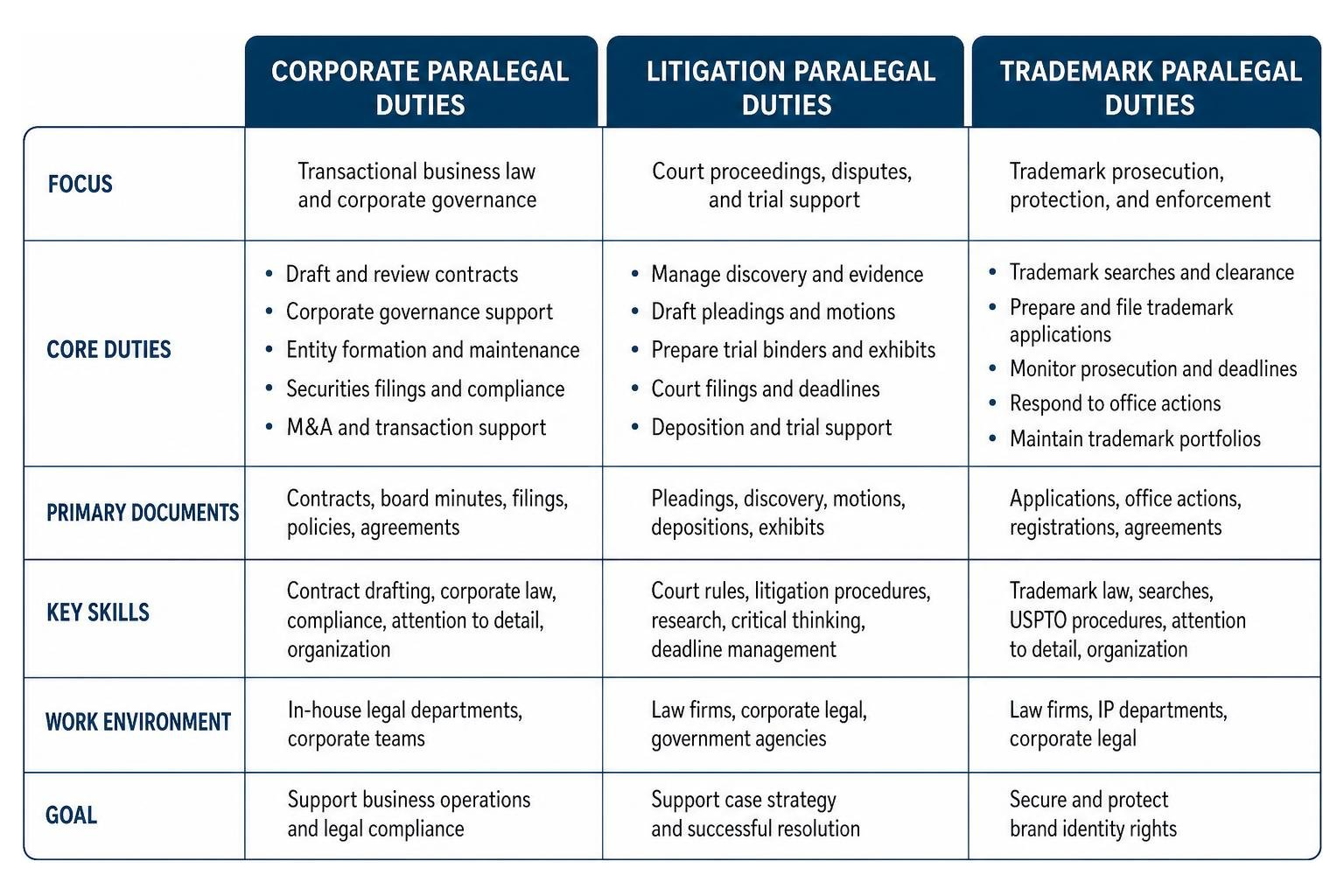
Understanding how corporate legal practice differs from other paralegal specialties is crucial when applying for roles. While litigation paralegals focus on court rules, pre-trial discovery, motions, and trial presentation, corporate paralegals deal primarily with transactional business law, contract administration, and organizational compliance.
Practice Area Comparison and Skill Requirements
To help align your job search strategy with your preferred career focus, review the fundamental differences across primary legal support specializations:
| Feature / Specialty | Corporate Paralegal | Litigation Paralegal | Trademark / IP Paralegal |
|---|---|---|---|
| Core Operational Focus | Entity formation, corporate governance, transaction closings, contract management | Court filings, trial preparation, discovery requests, casework management | Trademark searches, IP filings, portfolio tracking, prosecution office actions |
| Primary Work Product | Board resolutions, officer certificates, merger due diligence binders, SEC filings | Pleadings, discovery responses, deposition summaries, trial exhibits | Registration applications, renewal filings, opposition briefs, assignment records |
| Key Regulatory Bodies | State Secretaries of State, SEC, IRS, FTC | Federal and State Court Systems, Administrative Boards | US Patent & Trademark Office (USPTO), WIPO |
| Workplace Environment | In-house corporate departments, business practice groups in law firms | Litigation boutique firms, court-focused practice groups | IP specialty firms, corporate brand management legal teams |
| Essential Technical Tools | Entity management platforms, CLM software, electronic signature tools | E-discovery platforms, trial presentation software | Trademark databases, IP docketing software |
For deeper insights into how these roles compare in daily practice, explore our guides on the commercial litigation paralegal job description guide and the commercial paralegal job description guide.
Frequently Asked Questions
What qualifications and experience are required for entry-level corporate paralegals?
Most employers seeking entry-level corporate paralegals require a high school diploma combined with a formal paralegal certificate. Corporate legal departments value practical capabilities over theoretical knowledge: strong proofreading abilities, comfort managing digital document archives, basic understanding of business structures (such as LLCs and corporations), and clear professional communication.
While some applicants wonder if law school graduates apply for these positions, many corporate legal departments explicitly prefer career paralegals dedicated to long-term legal support over J.D. holders seeking temporary transition roles. Candidates entering the market can review foundational job requirements through our comprehensive resource on entry level corporate paralegal positions.
How much do corporate paralegals earn across different experience levels?
Compensation for corporate paralegals follows a clear career progression tier structure. Entry-level transactional support specialists build foundational earnings while mastering basic entity management and contract administration. Mid-level corporate paralegals with 3 to 5 years of experience earn higher compensation as they independently manage corporate minute books, foreign state qualifications, and routine closing processes.
Senior corporate paralegals, governance specialists, and legal operations managers commanding top-tier earnings typically bring 5 to 10+ years of dedicated transactional or public company SEC filing experience. At the highest levels, specialized paralegals in private equity, technology infrastructure, or capital markets legal teams achieve top-bracket industry compensation packages that include performance bonuses and equity grants.
What primary duties differentiate a corporate paralegal from a litigation paralegal?
The fundamental difference lies in transactional prevention versus dispute resolution. Corporate paralegals focus on transactional work: drafting entity documentation, organizing board meetings, tracking contract renewals, facilitating business acquisitions, and maintaining regulatory compliance to prevent legal disputes.
Conversely, litigation paralegals handle active legal disputes: gathering evidence, coordinating discovery requests, drafting trial motions, interviewing witnesses, and managing court calendars. Corporate paralegals interact primarily with internal business executives, outside transactional counsel, and state compliance agencies rather than court clerks and judicial officers. For a complete side-by-side analysis of legal support careers, check out our paralegal job complete guide.
Conclusion

Finding the right job among available corporate paralegal jobs takes structure, persistence, and continuous skill refinement. By breaking your job search down into practical daily habits—defining clear goals, mastering entity management skills, updating your resume with transactional vocabulary, and exploring high-growth corporate markets—you maintain full control over your professional journey.
At the Paralegal Institute, we are committed to helping career-focused adults transition rapidly into rewarding legal careers. Our accelerated 15-week paralegal certificate program delivers practical, job-ready training designed and taught by practicing legal professionals. Whether you choose our online classes featuring live instruction or our interactive in-person classes, you gain real-world legal capabilities that make you immediately competitive to corporate employers.
I am Matthew Pfau, a practicing U.S. attorney who teaches paralegal courses at the Paralegal Institute. While I am an attorney and not a paralegal, my experience training legal support staff has shown me how transformative practical education can be. Take the next step in building your corporate legal career today by exploring our top resources for paralegal education.