Understanding the Paralegal Career Path
A paralegal job description outlines a role that is the backbone of any law firm or legal department. Paralegals perform substantive legal work under attorney supervision, bridging the gap between administrative support and legal expertise. Their tasks include conducting legal research, drafting documents like contracts and pleadings, managing case files, preparing for trials, and communicating with clients. However, they cannot give legal advice or represent clients in court.
Key responsibilities often include:
- Legal Research: Investigating case law and statutes using legal databases.
- Document Drafting: Preparing contracts, briefs, and court filings.
- Case Management: Organizing files and tracking deadlines.
- Trial Support: Compiling exhibits and assisting attorneys in court.
- Client Communication: Interviewing clients and providing case updates.
Today's paralegals work in law firms, corporate legal departments, government agencies, and more. Yet many people still don't fully understand what the job entails or how to break into this stable, rewarding profession.
I'm Matt Pfau, a practicing U.S. attorney who owns a law firm and regularly hires and trains paralegals. My experience developing effective paralegal job descriptions and training programs led me to create the curriculum at Paralegal Institute. In this guide, I'll break down what employers look for, what the job entails, and how you can position yourself for success.
Understanding the Paralegal's Role and Scope
Paralegals are legal professionals who perform substantive legal work under the direct supervision of a licensed attorney. This partnership is the foundation of how the legal system delivers efficient, high-quality services. While attorneys focus on courtroom strategy and direct client representation, paralegals handle the detailed research, drafting, and case management that makes those high-level tasks possible.
What's non-negotiable is that a paralegal's non-lawyer status must always be clear in all interactions. This is an ethical and legal requirement. Paralegals cannot give legal advice, set legal fees, or represent clients in court (except in rare, statute-specific situations). These responsibilities belong exclusively to licensed attorneys. Understanding this boundary is essential to working ethically and effectively. For a deeper look at this partnership, explore our insights into the role of paralegals in law firms.

Paralegal vs. Lawyer: Key Distinctions
An attorney has earned a Juris Doctor (JD) degree, passed a state Bar exam, and is licensed to practice law. This gives them the authority to provide legal advice and represent clients in court. They are bound by strict ethical rules governing their independent practice.
A paralegal does not hold a JD or a license to practice law. They work under attorney supervision , which creates clear boundaries. Paralegals cannot give legal advice or legal opinions, set fees, or represent clients in court. Instead, they handle substantive legal tasks that free attorneys to focus on work only a licensed lawyer can do. This division of labor makes legal services more efficient and affordable.
At Paralegal Institute, we train students to understand these boundaries from day one. Knowing your scope of practice is empowering, allowing you to perform high-level work while maintaining the ethical standards that protect you and your clients.
Paralegal vs. Legal Assistant: A Functional Comparison
While some firms use the terms interchangeably, there's an important distinction between a paralegal and a legal assistant.
Legal assistants generally focus on administrative and clerical support, such as managing calendars, answering phones, and filing. These tasks are essential to keeping an office running smoothly.
Paralegals, on the other hand, perform substantive legal work that requires applying legal knowledge. They conduct in-depth legal research, draft complex documents like pleadings and contracts, and assist with trial preparation. Their primary value comes from their direct contribution to the legal casework itself. The key difference is the application of legal knowledge.
Our curriculum at Paralegal Institute focuses on building the practical skills needed for substantive paralegal work—the kind that appears in every serious paralegal job description.
| Feature | Paralegal | Legal Assistant |
|---|---|---|
| Primary Focus | Substantive legal work requiring legal knowledge | Administrative and clerical support |
| Key Tasks | Legal research, drafting pleadings and contracts, case analysis, trial preparation | Scheduling, filing, answering phones, office organization, general correspondence |
| Required Skills | Legal research, legal writing, critical thinking, document drafting, attention to detail | Organization, communication, data entry, office software proficiency |
| Legal Knowledge | High level, applied directly to casework | General understanding of legal processes for administrative support |
| Supervision | Works under attorney supervision on legal matters | Supports attorneys and legal staff with office tasks |
A Deep Dive into the Paralegal Job Description
Understanding the specific duties in a paralegal job description is crucial. Paralegals are integral members of the legal team, involved in virtually every stage of a case. Their work is intellectually stimulating and varied. One day you might be researching case law, the next organizing exhibits for a trial, and the following day interviewing witnesses. This variety is part of what makes the role so rewarding. To get a comprehensive view, check out our detailed overview of the Role of Paralegals in Law Firms.

Common Duties and Responsibilities in a Paralegal Job Description
The day-to-day life of a paralegal is dynamic. A solid paralegal job description will include several core responsibilities:
- Legal Research: This is a foundational skill. Paralegals use online databases like Westlaw or LexisNexis to investigate case law, statutes, and regulations to support legal proceedings. Our guide on Legal Research Skills Training dives deeper into this critical skill.
- Drafting Documents: Paralegals prepare first drafts of many legal documents, including pleadings (complaints, answers), contracts, correspondence, and internal memoranda summarizing research.
- Discovery: A crucial part of casework is the discovery process, which involves gathering and exchanging information between parties. This includes preparing and responding to interrogatories and requests for documents.
- Case Management: This involves maintaining case files, tracking deadlines, managing calendars, and ensuring all documents are properly filed and accessible. Attention to detail is paramount.
- Client and Witness Interaction: Paralegals often serve as a point of contact for clients, conducting initial interviews, gathering facts, and providing case updates. They also help prepare clients and witnesses for depositions and court testimony.
Trial Preparation and Support
When a case heads to trial, paralegals become even more indispensable. Their meticulous organization and support are critical for an attorney's success. Key tasks include organizing exhibits, preparing witnesses, summarizing depositions, compiling trial notebooks, and providing direct assistance to the attorney in the courtroom. For a deeper dive, see our Inside Look at Paralegal Trial Preparation.
Common Paralegal Specializations
Just as lawyers specialize, so do paralegals. Many paralegal job descriptions will specify a practice area, which can lead to deeper expertise.
- Corporate Law: Handling entity formation, mergers, compliance, and contracts.
- Litigation: Assisting attorneys throughout the lawsuit process, from discovery through trial.
- Real Estate Law: Focusing on property transactions, leases, and zoning issues.
- Family Law: Dealing with divorce, child custody, and adoption.
- Criminal Law: Assisting in prosecution and defense cases.
- Personal Injury: Focusing on cases involving accidents and medical malpractice, as detailed in our Personal Injury Paralegal Job Description.
Building Your Career: Education and Essential Skills
Landing a job that fits a paralegal job description requires the right education and a specific set of skills. At Paralegal Institute, we've designed our program around the practical competence that gets you hired.
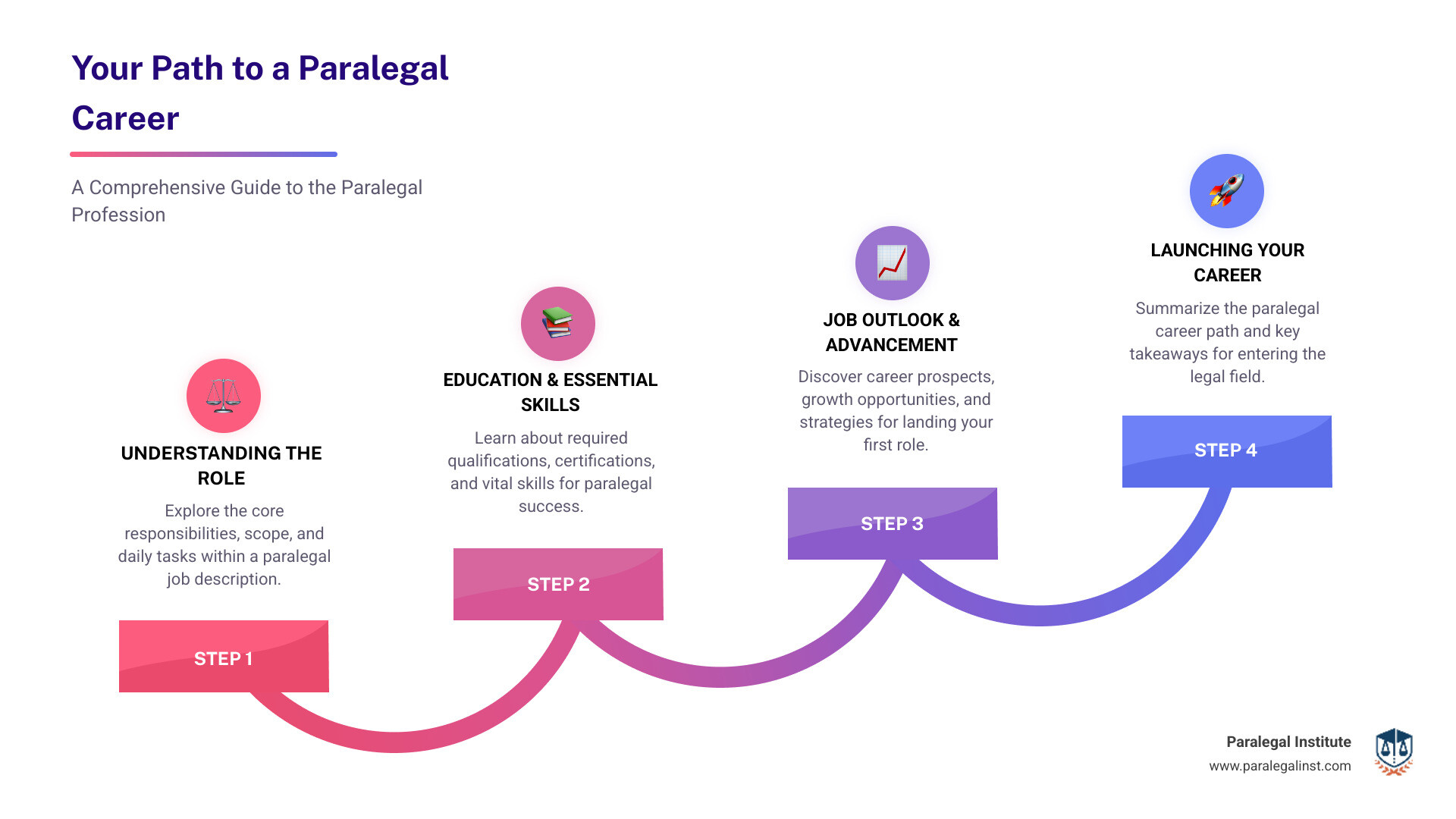
Educational Pathways: Paralegal Certificate and Degree Options
Most paralegal job descriptions require some form of post-secondary education or a specialized paralegal credential. While some educational paths can take years, you don't need to spend that long in school to launch a successful career.
Specialized paralegal programs offer a focused, intensive alternative. These programs concentrate on the skills you need to work as a paralegal, without the general education courses found in other academic programs. This is especially valuable if you already have a college education and want to transition into law.
At Paralegal Institute, our 15-week paralegal program is built for people who want to enter the workforce fast. Our curriculum is taught by practicing legal professionals who know what skills you need on day one. We offer both online classes with live instruction and in-person options, ensuring real-time interaction. This accelerated approach means you can be job-ready in less than four months. It's a practical, efficient path into the legal field. For a detailed comparison, see our Guide to Paralegal Education Options.
The Essential Skillset for a Top-Tier Paralegal
Education opens the door, but skills get you hired. When writing a paralegal job description for my firm, I look for a specific combination of technical abilities and personal qualities.
Technical (Hard) Skills:
- Legal Research: Proficiency with legal databases like Westlaw and LexisNexis is critical. Explore more in our Legal Research Guide for Paralegals.
- Legal Writing: You'll draft pleadings, contracts, and memoranda. These must be clear, concise, and error-free. Our courses emphasize improving your legal writing skills.
- Technology Proficiency: Comfort with Microsoft Office and electronic filing systems is expected.
Professional (Soft) Skills:
- Communication: You must communicate clearly and professionally with clients, court staff, and your legal team.
- Organization & Attention to Detail: In legal work, small errors can have big consequences. Managing multiple cases with strict deadlines is essential.
- Critical Thinking: Exceptional paralegals analyze facts, identify issues, and contribute to legal strategy.
At Paralegal Institute, we build these practical paralegal skills into our curriculum through real-world scenarios, training you to be the kind of paralegal that law firms actively seek.
Job Outlook, Advancement, and Landing Your First Role
The legal profession continues to need skilled paralegals. According to the U.S. Bureau of Labor Statistics, employment is projected to remain steady, with tens of thousands of openings expected each year on average. These openings arise as workers retire or transition to other careers, creating consistent demand for new talent.
When you explore paralegal job description postings, you'll find opportunities in diverse settings. The majority of paralegals work in law firms, but many corporations are expanding their in-house legal departments. This trend has created excellent opportunities, especially in cities like Las Vegas. Government agencies and industries like finance, insurance, and real estate also frequently hire paralegals. For more insights, explore our article on the Role of Paralegals in Law Firms.

Career Progression and Opportunities
A paralegal career is a foundation for professional growth. Advancement paths include moving to senior paralegal or paralegal manager roles, where you take on more complex cases and supervise junior staff. Specialization in a niche area like litigation or corporate law can also position you as an expert.
For some, the career is an excellent stepping stone to law school. The practical experience gained as a paralegal provides an invaluable foundation. At Paralegal Institute, our curriculum is designed to give you a competitive edge for a long and successful career, emphasizing lifelong learning and continuous skill development.
Crafting Your Application for a Paralegal Job Description
Your resume and cover letter must clearly show you meet the requirements of the paralegal job description.
- Resume: Lead with your education, especially your specialized paralegal training. Create a dedicated skills section for technical abilities (legal research, drafting) and soft skills (organization, communication). Emphasize transferable skills from previous jobs using strong action verbs like "Drafted," "Researched," and "Managed."
- Cover Letter: Customize each letter for the specific firm. Connect your practical training from Paralegal Institute to the duties listed in the job posting. Let your enthusiasm for the legal field shine through.
Your application is your first piece of legal writing for an employer—it needs to be perfect. For more guidance, check out our guides on How to Get a Paralegal Job and how to Prep for First Job as a Paralegal.
Frequently Asked Questions about the Paralegal Profession
Can a paralegal give legal advice?
No, absolutely not. This is a critical boundary in any paralegal job description. Giving legal advice—interpreting laws for a specific situation or recommending a course of action—constitutes the unauthorized practice of law. This is a serious legal violation.
A paralegal can provide factual information, explain legal procedures, and communicate an attorney's advice to clients. For example, they can state a court deadline or explain a general legal term. However, they cannot tell a client whether to settle a case or how a law applies to their specific circumstances. Those interpretations must always come from a licensed attorney.
What is the most challenging part of being a paralegal?
The profession is rewarding but demanding. The most common challenges include:
- High-Pressure Environment: The work is deadline-driven. Court deadlines are absolute, and managing multiple urgent tasks can be stressful.
- Meticulous Attention to Detail: There is little room for error. A single typo in a court filing or a missed deadline can have serious consequences for a case.
- Emotionally Difficult Cases: In areas like family law or criminal defense, you often work with clients during the worst moments of their lives. Maintaining professionalism and compassion is key.
- Working Under Supervision: The ultimate decision-making authority rests with the attorney. Learning to steer this dynamic professionally is an important skill.
Despite these challenges, most paralegals find the work intellectually stimulating and deeply satisfying.
How quickly can I start a paralegal career?
The timeline depends on your educational path. Some academic routes can take several years. For adults looking to enter the legal field faster, there is a more direct path.
Our 15-week paralegal program at Paralegal Institute is designed for career-focused adults who want job-ready skills as quickly as possible. It's an intensive, focused curriculum taught by practicing legal professionals. Our live instruction, available online or in-person, ensures you get real-time feedback and can engage directly with experienced instructors.
This accelerated timeline means you can be entering the workforce in less than four months, rather than spending years in school. For many of our students, this faster path is transformative. You can learn more in our guide on how to Become a Paralegal Fast.
Conclusion: Launching Your Career in the Legal Field
Understanding a paralegal job description is the first step toward an exciting journey. Paralegals are the backbone of legal teams, conducting vital research, drafting documents, and supporting attorneys through every phase of a case. This is substantive legal work that requires knowledge, skill, and dedication.
The role is both challenging and rewarding, offering a dynamic environment where your skills directly impact case outcomes. Whether you are drawn to litigation, corporate law, or another specialty, there is a place for you in this profession.
The path to becoming a paralegal doesn't have to take years. At Paralegal Institute, we've designed our 15-week paralegal program for career-focused adults who want to enter the legal field quickly and confidently.
What sets us apart is live instruction from practicing legal professionals, available online or in person. You learn real-world skills in real time, with immediate feedback from attorneys who do this work every day. Our hands-on training focuses on the tasks you'll actually perform on the job.
This accelerated, efficient approach means you can be job-ready in just a few months. The demand for competent paralegals remains strong, with opportunities waiting in law firms, corporate legal departments, and government agencies.
Your career in the legal profession starts with the right training. Explore the essential role of paralegals in modern law firms and find out how our program can help you launch an impactful, rewarding career. Let's get you started today.