What It's Really Like to Work as a Document Review Paralegal
A document review paralegal is a legal professional who reads, tags, and organizes large volumes of documents during the discovery phase of litigation or investigation — and it's one of the most accessible entry points into the legal field today.
Quick Answer: What is a document review paralegal?
| Question | Answer |
|---|---|
| What do they do? | Review documents for relevance, privilege, and key facts in legal cases |
| Who hires them? | Law firms, in-house legal teams, healthcare, finance, and IT companies |
| Is it entry-level? | Yes — 52 remote entry-level roles were recently listed on one platform alone |
| Can you work remotely? | Yes — 269 full-time remote positions are currently available |
| What do you need? | A paralegal certificate, attention to detail, and basic legal vocabulary |
| Is AI changing the role? | Yes — but human judgment on privilege and relevance is still essential |
This role sits at the heart of modern litigation. Legal workloads are growing fast — 83% of legal departments report rising demand for document review, and legal spend has climbed significantly in recent years. Yet many people overlook document review as a career path, or feel intimidated by the technical side of it.
The good news? You don't need a law degree. You need the right training, the right tools, and a clear understanding of what the job actually involves.
I'm Matthew Pfau, a practicing attorney who has hired and trained paralegals at my own law firm and taught paralegal courses at the University of Nevada, Las Vegas — giving me a front-row view of what employers expect from a document review paralegal on day one. In this guide, I'll walk you through everything you need to know to evaluate this career path clearly and confidently.
What a document review paralegal is and why this role matters
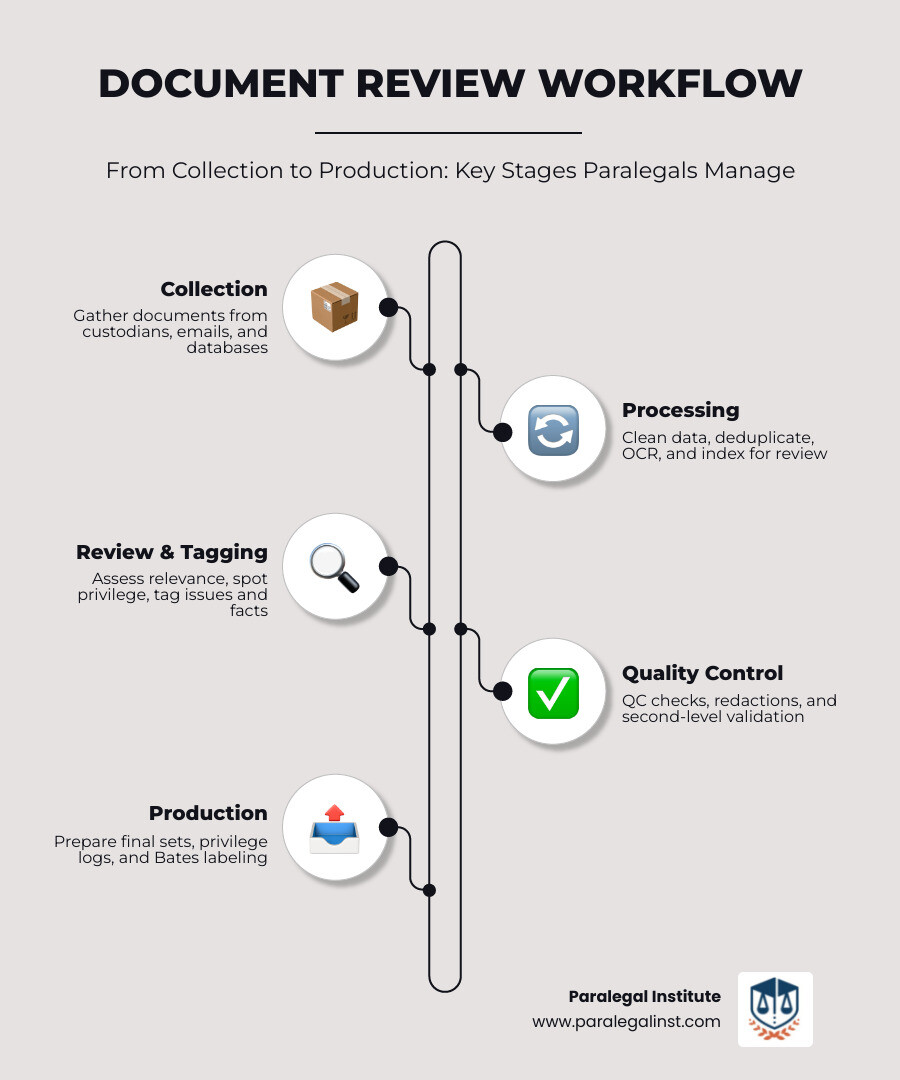
A document review paralegal helps legal teams sort through the mountain of information that shows up in lawsuits, investigations, compliance reviews, and internal disputes. During discovery, someone has to decide what matters, what does not, what is protected by privilege, and what may need redaction before production. That someone is often a trained paralegal working closely with attorneys and litigation support staff.
This matters because document review is not just glorified highlighting. It affects case strategy, deadlines, confidentiality, and risk. A missed privileged email can create serious problems. A missed key document can weaken a case. A well-trained reviewer saves time, reduces errors, and helps the legal team focus on the evidence that actually moves the case forward.
If you want a broader overview of how this role fits into the profession, see our Paralegal Job Description Complete Guide.
What does a document review paralegal actually do?
At the most basic level, document review means reading documents and applying decisions to them. In practice, that usually includes:
- Reviewing emails, contracts, invoices, medical records, spreadsheets, texts, and internal business files
- Deciding whether a document is relevant to the case or investigation
- Spotting potentially privileged communications
- Applying issue tags based on a review protocol
- Flagging documents that need attorney attention
- Redacting sensitive material
- Checking metadata, dates, custodians, and family relationships between files
- Writing short summaries or notes for attorneys
- Helping prepare production sets
A lot of this work happens in discovery databases rather than in Word or PDF folders. So while the job requires legal judgment, it also requires comfort with technology.
Where document review paralegals fit in a legal team
Document review paralegals usually work with:
- Law firms handling litigation or regulatory matters
- In-house legal departments
- Litigation support and discovery teams
- Corporate compliance groups
- Healthcare, finance, and IT employers with heavy document handling needs
- Investigations teams
Remote job data also shows that related roles appear outside traditional legal employers. Healthcare had 98 related remote openings in one recent data set, followed by IT with 53 and finance with 41. That tells us something important: the skills are transferable.
Within a legal team, the document review paralegal often serves as the bridge between raw documents and usable case information. That is why the role overlaps with litigation support. For a deeper look at that side of the field, read our Litigation Support Professional Guide.
The document review process from collection to production
Document review is one stage of a larger discovery workflow. A typical matter moves through collection, processing, review, quality control, and production. New documents can appear at any time, so the process is often ongoing rather than one-and-done.
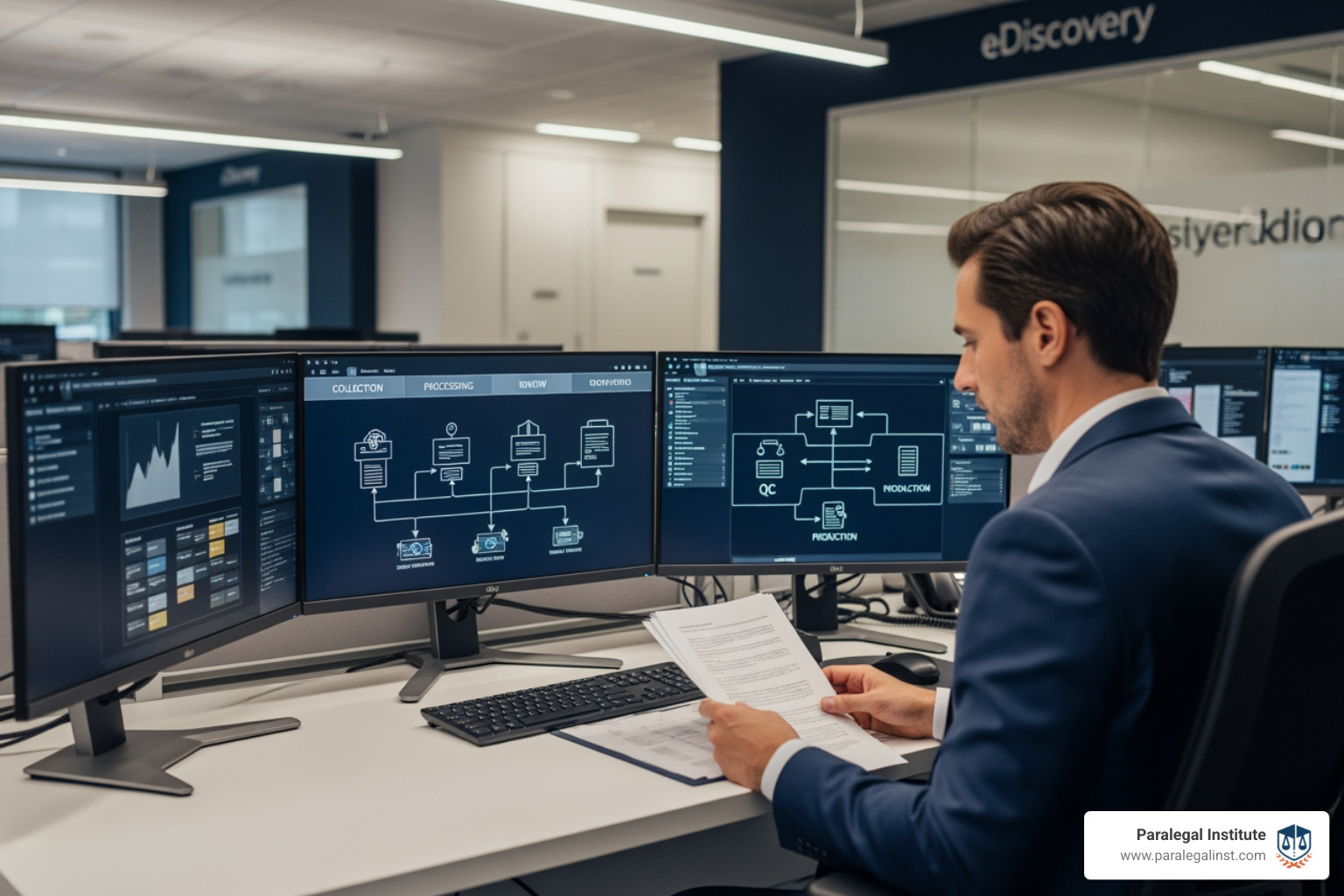
A simplified version looks like this:
- Documents are collected from email accounts, devices, cloud systems, or file shares.
- The data is processed so it can be searched and reviewed.
- Reviewers analyze the documents for relevance, issues, confidentiality, and privilege.
- Quality control checks are performed.
- Responsive documents are prepared for production.
- Privileged or withheld materials may be tracked in a privilege log.
How the document review paralegal supports each stage of review
Paralegals contribute at almost every step:
- Organizing source materials and tracking custodians
- Helping attorneys define review categories and coding choices
- Working in batches to keep review moving toward deadlines
- Tagging documents by issue, responsiveness, confidentiality, or hot status
- Building chronologies and fact timelines
- Performing first-pass QC checks
- Identifying duplicates, missing attachments, or odd file families
- Helping prepare final sets for production
This work is highly process-driven. Good reviewers do not just read documents. They follow protocols consistently, keep clear notes, and know when to escalate uncertain calls. If you want a fuller picture of the larger workflow, visit our Litigation Support Complete Guide.
Daily tasks, deliverables, and common assignments
On a normal day, a document review paralegal might:
- Review batches of documents in a database
- Apply tags for relevance or specific issues
- Mark possible privileged items for attorney review
- Create redactions
- Draft short document summaries
- Prepare witness files or hearing materials
- Help organize disclosure or production sets
- Check Bates labeling
- Communicate with attorneys or team leads about questions
- Handle administrative tasks tied to deadlines
Some job postings also show related assignments like preparing bundles for counsel, supporting witness statement drafting, and managing general file organization. In practice, the exact mix depends on whether the role is in a law firm, in-house team, or project-based review environment.
For related evidence-handling skills, see our Evidence Management Paralegal Success.
Common mistakes that slow reviews down
The fastest way to make document review painful is to be inconsistent. Common problems include:
- Using tags differently from other reviewers
- Missing privileged communications
- Writing vague notes that no one else can understand
- Confusing draft and final versions
- Failing to check attachments or email threads
- Naming files poorly outside the review platform
- Letting fatigue lead to careless calls
Review work can be repetitive, and that is exactly why discipline matters. The best reviewers build habits that protect accuracy when their brains want to wander off and start planning dinner.
Skills, tools, and training employers look for
Employers usually want a mix of legal basics, tech comfort, and reliability. They are not looking for drama. They are looking for someone who can follow instructions, stay consistent, protect confidentiality, and get through large document sets without melting down.
Software and platforms used in document review
The best-known platform in this space is Relativity, but employers may also use other review databases and eDiscovery tools. Across platforms, the same core functions show up again and again:
- Keyword searching
- Filtering by metadata
- OCR for scanned documents
- Deduplication
- Email threading
- Analytics and concept clustering
- Technology-assisted review
- Redaction tools
- Batch assignment and QC workflows
Attorney-focused job descriptions also regularly mention proficiency with document review software and eDiscovery tools as a core qualification, which applies to paralegals too. For a general role overview tied to document review technology, see Document Review Attorney role overview.
Core skills for entry-level and experienced roles
Whether a role is entry-level or more advanced, these skills matter:
- Attention to detail
- Analytical reading
- Written communication
- Organization
- Time management
- Confidentiality
- Consistency under pressure
- Team communication
- Basic legal research
- Comfort learning software quickly
As reviewers gain experience, employers often expect more judgment in areas like privilege spotting, chronology building, issue coding, and QC. Strong legal reading skills help enormously here. If you want to sharpen that foundation, our Legal Research Skills Complete Guide is a good next step.
What training or experience helps you get hired faster
The good news is that not every role requires prior document review experience. Recent remote job data showed 52 entry-level openings, and many related roles required only some college. That said, employers still prefer candidates who can show they understand the basics of legal workflow.
The strongest preparation usually includes:
- A paralegal certificate
- Familiarity with discovery terminology
- Practice reading legal and business documents
- Exposure to eDiscovery concepts
- Training in confidentiality and data handling
- Clear writing and summary skills
- Comfort with live instruction and feedback
This is one reason we believe accelerated, practical training matters. At Paralegal Institute, we focus on real-world job readiness through a 15-week paralegal certificate program taught by practicing legal professionals. For adults who want to enter the field faster, that is often a more practical route than spending years in a broader academic program before touching actual casework.
If you are just getting started, our Entry Level Paralegal Job Description can help you understand what employers commonly want.
Remote jobs, job market trends, and how to land a role
One of the biggest reasons people search this career path is flexibility. Yes, remote document review paralegal jobs are real. No, they are not mythical creatures like perfectly organized shared drives.
Are remote document review paralegal jobs real?
Yes. Recent remote job data showed:
- 269 full-time remote openings
- 49 part-time remote openings
- 41 independent contractor openings
- 172 permanent openings
- 8 temporary openings
- 52 entry-level openings
- 376 experienced openings
There were also 28 roles specifically in the legal category, with additional openings in healthcare, IT, and finance. That means remote opportunities exist, but many employers still prefer candidates with some experience, strong security awareness, and the ability to work independently.

Where to find openings and how to search smarter
Look on:
- General job boards
- Legal job boards
- Remote-work job boards
- Staffing firms that handle legal support projects
- Corporate career pages for in-house legal and compliance roles
Search using terms like:
- Document review paralegal
- Litigation paralegal
- Discovery paralegal
- eDiscovery paralegal
- Legal reviewer
- Litigation support paralegal
Use filters for:
- Full-time or part-time
- Permanent, temporary, or contractor
- Entry-level or experienced
- Remote only
- Legal, healthcare, finance, or IT categories
You can also review real-world posting language to see what employers ask for. For example, this document review paralegal posting reflects common duties such as review, redactions, disclosure support, and lawyer communication.
Application tips for first-time candidates
If you do not have direct review experience, your resume should still show that you can handle detail-heavy legal work. Recruiters often scan for phrases like:
- Document review
- Discovery support
- Redaction
- Confidentiality
- Legal research
- File organization
- Issue spotting
- Case summaries
- Deadline management
- Quality control
Other tips:
- Highlight coursework or projects involving legal documents
- Mention software you have used, even if only in training
- Show accuracy, not just speed
- Emphasize confidentiality and professional judgment
- Be specific about remote work readiness and availability
- Prepare examples of handling repetitive, detail-heavy tasks without losing consistency
If you are building your first legal resume, practical classroom exercises and mock casework can make a big difference. That is another advantage of live instruction: you get feedback in real time rather than trying to guess whether your work would survive in an actual law office.
Pay, career growth, and how AI is changing the work
Compensation varies a lot in document review because the market includes temporary projects, long-term staff roles, remote contractor work, and specialized litigation support positions. Rather than promise a magic number, it is more useful to understand what drives compensation and stability.
What affects compensation and job stability
Common factors include:
- Whether the role is temporary, contract, or permanent
- The size and type of employer
- Case volume and deadline intensity
- Your prior review experience
- Whether the work is remote or on-site
- Security requirements or clearance expectations
- The complexity of the subject matter
Project-based roles can offer quick entry and useful experience, but they may be less predictable. Permanent positions usually offer more stability. Experienced reviewers and those who can handle QC or specialized subject matter often have stronger long-term options.
Career benefits, challenges, and next steps
Benefits of starting in document review include:
- Fast entry into legal work
- Strong exposure to discovery and litigation process
- Transferable skills in organization, confidentiality, and analysis
- A clear path into litigation support, compliance, and broader paralegal work
Challenges include:
- Repetitive tasks
- High accuracy pressure
- Tight deadlines
- Mental fatigue from reviewing large volumes of similar material
Still, the role can be an excellent foundation. Many paralegals begin in review-heavy work and later move into litigation paralegal positions, discovery coordination, compliance support, or broader case management. If that path interests you, our Paralegal Litigation Support page is worth reading.
How AI has changed document review for paralegals
AI has absolutely changed the workflow, but it has not eliminated the need for skilled people. Legal departments report real gains from adoption: 82% say AI improved efficiency in document review. At the same time, 59% of chief legal officers report increased workloads, and document review remains a major time drain.
What AI now helps with:
- Prioritizing likely relevant documents
- Grouping similar files
- Surfacing email threads
- Reducing duplicate review effort
- Supporting QC and analytics
What still needs human judgment:
- Privilege decisions
- Context-sensitive relevance calls
- Redaction judgment
- Escalating unusual or risky documents
- Applying instructions consistently across gray areas
In other words, AI is more like a power tool than a replacement worker. It makes trained paralegals faster and more effective, but only if they understand the legal purpose behind the review. Employers continue to expect software proficiency plus judgment, as reflected in role descriptions like What employers expect in document review roles.
Frequently Asked Questions about document review paralegal careers
Can you become a document review paralegal with no experience?
Yes, especially in entry-level or project-based roles. A paralegal certificate helps because it shows employers you understand legal vocabulary, discovery basics, and professional expectations. Transferable experience in admin work, records handling, compliance, or detail-heavy customer service can also help.
Is document review a good way to start a legal career?
Yes. It is one of the clearest entry points into litigation support because you learn how cases are built from the evidence up. You develop document judgment, organization, confidentiality habits, and deadline discipline. Those skills transfer well to broader paralegal roles.
Do document review paralegals only work in law firms?
No. They also work in in-house legal departments, healthcare organizations, insurance environments, corporate compliance teams, and investigations. The rise of remote work has widened the field even more.
Conclusion
A document review paralegal role can be a smart, practical way to enter the legal field without law school and without spending years preparing before you are employable. It teaches you how legal teams handle discovery, manage evidence, protect privilege, and turn raw information into case strategy.
If you want to move into this kind of work, training matters. We built Paralegal Institute for adults who want a faster, career-ready path into legal work through live online instruction or in-person classes in Las Vegas. Our 15-week paralegal certificate program is designed to help students build practical skills for immediate workforce entry, not just collect theory and hope for the best.
For a broader look at how paralegals contribute in legal practice, visit role of paralegals in law firms.