How to Find Junior Paralegal Jobs After Graduation
To find junior paralegal jobs, search for entry-level paralegal, litigation assistant, and legal support specialist roles, not just "junior paralegal." Check law firm and corporate legal department career pages, job boards, and legal staffing agencies. Tailor each application to the practice area, and show how your coursework or past work prepared you to manage case files, track deadlines, and support discovery. Apply to contract-to-hire roles, too.
I'm Matthew Pfau, a practicing attorney who has hired and trained paralegals at my law firm. That experience shapes how I teach at Paralegal Institute and the advice I'll share here about landing junior paralegal jobs.
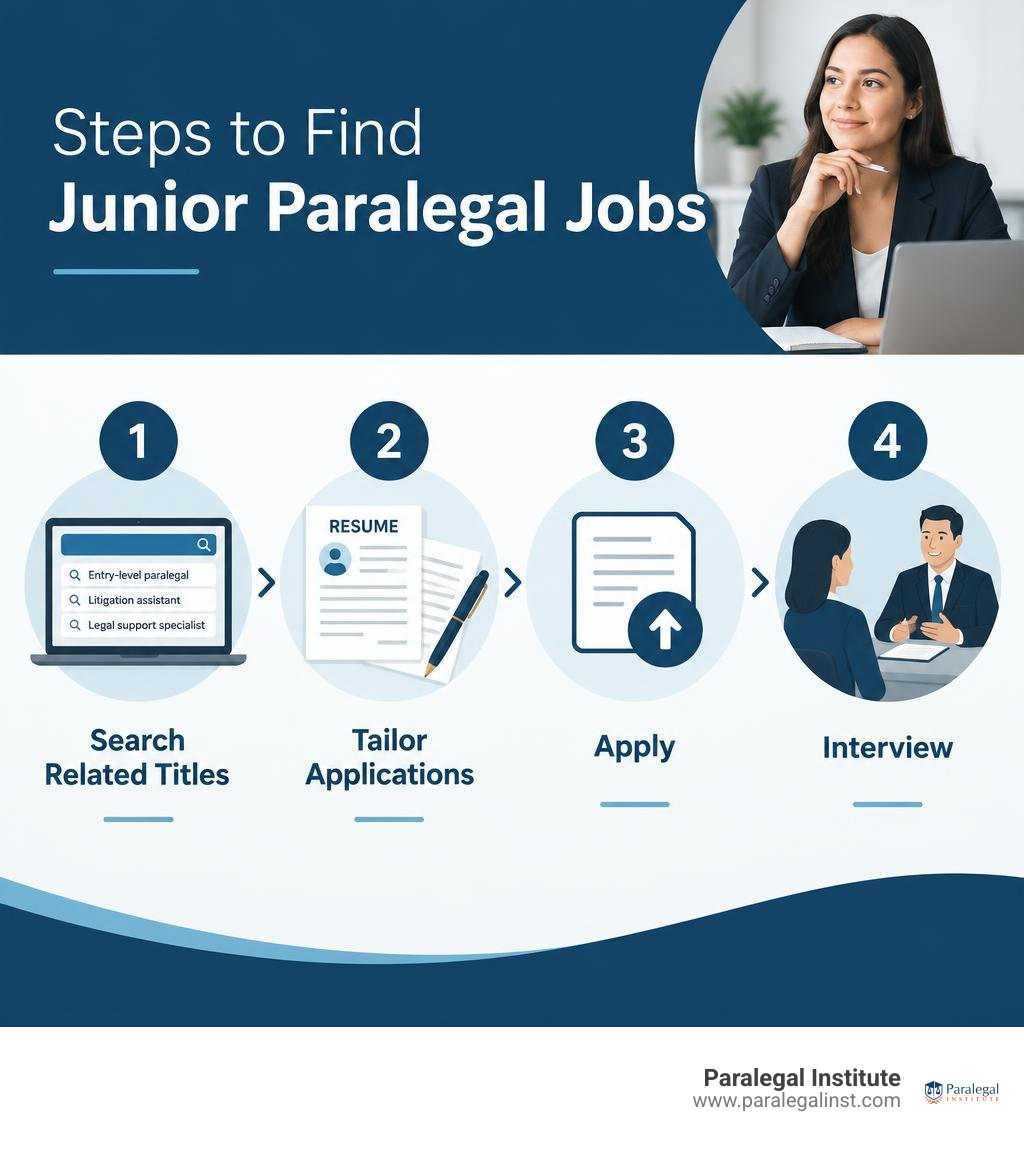
When you begin your search, focus on firms that handle active litigation or high-volume transactional work. These practices consistently need junior staff to manage document intake, prepare initial drafts, and maintain case calendars. A well-organized application that references specific drafting tasks from your training will position you as a candidate who can contribute immediately rather than one who needs weeks of foundational instruction.
What to Expect in Junior Paralegal Jobs: Core Duties and Day-to-Day Responsibilities

When attorneys bring entry-level talent onto their teams, they are looking for reliable professionals who can immediately shoulder substantive casework. Our primary goal as practicing attorneys is finding support staff who understand procedural timelines and document accuracy from day one. You can review our detailed breakdown in our paralegal job description guide to see how responsibilities expand over time.
In your first role, your daily tasks will center on managing case files, organizing evidentiary records, and drafting foundational legal pleadings. You will perform initial client intake interviews, prepare discovery requests and responses, calculate court deadlines, and coordinate electronic filings. Reviewing an entry-level paralegal job description shows that attorneys rely heavily on junior staff to maintain litigation dockets and manage document intake so cases move forward without administrative delays.
Practice Area Specializations for Junior Paralegals
Entry-level roles vary significantly depending on the law firm's core practice area:
- Civil Litigation Support: Managing discovery productions, indexing deposition transcripts, drafting exhibit lists, and assembling trial notebooks.
- Corporate Practice: Preparing initial formation documents, maintaining minute books, tracking annual reporting dates, and coordinating signature closings.
- Mass Tort & Class Actions: Organizing voluminous medical records, tracking multi-plaintiff documentation, and coordinating plaintiff communications, as seen in real-world mass tort litigation paralegal positions.
- Family Law: Preparing financial affidavits, drafting initial petitions, and managing sensitive client intake.
- Immigration Law: Assembling petition packets, tracking visa filing schedules, and collecting client identity documents.
- Landlord-Tenant & Real Estate: Drafting formal notices, tracking court return dates, and compiling commercial lease documentation.
Paralegal vs. Legal Assistant: Understanding the Functional Differences
Many candidates confuse paralegal roles with legal assistant positions. While both support attorneys, their core duties and billing methods differ substantially. Paralegals perform substantive legal work that an attorney would otherwise have to complete, allowing firms to bill their time directly to clients. Legal assistants primarily handle clerical and administrative operations.
| Operational Feature | Junior Paralegal | Legal Assistant |
|---|---|---|
| Primary Work Scope | Substantive legal tasks (drafting pleadings, discovery analysis) | Administrative support (scheduling, travel coordination, filing) |
| Client Billing | Direct billable hours for substantive client casework | Non-billable administrative overhead |
| Core Documentation | Interrogatories, subpoenas, trial exhibits, legal memos | Invoices, client intake intake sheets, general correspondence |
| Required Training | Structured paralegal certificate | General administrative or executive assistant background |
Essential Qualifications and Technical Skills for Entry-Level Candidates

To land an entry-level position, you do not need years of past firm experience, but you do need targeted, practical competence. Many candidates wonder whether a paralegal position is an entry-level job, and the answer is yes—provided you possess practical drafting skills, an understanding of court rules, and formal legal training. We designed the Paralegal Institute curriculum specifically to give students real-world practice drafting discovery and handling pleadings so they enter the job market fully prepared.
If you are exploring breaking into paralegal work without experience, prioritizing hands-on training over lengthy theoretical programs is your fastest route to employment. Law firms look for candidates who understand how civil lawsuits move through local and state court systems and who can manage deadlines accurately.
In-Demand Legal Technology and Practical Tools
Modern law offices rely on specialized platforms to manage casework. Candidates who already understand these applications stand out immediately:
- Electronic Court Filing: Navigating state and federal court filing portals to submit pleadings accurately and track docket updates.
- Discovery Management: Organizing and reviewing electronic records, tagging evidence, and preparing production sets.
- Document Execution & Cloud Workspaces: Coordinating digital signatures and managing shared drives for multi-party agreements, an essential skill highlighted in remote junior paralegal projects.
- Practice Calendaring: Calculating strict statutory response deadlines using rule-based court calendaring systems.
Beyond software familiarity, attorneys evaluate whether you can apply procedural rules to real casework. For example, knowing how to calculate a response deadline under the rules of civil procedure matters more than memorizing a platform's menu options. Our training emphasizes that practical application so you can handle active files from your first week on the job.
Career Outlook and Professional Growth
The legal market continues to demonstrate strong demand for well-trained paralegals across various practice environments. Law firms and corporate legal departments consistently seek skilled support professionals to streamline operations and handle essential discovery, client intake, and trial prep.
Candidates can explore current industry hiring projections by reviewing our paralegal job prospects resource. While long-term earning potential expands as you build expertise, entry-level candidates who develop strong procedural knowledge and technical capabilities position themselves for steady advancement.
Attorneys consistently tell me they need junior paralegals who can manage active casework without constant supervision. That demand creates a clear path for graduates who complete focused, practical training. The strongest candidates enter the market already familiar with drafting discovery, organizing exhibits, and tracking court deadlines, which allows them to contribute to billable work immediately and build a reputation for reliability.
Proven Job Search Strategies for Launching Your Legal Career
Landing your first legal position requires a proactive, structured strategy. Rather than submitting generic resumes to broad job postings, successful graduates tailor their materials to showcase their practical knowledge.
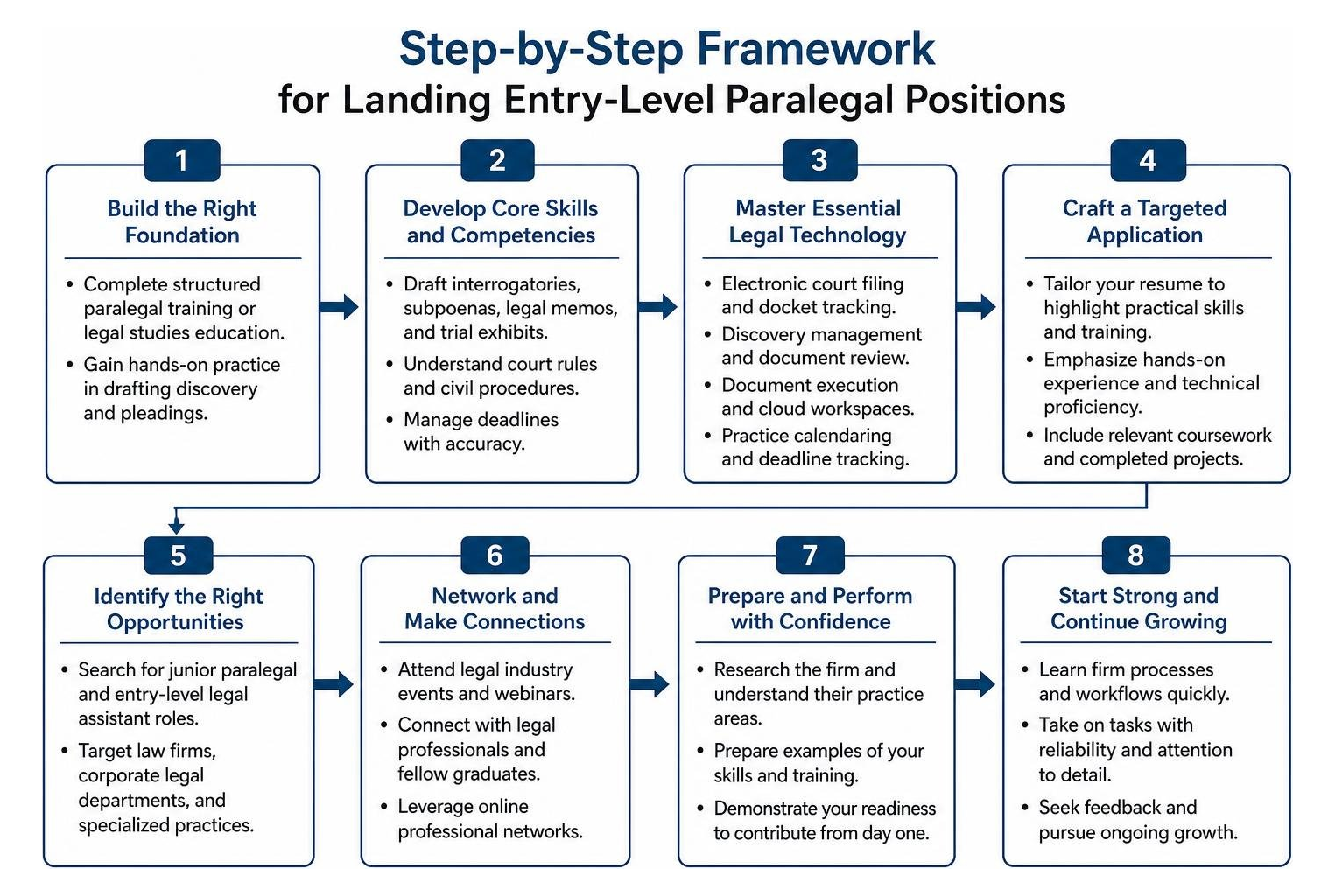
When learning how to get a paralegal job, your primary focus should be demonstrating that you require minimal on-the-job training for daily casework. You can also monitor entry-level legal assistant jobs as potential stepping stones into larger law firms.
How to Find and Land High-Quality Junior Paralegal Jobs
Maximize your application success with these proven tactics:
- Emphasize Practical Drafting: Tailor your resume to highlight experience drafting discovery requests, indexing records, and managing court deadlines from your coursework.
- Apply Early: Law firms often review applicants on a rolling basis; submitting your materials early gives you a significant advantage.
- Connect Directly with Local Attorneys: Reach out to practicing attorneys and legal professionals in your area to build relationships with hiring decision-makers.
- Target Direct Firm Portals: Use our structured paralegal job search strategies to identify unadvertised positions by contacting mid-sized firms directly.
Navigating In-Person and Remote Junior Paralegal Jobs
Entry-level roles exist across several work environments, each offering distinct advantages:
- Mid-Sized and Boutique Law Firms: Offer direct mentorship from practicing attorneys and early exposure to courtroom preparation and client interactions.
- Corporate Legal Departments: Focus on contract lifecycles, compliance audits, and corporate governance rather than litigation.
- Remote Legal Support: While remote roles exist for document management and signature collection, reviewing remote entry-level paralegal jobs shows that in-person positions often provide more immediate, hands-on mentorship for beginners.
When evaluating any opportunity, ask how quickly you will work directly on case files. Positions that involve substantive drafting and deadline management from the start will accelerate your professional growth far more than roles limited to administrative intake.
Long-Term Career Pathways and Advancement Opportunities
Starting as a junior paralegal opens doors to multiple professional trajectories. As you master complex casework, you can advance toward specialized roles or transition into broader operational fields.
Consult our paralegal career guide for comprehensive roadmaps detailing professional growth. Many paralegals move into specialized litigation roles or transition into entry-level corporate paralegal jobs, while others leverage their deep procedural knowledge to excel in law school.
Within a few years, junior paralegals who demonstrate consistent drafting accuracy and deadline management often advance to mid-level positions with greater case responsibility. Some choose to specialize in complex discovery or trial preparation, while others move into legal operations roles that coordinate workflows across entire firms. The foundational skills you build in your first position—drafting pleadings, managing evidence, and understanding civil procedure—remain valuable regardless of which path you ultimately pursue.
Frequently Asked Questions About Junior Paralegal Jobs
How hard is it to get a junior paralegal job without experience?
Breaking into the field depends on whether you have practical skills. As we explain in our guide on how hard it is to get an entry-level paralegal job, firms hesitate to hire untrained applicants because attorneys do not have time to teach procedural basics from scratch. However, if you understand how to navigate court dockets and draft standard discovery, securing a paralegal job without experience at a law firm becomes entirely achievable.
What qualifications do law firms prioritize when hiring entry-level paralegals?
Attorneys look for practical procedural competence over abstract legal theory. Completing focused entry-level paralegal training that covers civil procedure, legal document drafting, and court calendaring shows employers you are ready for active casework from your first day.
Conclusion
Building a rewarding career in the legal field starts with practical, real-world skills. Rather than focusing on abstract legal theory, attorneys need professionals who can handle active discovery, prepare trial exhibits, and manage client files immediately.
At the Paralegal Institute, we built our 15-week paralegal certificate program to deliver accelerated, practical training designed and taught directly by practicing attorneys. Whether you join our in-person classes in Las Vegas or participate online with live instruction, you receive direct mentorship and hands-on drafting experience for immediate workforce entry.
Take control of your professional path today by exploring our complete guide to landing your first paralegal job and launching your legal career with confidence.