Start a Career in Paralegal Employment Law
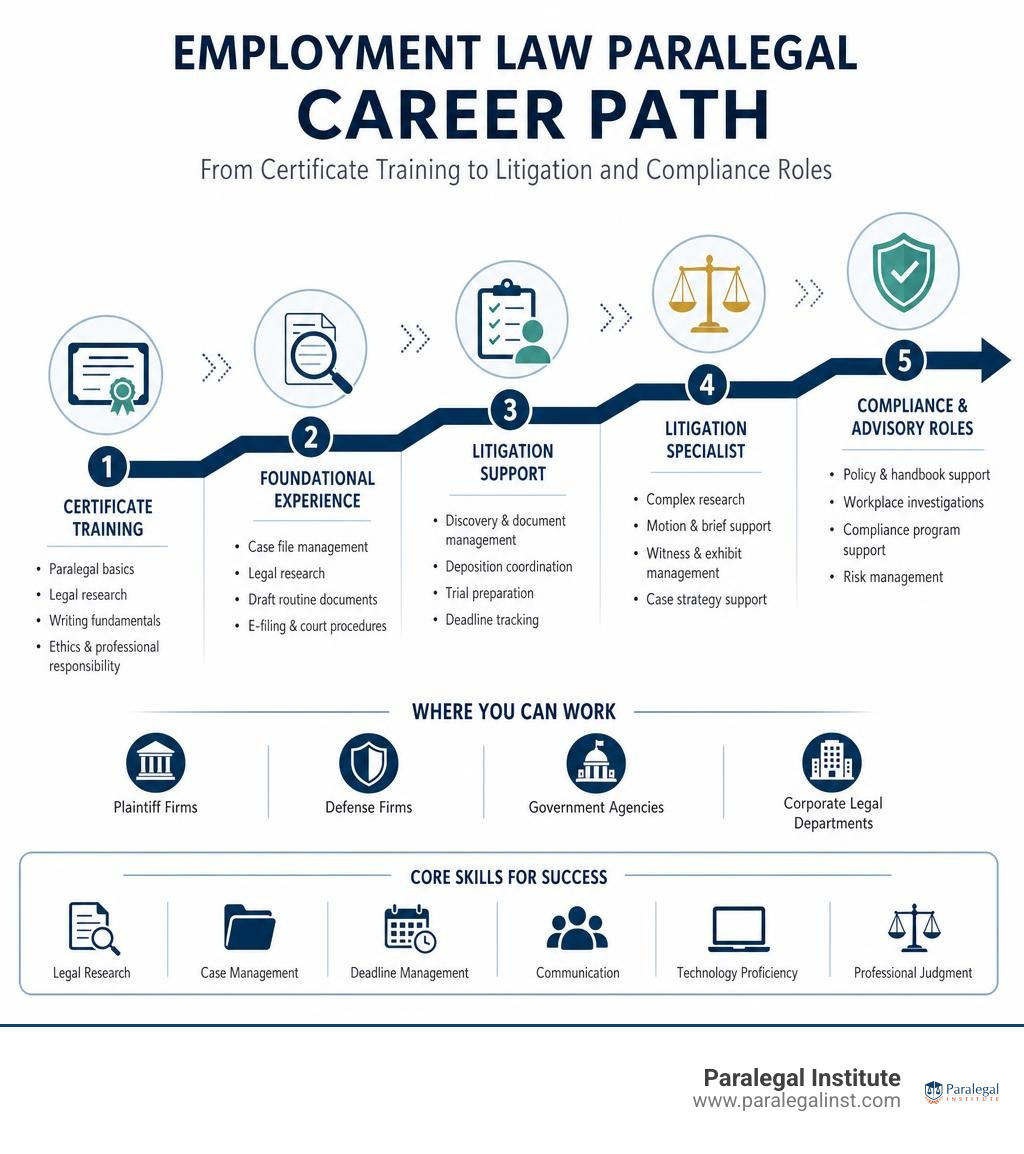
Paralegal employment law work supports attorneys who handle workplace disputes, employee rights, and employer compliance. It can be a practical legal career path for adults who want to enter the field without completing law school. A strong starting point is to earn a paralegal certificate, learn litigation basics, and build skill with legal research, discovery, case deadlines, and electronic filing.
Employment law paralegals may help with discrimination, harassment, wage-and-hour, leave, disability accommodation, retaliation, and wrongful termination matters. They organize personnel records, build timelines, prepare discovery, coordinate depositions, draft routine legal documents, and keep attorneys informed of critical deadlines.
The work can take place at plaintiff firms, defense firms, government agencies, and corporate legal departments. Earning potential and career opportunities can rise steadily with litigation experience, location, and specialized employment-law skills.
I am Matthew Pfau, a practicing U.S. attorney who teaches paralegal courses at Paralegal Institute and has hired and trained many paralegals in law-firm settings. My experience with paralegal employment law training helps aspiring legal professionals understand the skills employers need and the fastest realistic route into meaningful casework.
Labor Law vs. Employment Law: Key Distinctions
While many people use the terms interchangeably, labor law and employment law involve distinct legal frameworks, administrative bodies, and day-to-day procedures. Understanding these differences is essential when exploring what does a paralegal do in a modern workplace-focused practice.
| Category | Labor Law | Employment Law |
|---|---|---|
| Core Focus | Collective employee rights and union-management relations | Individual employee rights and employer obligations |
| Key Legislation | National Labor Relations Act (NLRA), Labor Management Relations Act | Title VII, ADA, ADEA, FLSA, FMLA |
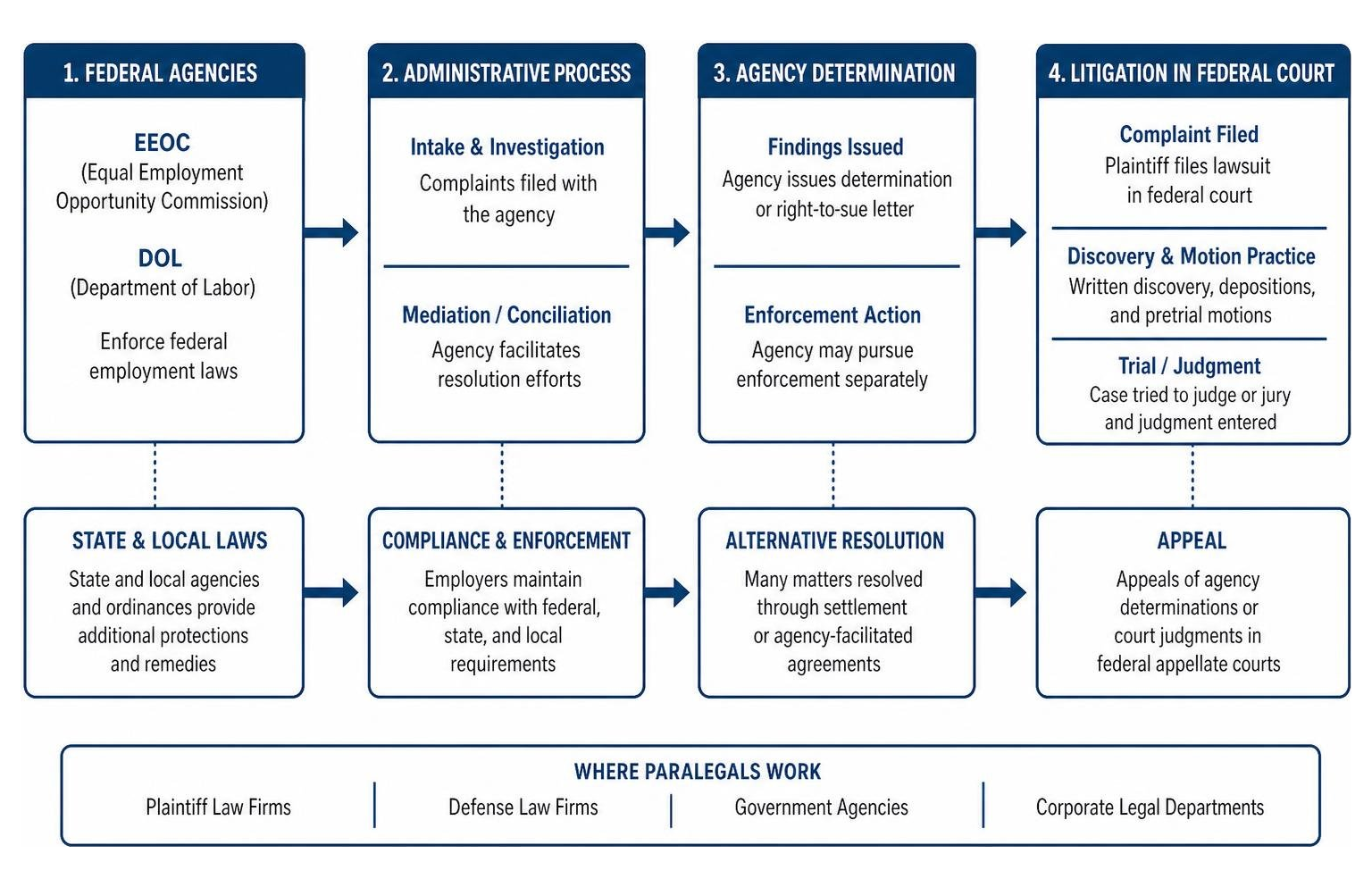
| Governing Agencies | National Labor Relations Board (NLRB) | Equal Employment Opportunity Commission (EEOC), Department of Labor (DOL) |
| Typical Casework | Collective bargaining, union elections, unfair labor practices, grievance arbitrations | Wrongful termination, workplace harassment, wage-and-hour disputes, reasonable accommodations |
| Client Type | Labor unions, unionized workforces, management bargaining teams | Individual employees (plaintiff side) or company leadership (defense/in-house) |
Labor law centers on the collective relationship between organized labor and management. Paralegals in this practice area frequently handle union election filings, compile exhibits for collective bargaining negotiations, track unfair labor practice (ULP) charges before the NLRB, and manage documentation for formal grievance arbitrations.
Employment law focuses on the direct legal relationship between individual workers and their employers. Paralegals in this arena assist with matters such as individual discrimination complaints, retaliatory discharge, failure to accommodate disabilities, and wage disputes. Whether an attorney represents a plaintiff seeking unpaid overtime or defends an employer against a harassment claim, the paralegal acts as the operational engine driving document analysis, witness coordination, and statutory compliance.
Understanding the Paralegal Employment Law Landscape

Workplace regulation is one of the most dynamic sectors of the American legal system. The U.S. Department of Labor administers and enforces more than 180 federal laws, covering millions of employers and workers nationwide. State-level labor agencies and administrative bodies provide additional oversight and regulatory enforcement frameworks that legal professionals must navigate.
Because employment relationships intersect with federal statutes, state regulations, and local ordinances, paralegals must develop a sharp understanding of both administrative procedures and courtroom litigation.
Core Federal Statutes in Paralegal Employment Law
To effectively support an attorney in workplace litigation, a paralegal must be conversant in key statutory frameworks. Understanding these federal acts is essential when learning the broader legal topics covered in paralegal certificate programs:
- Title VII of the Civil Rights Act: Prohibits workplace discrimination and harassment on the basis of race, color, religion, sex, and national origin. Paralegals handle administrative intake, draft EEOC charge documents, and track mandatory administrative deadlines.
- Fair Labor Standards Act (FLSA): Establishes federal standards for minimum wage, overtime eligibility, recordkeeping, and youth employment. Paralegals review detailed timecards, analyze payroll rosters, and quantify back-pay calculations.
- Americans with Disabilities Act (ADA): Guarantees equal opportunity for qualified individuals with disabilities and requires reasonable accommodations. Paralegals track the documented interactive process between employers and employees and review medical certifications.
- Family and Medical Leave Act (FMLA): Entitles eligible employees to take unpaid, job-protected leave for specified family and medical reasons. Paralegal casework involves tracking leave notice periods, intermittent leave records, and return-to-work authorizations.
- Age Discrimination in Employment Act (ADEA): Protects workers aged 40 and older from age-based employment discrimination in hiring, promotion, discharge, and compensation.
Essential Skills for Paralegal Employment Law Success
Excelling in this field requires more than general administrative skills. You must be able to organize complex factual records and safeguard sensitive evidentiary materials:
- Statutory Interpretation and Fact Mapping: Reading complex corporate records against statutory requirements to create clear, chronological timelines of adverse employment actions.
- Litigation Hold Directives: Drafting and tracking formal legal hold notices sent to corporate departments and IT custodians to ensure relevant emails, text messages, and devices are preserved.
- Document Redaction: Ensuring sensitive personally identifiable information (PII), proprietary business information, and protected medical records are redacted prior to public court filings or production.
- Discovery Management: Preparing initial disclosures, drafting responses to interrogatories, coordinating requests for production of documents (RFPs), and assembling detailed privilege logs.
- Electronic Court Filing (ECF): Navigating federal and state court electronic filing portals, ensuring strict adherence to local court rules, formatting requirements, and filing deadlines.
Day-to-Day Responsibilities and Work Environments
The daily workflow of an employment law paralegal moves quickly, demanding high attention to detail and strong organizational discipline. The role balances legal research, client communications, and rigorous litigation support.
When reviewing the 5 typical duties of paralegals, you will see that these core functions become highly specialized in an employment law context. As outlined in our guide on paralegal roles and responsibilities, paralegals act as the vital communication link connecting clients, outside counsel, courts, and agency investigators.
Practice Settings: Plaintiff, Defense, In-House, and Government
Employment law paralegals work across diverse legal settings, each presenting distinct responsibilities and professional goals.

- Plaintiff-Side Law Firms: Focus on representing workers who have experienced discrimination, wage theft, or wrongful discharge. Paralegals conduct extensive client intake interviews, compile emotional distress evidence, calculate unpaid wages, and prepare demand letters.
- Defense-Side Law Firms: Defend corporate clients against workplace lawsuits and agency investigations. Paralegals coordinate with corporate HR departments, interview internal supervisors, manage broad discovery productions, and draft position statements for administrative agencies.
- Corporate Legal Departments (In-House): Support in-house attorneys and corporate leadership with internal HR compliance, policy drafting, risk management, and pre-litigation dispute resolution. Paralegals manage internal investigation files, coordinate legal hold protocols, and track corporate labor metrics.
- Government Regulatory Agencies: Work for municipal, state, or federal agencies such as state labor commissions, the DOL, or the EEOC. Responsibilities include auditing employer records, drafting administrative findings, managing public records requests, and preparing documentation for formal enforcement actions.
To explore how these environments differ from other practice areas, review our overview on the role of paralegals in law firms.
Legal Technology and Remote Work Workflows
Modern employment litigation relies heavily on secure legal technology to process vast amounts of digital evidence, including internal emails, chat logs, timecard data, and HR management systems.
Paralegals utilize specialized tools to build structured evidence systems:
- E-Discovery Platforms: Coordinate digital evidence processing, search indexing, and document review workflows.
- Electronic Filing Portals: Prepare and submit pleadings via federal PACER/ECF platforms and state court systems.
- Data Dashboards and Spreadsheets: Track litigation milestones, legal expenses, settlement ranges, and complex payroll audit calculations.
- Document Automation: Streamline the production of standard litigation documents, such as demand letters, notices of appearance, deposition notices, and standard discovery requests.
Whether working in an office setting or across remote practice models, paralegals must follow strict data security protocols. Handling sensitive personnel records, pay stubs, and medical histories requires strict document retention compliance, multi-factor authentication, and secure client communication channels.
Salary Expectations and Education Pathways
Compensation in the legal field reflects specialized training, geographic market demands, and litigation expertise. As you review our paralegal job description complete guide, you will find that paralegals who master specific procedural skills—such as discovery management, wage-and-hour auditing, and administrative agency procedures—frequently qualify for advanced responsibilities.
Compensation levels vary across sectors:
- Government Agencies: Public-sector roles often offer structured compensation schedules, comprehensive health and retirement benefits, and clear advancement tiers.
- Private Law Firms: High-volume litigation practices reward paralegals who can efficiently manage heavy trial dockets, maintain accurate court calendars, and coordinate complex multi-party discovery.
- In-House Corporate Departments: Senior roles in corporate legal operations often involve managing broad compliance projects, directing outside litigation counsel, and analyzing risk metrics across multiple office locations.
Avoiding Costly Mistakes and Case Risks
Inexperienced staff can inadvertently introduce significant risk into high-stakes employment matters. A successful paralegal helps prevent these common litigation pitfalls:
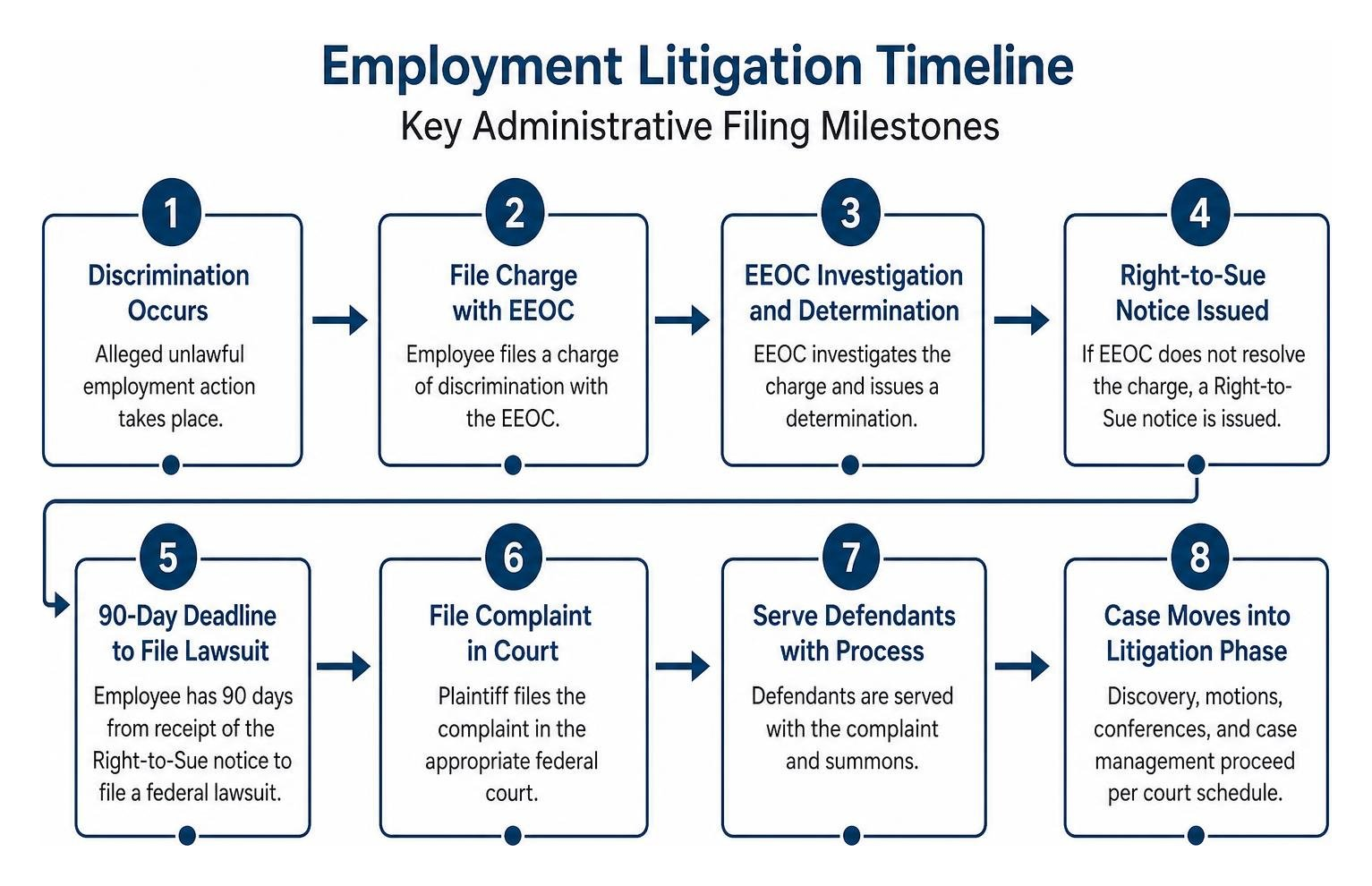
- Missing Strict Administrative Deadlines: Employment claims feature rigid filing windows. For instance, an employee receiving an EEOC Right-to-Sue notice has a strict 90-day window to initiate a federal lawsuit. A calendaring failure can lead to the permanent dismissal of a valid claim.
- Evidence Spoliation: Failing to promptly issue and track legal hold notices to IT custodians can result in the automatic deletion of crucial email threads or internal messages, leading to severe court sanctions.
- Improper Privilege Handling: Inadvertently disclosing confidential communications between human resources and legal counsel during discovery productions can result in a waiver of attorney-client privilege.
- Supervision Rule Violations: Paralegals must work under the direct supervision of a licensed attorney. Paralegals cannot provide legal advice, establish attorney-client fee agreements, or present arguments in court.
How to Launch Your Career Quickly
Adult learners seeking a practical, direct route into the legal field do not need to spend two to four years in a traditional academic program. Legal employers prioritize candidates who possess practical, job-ready skills: drafting pleadings, building discovery indexes, interpreting court rules, and managing electronic filings.
At the Paralegal Institute, we offer an accelerated 15-week paralegal certificate program designed and taught directly by practicing attorneys. Our curriculum focuses entirely on real-world legal training, providing the practical casework skills required for immediate workforce entry. We offer two convenient formats: online with live instruction and in-person classes. Our online format provides real-time, interactive learning directly with legal professionals, delivering a fast, cost-effective, and career-focused alternative to multi-year degree programs.
Frequently Asked Questions About Employment Law Paralegals
What is the difference between an employment law paralegal and a labor law paralegal?
An employment law paralegal primarily assists with disputes between individual workers and their employers, including discrimination claims, wrongful termination, unpaid wages, and leave violations. A labor law paralegal focuses on collective workplace matters, such as labor union organizing, collective bargaining agreements, unfair labor practice charges before the NLRB, and union grievance arbitrations.
What software tools are most important for employment litigation paralegals?
Employment law paralegals regularly use electronic discovery platforms for reviewing large volumes of emails and personnel records, court portals for filing pleadings, spreadsheet applications for auditing payroll data, and document automation systems for assembling standard litigation forms and discovery requests.
Do I need a college degree to work as an employment law paralegal?
No. Many law firms, corporate legal departments, and government agencies hire candidates based on practical litigation skills and a recognized paralegal certificate. An intensive, hands-on certificate program taught by practicing attorneys allows career changers and adult learners to develop job-ready skills and enter the legal field rapidly without the time and expense of a multi-year degree program.
Conclusion
Employment law is a rewarding legal specialty where dedicated support staff make a direct impact on workplace fairness, corporate compliance, and civil rights. As workplace regulations expand and litigation demands increase, attorneys rely heavily on well-trained paralegals to manage discovery, organize evidence, communicate with clients, and safeguard critical case deadlines.
Gaining the required skills does not require years of theoretical coursework. You can learn to interpret statutes, prepare litigation documents, and manage casework through practical training designed by attorneys who actively practice in the field. If you are ready to build a career-ready skill set and enter this dynamic sector, explore how to launch an entry-level paralegal career through our accelerated, practical training programs at the Paralegal Institute.