
Why Medical Records Review Matters to a Legal Case
Medical records review is the careful collection, organization, and analysis of a patient's health records to find facts relevant to a case. In personal injury and medical malpractice matters, it helps a legal team build a treatment timeline, spot missing records, and prepare questions for a medical expert.
A strong review starts with complete records, including notes, test results, and bills. During discovery, a paralegal can organize those documents and flag gaps or conflicts. A qualified medical expert must evaluate clinical questions, such as whether care met the standard of care.
I'm Matthew Pfau, a practicing attorney who has tried personal injury cases and teaches paralegal courses at the Paralegal Institute. My litigation experience shapes my approach to Medical records review: follow the evidence, flag what is missing, and seek medical opinions from qualified experts.
What Is a Medical Records Review in Legal and Clinical Practice?
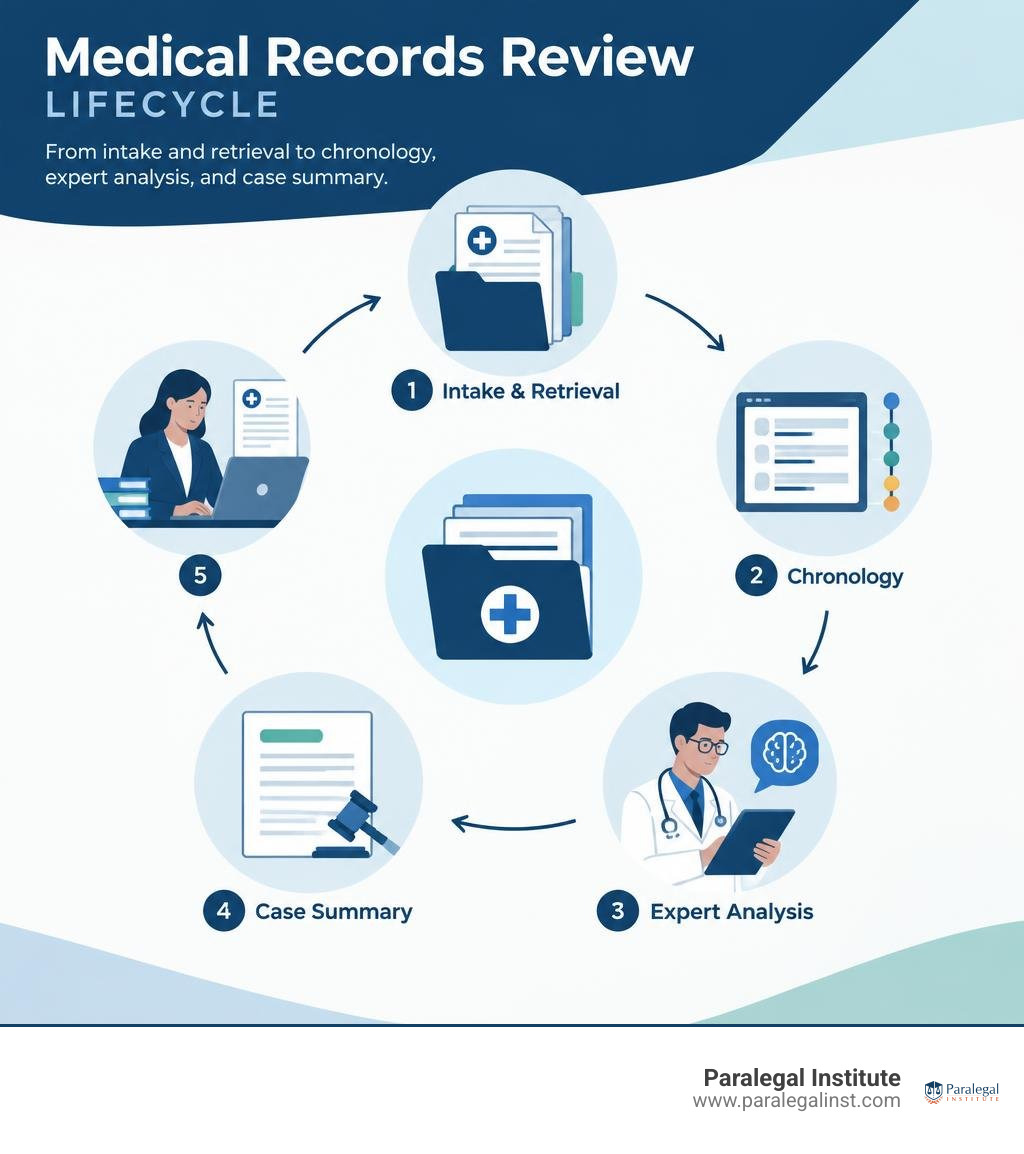
A medical record review is the systematic examination, extraction, and synthesis of documentation generated during patient care encounters. While attorneys rely heavily on this process to establish liability and damages, chart evaluation serves distinct purposes across clinical quality improvement, health insurance risk adjustment, and academic research.
In the legal arena, medical records serve as contemporaneous evidence. They capture real-time observations, vital signs, diagnostic imaging, surgical notes, and treatment plans recorded long before litigation was contemplated. Grounding a claim in objective medical documentation is fundamental to proving duty, breach, causation, and damages under core tort law fundamentals.
Outside the courtroom, healthcare organizations use chart reviews to evaluate standard-of-care adherence, monitor infection rates, and benchmark clinical outcomes against national quality standards. Health plans and provider groups conduct reviews to confirm risk-adjusted diagnostic coding, while clinical researchers abstract protected health information (PHI) to evaluate therapeutic interventions.
| Domain | Primary Objective | Reviewer Focus | Key Regulatory Standard |
|---|---|---|---|
| Litigation | Establish causation, liability, standard of care deviations, and damages. | Treatment chronologies, pre-existing conditions, objective injury findings. | Federal / State Rules of Evidence, HIPAA |
| Clinical Quality | Enhance patient safety and eliminate systemic care delivery errors. | Adverse event triggers, guideline adherence, hospital-acquired conditions. | CMS Conditions of Participation, Joint Commission |
| Risk Adjustment | Validate diagnostic accuracy and capture appropriate patient complexity. | Hierarchical Condition Categories (HCC), MEAT/TAMPER criteria. | RADV Audits, CMS Guidelines, NCD/LCD |
| Clinical Research | Investigate treatment efficacy, epidemiology, and health outcomes. | Protocol-specific data abstraction, inclusion/exclusion criteria. | Common Rule, IRB Protocols, HIPAA Privacy Rule |
Core Objectives Across Litigation, Insurance, and Clinical Settings
In civil litigation—spanning motor vehicle collisions, premises liability, and medical malpractice—the core objective is translating dense clinical narratives into actionable legal proof. A thorough review reveals whether the defendant's conduct directly caused the documented injuries or whether symptoms stem from degenerative, pre-existing pathologies.
In insurance and disability casework, reviews verify medical necessity and functional capacity. Adjusters and defense counsel evaluate whether prescribed interventions—such as extensive spinal surgeries or prolonged physical therapy—align with documented diagnostic objective findings. A skilled healthcare law paralegal bridges the gap between raw clinical entries and statutory compliance, ensuring every line item claimed reflects documented, necessary care.
Who Conducts a Medical Records Review: Roles of Paralegals and Clinical Experts
A successful medical records review requires clear delegation between legal support staff and licensed healthcare professionals:
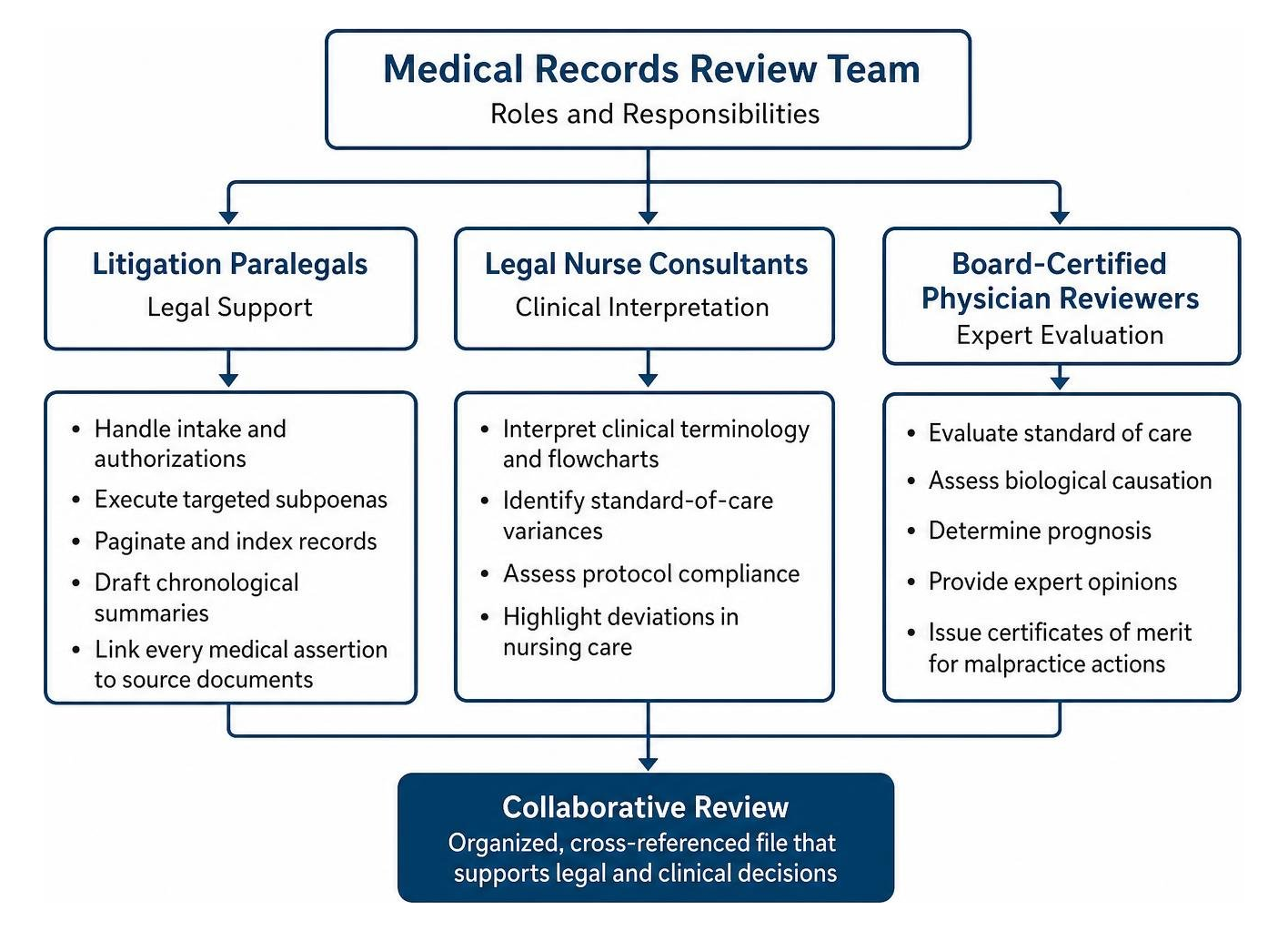
- Litigation Paralegals: Paralegals handle intake, process authorizations, execute targeted subpoenas, paginate and index records, and draft chronological summaries. Mastering personal injury paralegal duties ensures that the legal team works from an organized, cross-referenced file where every medical assertion links directly to Bates-stamped source documents.
- Legal Nurse Consultants (LNCs): Registered nurses bridge clinical terminology and legal strategy. They interpret complex bedside flowcharts, identify standard-of-care variances, assess institutional protocol compliance, and highlight subtle deviations in nursing care.
- Board-Certified Physician Reviewers: Physicians across specialties—including orthopedic surgery, neurology, cardiology, and emergency medicine—evaluate standard of care, biological causation, and prognosis. They provide the expert opinions and certificates of merit required to initiate and sustain complex malpractice actions.
Key Steps in the Medical Records Review Workflow
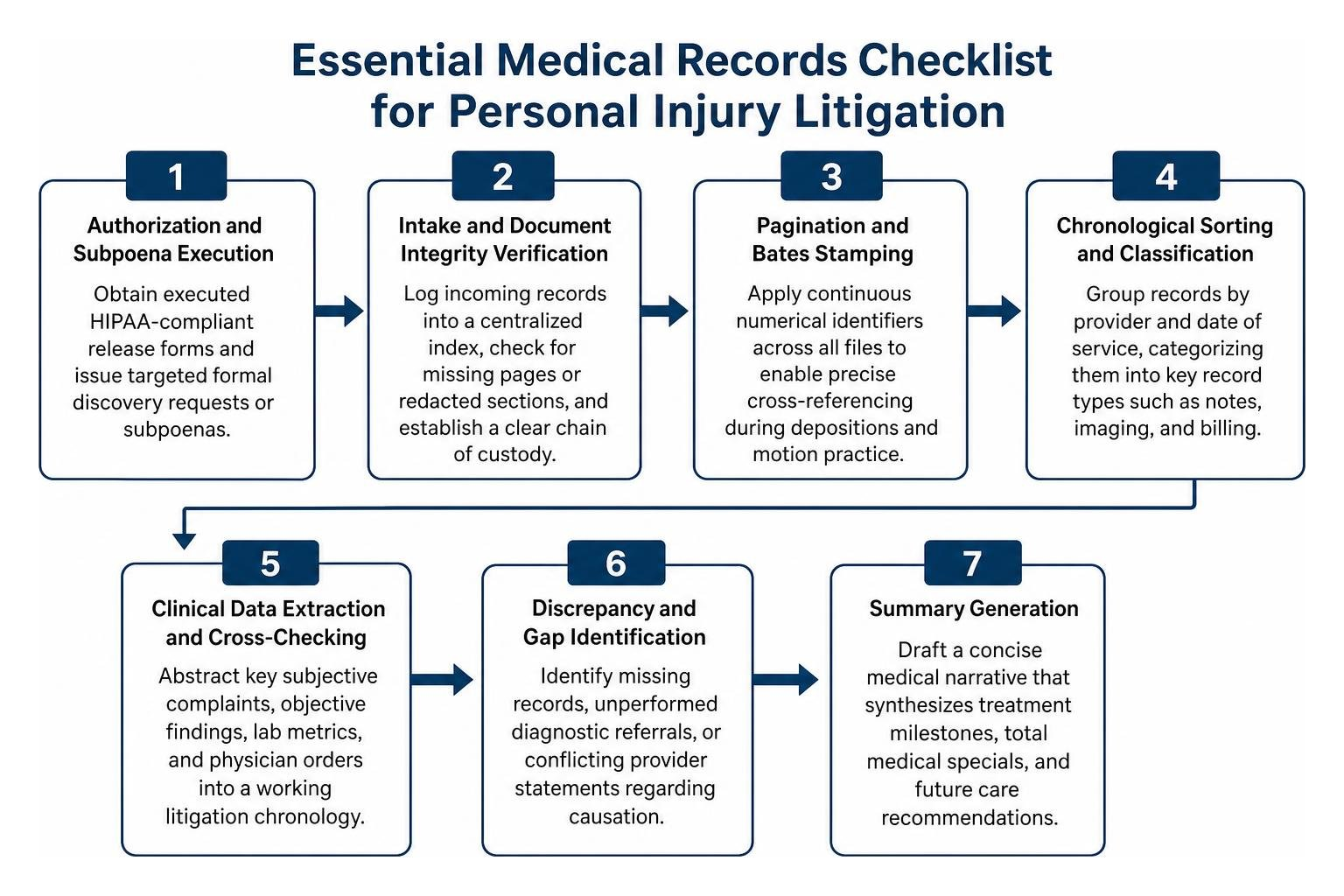
A disorganized stack of electronic health record (EHR) printouts is a liability. Executing a defensible chart evaluation demands a disciplined, step-by-step workflow from initial client intake to final trial preparation.
- Authorization and Subpoena Execution: Obtain executed HIPAA-compliant release forms and issue targeted formal discovery requests or subpoenas to all relevant facilities.
- Intake and Document Integrity Verification: Log incoming records into a centralized index, check for missing pages or redacted sections, and establish a clear chain of custody.
- Pagination and Bates Stamping: Apply continuous numerical identifiers across all files to enable precise cross-referencing during depositions and motion practice.
- Chronological Sorting and Classification: Group records by provider and date of service, categorizing them into emergency transport notes, operative reports, diagnostic imaging, progress notes, and billing ledgers.
- Clinical Data Extraction and Cross-Checking: Abstract key subjective complaints, objective physical examination findings, lab metrics, and physician orders into a working litigation chronology.
- Discrepancy and Gap Identification: Identify missing records, unperformed diagnostic referrals, or conflicting provider statements regarding causation.
- Summary Generation: Draft a concise medical narrative that synthesizes treatment milestones, total medical specials, and future care recommendations for the trial attorney.
During the formal discovery phase, precision is paramount. Overlooking a single primary care record from three years prior can dismantle a personal injury claim if it reveals an undisclosed pre-existing condition.
Record Retrieval, Indexing, and Chronology Development
The backbone of any medical damages claim is the medical chronology. Rather than simply summarizing records sequentially, an effective chronology correlates clinical notes directly with billing entries and objective imaging findings.
To maintain strict evidentiary integrity, paralegals implement standardized evidence management systems. Every entry in the chronology must reference a specific provider, exact date of service, document type, and Bates-stamped page number.
When building this timeline, always match clinical encounters with corresponding billing ledgers. If physical therapy notes show twenty distinct treatment dates, but the itemized billing statement only accounts for fifteen, you must identify and resolve that administrative discrepancy before submitting settlement demands.
Qualitative Analysis and Identifying Gaps or Inconsistencies
Qualitative analysis moves beyond tracking visit dates to scrutinizing what the provider actually documented. Paralegals and attorneys must rigorously differentiate between subjective complaints (what the patient reports) and objective clinical findings (what diagnostic tests, MRI scans, and physical examinations demonstrate).
Using a structured personal injury case checklist, legal professionals inspect the records for red flags:
- Treatment Gaps: Unexplained intervals between medical appointments that insurance adjusters will exploit to argue injury resolution or intervening causation.
- Contradictory Intake Histories: Discrepancies between the mechanism of injury reported to emergency room staff versus statements made during subsequent depositions.
- Late Entries and Addendums: Clinical notes modified days or weeks after an adverse outcome occurred, which may indicate altered documentation.
- Non-Compliance Notes: Documented instances where a patient failed to fill prescribed medications, missed physical therapy sessions, or ignored work restrictions.
Challenges, Reliability, and Regulatory Compliance in Chart Analysis
Evaluating patient charts involves navigating complex, fragmented healthcare documentation. Reviewers must parse narrative ambiguities, incomplete electronic data migrations, and provider-specific shorthand without introducing personal bias or violating federal privacy mandates.
Measuring Reliability: Inter-Rater and Intra-Rater Agreement in Medical Records Review
A critical consideration in retrospective chart analysis is whether different reviewers evaluate the same chart and reach consistent, reproducible conclusions. In research and clinical audit environments, reliability is quantified using Cohen's kappa coefficient, where values between 0.61 and 0.80 indicate substantial agreement ( Ock et al., 2015).
In a landmark clinical research study on adverse event detection reliability, researchers assessed agreement rates across multi-stage record reviews. During the initial screening phase, nurses achieved an 84.2% agreement rate (kappa = 0.68) regarding whether a record warranted second-stage physician evaluation ( Ock et al., 2015). When board-certified physicians conducted secondary adjudications, their agreement regarding the presence or absence of an adverse event reached 93.0% (kappa = 0.71) ( Ock et al., 2015).
To maintain high intra-rater and inter-rater reliability, legal teams and clinical audit programs rely on structured frameworks, such as the HHS OIG Medical Record Review Methodology, which pairs standardized screening tools with formal adjudication criteria.
Navigating HIPAA, Minimizing Bias, and Regulatory Guidelines
Chart analysis must adhere strictly to federal privacy statutes. The HIPAA Privacy Rule limits the use and disclosure of Protected Health Information to the "minimum necessary" required to accomplish the intended legal or operational objective.
When conducting reviews for clinical research, protocols must be submitted to an Institutional Review Board (IRB). Expedited reviews or formal waivers of informed consent are permitted only when studies pose minimal risk and utilize de-identified or coded health data.
In health plan and provider environments, documentation integrity must align with National Coverage Determinations (NCD) and Local Coverage Determinations (LCD). Under industry clinical documentation integrity and compliant query standards, chronic condition documentation must satisfy MEAT (Monitoring, Evaluation, Assessment, Treatment) or TAMPER (Treatment, Assessment, Monitoring, Plan, Evaluate, Referral) criteria. Any physician query regarding ambiguous chart entries must use neutral, non-leading language that provides all clinically supported options without steering the provider toward a higher-paying diagnostic code.
Modern Tools, Technologies, and Financial ROI of Medical Chart Analysis
The volume of modern electronic health records has made manual page-by-page review of thousand-page charts inefficient. Legal practices and healthcare systems increasingly use technology-assisted review tools featuring Natural Language Processing (NLP), Optical Character Recognition (OCR), and automated chronological indexing.

These tools search unstructured clinical text, identify relevant diagnostic codes, flag medication changes, and build draft timelines. However, technology serves as an assistant rather than a replacement for human oversight. An experienced legal professional or clinical specialist must validate all extracted data to ensure accuracy and contextual relevance.
Leveraging AI, NLP, and Pre-Visit Risk Adjustment Workflows
In healthcare administration and risk adjustment operations, prospective pre-visit record reviews generate substantial financial and clinical returns. Identifying undocumented or incorrectly coded chronic conditions before a patient encounter prevents both compliance exposure and lost revenue.
According to industry case studies on risk adjustment coding accuracy, medical practices exhibited an average diagnostic over- or under-coding error rate of 14 percent. In clinical documentation audits:
- Over-coding Errors: Resulted in significant improper risk adjustment payments, creating regulatory exposure during Risk Adjustment Data Validation (RADV) audits.
- Under-coding Errors: Caused substantial lost reimbursements due to missed Hierarchical Condition Categories (HCC).
- Net Financial Impact: Produced a measurable annual bottom-line deficit in potential revenue.
By deploying structured chart reviews prior to clinical encounters, healthcare organizations correct diagnostic coding gaps, ensure regulatory compliance, and stabilize capitated reimbursements.
Frequently Asked Questions About Medical Records Review
What is the primary difference between a clinical audit and a legal medical records review?
A clinical audit evaluates healthcare documentation to improve quality of care, ensure patient safety, and verify billing compliance against institutional or payer standards. A legal medical records review analyzes records as legal evidence to establish liability, prove or disprove proximate causation, evaluate standard-of-care deviations, and quantify past and future damages in litigation.
How long does a thorough medical records review typically take?
Turnaround times vary based on record volume, document complexity, and the number of treatment providers involved. Standard legal and clinical reviews typically require two to four weeks. However, expedited reviews for emergency hearings or imminent statute-of-limitations deadlines can be completed in two to three business days when organized electronic records are available.
What certifications or skills do paralegals need to review medical charts effectively?
Effective chart review requires proficiency in medical terminology, human anatomy, pharmacology basics, and electronic health record structures. Paralegals must understand discovery procedures, Bates stamping, cross-referencing techniques, and medical chronology formatting. Completing a structured legal education program ensures mastery of these practical litigation workflows.
Conclusion
A successful personal injury or medical malpractice case relies on what is documented in the medical records. A thorough medical records review transforms voluminous, confusing medical files into an organized, defensible litigation roadmap. By understanding how to retrieve complete records, build precise chronologies, identify subtle treatment gaps, and coordinate with expert witnesses, legal teams protect their clients' interests and negotiate from strength.
For aspiring legal professionals seeking to enter this growing field, mastering chart review, discovery management, and trial preparation is an invaluable career asset. The Paralegal Institute offers an intensive 15-week paralegal certificate program designed and taught by practicing legal professionals. Delivered either online with live instruction or through in-person classes, our practical, accelerated curriculum prepares career-focused adults for the realities of modern casework. Explore the evolving role of paralegals in law firms and build the hands-on skills required to excel in litigation support.
References
Ock M, Lee SI, Jo MW, Lee JY, Kim SH. "Assessing Reliability of Medical Record Reviews for the Detection of Hospital Adverse Events.." Journal of preventive medicine and public health = Yebang Uihakhoe chi, 2015. PMCID PMC4592027.