
Understanding the Backbone of Modern Legal Practice
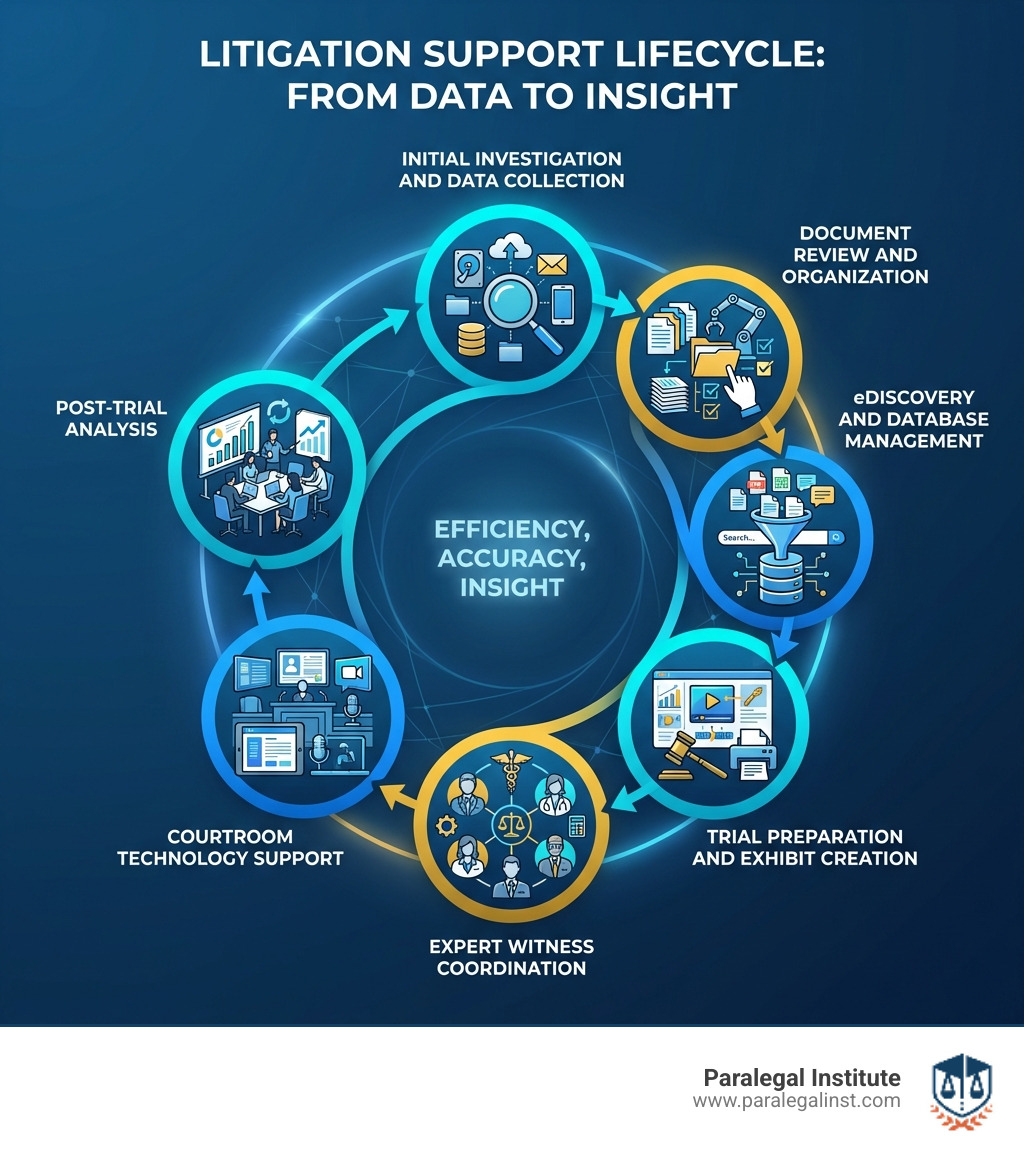
Litigation support is the set of services and professionals that help legal teams manage data, organize evidence, and prepare cases from investigation through trial. It includes tasks like electronic discovery (eDiscovery), document review, database management, trial presentation, and expert witness coordination—all designed to make complex litigation more efficient and effective.
Quick Definition:
- What it is: Services that assist attorneys in managing case data, evidence, and trial preparation
- Core functions: eDiscovery, document management, database creation, trial technology, record retrieval
- Key benefit: Transforms overwhelming volumes of information into organized, searchable case materials
- Who provides it: Litigation support specialists, paralegals, court reporters, project managers, and technology experts
Twenty years ago, litigation support focused mainly on managing paper documents and courtroom presentations. Today, it's fundamentally about handling electronically stored information (ESI). With cases now involving terabytes of digital data—emails, text messages, social media posts, and cloud storage—the field has evolved into a critical component of every complex legal matter. Companies have forensically imaged hundreds of hard drives and processed over 10 terabytes of data in single cases, while firms conduct more than 300,000 depositions annually with global networks of court reporters.
Managing a court case can be a full-time job, especially for large matters involving thousands of documents and multiple witnesses. Busy attorneys don't have time to sort through massive data sets, coordinate expert witnesses, build searchable databases, and create multimedia trial exhibits. That's where litigation support becomes essential. These specialized services free attorneys to focus on legal strategy while trained professionals handle the technical and organizational work that modern litigation demands.
I'm Matthew Pfau, a practicing attorney who has hired and trained numerous paralegals and litigation support professionals throughout my career managing complex cases. At Paralegal Institute, I teach aspiring legal professionals the practical skills needed to excel in litigation support roles within today's technology-driven legal environment.
Defining Modern Litigation Support
In the contemporary legal landscape, litigation support is no longer just about filing papers; it is about the sophisticated management of information. Modern cases are won or lost based on how well a legal team can navigate the sea of data produced during discovery.
For us in the legal field, litigation support encompasses the integration of people, processes, and technology. It ensures the integrity and authenticity of information, particularly electronically stored information (ESI). Whether we are working on a high-stakes corporate dispute or a complex intellectual property case, the goal remains the same: to make data searchable, manageable, and actionable.
Key components of modern litigation support include:
- Data Integrity: Ensuring that evidence is collected and stored in a way that maintains a strict chain of custody.
- Document Retention: Helping clients develop sound programs to preserve relevant data before litigation even begins.
- Legal Workflows: Designing consistent processes that allow attorneys to review evidence without getting bogged down in technical glitches.
| Feature | Traditional Support | Modern Litigation Support |
|---|---|---|
| Primary Format | Paper documents & banker boxes | Electronically Stored Information (ESI) |
| Search Method | Manual reading and tabbing | Keyword search, AI, and analytics |
| Storage | Physical file rooms | Secure cloud databases & extranets |
| Evidence Type | Signed contracts & letters | Emails, Slack messages, GPS data |
| Trial Prep | Foam board blow-ups | Interactive digital presentations |
Core Services and the Role of eDiscovery
When we talk about litigation support, we are referring to a broad umbrella of services. These services are designed to alleviate the burden on legal teams, allowing them to focus on the "law" while the support team handles the "logistics."
Core services often include:
- Legal Research and Drafting: Assisting with the heavy lifting of finding precedents and preparing initial drafts of motions.
- Record Retrieval: Obtaining medical records, financial statements, and business logs from third parties—a task that can be incredibly tedious for an attorney to handle alone.
- Document Review: Utilizing Paralegal Litigation Support to sort through thousands of documents to identify what is "privileged" versus "responsive."
- Deposition Summaries: Condensing hours of testimony into digestible highlights for the trial team.
The Impact of eDiscovery on Litigation Support
eDiscovery has become the cornerstone of litigation support. In fact, in many modern law firms, the two terms are almost used interchangeably. eDiscovery involves the collection, preservation, and review of digital data.
When a single smartphone can hold more data than an entire library, Legal Technology for Paralegals is vital. Professionals in this space use advanced search analytics and metadata—the "data about the data," such as when an email was sent or who BCC’d—to uncover case-changing insights. For example, in a smart car IP litigation case, experts imaged 230 hard drives to extract 10 TB of data, eventually narrowing it down to 2 TB of relevant evidence. This level of precision is only possible with specialized eDiscovery tools.
Trial Presentation and Multimedia Exhibits
The work doesn't stop once the evidence is gathered. Litigation support extends into the courtroom itself. A strong trial presentation can make a lasting impression on a jury.
Today’s litigation support professionals create multimedia exhibits, interactive timelines, and synchronized video transcripts. They manage courtroom technology to ensure that when an attorney says, "Let's look at Exhibit A," the correct document appears instantly on the screen. This seamless integration of technology allows the trial team to maintain their rhythm and persuasiveness.
Key Professionals and Strategic Benefits
Who actually does this work? It’s a team effort involving several specialized roles. By leveraging these experts, law firms see massive efficiency gains and cost savings. Instead of having a highly-paid senior partner spend ten hours searching for a specific email, a Litigation Support Professional can find it in seconds using a database.
The Essential Role of the Litigation Support Professional
The Role of Paralegals in Law Firms has expanded significantly to include these technical duties. A litigation support professional acts as the bridge between the legal team and the IT department.
Their responsibilities include:
- Database Administration: Building and maintaining the repositories where evidence lives.
- Project Management: Ensuring that deadlines for discovery are met and that the workflow stays on track.
- Expert Witness Coordination: Finding and vetting subject matter experts to testify on complex issues.
- Evidence Management: Ensuring Evidence Management Paralegal Success by maintaining the integrity of every file.
Court Reporters and Technology Experts
We also rely heavily on court reporters and technology experts. Court reporters provide verbatim transcripts of depositions and hearings, which are essential for impeachment and trial prep. In international cases, these professionals often provide translation services in over 200 languages.
Technology experts, on the other hand, troubleshoot software like Relativity or Concordance and ensure that the firm’s AI Tools for Paralegals are functioning correctly to identify patterns in massive data sets.
Launching a Career in the Field
If you enjoy technology, organization, and the environment of the legal world, a career in litigation support might be your calling. Law firms in Las Vegas and across the country are constantly looking for staff who can hit the ground running with practical skills.
Essential Skills for Modern Casework
To succeed, you need more than just a general interest in the law. You need Building Practical Skills in Paralegal Training.
Key skills include:
- Technical Aptitude: Proficiency with data management and legal software.
- Attention to Detail: Missing one "hot" document can change the outcome of a case.
- Critical Thinking: Developing Critical Thinking Skills in Paralegal training allows you to look at a data set and understand its strategic value.
- Legal Research: Knowing how to find the right information quickly via a Legal Research Guide for Paralegals.
At Paralegal Institute, we focus on these hands-on skills. Our program is designed by practicing professionals like myself to ensure our students are workforce-ready in just 15 weeks. Compared to traditional academic programs that focus heavily on theory, our accelerated path is a more cost-effective and practical way to enter the legal field.
Frequently Asked Questions about Litigation Support
What is the difference between eDiscovery and litigation support?
Think of litigation support as the "house" and eDiscovery as one of its most important "rooms." Litigation support is the broad term for all services aiding a case (including trial prep and expert coordination), while eDiscovery specifically refers to the process of identifying, collecting, and reviewing electronic data.
When should a law firm consider outsourcing these services?
Law firms should consider outsourcing when a case becomes too complex for in-house staff to handle without being "stretched thin." This is common in class-action lawsuits, intellectual property disputes, or cases involving massive volumes of ESI. Outsourcing to specialized firms can also reduce liability by ensuring experts handle sensitive data.
What qualifications are needed to enter this field?
While some enter with degrees in political science or English, most successful professionals have a paralegal certificate. Technical certifications in specific software (like eDiscovery platforms) are also highly valued. The most important qualification is a combination of legal knowledge and technical proficiency.
Conclusion
Litigation support is the engine that drives modern legal victories. By mastering the tools of eDiscovery, document management, and trial presentation, support professionals allow attorneys to perform at their best. Whether you are a law firm looking to improve efficiency or an individual looking for a career-ready path into the legal field, understanding these services is essential.
At Paralegal Institute, we provide the real-world training necessary to excel in these roles. Our 15-week paralegal certificate program offers live instruction—whether you choose to learn online or in-person at our Las Vegas, NV location. We focus on the practical, hands-on training that law firms actually need, making us the premier destination for those seeking an affordable and accelerated entry into the legal profession.
Start your career with legal support staff training at Paralegal Institute