What Are Paralegal Skills — and Why Do They Matter?
Paralegal skills are the mix of technical knowledge and interpersonal abilities that allow legal professionals to support attorneys, manage casework, and keep a law office running efficiently.
Here is a quick overview of the most essential paralegal skills:
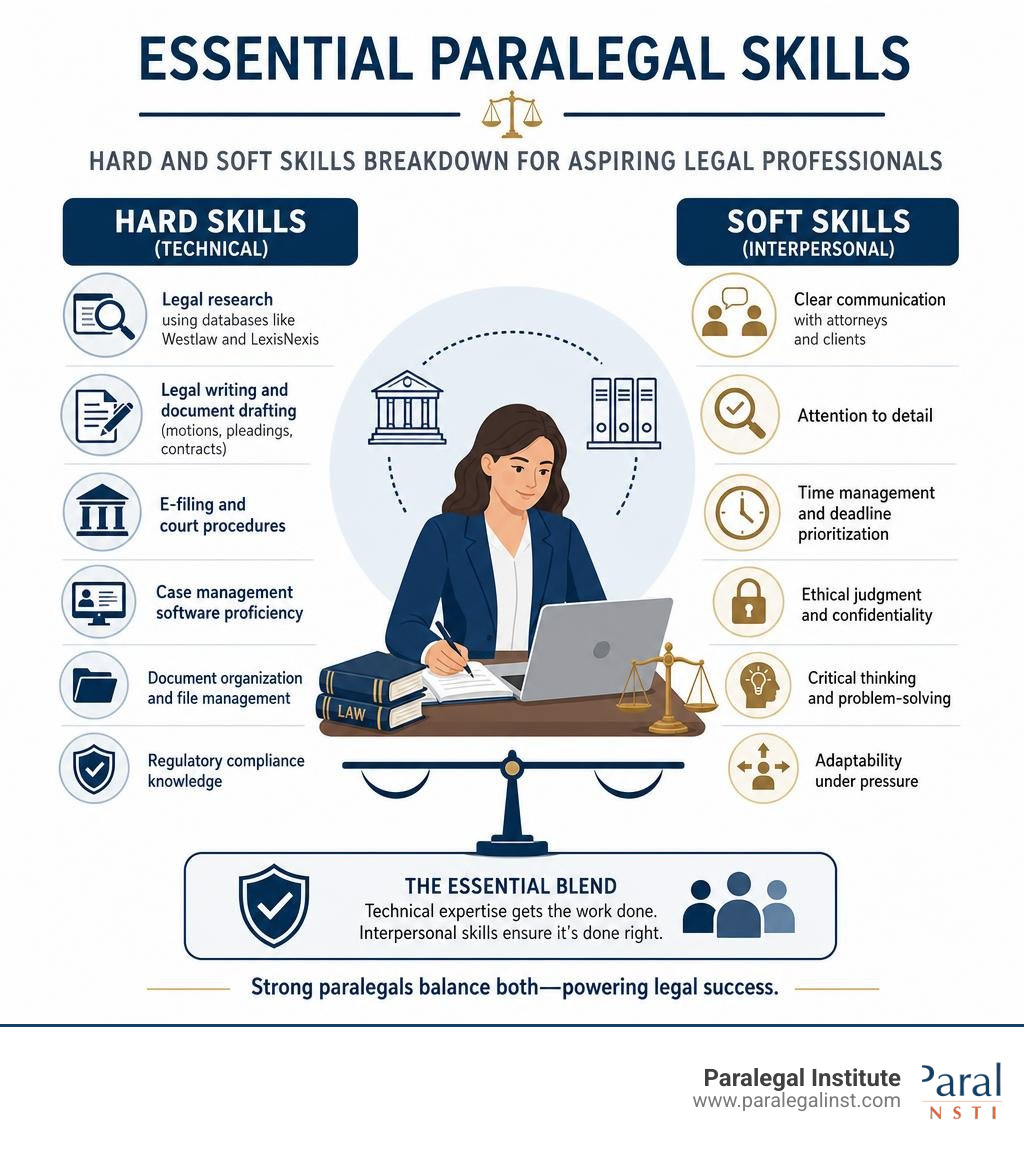
Hard Skills (Technical)
- Legal research using databases like Westlaw and LexisNexis
- Legal writing and document drafting (motions, pleadings, contracts)
- E-filing and court procedures
- Legal technology and document management systems
- Document organization and file management
- Regulatory compliance knowledge
Soft Skills (Interpersonal)
- Clear communication with attorneys and clients
- Attention to detail
- Time management and deadline prioritization
- Ethical judgment and confidentiality
- Critical thinking and problem-solving
- Adaptability under pressure
Whether you are just starting out or looking to sharpen your edge in a competitive job market, the skills you bring to a law firm matter — a lot.
With thousands of annual job openings across the country, the best positions consistently go to the candidates who stand out. That means building the right skills — fast — is more important than ever.
I'm Matthew Pfau, a practicing attorney and educator who has hired and trained numerous paralegals through my law firm. That hands-on experience showed me exactly which paralegal skills separate candidates who get hired from those who don't — and it is the foundation of everything taught at Paralegal Institute.
The Essential Blend of Hard and Soft Paralegal Skills
To succeed in a law office, you cannot rely on technical knowledge alone, nor can you get by solely on a friendly personality. The magic happens at the intersection of hard technical competencies and durable soft skills.
While hard skills allow you to physically execute tasks—such as formatting a brief or navigating an electronic filing portal—soft skills ensure those tasks are executed with strategic intent, emotional intelligence, and flawless ethical compliance.
In our experience representing clients and running busy legal practices in Las Vegas, we find that the best paralegals function as a "second brain" for their supervising attorneys. This level of attorney-paralegal collaboration requires professional adaptability and a proactive mindset. If an attorney is preparing for a high-stakes hearing in the Eighth Judicial District Court of Nevada, they need a partner who can anticipate challenges before they arise, organize evidence seamlessly, and communicate updates to anxious clients with empathy and clarity.
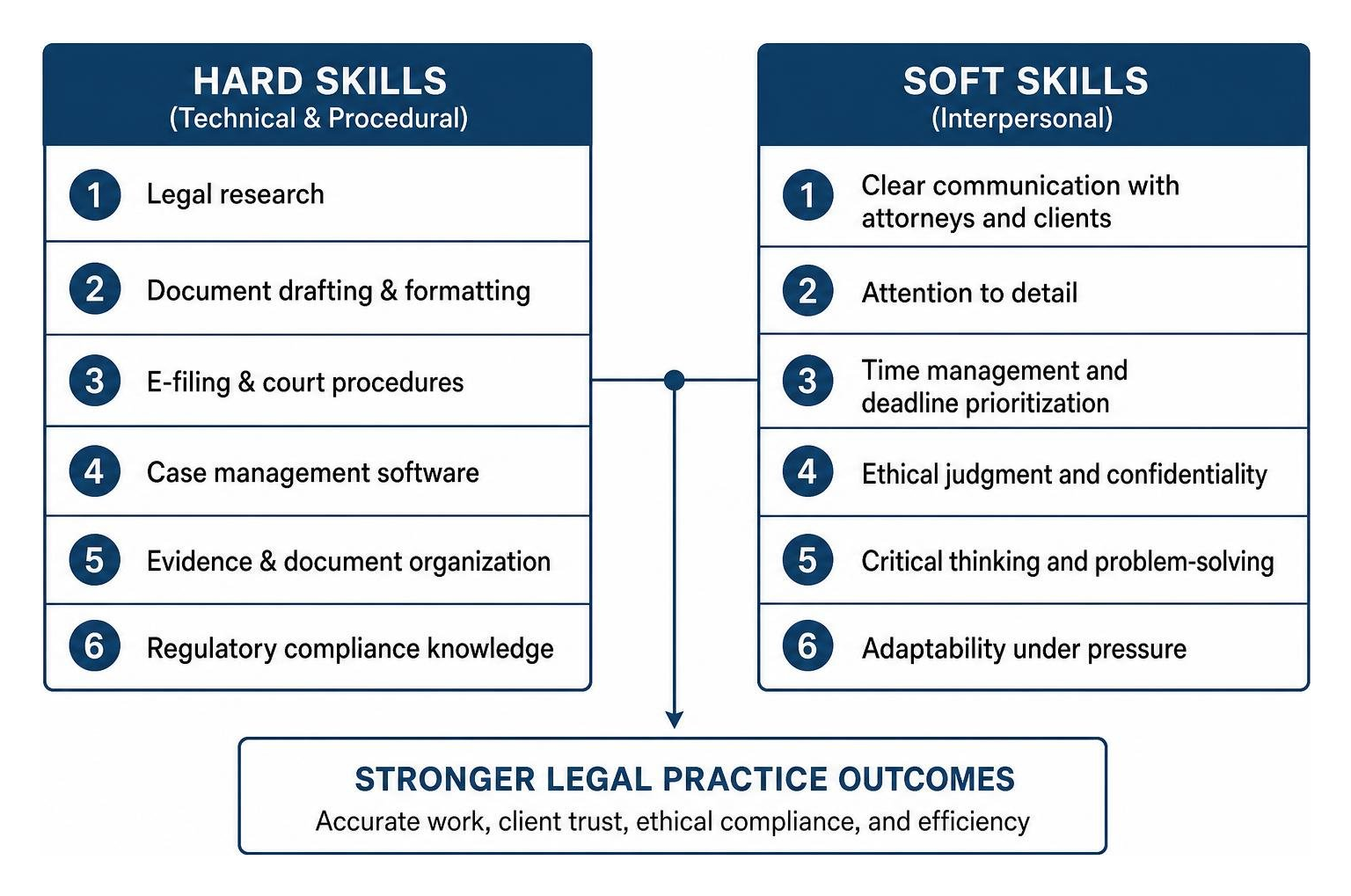
The table below highlights how these two skill sets balance and reinforce one another in daily practice:
| Hard Skills (Technical & Procedural) | Soft Skills (Interpersonal & Behavioral) | Combined Real-World Impact |
|---|---|---|
| Legal Research: Finding relevant Nevada statutes or court rules. | Critical Thinking: Analyzing how a specific precedent applies to a client's unique situation. | The attorney receives a highly persuasive, legally sound draft brief. |
| E-Filing & Court Systems: Navigating local Las Vegas court filing portals. | Composure Under Pressure: Managing tight deadlines without panic when systems run slowly. | Submissions are filed accurately and on time, avoiding costly rejections. |
| Document Drafting: Using templates to draft contracts or pleadings. | Attention to Detail: Spotting tiny inconsistencies or cross-referencing errors. | The firm maintains its professional credibility and avoids malpractice risks. |
| Information Management: Organizing physical and digital trial folders. | Teamwork & Collaboration: Coordinating smoothly with co-counsel and administrative staff. | The litigation team operates like a well-oiled machine during trial. |
By blending these areas, you move from being a simple administrative support worker to an indispensable legal strategist.
Developing Core Technical Paralegal Skills
The foundation of your career rests on your technical toolkit. When a law firm reviews your application, they want to know that you can step in on day one and handle the workload. This means you must understand basic legal procedures, know how to find the law, and know how to process documents through the court system.
To build this technical foundation, you should focus on mastering:
- Legal Research: Knowing how to navigate secondary sources, locate binding statutes, and verify that the case law you are citing is still valid.
- Document Drafting: Understanding the anatomy of common legal documents, including pleadings, motions, discovery requests, and transactional contracts.
- Court Procedures and E-Filing: Learning the logistical steps required to file documents with federal and local state courts, particularly the electronic filing systems used throughout Clark County.
If you want to understand how these technical pieces fit together and how you can begin building them systematically, check out our comprehensive Skills for Paralegal Guide.
Mastering Interpersonal Paralegal Skills
While hard skills get your foot in the door, soft skills are what keep you there and propel you into senior roles. In a law office, you are dealing with people who are often going through some of the most stressful moments of their lives. Whether it is a business owner facing a devastating lawsuit or an individual dealing with a complex family matter, emotional intelligence is vital.
Excellent communication is not just about speaking clearly; it is about active listening. You must be able to listen to a client’s story, strip away the emotional noise, extract the legally relevant facts, and translate complex legal jargon into plain, compassionate language they can understand.
Furthermore, you must maintain unwavering ethical judgment. Because attorney-client privilege extends directly to the work performed by paralegals, maintaining absolute confidentiality is a strict legal mandate. Every document you handle, every phone call you take, and every email you draft must be treated with the highest degree of discretion.
A single oversight—such as failing to redact sensitive personal data or missing a conflict of interest—can derail a case and expose the firm to severe liability. This is why we emphasize the Importance of Attention to Detail in Paralegal Work as a core pillar of professional training.
Essential Technical and Legal Competencies
Modern law offices are highly digitized environments. To stand out, you must go beyond basic computer literacy and develop specialized technological and procedural competencies.
According to Indeed's Guide to Paralegal Skills, top-performing legal assistants are highly self-sufficient, technically savvy, and capable of managing complex document workflows with minimal oversight.

In our day-to-day work, we see four technical areas that demand absolute mastery:
- Docketing and Calendaring: Missed court deadlines are one of the leading causes of legal malpractice lawsuits in the United States. Paralegals must maintain rigorous manual and electronic calendaring systems to track filing deadlines, hearing dates, and deposition schedules.
- Document Preparation and Redlining: When revising contracts or preparing joint filing agreements, you must be skilled in tracking changes, redlining documents, and comparing drafts to ensure no unauthorized modifications slip through.
- E-Filing Portal Navigation: Courts across Nevada and the broader U.S. have transitioned almost entirely to electronic filing. You must understand the specific file size limits, formatting rules, and submission protocols of different jurisdictions to prevent document rejections.
- Compliance and Regulatory Research: Many practice areas require a firm grasp of specific regulatory frameworks, such as healthcare laws, employment regulations, or corporate governance rules.
Legal Research and Citation Mastery
You cannot write a persuasive legal argument without solid research to back it up. Legal research involves a systematic approach to finding, analyzing, and validating the law.
First, you must understand the difference between primary sources of law (such as statutes, constitutions, and judicial opinions) and secondary sources (such as legal encyclopedias, practice guides, and law reviews). Secondary sources are excellent for getting your bearings on an unfamiliar topic, but you must always base your final arguments on binding, primary authority.
Once you find relevant case law, you must perform "cite checking" to verify that the cases have not been overturned, vacated, or limited by subsequent decisions. Finally, you must format your citations in perfect compliance with standard legal citation systems, typically referencing the rules of The Bluebook. Proper citation is not a pedantic exercise; it is a critical marker of professional credibility.
To master these complex research steps, explore our Legal Research Skills Complete Guide.
Document Drafting and Quality Control
Writing in the legal world is entirely different from academic or creative writing. It requires a style that is clear, concise, objective, and highly structured. There is no room for ambiguity. A misplaced comma or an unclear pronoun in a contract can result in devastating financial losses or years of litigation.
As a paralegal, you will draft an array of documents, including:
- Pleadings: The formal documents filed with a court that outline a party's claims or defenses (such as complaints and answers).
- Motions: Written requests asking a judge to make a specific ruling or take a particular action.
- Discovery Requests: Documents used to gather evidence from the opposing party, such as interrogatories and requests for production.
- Transactional Documents: Contracts, settlement agreements, and corporate resolutions.
To ensure quality control, you must develop rigorous proofreading habits. Never rely solely on automated spellcheckers. You must manually review every line, verify that all factual details match the case file, and confirm that all legal citations are accurate.
If you are looking to refine these habits, you can read about Improving Your Legal Writing Skills in Paralegal Courses to see how formal training elevates your drafting precision.
How to Develop and Improve Your Legal Abilities
If you are looking to enter the legal field, you might wonder how you can realistically develop these complex skills. The good news is that you do not need to spend two to four years in a generalized degree program to become job-ready.
While traditional academic institutions often require multi-year commitments, many career-focused adults prefer a more direct, cost-effective route that focuses strictly on practical, real-world skills.
At the Paralegal Institute, we offer an accelerated 15-week paralegal certificate program designed specifically for rapid, high-impact workforce entry. Our curriculum is built and taught by practicing legal professionals who understand exactly what local law firms are looking for.
We teach essential core competencies in a highly practical format, ensuring you spend your time building skills that translate directly to a paycheck.
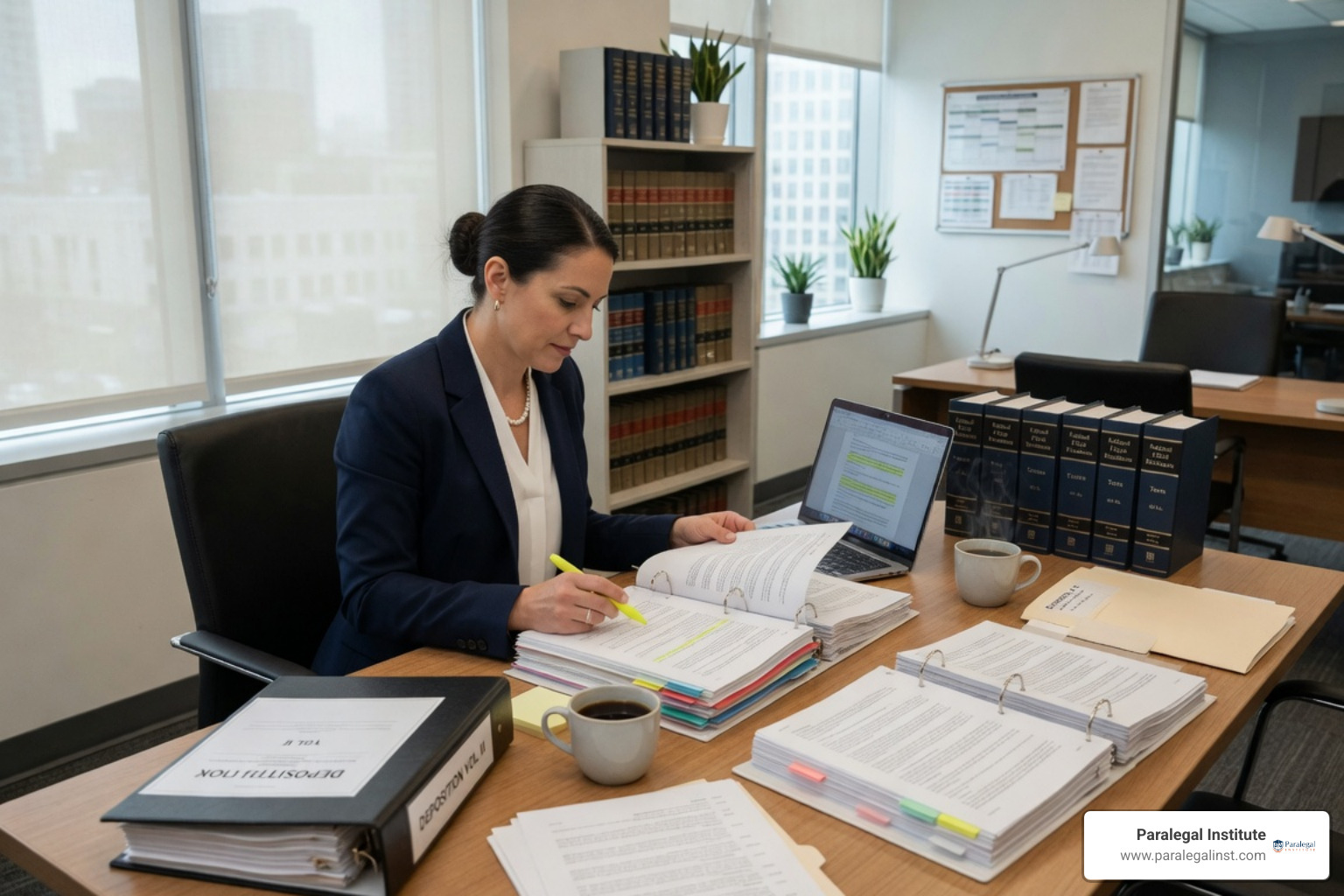
Whether you choose our in-person classes in Las Vegas or our online format with live instruction, you will receive real-time, interactive training. We do not believe in passive learning; our students engage in real-time discussions, ask questions, and receive immediate feedback from experienced attorneys.
Choosing the Right Educational Path
When evaluating your educational options, it is important to consider the return on your investment. Traditional multi-year degree programs require a massive commitment of time and money, and they often focus heavily on theoretical concepts rather than practical application.
An accelerated path, by contrast, focuses strictly on the skills you need to get hired. By stripping away general education requirements and focusing exclusively on practical legal training, you can transition into a new career in less than four months. This makes an accelerated certificate program a smart, affordable investment for adults who want to minimize tuition costs and start earning as quickly as possible.
To learn more about what to look for in a curriculum, check out our insights on Skills on Paralegal Training.
Practical Training and Real-World Application
The best way to learn the law is by doing. You cannot master e-filing or document drafting simply by reading a textbook. You need hands-on practice.
Our program uses active learning methods, including:
- Mock Filings: Preparing and filing mock court documents using simulated electronic court portals.
- Case Studies: Analyzing real-world case files to identify legal issues, draft appropriate responses, and organize evidence.
- Factual Investigations: Practicing witness interviewing techniques and public records requests to locate key information.
By working through these practical exercises, you build the confidence and muscle memory needed to handle real cases on your very first day on the job. To see how we structure these hands-on exercises, read about Building Practical Skills in Paralegal Training.
Frequently Asked Questions
What are the most critical skills for an entry-level paralegal?
For an entry-level paralegal, the most critical skills are absolute attention to detail, strong legal research abilities, and clear, professional communication. Law firms are willing to train you on their specific internal workflows, but they expect you to arrive with a solid understanding of legal terminology, basic document drafting, and a highly organized approach to managing files.
How long does it take to learn essential paralegal skills?
Through our accelerated paralegal certificate program, you can learn all the essential, job-ready skills in just 15 weeks. This fast-track structure is designed to deliver intensive, practical training that allows you to bypass years of general education and enter the legal workforce immediately.
Why is confidentiality so important in paralegal work?
Confidentiality is the cornerstone of the legal profession. Because the attorney-client privilege extends to paralegals, any breach of confidentiality can compromise a case, destroy client trust, and lead to severe legal consequences for both the firm and the supervising attorney. Understanding how to manage sensitive data, avoid conflicts of interest, and maintain strict discretion is a fundamental ethical requirement.
Conclusion
The legal industry in Las Vegas and across the nation is highly competitive, but it is filled with opportunity for those who possess the right practical skills. By mastering a strategic blend of hard technical competencies and durable soft skills, you position yourself as a highly valuable asset to any legal team.
If you are ready to launch your legal career without the time and expense of a multi-year degree, the Paralegal Institute is here to help. Our 15-week paralegal certificate program offers an accelerated, affordable, and highly practical path to your goals. With options for in-person classes in Las Vegas or live, interactive online instruction, you can learn directly from practicing attorneys and graduate with the confidence to succeed from day one.
Take the first step toward a rewarding, career-ready future today. Explore our Skills for Paralegal Guide or contact us to learn more about how we can help you achieve your professional dreams.