Why the Right Legal Training Matters
If you want to enter the legal field quickly, understanding the education needed to be a paralegal is your very first step. While some people spend years in college, you do not actually need a multi-year degree to start working.
Here is a quick breakdown of your options:
- Paralegal Certificate: The fastest, most cost-effective path. It takes just a few months and focuses strictly on practical, job-ready legal skills.
- No Degree / High School Diploma: While technically possible in some states, finding a job without any formal legal training is very difficult today.
The legal world moves fast. Law firms do not want to spend months teaching you how to draft a contract or organize discovery documents. They want you to walk in on day one ready to help. That is why choosing the right educational path is so important.
My name is Matthew Pfau. As a practicing trial attorney and owner of a law firm, I have hired and trained many legal professionals, which has given me deep insight into the exact education needed to be a paralegal to succeed in the real world. I designed the curriculum at the Paralegal Institute to give you a faster, more affordable, and highly practical way to launch your career.
Understanding the Education Needed to Be a Paralegal

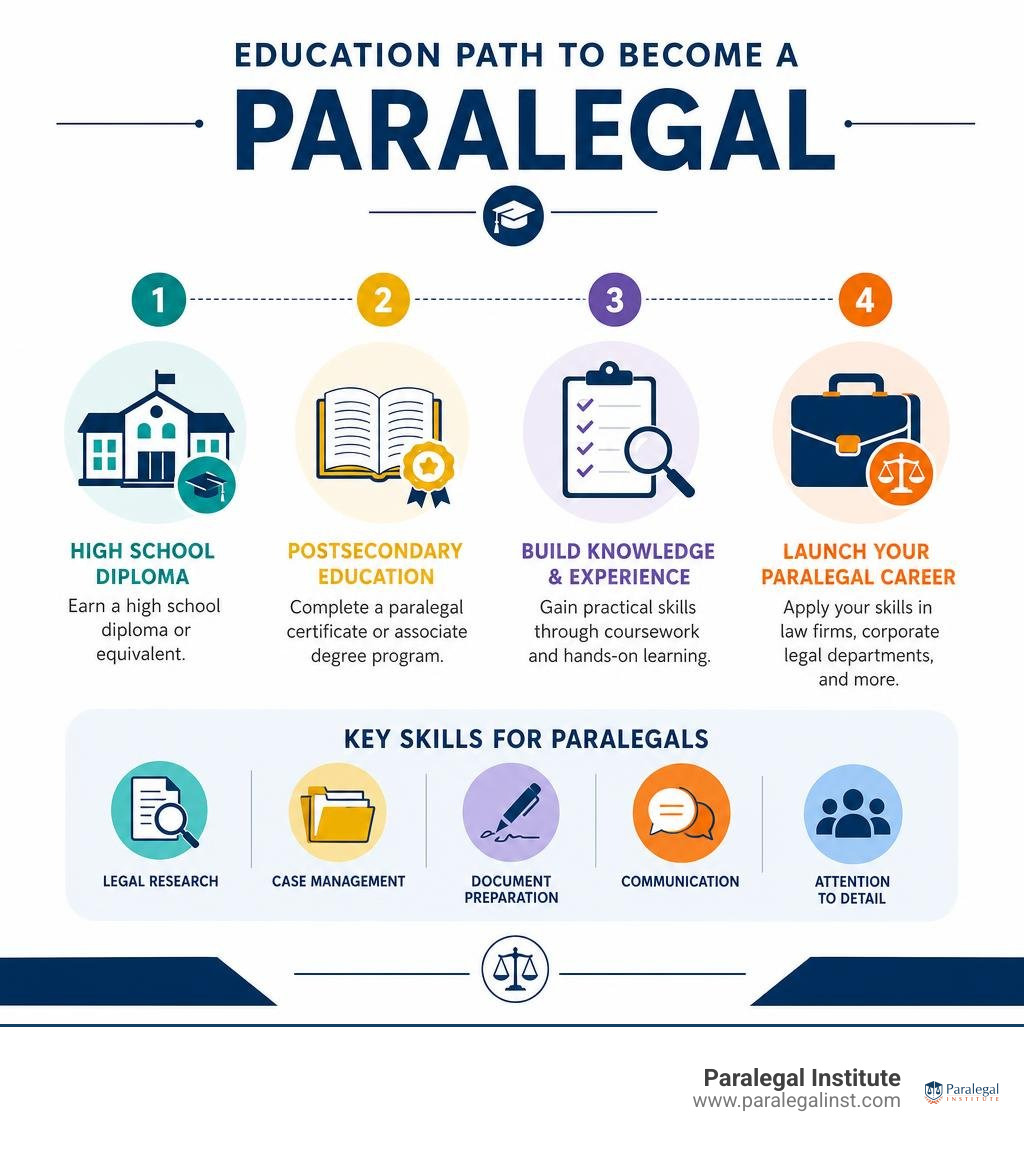
When we look at the legal landscape in July 2026, the expectations for incoming paralegals have shifted toward specialized, job-ready knowledge. While a high school diploma or GED is the absolute baseline requirement to enter any professional training program, law firms rarely hire individuals who possess only a high school education without any specialized training.
The primary pathways to obtaining the necessary credentials include dedicated certificate programs and other specialized training options. Each pathway offers a different approach to teaching legal concepts, and the right choice depends heavily on your current education level, your career goals, and how quickly you want to enter the workforce. For a comprehensive overview of these options, you can explore our Paralegal Education Programs Guide.
To better understand the national standards and how educational programs structure their courses, prospective students can also reference the Educational Information for Paralegals provided by the American Bar Association. This resource outlines how academic institutions structure their curriculums to meet the demands of modern legal environments.
Degree Options vs. Certificate Programs
The most significant distinction in paralegal education is between general academic degrees and professional certificate programs. Academic degrees require students to complete a large number of general education courses. These include subjects like college algebra, English composition, natural sciences, and humanities. While these courses provide a broad academic foundation, they do not directly contribute to your ability to draft a legal brief or manage a litigation file.
In contrast, a paralegal certificate program is designed exclusively around legal specialty courses. There are no general education requirements. Every single class you take is directly applicable to the daily tasks you will perform in a law office. This focused approach allows you to acquire the same core legal knowledge as a degree-holding student but in a fraction of the time. To dive deeper into how these two paths compare, read our Paralegal Certificate or Degree Ultimate Guide.
The Accelerated Certificate Path for the Education Needed to Be a Paralegal
For career changers, busy adults, or recent high school graduates who want to start earning an income quickly, the accelerated certificate path is highly effective. Instead of spending years sitting in general education lectures, certificate students focus entirely on practical training and job readiness.
At the Paralegal Institute, we have designed our program specifically around this accelerated model. Our 15-week paralegal certificate program is built and taught by practicing legal professionals, ensuring that every lesson translates directly to real-world casework. By stripping away the academic filler, we help you master legal research, document drafting, and litigation preparation in under four months. You can learn more about how these programs operate by reading our Paralegal Certificate Programs Complete Guide.
Comparing Paralegal Degrees and Certificate Programs

Choosing between a degree and a certificate requires a careful look at your personal timeline, financial resources, and career aspirations. While some large corporate law firms or government agencies occasionally list a degree as a preferred qualification, the vast majority of law firms prioritize practical ability and real-world skills over a multi-year degree.
If you already hold a degree in another field, such as psychology, criminal justice, or English, obtaining a paralegal certificate is almost always the smartest move. It allows you to combine your existing education with specialized legal training, making you highly competitive in the job market without forcing you to earn an entirely new degree. For more insights on this topic, check out our guide on Do You Need a Degree to Be a Paralegal.
To help you visualize the differences, we have compiled a comparison of the primary educational pathways:
| Feature | Certificate Program | Multi-Year Degree Program |
|---|---|---|
| Average Time to Complete | 15 weeks | 2 to 4 years |
| General Education Required | None | Extensive general education credits |
| Focus of Curriculum | 100% Practical Legal Skills | Mix of General Ed & Legal Theory |
| Ideal Candidate | Career changers, busy adults | Individuals wanting a traditional college experience |
| Cost-Effectiveness | High (fast entry, lower tuition) | Low (high tuition and opportunity cost) |
Multi-Year Degrees in Legal Studies
Multi-year degrees in Paralegal Studies typically require a significant commitment of time and resources. These programs are often offered by colleges and universities and require a mix of general education and basic legal courses.
While a multi-year degree provides an extensive academic background and can serve as a stepping stone if you plan to attend law school in the future, it represents a massive investment of time and money. For many aspiring legal professionals, spending years in school before earning an income is simply not practical. You can read more about degree structures in our Paralegal Degree Guide 2026.
Why a Certificate is Often the Best Education Needed to Be a Paralegal
For the vast majority of students, a certificate program provides the most efficient return on investment. It acts as a fast-track option that respects your time and financial resources. Because the curriculum is highly concentrated, you do not lose momentum. You learn the law, practice the skills, and enter the job market while a degree student is still completing their first-year general education requirements.
This is especially true for those who do not currently hold a college degree but want to build a professional career. A well-structured certificate program provides the exact technical training employers look for, proving that you have the drive and competence to handle complex legal tasks. For a detailed breakdown of how to succeed via this route, see our guide on the Paralegal Certificate No Degree Best Path.
Core Curriculum and Practical Skills in Paralegal Programs
Regardless of the educational pathway you choose, the core curriculum must focus on the actual work you will perform under attorney supervision. In a high-quality program, you will not just read about the law; you will actively draft documents, analyze case law, and learn how to manage a case file from start to finish.
To ensure you are fully prepared for employment, we recommend seeking out programs that emphasize hands-on training in core practice areas. You can explore the specific courses we offer by visiting our Paralegal Studies Certificate page.
Essential Legal Coursework
A robust paralegal education must cover several foundational areas of substantive and procedural law:
- Legal Research and Writing: Learning how to locate relevant statutes, administrative regulations, and judicial opinions using online legal databases, and translating that research into clear, persuasive legal memoranda.
- Civil Litigation: Understanding the lifecycle of a lawsuit, including drafting complaints, answers, motions, and managing the discovery process (such as interrogatories and requests for production).
- Contracts and Torts: Mastering the elements of enforceable agreements and the laws governing personal injury, negligence, and civil wrongs.
- Legal Ethics: Understanding the strict ethical boundaries of the legal profession, including the unauthorized practice of law, client confidentiality, and conflict of interest rules.
When comparing educational options, it is important to distinguish between a general criminal justice degree and a dedicated paralegal program. While criminal justice programs focus on the broader law enforcement and penal systems, they do not teach the practical civil litigation and drafting skills required in a law office. For a detailed comparison, read our article on Criminal Justice Degree vs Paralegal Certificate.
The Value of Live Instruction and Real-World Training
One of the biggest pitfalls of modern online education is the "self-paced" model, where students are left to read textbooks and take automated quizzes on their own. In the legal profession, this approach rarely works. The law is nuanced, interactive, and highly collaborative.
At the Paralegal Institute, we believe that live instruction is vital to your success. Whether you choose our in-person classes in Las Vegas, NV, or our online format, you will experience live instruction with real-time learning. This allows you to ask questions, engage in debates, and receive direct feedback from practicing attorneys who understand the daily realities of the legal market. This real-world training ensures that you graduate with confidence, ready to handle real casework immediately. To learn more about the differences in training delivery, see our guide on Paralegal Certificate and Degree Programs.
Frequently Asked Questions About Paralegal Education
Do paralegals need a law degree or to pass the bar exam?
No. Paralegals do not need a law degree, nor do they take the bar exam. A law degree (Juris Doctor) and the bar exam are strictly required for attorneys who wish to practice law independently.
Paralegals perform substantive legal work, but they must always work under the direct supervision of a licensed attorney. Under American legal ethical standards, paralegals cannot provide legal advice directly to clients, set legal fees, or represent clients in a court of law.
How long does it take to complete paralegal training?
The timeline depends entirely on the pathway you select:
- Our Accelerated Certificate Program: 15 weeks of intensive, focused training.
- Traditional Certificate Programs: 6 months to 1 year.
- Multi-Year Degree Programs: 2 to 4 years of full-time college enrollment.
If your goal is to transition into a new career quickly without taking on years of school, our 15-week program is designed to get you job-ready in the shortest time possible.
Are there specific state regulations for paralegals?
Most states do not have mandatory licensing or registration requirements for paralegals, meaning that individual employers set their own educational standards. However, there are a few notable exceptions:
- California: California directly regulates the profession under Business and Professions Code Section 6450, which mandates specific educational minimums (such as a certificate from a qualified program or a degree) and continuing education to use the title "paralegal."
- Nevada: In Las Vegas and throughout Nevada, there are no state-mandated licensing requirements to work as a paralegal under attorney supervision. However, local law firms maintain high standards and strongly prefer candidates who hold a formal paralegal certificate. Nevada also regulates independent "legal document preparers" who assist the public directly with basic forms without attorney supervision, which is a separate registration process.
Conclusion
Finding the right education needed to be a paralegal does not have to mean spending years in a college classroom or taking on massive debt. By choosing a practical, career-focused program, you can acquire the exact skills that law firms are actively looking for in July 2026.
At the Paralegal Institute, we are committed to helping you launch your legal career as quickly and affordably as possible. Our 15-week paralegal certificate program—available both online with live instruction and in-person at our Las Vegas, NV location—is a smart investment in your future. Taught by practicing legal professionals, our curriculum focuses on real-world legal writing, research, and casework to ensure you are job-ready from day one.
Ready to take the next step? Explore our comprehensive guide on What Training is Required to Be a Paralegal and start your journey toward a rewarding legal career today.