Why Every Paralegal Must Master the Discovery Process
The paralegal discovery process is one of the most critical — and demanding — phases of civil litigation. It is the stage where both sides exchange evidence, build their case strategies, and lay the groundwork for trial.
Here is a quick overview of what paralegals do during discovery:
| Discovery Task | Paralegal's Role |
|---|---|
| Interrogatories | Draft written questions; review opposing responses |
| Requests for Production | Request and organize documents; apply Bates labels |
| Requests for Admission | Draft and respond to written admissions |
| Depositions | Coordinate logistics; prepare summaries |
| E-Discovery | Collect and review electronic files; preserve metadata |
| Deadline Management | Track due dates; maintain compliance calendars |
| Privileged Materials | Identify, log, and protect attorney-client communications |
Discovery is not just paperwork. It is the only route to gather all the facts needed to build a trial-ready case file. Over 90% of documents produced in litigation today are electronic — which means paralegals need sharp organizational skills, knowledge of digital evidence, and a firm grasp of court rules.
Miss a deadline, send a vague response, or overlook a privileged document — and the consequences can include sanctions, lost evidence, or even case dismissal.
I'm Matthew Pfau, a practicing attorney and founder of Paralegal Institute, where I train aspiring paralegals to handle real-world litigation tasks — including the full paralegal discovery process — with confidence and precision. My years of courtroom experience and hands-on paralegal training have shown me exactly where new paralegals struggle in discovery, and this guide will help you avoid those pitfalls from day one.
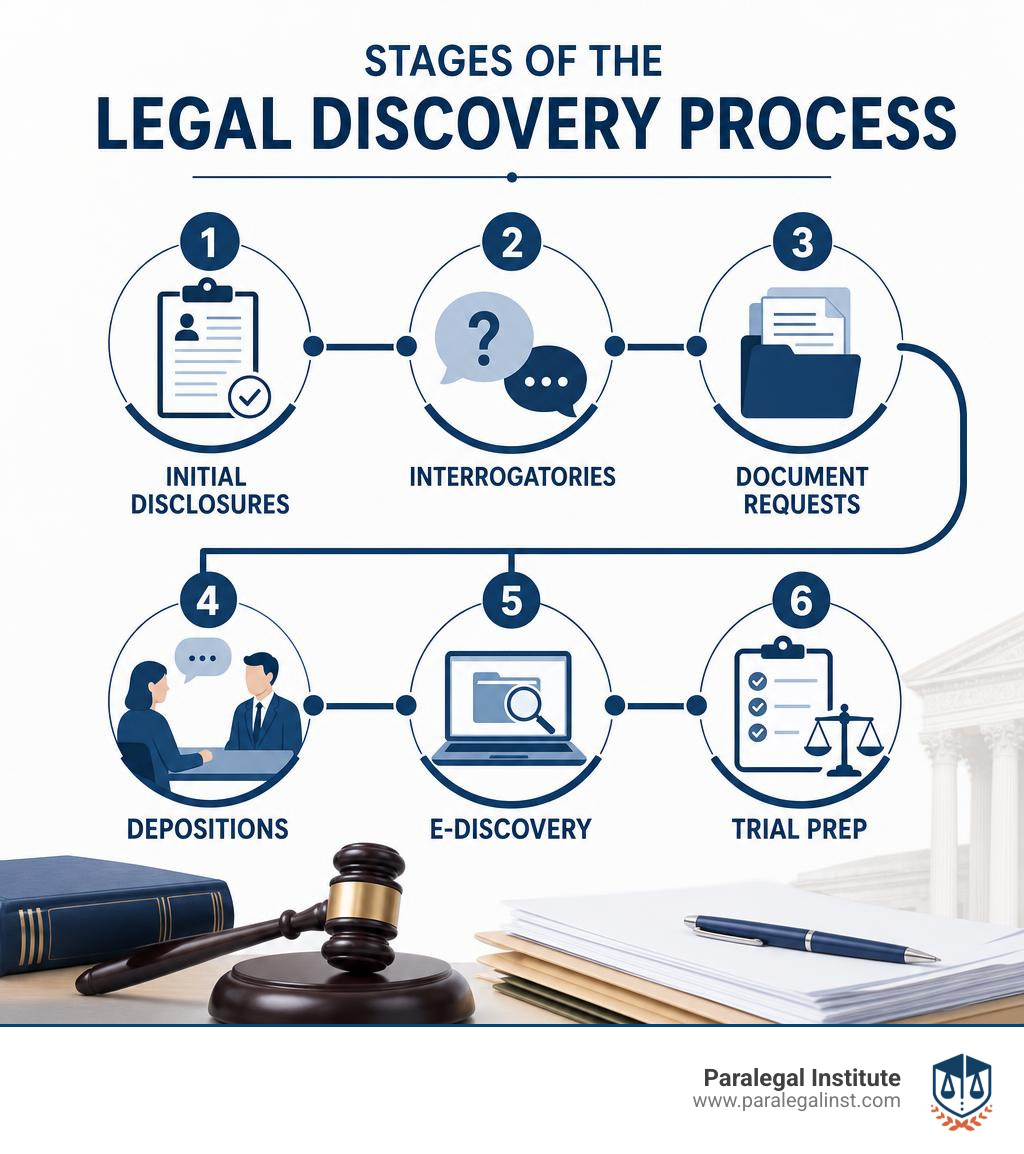
Understanding the Paralegal Discovery Process and Its Importance
Discovery is the formal fact-finding phase of litigation. In simple terms, each side asks the other side for information, documents, admissions, testimony, and evidence that relate to the claims and defenses in the case.
Cornell Law School defines discovery as the pretrial process where parties obtain evidence from one another. For paralegals, that definition becomes a daily workflow: tracking requests, gathering documents, drafting responses, organizing evidence, protecting privileged materials, and helping attorneys prepare for depositions, motions, settlement, and trial.
Discovery matters because it helps the legal team:
- Understand what actually happened
- Evaluate the strengths and weaknesses of the case
- Identify key witnesses and documents
- Avoid surprise evidence at trial
- Narrow disputed issues
- Prepare settlement strategy
- Build trial exhibits and witness outlines
A strong discovery paralegal is not just “helping with paperwork.” We are helping transform scattered facts into usable legal evidence. That is why discovery is one of the most important areas for anyone asking, What Does A Paralegal Do?
In practice, paralegals often become the organizational center of the litigation team. Attorneys may decide legal strategy, but paralegals keep the discovery engine from catching fire. And yes, without a good tracking system, that engine will absolutely start smoking.
The Four Primary Discovery Tools and How to Use Them

Most civil discovery involves four core tools:
- Interrogatories
- Requests for Production
- Requests for Admission
- Depositions
Each tool serves a different purpose. A skilled paralegal understands not only what each tool is, but how it fits into the broader discovery plan.
| Discovery Tool | What It Does | Paralegal Use |
|---|---|---|
| Interrogatories | Written questions answered under oath | Draft, organize, review, summarize |
| Requests for Production | Requests for documents, records, data, or physical items | Collect, review, label, produce |
| Requests for Admission | Statements the other party must admit or deny | Draft precise statements; track responses |
| Depositions | Live sworn testimony before trial | Schedule, prepare exhibits, summarize testimony |
For more on how evidence is organized and preserved, see our guide to Evidence Management Paralegal Success.
Drafting Interrogatories and Requests for Production in the Paralegal Discovery Process
Interrogatories are written questions sent to another party. They are answered in writing and usually signed under oath. In federal court, interrogatories are generally limited to 25, including discrete subparts, unless the court allows more.
Paralegals may help draft interrogatories by reviewing:
- The complaint and answer
- Affirmative defenses
- Prior correspondence
- Incident reports
- Medical records
- Contracts
- Photos, videos, and electronic evidence
- Prior discovery responses
Good interrogatories are specific. Weak interrogatories are vague, overbroad, or confusing. A good request asks for useful information in a way that can be answered and enforced.
Weak example:
“State all facts about the case.”
Better example:
“Identify each person who witnessed the collision on March 3, 2026, including each person’s name, last known address, telephone number, and a summary of the facts known by that person.”
Requests for Production, often called RFPs, ask for documents, electronically stored information, tangible items, photos, videos, reports, contracts, emails, text messages, and similar evidence.
A strong RFP should define:
- The relevant time period
- The subject matter
- The document categories
- The parties or accounts involved
- The requested format for electronic files, when appropriate
For example:
“Produce all emails, text messages, photographs, videos, repair records, and incident reports relating to the subject vehicle collision from January 1, 2026, through May 31, 2026.”
That is much easier to enforce than “produce all relevant documents,” which sounds simple but often creates avoidable objections.
Templates can help, but they should never replace legal judgment. We teach students to use forms as a starting point, then tailor each request to the facts of the case. For practical drafting resources, visit Templates And Tools In Paralegal.
Managing Requests for Admission and Depositions
Requests for Admission, or RFAs, ask a party to admit or deny specific statements. They are powerful because they narrow the issues.
Examples include:
- “Admit that Defendant owned the vehicle involved in the collision.”
- “Admit that the contract attached as Exhibit A is authentic.”
- “Admit that Plaintiff received medical treatment on April 12, 2026.”
Paralegals help by drafting clear statements, tracking responses, and flagging denials that conflict with documents or testimony.
Depositions are different. A deposition is sworn testimony taken before trial, usually recorded by a court reporter and sometimes by video. Paralegals may not take depositions unless authorized by law, but they play a major support role.
Common deposition tasks include:
- Scheduling the date, time, and location
- Coordinating with witnesses, attorneys, court reporters, and videographers
- Preparing deposition notices and subpoenas
- Organizing exhibits
- Creating witness folders
- Reviewing prior discovery responses
- Preparing deposition summaries
- Tracking follow-up requests after testimony
A good deposition binder or digital folder should include pleadings, key records, prior statements, relevant photos, discovery responses, and a clean exhibit list. The attorney asks the questions, but the paralegal helps make sure the attorney has the ammunition.
For more on how paralegals support discovery preparation, see The Role of Paralegals in Discovery Preparation.
Managing Deadlines, Calendars, and Compliance

Discovery is deadline-heavy. If you enjoy calendars, reminders, checklists, and color coding, litigation may be your happy place. If not, it will teach you quickly.
Paralegals often track:
- Initial disclosure deadlines
- Written discovery response deadlines
- Deposition dates
- Expert disclosure deadlines
- Rebuttal expert deadlines
- Discovery cutoff dates
- Motion to compel deadlines
- Supplementation deadlines
- Court-ordered production dates
In many civil cases, written discovery responses are due within a set number of days after service. The exact deadline depends on the court rules, jurisdiction, method of service, and any court order. Paralegals must confirm the applicable rule rather than guessing.
Best practices include:
- Calendar the deadline the day discovery is received
- Calendar internal reminders before the actual deadline
- Confirm whether weekends or court holidays affect the due date
- Track extensions in writing
- Save proof of service
- Use a master discovery chart
- Notify the attorney early if responses are incomplete
- Follow up with clients before the deadline becomes an emergency
A discovery tracker should show:
| Item | Example |
|---|---|
| Date received | May 5, 2026 |
| Requesting party | Plaintiff |
| Type of discovery | Interrogatories and RFPs |
| Response deadline | Confirmed under applicable rule |
| Attorney assigned | Supervising attorney |
| Client materials needed | Emails, photos, medical records |
| Status | Drafting, attorney review, served |
| Deficiencies | Missing documents, objections needed |
Missing discovery deadlines can lead to motions to compel, sanctions, evidence exclusion, or other serious consequences. That is why deadline management is not administrative fluff. It is risk management.
For broader workflow guidance, see Paralegal Case Management.
E-Discovery, Bates Labeling, and Document Review
E-discovery is the process of identifying, preserving, collecting, reviewing, and producing electronically stored information, often called ESI.
ESI may include:
- Emails
- Text messages
- PDFs
- Word documents
- Spreadsheets
- Photos and videos
- Social media content
- App messages
- Cloud files
- Database exports
- Metadata
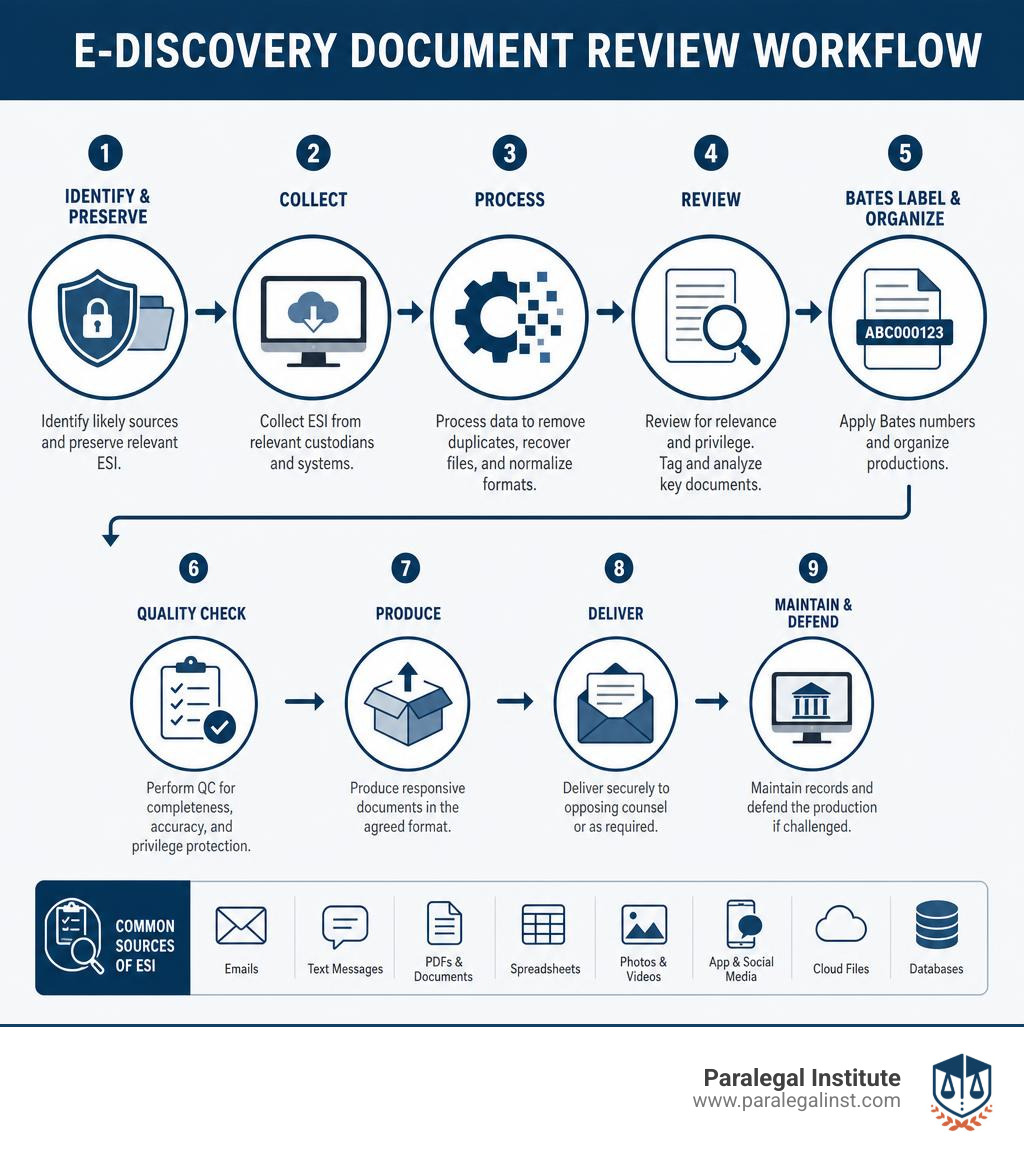
Modern discovery is overwhelmingly digital. Over 90% of produced documents are now electronic, and e-discovery can account for a major share of litigation costs in document-heavy cases. That means paralegals must understand how to organize digital evidence without accidentally altering it.
Key e-discovery tasks include:
- Identifying likely sources of electronic evidence
- Sending preservation reminders under attorney supervision
- Collecting files from clients in an organized way
- Maintaining original file integrity
- Avoiding unnecessary changes to metadata
- Sorting documents by source, date, issue, and witness
- Flagging duplicates
- Preparing documents for attorney review
- Applying Bates labels
- Redacting confidential or privileged information when approved
Bates labeling assigns a unique number to each page or document in a production. For example:
DEF000001
DEF000002
DEF000003
These labels make it possible to identify the exact document during depositions, motions, settlement negotiations, and trial. Without Bates labels, everyone ends up saying, “You know, that one email from March?” That is not a litigation strategy. That is a group project gone wrong.
Paralegals should also maintain a production log showing:
- Bates range
- Document description
- Source
- Date produced
- Producing party
- Receiving party
- Confidentiality designation
- Redactions
- Privilege status
- Notes for follow-up
For more on technology-supported litigation work, visit Litigation Support Complete Guide.
Identifying and Logging Privileged Materials
Not every relevant document should be produced. Some materials may be protected by attorney-client privilege, the work product doctrine, privacy rules, protective orders, or confidentiality obligations.
Attorney-client privilege generally protects confidential communications between attorney and client made for the purpose of seeking or giving legal advice.
Work product protection generally protects materials prepared by or for attorneys in anticipation of litigation.
Paralegals must learn to spot possible privileged materials, such as:
- Emails between attorney and client
- Attorney notes
- Legal strategy memos
- Draft pleadings with attorney comments
- Internal litigation evaluations
- Communications discussing legal advice
- Expert consulting materials, depending on the rules and circumstances
When privileged documents are withheld, the legal team may need to prepare a privilege log. A privilege log usually identifies the document without revealing the protected content.
A basic privilege log may include:
| Field | Purpose |
|---|---|
| Date | Shows when the document was created |
| Author | Identifies who created it |
| Recipient | Shows who received it |
| Document type | Email, memo, letter, note |
| General subject | Describes topic without revealing legal advice |
| Privilege claimed | Attorney-client, work product, or other protection |
Paralegals should never make final privilege decisions alone. The correct process is to flag questionable documents for attorney review. When in doubt, do not produce first and ask questions later. Privilege mistakes are hard to unring, much like sending a text to the wrong group chat, except with court consequences.
For related litigation support duties, see Paralegal Litigation Support.
Ethical Considerations and Best Practices for Paralegals
Ethics are not separate from discovery. They are built into every discovery task.
Paralegals must understand:
- Confidentiality obligations
- Attorney supervision requirements
- Unauthorized practice of law limits
- Duties related to honest and complete responses
- Proper handling of privileged materials
- Secure treatment of client documents
- Technology competence
- Conflicts and confidentiality screens
- The need to preserve evidence
Paralegals cannot give legal advice, sign pleadings as attorneys, or make final strategic decisions. But they can and should help the attorney by preparing organized drafts, flagging problems, and maintaining accurate records.
Important ethical habits include:
- Do not hide damaging evidence
- Do not alter documents
- Do not delete metadata
- Do not communicate legal advice to a client unless directed by the attorney
- Do not use personal email or unsecured systems for sensitive case files
- Do not ignore a possible privilege issue
- Do not use boilerplate objections without attorney approval
- Do not miss supplementation obligations
Discovery responses must be complete, accurate, and made in good faith. If new information becomes available, the legal team may need to supplement prior responses. A paralegal who tracks what was produced, what was withheld, and what remains outstanding helps prevent costly mistakes.
For a broader view of professional duties, read Paralegal Roles And Responsibilities.
Strategic Drafting and Avoiding Pitfalls in the Paralegal Discovery Process
Strong discovery drafting is clear, specific, and defensible. Weak drafting creates objections, delays, and motions.
When initiating discovery, paralegals should help attorneys ask:
- What facts do we need to prove?
- What defenses must we challenge?
- What documents likely exist?
- Who has the information?
- What time period matters?
- Is the request proportional to the needs of the case?
- How might opposing counsel object?
When responding to discovery, paralegals should help attorneys ask:
- Is the request clear?
- Is it overbroad?
- Is it seeking privileged information?
- Is the client able to answer?
- Are responsive documents available?
- Do we need a partial objection and partial response?
- Do we need to supplement later?
Avoid these common pitfalls:
- Vague requests
- Overly broad time periods
- Boilerplate objections
- Incomplete client intake
- Missing redactions
- Producing privileged documents
- Forgetting to Bates label
- Failing to track what was produced
- Ignoring expert disclosure deadlines
- Waiting until the deadline week to start
In personal injury cases, for example, discovery may involve medical records, billing records, photos, insurance materials, employment records, prior injuries, expert reports, and witness statements. Organization is everything. For more on this practice area, visit Personal Injury Paralegal Duties Complete Guide.
A strong paralegal discovery workflow looks like this:
- Review pleadings and court orders.
- Calendar all deadlines.
- Create a discovery tracker.
- Draft or review requests.
- Send client information requests early.
- Collect and organize documents.
- Flag objections and privilege issues.
- Prepare draft responses.
- Submit drafts for attorney review.
- Finalize, serve, and save proof of service.
- Update logs and calendar supplementation.
- Prepare summaries for depositions, motions, or trial.
That is the paralegal discovery process in action: organized, careful, ethical, and always deadline-aware.
Frequently Asked Questions about the Discovery Process
What is the primary role of a paralegal during discovery?
The primary role of a paralegal during discovery is to help the attorney manage the exchange of information in a timely, organized, and rule-compliant way.
That includes:
- Drafting discovery requests
- Preparing draft responses
- Reviewing incoming discovery
- Communicating with clients under attorney supervision
- Organizing documents
- Tracking deadlines
- Preparing discovery logs
- Identifying missing information
- Flagging possible objections
- Protecting privileged materials
- Supporting depositions and expert disclosures
In short, paralegals keep discovery moving. Attorneys rely on paralegals to know what has been requested, what has been produced, what is overdue, and what still needs attention.
How do paralegals handle electronic evidence (e-discovery)?
Paralegals handle electronic evidence by preserving, collecting, organizing, reviewing, and preparing digital files for attorney review and production.
This may include emails, texts, PDFs, photos, videos, spreadsheets, cloud files, and other digital records. Paralegals should preserve original files when possible, avoid changing metadata, maintain clear folder structures, and document where files came from.
A good e-discovery workflow includes:
- Identify likely data sources.
- Collect files in a controlled way.
- Maintain source information.
- Sort by issue, date, witness, or document type.
- Remove obvious duplicates when instructed.
- Flag privileged or confidential items.
- Apply Bates labels.
- Prepare a production log.
- Confirm attorney approval before production.
The most important rule: do not casually open, edit, rename, forward, or convert digital files if doing so could affect metadata or chain of custody. When unsure, ask the supervising attorney.
What happens if a discovery deadline is missed?
A missed discovery deadline can create serious consequences. The opposing party may send a deficiency letter, request a meet-and-confer, file a motion to compel, seek sanctions, ask the court to exclude evidence, or request other relief.
Possible consequences include:
- Court orders requiring responses
- Monetary sanctions
- Loss of the ability to use certain evidence
- Adverse rulings
- Damage to attorney credibility
- Delay in settlement or trial preparation
- In extreme cases, dismissal or default-related consequences
This is why paralegals should calendar deadlines immediately, use reminders, confirm extensions in writing, and alert the attorney early when a client has not provided needed information.
Conclusion
The discovery process is where litigation becomes real. It is where facts are tested, documents are exchanged, witnesses are prepared, and trial strategy begins to take shape.
For aspiring paralegals, mastering discovery is one of the fastest ways to become valuable to a legal team. A paralegal who can manage deadlines, organize evidence, draft clear discovery, handle e-discovery, protect privilege, and support depositions is not just employable. That paralegal is useful from day one.
At Paralegal Institute, we focus on practical, career-ready legal training. Our 15-week paralegal certificate program is designed and taught by practicing legal professionals, including Matt Pfau, a practicing U.S. attorney. Students can choose online classes with live instruction or in-person classes in Las Vegas, Nevada.
Instead of spending years in a traditional academic path before learning practical legal work, our students build job-focused skills quickly, affordably, and with real-time instructor interaction.
If you are exploring whether this field is right for you, start with Is Paralegal an Entry-Level Job?. Then keep building the skills that law offices actually need: organization, precision, communication, legal research, and discovery management.
Because in litigation, discovery is not just a phase.
It is where the case is won, lost, settled, or saved from chaos.