
Why Personal Injury and the Law of Torts for Paralegals Is Essential Knowledge
Personal injury and the law of torts for paralegals is one of the most in-demand and rewarding specializations in the legal field. This area of law addresses civil wrongs where individuals seek compensation for harm caused by others' actions or negligence.
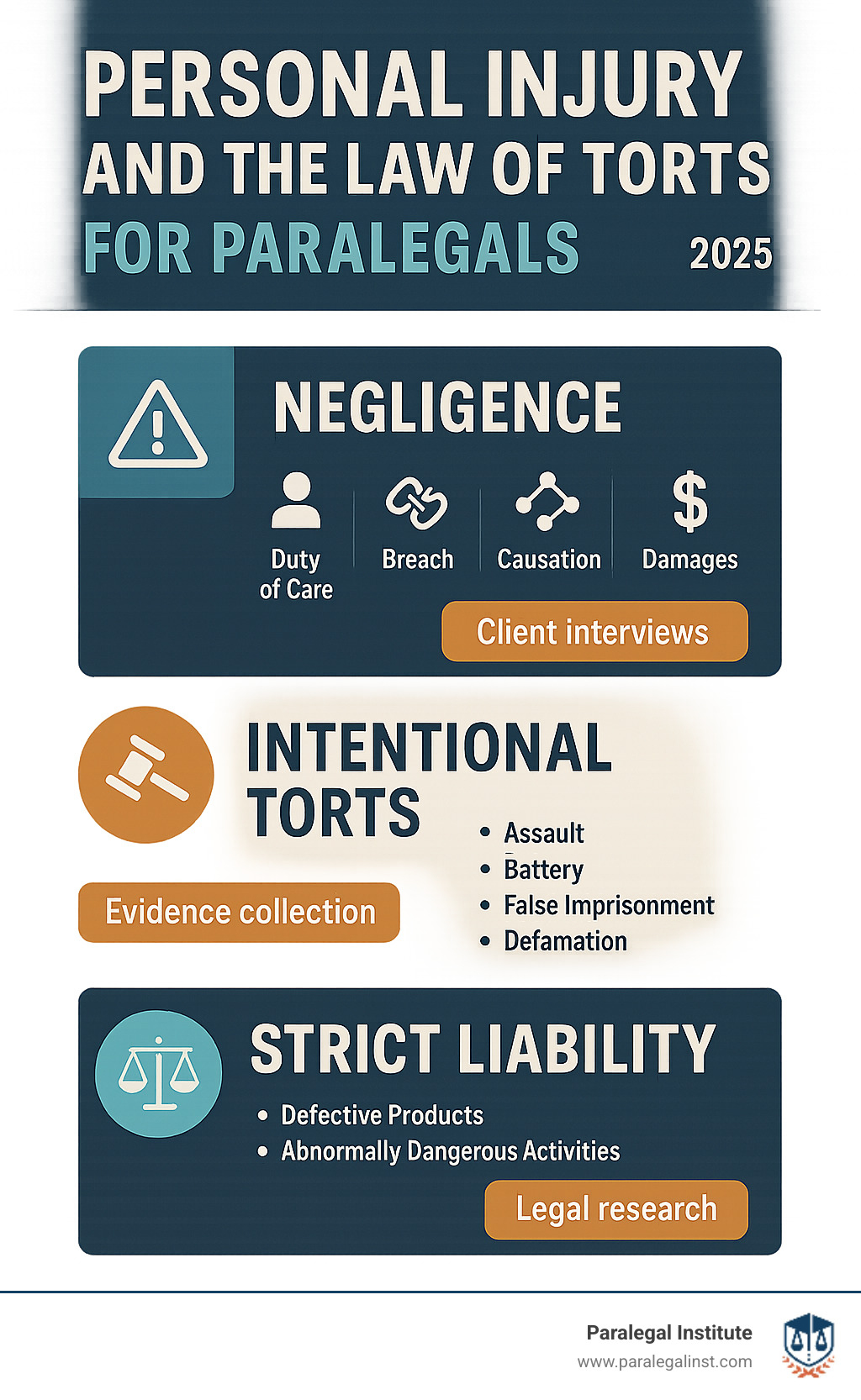
Key Components of Personal Injury and Tort Law for Paralegals:
-
Three Main Types of Torts:
- Negligence (e.g., car accidents, slip and falls)
- Intentional Torts (e.g., assault, battery, defamation)
- Strict Liability (e.g., defective products, dangerous activities)
-
Essential Elements of Negligence:
- Duty of care
- Breach of that duty
- Causation (actual and proximate)
- Damages
-
Paralegal Responsibilities:
- Client intake and interviewing
- Medical record gathering and analysis
- Evidence collection and organization
- Discovery assistance
- Settlement preparation
- Trial support
Personal injury law allows paralegals to work on meaningful cases that directly impact people's lives by helping victims of accidents, medical malpractice, or defective products seek justice. The field requires strong organizational skills, attention to detail, and the ability to work with medical records and expert witnesses. Since most cases settle before trial, negotiation support and case valuation are crucial paralegal skills.
I'm Matthew Pfau, and my experience owning a personal injury law firm has shown me how essential this knowledge is for career success. My work hiring and training paralegals inspired the development of practical curricula that prepare students for this high-demand field.
Foundations of Tort Law: The Core Concepts
Tort law addresses civil wrongs —situations where one person's actions cause harm to another, and the law provides the victim with a right to compensation. Unlike criminal law, which punishes crimes against society, tort law focuses on making the injured person 'whole' again, typically through monetary damages. Understanding tort cases is essential for paralegals, and a solid Legal Research Guide for Paralegals is an invaluable tool.
Foundational Concepts in Personal Injury and the Law of Torts for Paralegals
When working in personal injury and the law of torts for paralegals, you'll encounter three main types of civil wrongs.
Negligence is the most common type of tort, involving unintentional harm caused by carelessness. It occurs when someone fails to act as a reasonable person would, and that failure injures someone else. Examples include a driver running a red light while texting or a store owner failing to clean up a spill. Every negligence case requires proof of four elements: duty of care, breach of duty, causation, and damages. If any element is missing, the claim is not valid.
Intentional Torts
Unlike negligence, intentional torts involve deliberate acts where the defendant intended to cause harm or knew with substantial certainty that harm would result.
- Assault and Battery: Assault is the act of creating a fear of immediate harmful contact, while battery is the actual harmful or offensive touching.
- False Imprisonment: This occurs when someone unlawfully confines or restrains another person against their will.
- Defamation: This involves damaging someone's reputation through false statements. Written defamation is libel, and spoken defamation is slander.
- Intentional Infliction of Emotional Distress: This tort requires proving that the defendant's conduct was extreme and outrageous.
These cases may involve punitive damages to punish the defendant's deliberate conduct, making strong legal writing skills essential.
Strict Liability
In strict liability cases, a defendant can be held liable for harm even without proof of fault or intent. The law imposes strict liability for abnormally dangerous activities, such as transporting explosives or keeping wild animals.
Product liability is a major area of strict liability. Manufacturers, distributors, and sellers can be held liable for injuries caused by defective products. A product may have a manufacturing defect(a flaw in production), a design defect(the product's blueprint is inherently unsafe), or a warning defect(failure to warn of non-obvious dangers). The policy behind strict liability is that companies profiting from potentially dangerous products are best positioned to prevent harm and absorb the costs of injuries.
Understanding these concepts is key to Building Practical Skills in Paralegal Training.
Deconstructing Negligence: The Four Elements and Key Defenses

Proving negligence in personal injury and the law of torts for paralegals requires establishing four specific elements. It's a methodical process where your Importance of Attention to Detail in Paralegal Work is critical.
The Four Essential Elements of a Negligence Claim
Every negligence case is built on these four pillars:
- Duty of Care: Did the defendant owe the plaintiff a legal duty to exercise reasonable care? For most people, this is the duty to act as a reasonable person would. For professionals like doctors or lawyers, the standard is higher, requiring the skill and care of a reasonably skilled member of their profession.
- Breach of Duty: Did the defendant fail to meet that standard of care? This could be an action (like speeding) or an omission (like failing to salt an icy sidewalk).
- Causation:
The defendant's breach must have caused the plaintiff's injury. This has two parts:
- Actual Cause: The injury would not have occurred "but for" the defendant's actions.
- Proximate Cause: The injury must have been a foreseeable result of the defendant's breach. An injury that is too remote or bizarrely disconnected from the defendant's act may not meet this test.
- Damages: The plaintiff must have suffered actual, legally recognized harm, such as physical injuries, property damage, or lost wages.
Common Defenses to Negligence
Defendants will raise defenses to reduce or eliminate their liability.
- Contributory Negligence: In the few states that follow this harsh rule, plaintiffs cannot recover any damages if they were even slightly at fault for their own injury.
- Comparative Negligence: Most states use this approach, which reduces the plaintiff's recovery by their percentage of fault. In a pure system, a plaintiff can recover even if 99% at fault. In a modified system, a plaintiff is barred from recovery if their fault exceeds a certain threshold (usually 50% or 51%).
- Assumption of Risk: This defense applies when the plaintiff knowingly and voluntarily accepted a known risk, such as attending a baseball game and sitting in an area unprotected from foul balls.
- Statute of Limitations: This is a strict deadline for filing a lawsuit. Missing this deadline permanently bars the claim, which is why Prioritize Tasks Effectively as a Paralegal.
The Anatomy of Damages: Calculating and Proving a Client's Loss

A crucial aspect of personal injury and the law of torts for paralegals is calculating and proving damages. The goal of damages is to provide financial compensation to "make the plaintiff whole" again after an injury. As a paralegal, you will be responsible for gathering the evidence needed to tell the financial story of your client's losses. Tools like AI for Paralegals can streamline this process, but understanding the human impact of an injury remains key.
Proving Damages: A Key Task in Personal Injury and the Law of Torts for Paralegals
Damages are typically categorized into three types:
-
Special Damages (Economic Damages): These are the tangible, calculable financial losses resulting from the injury. They include:
- Medical Expenses: Past and future costs for treatment, therapy, medication, and medical devices.
- Lost Wages and Earning Capacity: Income lost during recovery and any reduction in future earning potential.
- Property Damage: Costs to repair or replace damaged property, like a vehicle.
- Other Out-of-Pocket Expenses: Costs for travel to medical appointments or home modifications.
-
General Damages (Non-Economic Damages): These compensate for intangible losses that don't have a specific price tag but are just as real. They include:
- Pain and Suffering: Compensation for the physical pain and emotional toll of the injury.
- Emotional Distress: Damages for anxiety, depression, fear, and other psychological impacts.
- Loss of Consortium: Compensation for the negative impact on a spouse's relationship with the injured person.
-
Punitive Damages: These are rare and intended to punish the defendant for particularly outrageous or malicious conduct and to deter similar behavior in the future. They are not awarded in typical negligence cases.
Thorough documentation is essential for proving damages. Hands-On Legal Training provides the practical experience needed to master this critical skill.
The Paralegal's Role in Personal Injury and the Law of Torts for Paralegals

As a paralegal in personal injury and the law of torts for paralegals, you are central to the firm's operations. You act as an investigator, organizer, and legal strategist, playing a vital role from initial client contact to final case resolution. This work combines legal knowledge with human connection, as detailed in the Role of Paralegals in Law Firms.
Pre-Litigation and Investigation
Before a lawsuit is filed, extensive investigative work is required.
- Initial Client Interview: You will conduct initial interviews, listening with empathy while gathering the critical facts needed to evaluate the case.
- Evidence Gathering: A major part of your job is collecting evidence. This includes obtaining and organizing all relevant medical records, police reports, and witness statements. Understanding medical terminology is essential for this task.
- Case Assessment: You will work with the attorney to analyze the collected evidence, identify the strengths and weaknesses of the case, and determine its potential value. Success in this phase depends on meticulous organization, making it important to use Strategies for Paralegals to Stay Organized.
Discovery and Litigation
Once a lawsuit is filed, the case enters the discovery phase, where both sides exchange information.
- Drafting Pleadings: You will assist in drafting complaints and other legal documents that set the framework for the case.
- Written Discovery: You will help draft and respond to interrogatories(written questions) and requests for production of documents. This requires careful attention to detail and legal strategy.
- Depositions: You will help prepare for depositions (sworn out-of-court testimony) and will often be responsible for summarizing deposition transcripts, highlighting key information for the attorney.
- Document Management: You will manage vast amounts of information, often using e-discovery software to organize and search electronic documents. Your Legal Research Skills Training is crucial for supporting legal arguments during discovery disputes.
Settlement and Trial Preparation
Most personal injury cases settle before trial, but preparation is still intensive.
- Settlement Negotiations: You will help prepare demand letters that outline the client's case and damages. You will also assist the attorney during negotiations by providing organized evidence and calculations.
- Trial Preparation: If a case goes to trial, your role is critical. You will be responsible for preparing exhibits, creating trial notebooks to organize all case materials, and assisting with witness preparation. You may also assist the attorney in the courtroom.
This entire process requires the skills developed through comprehensive Legal Support Staff Training.
Beyond the Basics: Specialized Torts and Ethical Duties

Beyond the basics, personal injury and the law of torts for paralegals includes complex specialized areas. These fields have unique rules and require advanced skills, demonstrating how tort law evolves. This is why Paralegal Continuing Education Courses are valuable for career-long learning.
Specialized Areas: Medical Malpractice and Product Liability
-
Medical Malpractice: This is a type of professional negligence where a healthcare provider's actions fall below the accepted standard of care, causing injury to a patient. Proving a breach of this standard almost always requires expert testimony from another medical professional. Cases often involve issues of informed consent, where a provider fails to adequately explain the risks of a procedure. Paralegals in this field must analyze complex medical records and work closely with experts.
-
Product Liability: This area focuses on injuries caused by defective products. Claims can be based on negligence, strict liability, or breach of warranty. There are three main types of defects:
- Manufacturing Defects: A flaw in the production of a specific item.
- Design Defects: The product's blueprint is inherently dangerous.
- Failure to Warn: Inadequate warnings about non-obvious dangers. Mass torts are large-scale product liability cases involving a single product that has harmed many people, requiring exceptional organizational skills. These specialized areas build on the Fundamentals of Tort Law.
Key Ethical Considerations for Paralegals
Working in personal injury involves handling sensitive client information and carries significant ethical responsibilities.
- Unauthorized Practice of Law (UPL): Paralegals must not give legal advice, set legal fees, or represent clients in court. They work under the direct supervision of an attorney.
- Client Confidentiality: Paralegals have a strict duty to protect all client information from unauthorized disclosure.
- Attorney-Client Privilege: This protects confidential communications between a client and the legal team. Paralegals must understand and protect this privilege.
- Conflicts of Interest: Paralegals must help screen for and avoid situations where the firm's interests conflict with a client's interests.
- Professional Conduct: This includes maintaining honesty, integrity, and competence in all professional interactions.
Adhering to these ethical principles is a core part of the Entry-Level Paralegal Job Description.
Frequently Asked Questions about Personal Injury Law for Paralegals
Here are answers to some common questions about a career in personal injury and the law of torts for paralegals.
What is the difference between a tort and a crime?
A tort is a civil wrong against an individual, leading to a lawsuit where the victim seeks monetary damages for compensation. A crime is a public wrong against society, prosecuted by the state, with penalties like fines or imprisonment. A single act, such as an assault, can be both a tort and a crime, leading to two separate legal actions.
Why is medical knowledge important for a personal injury paralegal?
Medical knowledge is crucial because paralegals spend significant time reviewing and summarizing medical records. This is necessary to understand a client's injuries, prove that the accident caused the harm (causation), and help calculate the full value of the damages. A basic understanding of medical terminology and procedures is essential for effective case development.
What is a statute of limitations in a personal injury case?
A statute of limitations is a law that sets a strict time limit for filing a lawsuit after an injury occurs. If this deadline is missed, the client loses their right to sue forever, regardless of the strength of their case. These deadlines vary by state and type of claim, making it one of the most critical dates for a paralegal to track.
Conclusion: Is This Your Path to a Rewarding Career?
We've covered the core concepts of personal injury and the law of torts for paralegals, from the types of torts and elements of negligence to the vital role a paralegal plays in managing cases and proving damages.
This field offers a unique opportunity to help people during some of the most challenging times of their lives. It demands intelligence, organization, and attention to detail, but it rewards those skills with meaningful work that makes a tangible difference. Every task you complete brings a client one step closer to justice.
If you enjoy problem-solving and want a career helping others steer the legal system, mastering personal injury and the law of torts for paralegals could be your path to a fulfilling career. The Paralegal Institute provides accelerated, hands-on training to equip you with the practical skills needed to excel in high-demand fields like personal injury. Our program is designed by practicing legal professionals to prepare you for the workforce.
Ready to become a vital part of the justice system? Learn more about our Legal Support Staff Training and take the first step toward a career that truly matters.