
Two Paths Into the Legal Field — Which One Is Right for You?
Criminal justice degree vs paralegal certificate — these two educational paths both lead into the legal world, but they take you to very different places.
Here's a quick side-by-side to answer the core question:
| Factor | Criminal Justice Degree | Paralegal Certificate |
|---|---|---|
| Duration | Multiple years | 15 weeks |
| Focus | Law enforcement, corrections, public safety | Legal research, document prep, litigation support |
| Work Setting | Police, courts, corrections, investigations | Law firms, corporate legal, government offices |
| Entry-Level Roles | Police officer, probation officer, correctional officer | Paralegal, legal assistant, compliance support |
| Career Flexibility | Broad — spans many justice system roles | Focused — primarily legal support roles |
The bottom line: if you want to work in the legal system enforcing laws, a criminal justice degree builds that foundation. If you want to work alongside attorneys in a legal setting — and get there fast — a paralegal certificate is the more direct route.
Both paths matter. Both serve the justice system. But they serve it very differently.
I'm Matthew Pfau, a practicing attorney and founder of Paralegal Institute, where I've hired, trained, and taught paralegals for years — and the criminal justice degree vs paralegal certificate question is one I hear constantly from people ready to break into the legal field. That experience shapes everything I'll walk you through here.
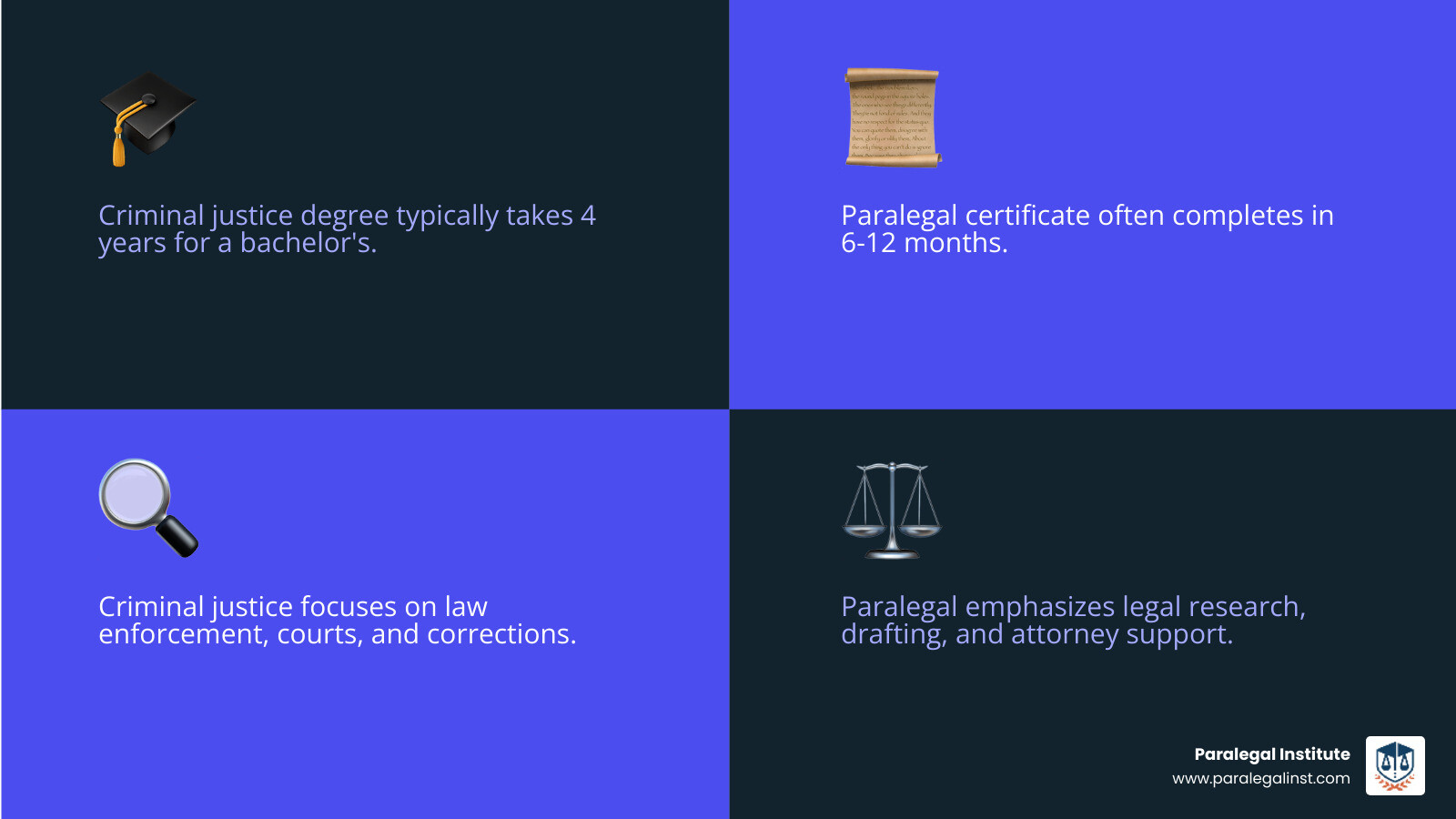
Understanding the Criminal Justice Degree

When we talk about a criminal justice degree, we are looking at the "big picture" of how our legal system functions. This is an academic path designed to provide a comprehensive understanding of how society responds to crime through three primary pillars: law enforcement, the court system, and corrections.
The curriculum for a criminal justice degree is often heavy on theory and sociology. You aren’t just learning the rules; you’re learning why the rules exist and what happens when people break them. Typical coursework includes:
- Criminology: The study of criminal behavior and the psychological or social factors that lead to it.
- Public Safety and Policing: Understanding the history and operations of police departments.
- Corrections Systems: Examining jails, prisons, and the parole/probation systems.
- Investigative Procedures: Learning how evidence is collected and handled in the field.
Because this is a degree program, about half of your time will be spent on general education requirements like math, science, and humanities. It is a broad education that prepares you for roles where you are often out in the community, working in public safety, or managing the operations of the justice system itself.
The Criminal Justice Degree vs Paralegal Certificate: Key Differences
The most striking difference between a criminal justice degree vs paralegal certificate is the "finish line."
A criminal justice degree is a marathon. These programs are designed to give you a well-rounded academic background. They are excellent if you have the time and want a degree that could eventually lead to roles in policymaking or high-level federal law enforcement.
On the other hand, a paralegal certificate is much faster. At the Paralegal Institute, our program is 15 weeks long. It is designed for the go-getter who wants to enter the workforce immediately. Unlike a degree, a certificate program strips away the "fluff" of general education and focuses 100% on the practical skills you need to walk into a law firm and start working on day one.
In our Paralegal Certificate or Degree Ultimate Guide, we often point out that the choice comes down to your timeline. If you have several years to spare, a degree is a scenic route. If you have bills to pay and a career to start, a certificate is the direct flight.
Curriculum Focus in a Criminal Justice Degree vs Paralegal Certificate
The "what" you learn is just as different as the "how long."
In a criminal justice program, you might spend a semester debating the sociological causes of urban crime. In a paralegal certificate program, we spend that time teaching you how to draft a motion, conduct legal research using professional databases, and manage the discovery process.
When you look at what to expect paralegal degree coursework, you’ll see a heavy emphasis on:
- Legal Research and Writing: Learning how to find case law and summarize it for an attorney.
- Litigation: Understanding the step-by-step process of a lawsuit.
- Ethics: Navigating the strict rules of professional conduct in a legal setting.
- Case Management: Using technology to keep thousands of documents organized.
While criminal justice students are studying criminal behavior, paralegal students are studying the mechanics of the law. One is about the "why," and the other is about the "how."
Career Outcomes for Criminal Justice Degree vs Paralegal Certificate
If you chose the criminal justice path, you might be:
- Patrolling a neighborhood as a police officer.
- Meeting with a client as a probation agent.
- Supervising a facility as a correctional officer.
- Investigating a scene as a private detective.
If you chose the paralegal certificate path, you are much more likely to be in a professional office setting. Law firms, corporate legal departments, and government offices rely on paralegals to keep the wheels of justice turning. You might be:
- Summarizing depositions for a trial.
- Drafting contracts for a major corporation.
- Helping a family navigate a probate case.
- Working as a court clerk or a compliance officer.
Work Environments and Daily Responsibilities
Your daily life will look very different depending on which path you take. Criminal justice roles are often "active." They involve interacting with the public, sometimes in high-stress or outdoor environments. It is a career for people who don't want to be tied to a desk.
Paralegal work is the backbone of the law office. It is "behind-the-scenes" but essential. You are the person who ensures the attorney has everything they need for a hearing. You manage the discovery process — which is the formal exchange of information between parties in a lawsuit — and you handle heavy administrative duties that require extreme attention to detail.
One question we get often is, " Do you need a degree to be a paralegal?" In most states, including right here in Las Vegas, the answer is no. Most law firms value skill and experience over a traditional degree. They want someone who knows how to use the tools of the trade, not someone who can write a 20-page essay on the history of the prison system.
Making the Decision: Speed vs. Breadth
How do you decide? It usually comes down to three factors: your goals, your budget, and your clock.
| Feature | Paralegal Institute Certificate | Traditional CJ Degree |
|---|---|---|
| Time to Completion | 15 Weeks | Multiple Years |
| Instruction Style | Live (Online or In-Person) | Often pre-recorded or lecture-heavy |
| Focus | Job-ready skills | Academic theory |
| Cost-Effectiveness | High (Fast ROI) | Lower (Long-term debt potential) |
For career switchers — people who already have a job but want a better one — the criminal justice degree vs paralegal certificate debate isn't much of a debate at all. Spending several years back in school isn't realistic for someone with a family or a mortgage. This is why a paralegal certificate no degree best path is so popular. It allows you to pivot into a professional career in less than four months.
Furthermore, our program at the Paralegal Institute offers live instruction. Whether you are joining us in-person in Las Vegas or online, you are talking to a real attorney in real-time. This isn't a "watch a video and take a quiz" type of education. It’s practical, hands-on training that prepares you for the technical skills required in modern law firms.
Frequently Asked Questions
Can I work as a paralegal with a criminal justice degree?
Yes, you can, but it’s often like trying to use a screwdriver to drive a nail. You have the "general" knowledge of the system, but you might lack the specific "technical" skills like legal research, e-filing, and document drafting that law firms require. Many people with criminal justice degrees actually come to us for a 15-week certificate to "bridge the gap" and become employable in a law office.
How long does it take to earn a paralegal certificate?
At the Paralegal Institute, it takes just 15 weeks. Other programs might take six months to a year, but we focus on an accelerated, high-impact curriculum designed by practicing attorneys to get you into the workforce as fast as possible.
Which path is better for someone wanting to go to law school?
Both can work! A criminal justice degree gives you a broad view of the system, while a paralegal certificate gives you a head start on the actual work you'll do in law school (research and writing). However, working as a paralegal first is the best way to "test drive" the legal profession before committing to the massive expense of law school.
Conclusion
Deciding between a criminal justice degree vs paralegal certificate is about deciding who you want to be in the legal system. Do you want to be the officer on the street, or the professional in the firm? Do you want to spend years in a classroom, or 15 weeks in intensive, practical training?
As an attorney, I can tell you that the legal world is always looking for competent, trained paralegals. We need people who can hit the ground running. If you are looking for a career that offers professional respect, an office environment, and a fast path to entry, the paralegal certificate and degree programs at the Paralegal Institute are designed for exactly that.
We believe in live instruction, real-world skills, and getting you into your new career without wasting years of your life. If you're ready to stop debating and start working, we’re ready to teach you.