
What Is a Corporate Paralegal? A Quick Overview
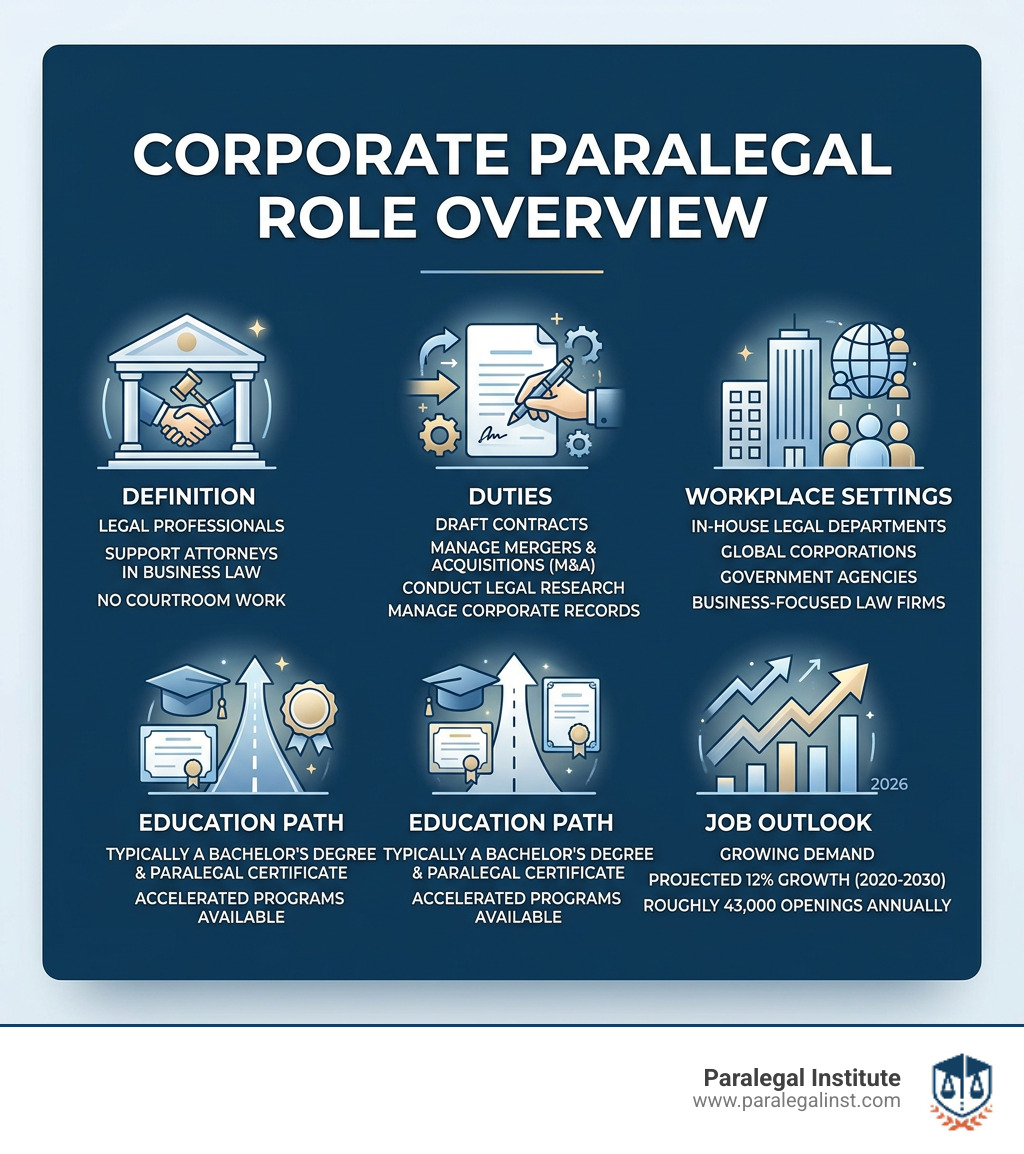
Corporate paralegals are legal professionals who support attorneys inside companies, corporations, and law firms that handle business law matters. They handle everything from drafting contracts to managing mergers and acquisitions — without ever setting foot in a courtroom.
Here's a quick snapshot of what defines the role:
- What they do: Prepare legal documents, conduct research, manage corporate records, and support business transactions
- Where they work: In-house legal departments, global corporations, government agencies (like the SEC), and business-focused law firms
- What they don't do: Practice law or represent clients independently
- Earning potential: Average salaries range widely based on experience and location, with top earners in states like California and New York
- Job outlook: The field is projected to grow 12% from 2020 to 2030, with roughly 43,000 job openings expected each year
If you're considering a career in law but want to skip the courtroom drama, corporate paralegal work offers something genuinely compelling — varied, , business-critical work that keeps you at the center of major decisions.
I'm Matthew Pfau, a practicing attorney who has hired and trained paralegals throughout my career and now teaches paralegal courses at the Paralegal Institute. My hands-on experience building legal teams has given me a clear view of exactly what it takes to succeed as one of the many skilled corporate paralegals working in today's legal landscape — and I'm here to walk you through everything you need to know.
The Growing Demand for Corporate Paralegals
The legal landscape is shifting. Historically, when a company faced a legal hurdle, they immediately called an outside law firm. Today, things look different. Large corporations are increasingly expanding their in-house legal departments to manage costs and ensure that legal experts are embedded directly within the business operations.
This shift has created a massive surge in demand for corporate paralegals. These professionals are the "engine room" of a company's legal team. By handling high-volume tasks that require extreme legal accuracy—such as responding to massive document requests or managing contract lifecycles—they provide a level of cost-effectiveness that outside counsel simply cannot match.
Beyond just saving money, corporate paralegals are essential for risk management. They ensure that every move a business makes is recorded, legal, and "above board." In an era of tightening corporate compliance and complex global regulations, having a skilled paralegal to dot the "i"s and cross the "t"s isn't just a luxury; it's a business necessity.
Where do these professionals work?
One of the best things about this career path is the sheer variety of work environments. While many people picture a mahogany-row law firm, that is only one piece of the puzzle. You can find corporate paralegals in:
- Global Corporations: Working in-house for household names in tech, manufacturing, or retail.
- Government Agencies: Entities like the Securities and Exchange Commission (SEC) or the Patent Trademark Office rely on paralegals to handle regulatory filings.
- Private Law Firms: Specifically those that focus on business law, mergers and acquisitions (M&A), and intellectual property.
If you are just starting out, exploring entry-level-corporate-paralegal-jobs can reveal a wide world of opportunities across these different sectors.
How the role differs from litigation
If you’ve watched legal dramas on TV, you’ve seen litigation paralegals—they are the ones carrying boxes of evidence into a courtroom. Corporate paralegals, however, live in a different world. Their work is "transactional," meaning it focuses on deals, agreements, and the ongoing life of a business rather than disputes in front of a judge.
| Feature | Corporate Paralegal | Litigation Paralegal |
|---|---|---|
| Primary Focus | Transactions, deals, and compliance | Disputes, lawsuits, and trials |
| Courtroom Presence | Slim to zero | Frequent (during trial phases) |
| Key Tasks | Entity formation, M&A, contracts | Discovery, depositions, trial prep |
| Work Pace | Driven by deal deadlines | Driven by court schedules |
| Core Goal | Facilitating business growth | Resolving legal conflict |
While a litigation paralegal deals with "what went wrong," a corporate paralegal is focused on "making things go right" from the start.
Core Responsibilities and Daily Tasks
What does a typical Tuesday look like for corporate paralegals? It is rarely boring. Because businesses are constantly evolving, the legal support they need changes daily. You might start the morning helping form a new subsidiary and end the afternoon preparing for a board of directors meeting.
Day-to-Day Duties of Corporate Paralegals
At its core, the job is about maintaining the "legal health" of the corporation. Common duties include:
- Entity Formation: Drafting and filing the paperwork to create new corporations, LLCs, or partnerships.
- Corporate Governance: Maintaining minute books, drafting resolutions, and ensuring that board meetings are properly recorded.
- Contract Management: Overseeing the full lifecycle of a contract, from the initial draft to the final signature.
- Due Diligence: Conducting deep-dive research into other companies, often reviewing their annual reports and existing contracts to identify potential risks.
- Regulatory Filings: Keeping the company compliant by filing necessary paperwork with state and federal agencies.
For those entering the field as an entry-level-corporate-paralegal, much of the early work involves signature coordination, electronic filing, and subsidiary maintenance—essential tasks that keep the corporate machinery humming.
Specialized Transactional Support
As you gain experience, you may move into high-stakes transactional support. This includes:
- Mergers and Acquisitions (M&A): Assisting in the complex process of one company buying another. This involves managing "virtual data rooms" where thousands of sensitive documents are stored and reviewed.
- Securities Offerings: Helping the company issue stock or bonds, which requires strict adherence to SEC rules.
- Intellectual Property (IP): Managing portfolios of trademarks and patents to protect the company’s unique ideas.
- Closing Binders: After a major deal closes, the paralegal is responsible for organizing all final documents into a comprehensive "closing binder" for all parties involved.
Essential Skills and Education for Corporate Paralegals
To thrive in this environment, you need a specific blend of "book smarts" and "street smarts." While the Bureau of Labor Statistics projects significant growth in the legal support field, the best jobs go to those who have invested in a solid educational foundation.
Essential Skills for Corporate Paralegals
We often tell our students that a great corporate paralegal is part detective, part librarian, and part project manager. Based on our analysis of thousands of job postings, the most sought-after skills include:
- Extreme Attention to Detail: In corporate law, a misplaced comma in a contract can cost a company millions. You must be the type of person who dots every "i" and crosses every "t."
- Organizational Proficiency: You will often manage dozens of entities and hundreds of documents simultaneously.
- Communication Skills: You’ll be interacting with high-level executives, attorneys, and government agencies. You need to be professional and clear.
- Technical Savvy: Proficiency in MS Office is a baseline. You’ll also need to learn specialized tools like virtual data rooms and time-billing software.
- Analytical Thinking: You aren't just filing papers; you are identifying patterns and potential legal hurdles during due diligence.
Professional Development and Advancement
The path to becoming a corporate paralegal doesn't have to take four years. While many in the field hold a bachelor's degree, a specialized paralegal certificate is often the key that opens the door. At the Paralegal Institute, we focus on an accelerated, 15-week curriculum designed by practicing professionals like myself. We prioritize practical, hands-on training over abstract theory so you can enter the workforce ready to contribute on day one.
Once you are in the field, the opportunities for advancement are excellent. You can move into senior paralegal roles, become a department manager, or specialize in high-demand areas like M&A or IP.
Career Outlook and Advancement Opportunities
The future looks bright for corporate paralegals. As business operations become more complex and compliance needs evolve, companies will continue to rely on skilled legal support staff to navigate the landscape.
The growth in this field is driven by:
- Increasing Business Complexity: More regulations mean more paperwork and more oversight.
- In-House Expansion: Companies want to keep their legal knowledge "under one roof" to save on outside legal fees.
- Technological Evolution: Paralegals who can manage digital legal assets and electronic filings are in high demand.
Preparing for the Job Search
If you're ready to make the jump, here is how we recommend preparing:
- Build a Legal-Focused Resume: Highlight your organizational skills and any experience you have with research or document management.
- Networking: Connect with attorneys and other paralegals in your area. In cities like Las Vegas, NV, the legal community is tight-knit, and a good word can go a long way.
- Interview Prep: Be ready to answer questions about your attention to detail and your ability to handle high-pressure deadlines.
- Leverage Placement Support: Choose a program that offers job placement assistance to help you navigate the transition from student to professional.
Frequently Asked Questions about Corporate Law Roles
Do corporate paralegals go to court?
The chances of a corporate paralegal seeing the inside of a courtroom are slim to zero. While litigation paralegals are trial-focused, corporate roles are transactional. You might attend an administrative hearing or a corporate meeting, but you won't be sitting at a counsel table in front of a jury.
What is the most important skill for this role?
While many skills matter, attention to detail is the undisputed king. Corporate legal departments are incredibly scrutinizing. They need to know that every contract, resolution, and filing is perfect. If you enjoy organizing complex information and ensuring total accuracy, you will excel here.
Can I become a corporate paralegal without a 4-year degree?
Yes. While many job postings mention a bachelor's degree, many employers value a paralegal certificate from a reputable program just as highly—especially if it comes with practical, hands-on training. An accelerated program allows you to gain the specific legal knowledge you need without the time and expense of a traditional 4-year degree.
Conclusion
A career as a corporate paralegal offers a unique blend of stability, intellectual challenge, and the opportunity to be at the heart of the business world. Whether you are helping a startup incorporate or assisting a global giant with a multi-billion dollar merger, your work is essential to the success of the company.
At the Paralegal Institute, we are dedicated to providing a career-ready path through live instruction and an accelerated curriculum. We don't just teach you the law; we teach you how to be a professional in a modern legal department. If you're ready to take the next step, you can start your career as an entry-level corporate paralegal today. The legal world is waiting—let's get to work.