Are Paralegals in Demand? The Real Story Behind the Flat Growth Numbers
When looking at national labor projections, a surface-level glance might suggest stagnation. Official Paralegal and legal assistant employment projections project flat net employment change over the next decade. Yet, anyone managing a firm knows that macro statistics do not reflect the day-to-day reality of law office operations.
Staying current on paralegal industry trends reveals that the legal industry is undergoing a structural transformation rather than a contraction. While basic clerical entry roles are being consolidated through automated document assembly, the demand for competent professionals who understand procedural law and substantive casework has never been higher.
The distinction lies entirely between net job creation and annual replacement hiring:
| Metric | Projection Trend | Real-World Impact for Job Seekers |
|---|---|---|
| Net Job Growth (2024–2034) | Flat (0% net change) | Routine, paper-shuffling roles decline as tech adoption rises. |
| Annual Job Openings | ~39,300 per year | Steady stream of open positions created by career advancement and retirements. |
| Attorney Expansion | 5% growth | More practicing attorneys requiring dedicated, skilled support staff. |
| Tech-Proficient Roles | Rapidly Expanding | Candidates with discovery and digital verification skills see high placement rates. |
The 39,300 Annual Openings Paradox
Why are tens of thousands of positions opening each year if net growth appears flat? The answer comes down to workforce replacement and structural advancement. Every year, thousands of experienced legal professionals retire, transition into corporate governance, or take on specialized roles in legal operations.
Furthermore, as attorney ranks expand by 5%, lawyers rely on capable support professionals to handle the heavy lifting of case preparation. An attorney cannot efficiently conduct depositions, negotiate settlements, and handle courtroom appearances without someone managing trial binders, organizing disclosures, and keeping track of procedural deadlines. These shifts drive strong paralegal job prospects for professionals equipped with job-ready skills.
Why the Legal Job Market Tells a Different Story
Legal leaders across the country consistently report that hiring skilled legal staff remains a significant challenge. Despite wider economic shifts, the unemployment rate for legal support roles remains exceptionally low, maintaining tight market conditions.
Private firms and corporate legal departments continue to actively recruit. As shown in recent data on 2026 legal hiring trends, the majority of legal department leaders plan to add permanent staff to manage complex regulatory demands and ongoing trial work. The bottleneck is not a lack of open positions; it is a shortage of candidates who have practical, hands-on casework capabilities right out of the gate.
This is where focused training makes the difference. In my experience teaching paralegal courses at the Paralegal Institute, I see employers consistently favor candidates who can immediately manage discovery deadlines, organize trial exhibits, and communicate professionally with clients. The firms that call me looking for graduates are not asking whether someone has memorized legal theory; they want to know whether that person can step into an active litigation file and contribute from the first week.
How AI Is Reshaping What Law Firms Actually Need
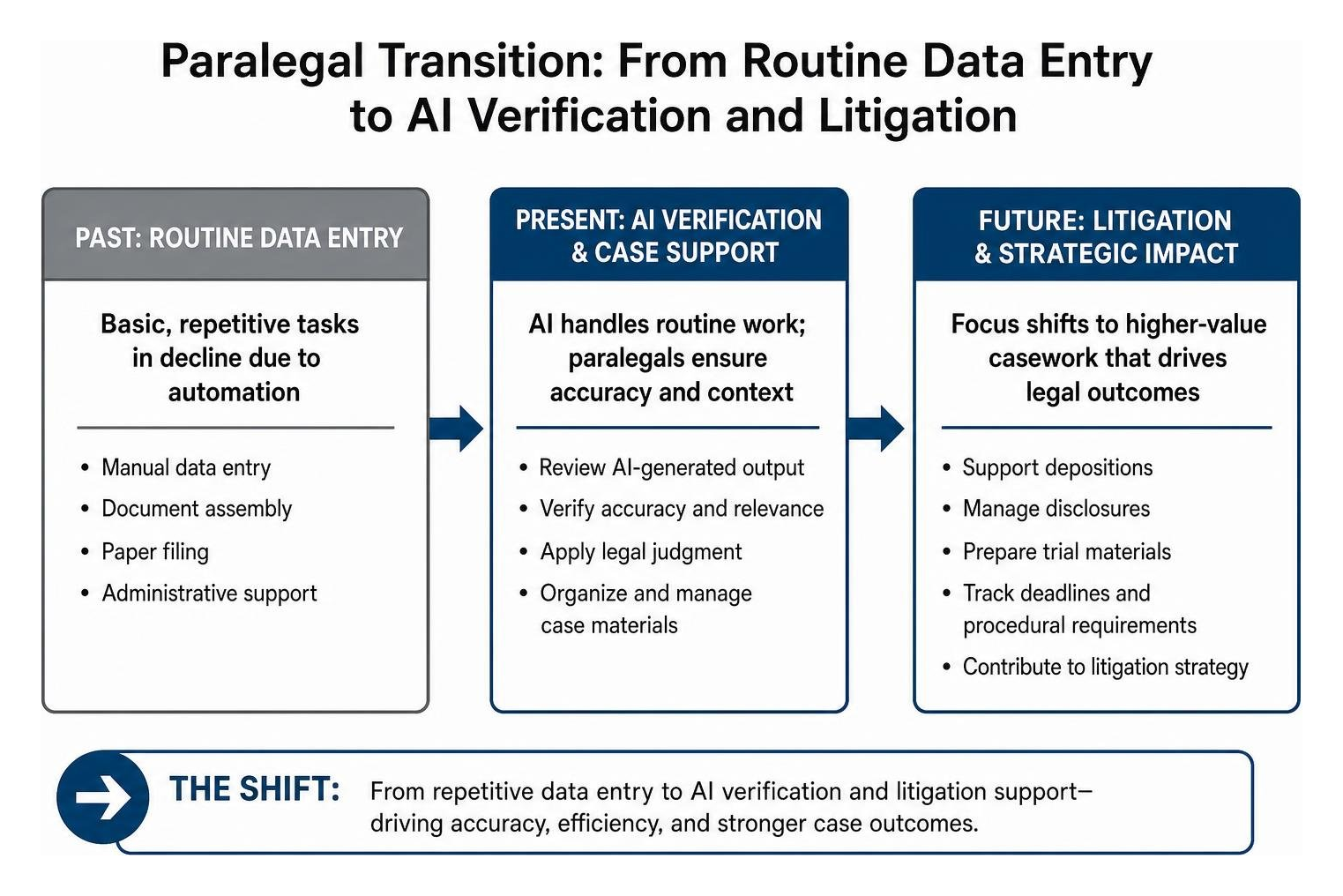
Artificial intelligence has rapidly entered the modern legal practice, but its impact is widely misunderstood. Generative software can assemble standard templates, sort raw transcripts, and draft basic letters in seconds. However, automated software lacks real-world judgment, ethical accountability, and contextual awareness.
As I often share when providing paralegal career advice, automation does not replace the professional; it raises the baseline of what employers expect. Instead of spending hours typing initial summaries, the legal professional is now responsible for validating accuracy, managing data workflows, and executing complex casework tasks that computers cannot perform.
The AI Verification Workload
A major new workload inside law offices is the verification of machine-generated text. Automated tools frequently invent nonexistent case citations, misapply jurisdictional statutes, or omit vital exceptions.
Submitting an unverified citation to a court can lead to immediate sanctions and judicial reprimands. Legal teams need detail-oriented professionals who can:
- Audit automatically drafted motions and pleadings for factual accuracy.
- Verify that cited case law is good law and properly formatted under regional court rules.
- Review complex discovery datasets for privilege exemptions and confidentiality breaches.
- Oversee prompt accuracy and ensure proprietary client information remains secure.
This verification work is not a temporary adjustment. As more firms adopt generative drafting tools, the volume of machine-generated text requiring human review continues to grow. A professional who can systematically audit citations, compare statutory language across jurisdictions, and flag inconsistencies before a filing reaches the court becomes an indispensable part of the litigation team.
Why Tech-Savvy Paralegals Are in Demand More Than Ever
Firms are eager to hire professionals who understand digital discovery workflows and legal technology platforms. Processing large volumes of electronic communications, structuring interrogatory responses, and coordinating trial preparation require human oversight and strategic organization.
These technical competencies also unlock flexible work arrangements. As detailed in our remote paralegal career options, law offices readily hire professionals who can manage discovery databases and digital filing systems effectively from any location. The key is demonstrating that you can handle the technology while maintaining the procedural rigor that litigation demands.
High-Growth Practice Areas and Regional Market Realities

The opportunities available to you depend significantly on the practice area you enter and the local market conditions where you operate. Following a structured paralegal career guide can help you target sectors that prioritize dedicated support staff.
Practice Areas Where Paralegals Are in Demand Now
Certain legal fields have high procedural complexity, creating continuous demand for skilled casework support:
- Civil Litigation and Trial Support: Managing pleadings, deposition logistics, evidence indexing, and courtroom exhibits.
- Corporate Law and Compliance: Drafting resolutions, tracking governance requirements, and auditing regulatory records.
- Immigration Law: Navigating federal filings, tracking evidentiary documentation, and maintaining direct communication with clients.
- Criminal Casework: Handling evidentiary disclosures, coordinating witness appearances, and preparing arraignment and motion files.
Each of these areas requires a professional who can manage deadlines, organize large volumes of documentation, and communicate clearly with clients, opposing counsel, and court staff. The demand is not for someone who simply understands legal concepts in the abstract; it is for someone who can execute the daily tasks that keep a case moving forward.
For those targeting specific regional markets, our guide to paralegal opportunities in Las Vegas outlines how local trial dockets and corporate expansion create immediate hiring opportunities for trained professionals.
Salary Outlook and Regional Compensation Trends
Compensation in the legal field reflects a candidate's practical capabilities and specialized procedural knowledge. Rather than traditional administrative pay, professionals who master complex discovery, litigation preparation, and compliance command substantial premiums. Reviewing comprehensive paralegal career information shows that municipal agencies, corporate legal departments, and busy litigation practices offer steady compensation progression as casework experience grows.
Regional demand also plays a significant role. Urban legal centers with active trial dockets and corporate headquarters tend to maintain consistent hiring activity across multiple practice areas. A professional who understands local court rules, filing procedures, and the specific needs of regional clients can position themselves as a valuable asset from the first day on the job.
Is Pursuing a Paralegal Career Still a Smart Investment?
Navigating the educational pathway into the legal profession requires choosing the right training model. Traditional multi-year degree routes often demand years of general education coursework and heavy tuition commitments without providing direct exposure to active case files.
When mapping out how to get a paralegal job, focused, practical training is the decisive advantage. At the Paralegal Institute, we offer a 15-week paralegal certificate program designed to deliver job-ready skills for rapid workforce entry.
Our curriculum focuses on practical training:
- Live Instruction for Real-Time Learning: Choose between online with live instruction or in-person classes, ensuring you interact directly with practicing legal professionals.
- Hands-On Casework: Draft pleadings, organize discovery disclosures, and build trial portfolios using actual legal standards.
- Accelerated, Affordable Path: Enter the workforce in months rather than years, keeping educational costs low while maintaining high placement potential.
As a practicing attorney who teaches in this program, I see the difference that live instruction makes. Students ask questions in real time, work through procedural scenarios with immediate feedback, and build the confidence that comes from direct interaction with legal professionals who handle cases every day. This is not passive video content; it is active preparation for the realities of law office work.
Overcoming the Experience Barrier
The most common hurdle for new professionals is securing that initial role without previous office tenure. Hiring attorneys prioritize proof of competence over theoretical study.
By building a tangible work portfolio that includes mock discovery requests, formatted motions, and compliance checklists, candidates applying for entry level paralegal jobs can immediately prove their ability to contribute on day one. That portfolio becomes the bridge between classroom training and professional employment, showing a hiring attorney exactly what you can do before you ever walk into the interview.
Frequently Asked Questions About Paralegal Demand
How does artificial intelligence affect paralegal job security in 2026?
AI automates repetitive data entry and basic drafting, but it creates substantial demand for professionals who can audit machine output, check citations, and manage electronic discovery. The profession is shifting toward higher-level analysis, verification, and procedural oversight.
Which legal practice areas offer the highest compensation for paralegals?
Complex civil litigation, corporate compliance, and intellectual property casework consistently offer strong earning potential due to the heavy volume of detailed procedural documentation and discovery oversight involved.
Can you enter the paralegal profession without completing a multi-year degree?
Yes. Employers prioritize practical drafting ability, procedural understanding, and tech fluency over multi-year theoretical programs. An accelerated certificate emphasizing live instruction and real casework provides direct preparation for open roles.
What makes the Paralegal Institute's training model different from traditional degree programs?
Our 15-week paralegal certificate program focuses exclusively on job-ready skills. Students learn through live instruction from practicing legal professionals, work with actual case documents, and build a portfolio that demonstrates competence to hiring attorneys. The accelerated format means you enter the workforce in months rather than years, without the general education requirements that slow down traditional degree paths.
Conclusion
The legal profession continues to rely heavily on skilled, adaptable support professionals. While automation continues to replace basic clerical tasks, the need for individuals who can manage trial logistics, oversee discovery, and verify complex legal filings remains strong.
At the Paralegal Institute, our 15-week accelerated certificate provides the hands-on training and live instruction needed to succeed in modern law firms. Whether you choose online with live instruction or in-person classes, you will learn directly from practicing legal professionals who understand what today's employers actually require. To learn more about standard day-to-day duties across practice areas, explore our comprehensive paralegal job description guide.