
Find Entry-Level Paralegal Certificate Jobs Faster
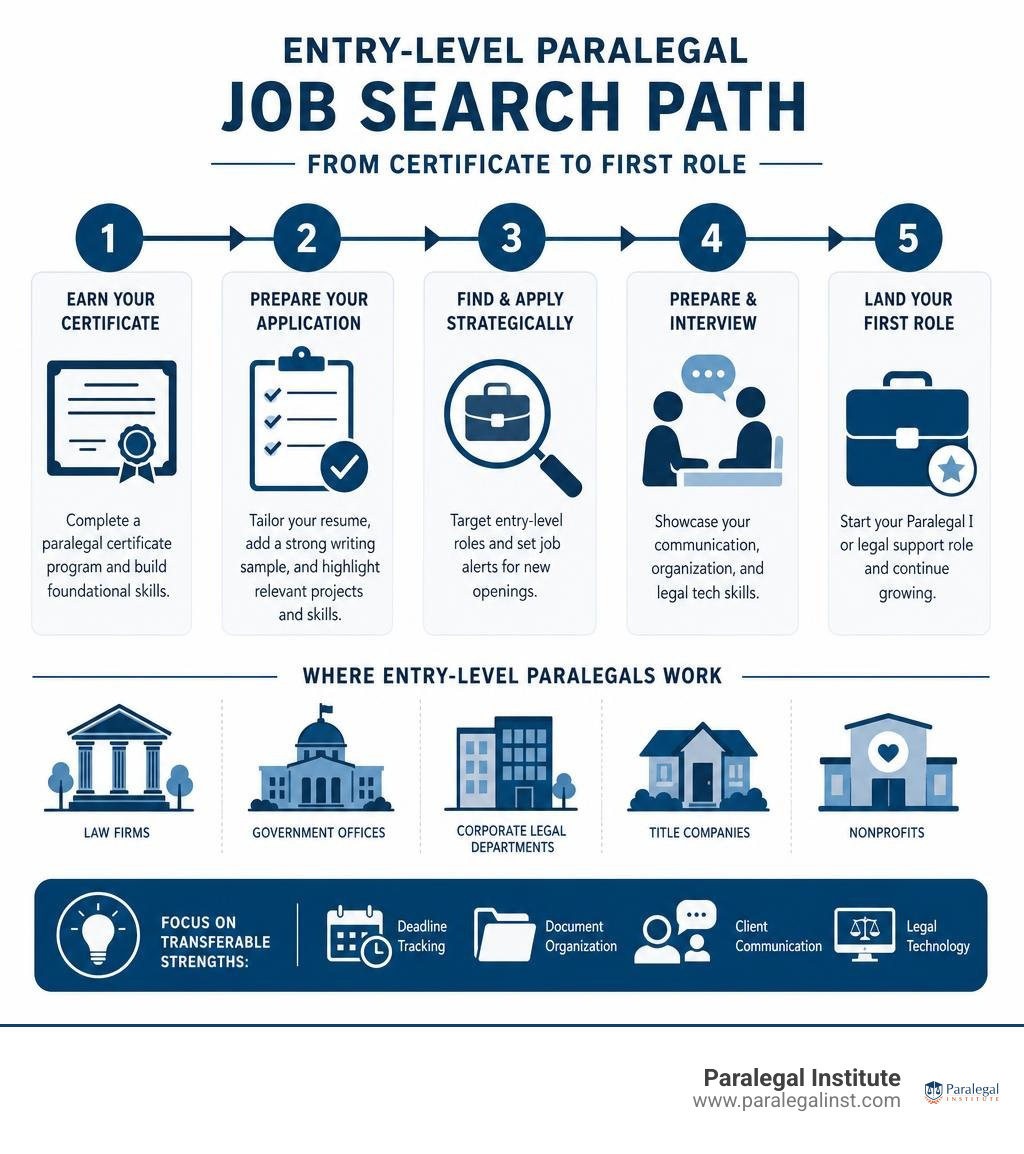
You can get hired with a paralegal certificate and no prior law-firm experience. Start by targeting Paralegal I, legal assistant, litigation assistant, and legal support roles at law firms, government offices, corporate legal departments, title companies, and nonprofits. Then make your application specific:
- Match your resume to the job's practice area, such as litigation, real estate, or corporate casework.
- Include a clean writing sample, legal research work, and course-based discovery or drafting projects.
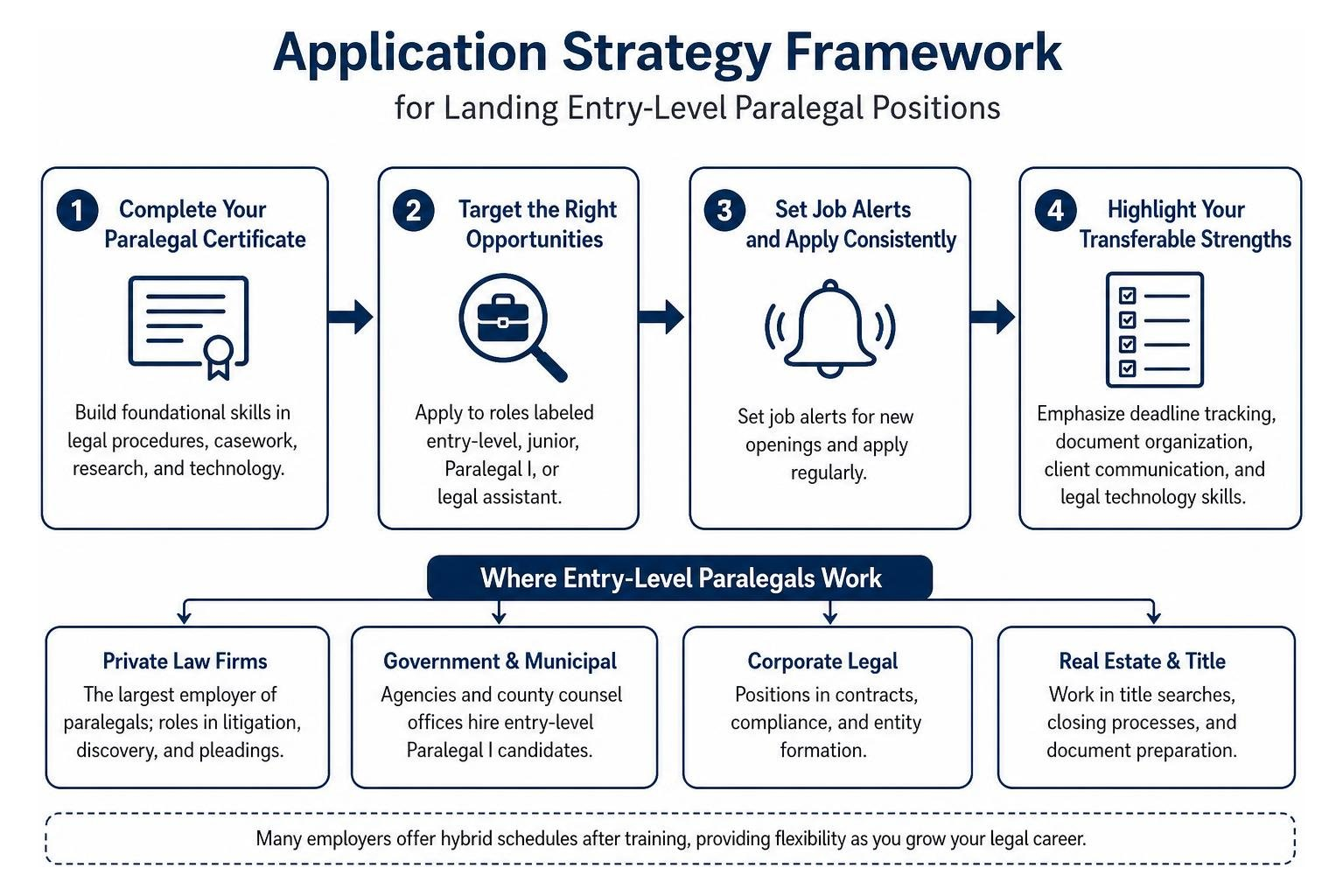
- Apply to roles labeled entry-level, junior, Paralegal I, or legal assistant, and set job alerts for new openings.
- Highlight transferable strengths: deadline tracking, document organization, client communication, and legal technology skills.
Private law firms remain the largest employer of paralegals, but they are not the only path. Government agencies and county counsel offices may hire entry-level Paralegal I candidates who meet the education requirements, while some employers offer flexible schedules after training.
I am Matt Pfau, a practicing U.S. attorney who teaches paralegal courses at Paralegal Institute, not a paralegal. I have hired and trained paralegals in my law firm, and I built this guide to help career-focused adults pursue Paralegal certificate jobs with a practical plan.
Overview: The Reality of Paralegal Certificate Jobs in 2026
The legal sector in 2026 presents strong demand for practice-ready support professionals. Attorneys like myself rely heavily on capable staff to keep casework organized, draft initial pleadings, coordinate discovery schedules, and maintain client communication. Private law firms continue to be the single largest employer of paralegals, but hiring managers across corporate legal departments and municipal offices actively recruit individuals who hold a verified paralegal certificate.
Candidates entering the legal field often wonder how the employment landscape differs across sectors. Entry-level openings frequently appear under titles such as Paralegal I, Legal Assistant, Litigation Specialist, or Document Clerk. While multi-year academic degrees were once considered the standard route, employers now focus on direct competency: can you draft a concise trial brief, index complex discovery files, and manage strict court deadlines on day one?
Explore our certificate in paralegal studies salary guide to understand compensation dynamics across practice areas.
| Sector | Common Entry Titles | Primary Casework Focus | Work Setting Options |
|---|---|---|---|
| Private Law Firms | Paralegal I, Litigation Assistant | Trial preparation, discovery, pleadings | On-site, selected telecommute |
| Municipal & Government | Paralegal Specialist, Legal Clerk | Administrative hearings, public records | In-office, flexible schedules |
| Corporate Legal | Contracts Administrator, Compliance Specialist | Entity formation, contract review | In-office, remote options |
| Real Estate & Title | Title Examiner, Settlement Clerk | Title searches, closing binders | On-site, structured telework |
Public sector agencies offer defined entry tracks, such as public sector paralegal compensation structures that outline career steps without requiring years of prior law-firm tenure.
5 Proven Strategies to Secure Entry-Level Paralegal Roles
Securing your first role requires positioning your academic training as actionable work experience. When reviewing resumes, managing attorneys look for functional knowledge rather than generic administrative bullet points.
1. Target Government Agencies and Municipal Departments
Municipal departments, public defender offices, district courts, and county counsel divisions regularly hire entry-level paralegal certificate holders. Government postings, such as those found through King County legal support openings, establish clear classification tiers where an academic certificate satisfies the baseline entry requirement.
Public sector roles expose you to high-volume casework, including:
- Assembling trial exhibits, witness binders, and subpoena packages
- Reviewing administrative records and processing public information requests
- Drafting motions, orders, and standard court pleadings
- Managing court calendars and filing deadlines
Because public agencies rely on standardized hiring criteria, applicants with an intensive educational foundation can compete directly for entry-level positions. Learn more in our local guide to paralegal certificate jobs.
2. Leverage In-Demand Tech and AI Skills for Paralegal Certificate Jobs

Modern law offices rely on advanced tools to accelerate document review, transcript summarization, and statutory research. Candidates who understand how to responsibly deploy artificial intelligence alongside standard research databases hold a distinct advantage.
To make an impression during the interview process, showcase your practical ability to:
- Extract relevant facts from multi-page deposition transcripts using automated search tools
- Verify automated research findings against official statutory case reporters
- Organize complex discovery productions with structured digital indices
- Draft clear correspondence, demand letters, and initial contract clauses
Demonstrating both technological proficiency and an understanding of ethical confidentiality boundaries immediately sets you apart. For a detailed breakdown of core daily duties, review our paralegal job description complete guide.
3. Explore Non-Law-Firm Sectors for Paralegal Certificate Jobs
Do not limit your application efforts exclusively to traditional law firms. Many corporate, healthcare, and nonprofit organizations maintain internal legal teams that seek organized certificate holders for compliance, entity maintenance, and transactional support.
Consider applying within these thriving sectors:
- Corporate Legal Departments: Reviewing commercial agreements, assisting with mergers and corporate filings, and maintaining compliance records.
- Real Estate and Title Companies: Conducting chain-of-title searches, identifying liens or clouds on titles, and assembling closing documentation.
- Healthcare Organizations: Handling medical records subpoenas, managing patient data compliance, and supporting regulatory review.
- Nonprofit Entities & NGOs: Assisting staff counsel with administrative filings, community advocacy documentation, and regulatory compliance.
For an extensive review of practice environments outside private firms, see our breakdown of diverse paralegal positions.
4. Build a Practice-Specific Portfolio and Writing Sample Packet

When an applicant has not yet worked in a law firm, their portfolio serves as tangible proof of competence. Rather than relying solely on a resume, bring an organized binder or digital portfolio containing samples developed during your coursework.
Your portfolio should contain:
- A Legal Research Memorandum: An objective analysis of a specific legal issue applying statutory law and relevant court opinions.
- Pleadings and Motions: Redacted sample complaints, answers, or motions for summary judgment demonstrating proper formatting.
- Discovery Documents: Form interrogatories, requests for production of documents, and deposition summaries.
- Professional Correspondence: Polished client intake summaries, settlement demand letters, and transmittal notices.
If you are fluent in a second language, highlight it prominently. Multilingual paralegals provide immediate value to firms handling diverse client bases or cross-border matters. Review our comprehensive guide on how to get a paralegal job for additional portfolio tips.
5. Capitalize on Flexible and Remote Entry-Level Opportunities
The expansion of digital filing and remote case operations has created flexible work arrangements within legal departments. While initial training often occurs on-site to ensure mastery of internal processes, many employers transition legal support staff into structured remote arrangements once proficiency is demonstrated.
To excel in remote or flexible legal roles:
- Maintain meticulous digital file organization so supervising attorneys can access casework instantly.
- Demonstrate reliable mastery of electronic court filing portals and document submission rules.
- Communicate proactively regarding task milestones, court deadlines, and discovery responses.
Discover current remote and on-site trends in our updated 2026 paralegal jobs guide.
Understanding Statutory Requirements and Career Advancement
Building a sustainable legal career requires understanding regulatory standards and clear progression milestones. In structured settings such as municipal agencies, legal support careers advance through transparent levels.
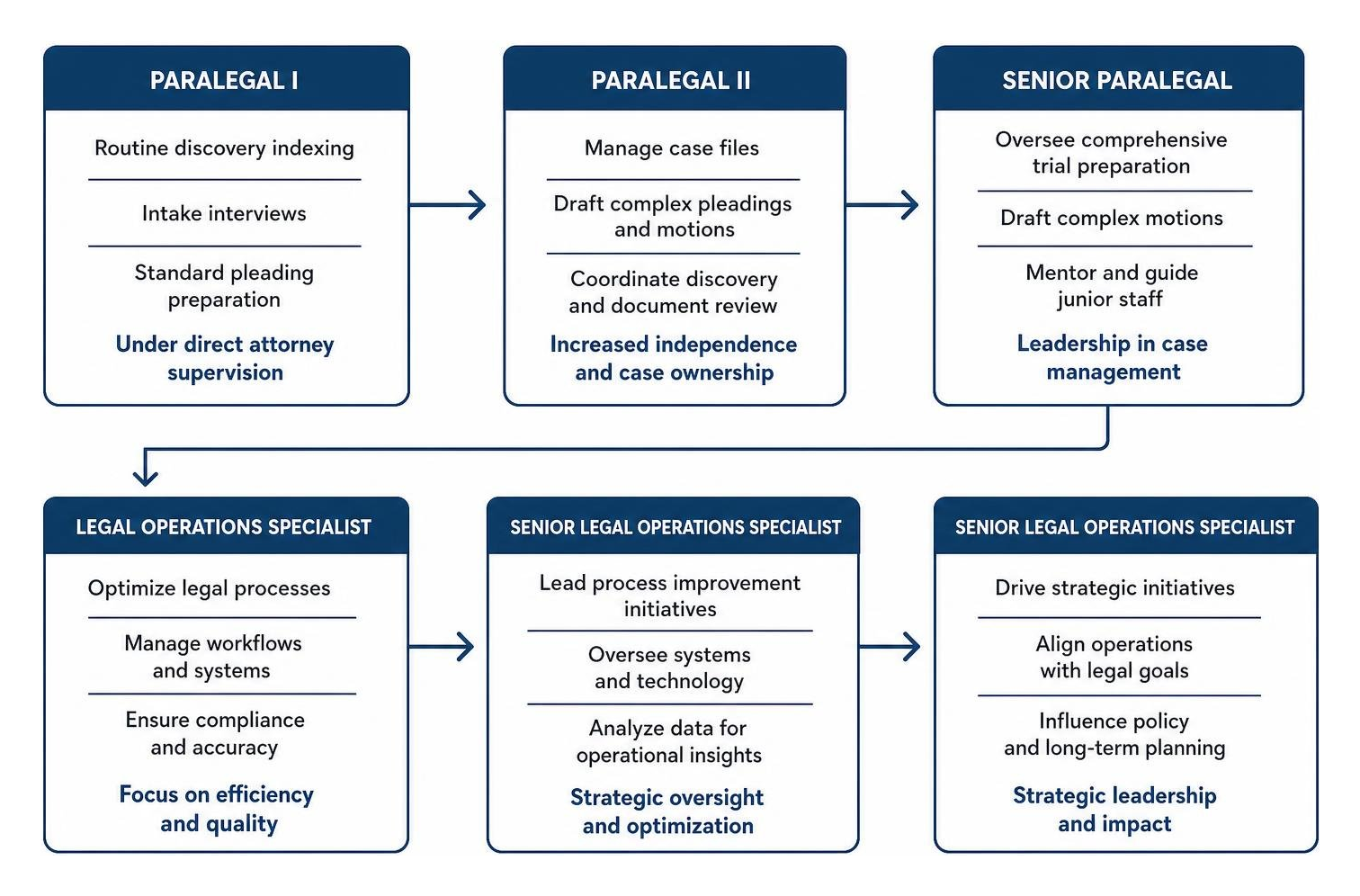
A Paralegal I generally focuses on routine discovery indexing, intake interviews, and standard pleading preparation under direct attorney supervision. As you gain mastery over complex casework, you can advance to a Paralegal II or Senior Paralegal role, taking ownership of comprehensive trial preparation, complex motion drafting, and junior staff coordination.
Starting with structured, intensive training accelerates your readiness for these promotional steps. Explore our formal paralegal certificate programs and discover what it takes to build a rewarding, long-term career as a paralegal.
Frequently Asked Questions About Paralegal Certificate Jobs
Can you get hired as a paralegal with just a certificate and no experience?
Yes. Many law firms, municipal legal departments, and corporate offices hire entry-level candidates who possess an academic paralegal certificate. Employers evaluate your ability to handle legal research, draft pleadings, manage discovery, and track deadlines. Demonstrating practical skills through a clean portfolio of coursework samples bridges the gap between education and employment.
What are the highest-paying practice areas for new certificate holders?
Corporate transactions, complex civil litigation, intellectual property, and public sector county counsel offices consistently offer strong compensation packages. Highly technical areas that involve extensive document review, regulatory filings, or specialized contract drafting reward candidates who bring disciplined organization and solid analytical writing skills.
Do government paralegal jobs offer remote or flexible work options?
Many government legal offices provide structured telework options. While onboarding, court attendance, and initial training typically require in-person participation, many municipal and state departments allow staff to work remotely on designated days once they complete their initial probationary period.
Conclusion
Entering the legal profession does not require spending two to four years in a traditional academic program. What managing attorneys value most is focused, practical competence: can you draft accurate documents, navigate discovery procedures, and support active litigation efficiently?
At the Paralegal Institute, we provide an accelerated 15-week paralegal certificate program designed to deliver job-ready skills. Taught directly by practicing attorneys, our curriculum focuses on real-world application rather than abstract theory. We offer two convenient formats: online with live instruction—giving you real-time interaction with instructors—and in-person classes.
Take the next step toward launching your legal career by exploring our comprehensive legal support staff training today.