Case Management Paralegal Training for Law Firm Workflows
Case management paralegal training should teach you to track each matter from intake through resolution: keep client records organized, calendar deadlines, document every handoff, and flag work that needs an attorney's review. In a law firm, a case manager often handles client updates and logistics, while a paralegal supports legal research, discovery, and document drafting under attorney supervision.
Clear roles help the team keep casework moving without missing a deadline or asking support staff to give legal advice. A shared matter file and regular updates let both roles work from the same information.
I'm Matthew Pfau, a practicing attorney who has hired and trained paralegals at my law firm. I teach at Paralegal Institute, where I focus on the practical casework behind case management paralegal training.
Case Manager vs. Paralegal vs. Legal Assistant: Understanding Legal Roles
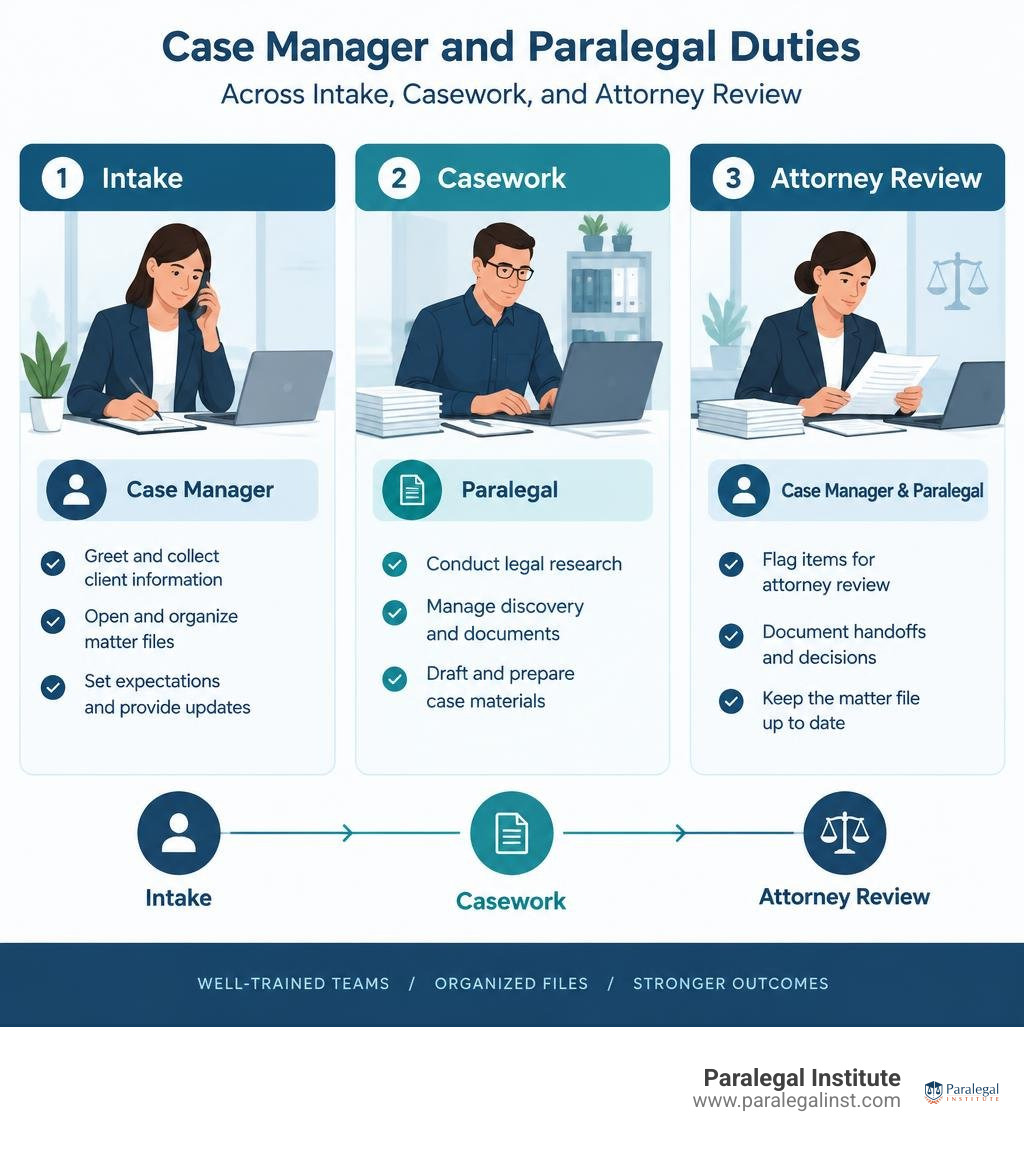
In my years managing active litigation dockets, I have seen many practices struggle because they blur the lines between administrative coordination, clerical support, and substantive legal casework. To build a reliable workflow, a firm must clearly distinguish between a case manager, a paralegal, and a legal assistant.
Each role contributes to operational health, but they require different training and handle distinct stages of a file. Applying effective paralegal case management ensures tasks are routed to the team member best equipped to handle them.
The table below breaks down how these three legal support roles differ across daily duties, background preparation, and client interaction:
| Role | Primary Focus | Core Duties | Typical Background & Education |
|---|---|---|---|
| Case Manager | Administrative logistics & client care | Intake screening, medical record collection, insurance follow-up, scheduling | Customer service, healthcare administration, or social work background |
| Paralegal | Substantive legal support under attorney supervision | Legal research, drafting pleadings, preparing discovery requests, trial preparation | Comprehensive paralegal certificate program or formal legal education |
| Legal Assistant | Clerical & secretarial support | Calendar entry, basic correspondence, transcription, billing entry, filing | High school diploma or general administrative experience |
According to occupational data from the U.S. Bureau of Labor Statistics, paralegals and legal assistants perform foundational roles in maintaining law firm operations. However, modern practices often layer case managers on top of these positions to handle the growing logistical demands of high-volume dockets.
Defining the Case Manager in Law Practice
A legal case manager acts as the operational hub for client-facing logistics. Their core responsibility is keeping the client informed and gathering non-legal factual materials so the file moves steadily through its initial stages.
In practice areas like personal injury or family law, a case manager handles the initial client intake interviews, requests medical records and bills, maintains communication logs, and follows up with insurance adjusters. They do not draft formal legal instruments or conduct statutory analysis. Instead, they ensure that the legal team has the factual foundation necessary to build the substantive matter.
The Core Responsibilities of a Professional Paralegal
Paralegals perform substantive legal work delegated and supervised by a licensed attorney. Unlike purely administrative personnel, a paralegal possesses specialized legal knowledge that enables them to analyze statutes, summarize depositions, and prepare complex filings.
A paralegal's core responsibilities include:
- Conducting legal research using primary and secondary legal authorities
- Drafting complaints, answers, motions, and supporting affidavits
- Formulating and responding to interrogatories, requests for production, and requests for admissions
- Organizing exhibits and preparing trial binders for court appearances
- Reviewing medical chronologies and financial records to assist with damages analysis
Every task a paralegal performs directly supports the attorney’s representation of the client in a legal capacity.
Where Legal Assistants Fit into Modern Casework
Legal assistants provide essential secretarial and clerical support that keeps the office organized. While a case manager tracks client logistics and a paralegal handles substantive drafting, the legal assistant ensures day-to-day office processes run smoothly.
Their duties include transcribing attorney dictation, mailing formal notices, maintaining office filing systems, scheduling appointments, and assisting with client billing entries. Having a dedicated legal assistant prevents paralegals and attorneys from spending valuable time on basic clerical tasks.
Essential Workflows and Collaborative Case Management
A successful law practice requires seamless collaboration across all support roles throughout the lifecycle of a matter. When support staff understand where their responsibilities begin and end, casework moves forward without bottlenecks.
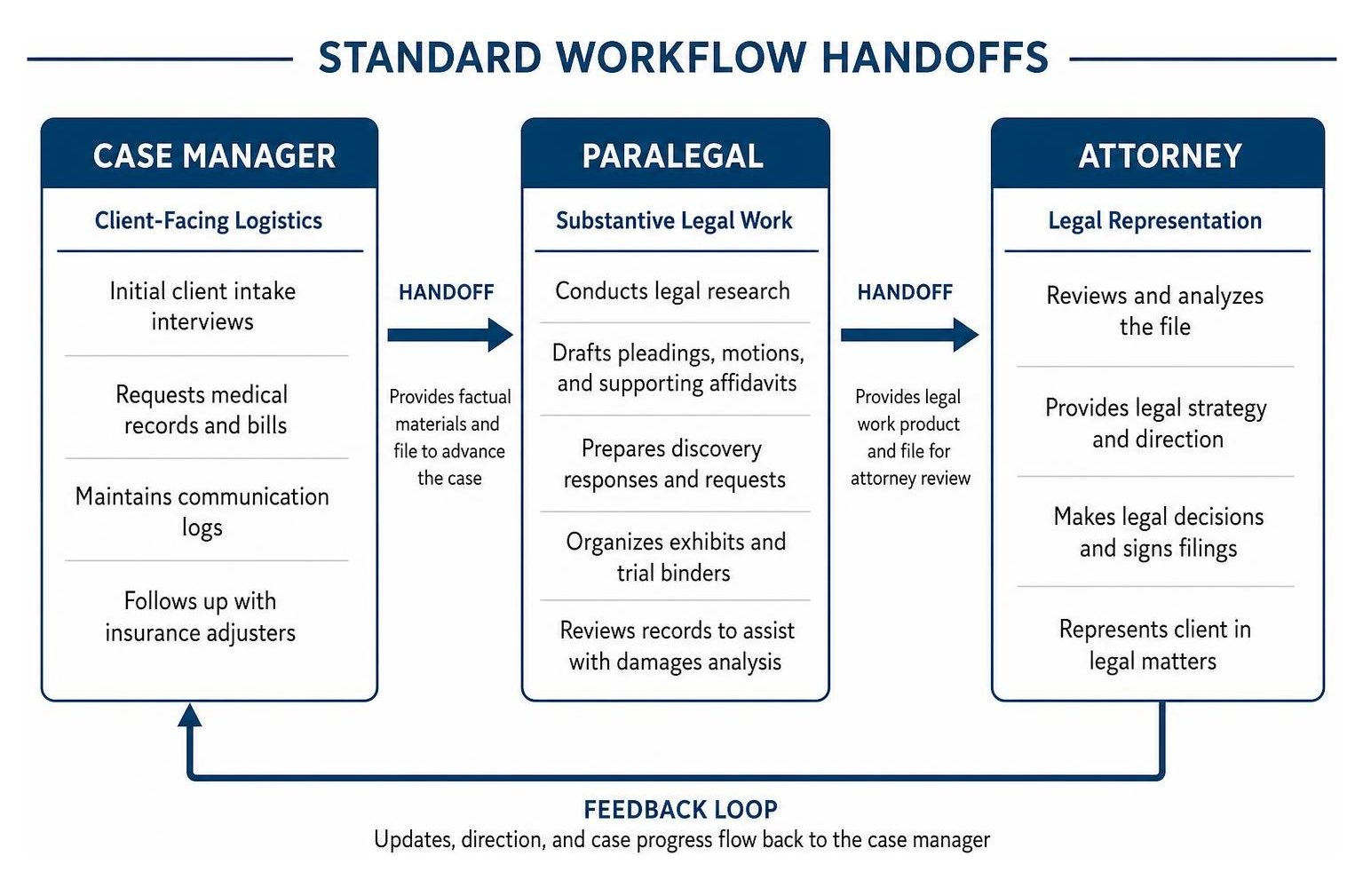
From the moment a new client contacts the office to the final resolution, each team member performs specific handoffs. Utilizing structured paralegal litigation support keeps discovery moving and ensures court deadlines are consistently met.
Navigating Discovery, Client Communications, and Intake
In a typical personal injury or litigation matter, the case manager leads the intake phase. They record the client’s narrative, collect insurance policy details, and order initial incident reports. As treatment progresses, the case manager maintains regular contact with the client and coordinates with medical providers to compile billing statements.
Once the file transitions to active litigation or settlement negotiations, the paralegal steps in. The paralegal reviews the medical records collected by the case manager, drafts a comprehensive demand letter or complaint, and builds the discovery responses. When discovery requests arrive from opposing counsel, the paralegal collaborates with the client to gather responsive documents and draft verified answers under attorney supervision.
Integrating Case Management Paralegal Training into Litigation Workflows

Comprehensive case management training for paralegals bridges the gap between factual investigation and procedural court rules. A properly trained paralegal understands how administrative details feed directly into litigation deadlines.
By learning how to manage document indexes, track evidentiary disclosures, and anticipate filing windows, paralegals protect the firm against procedural defaults. They transform raw intake data and medical chronologies into well-structured litigation exhibits that attorneys can present in court.
Ethical Boundaries and Attorney Supervision
Every legal team member must maintain strict ethical compliance under American legal standards. Paralegals and case managers are non-lawyers and are strictly prohibited from engaging in the unauthorized practice of law (UPL).
Non-lawyers must never:
- Provide legal advice or evaluate the legal merits of a claim to a client
- Set legal fees or sign attorney-client fee agreements
- Represent clients in court proceedings or conduct depositions
- Sign substantive legal pleadings without supervising attorney review
Supervising attorneys are ethically responsible for the work product of their non-attorney staff. Case managers and paralegals must maintain client confidentiality under applicable rules of professional conduct and clearly state their non-lawyer status in all client interactions.
Essential Skills and Tools for Effective Casework
Modern legal casework demands high organizational discipline and proficiency with digital tools. Managing multiple active matters simultaneously requires systematic methods for tracking deadlines, organizing digital evidence, and logging communications. Applying proven strategies for paralegals to stay organized prevents missed filings and reduces operational stress.
Critical Organizational and Communication Skills
Case managers and paralegals need refined communication skills. Case managers require empathy and patience when dealing with distressed clients during intake and treatment updates. Paralegals must write with precision, drafting legal correspondence and court pleadings that reflect exact statutory standards.
Both roles require rigorous attention to detail, proactive task prioritization, and structured time management to handle heavy caseloads without compromising accuracy.
Document Management, Calendaring, and Court Procedures

A fundamental element of case management is mastering docketing systems and jurisdiction-specific rules. Paralegals must understand local court rules, compute statutory response times accurately, and manage electronic filing systems.
Mastering court filing procedures ensures that summonses, motions, and notices are formatted correctly and filed within mandatory deadlines, protecting the firm and client from administrative dismissals.
Case Management Paralegal Training and Education Pathways
Entering the legal field requires choosing an education path that delivers direct, practical capabilities. While case management positions often accept candidates with general administrative backgrounds in healthcare or customer service, paralegal roles require specialized instruction in legal principles and substantive document preparation. Investing in building practical skills in paralegal training prepares students to step directly into law firm operations on day one.
Formal Education vs. On-the-Job Experience
Some law firms attempt to train support staff entirely on the job, but this approach often leaves significant gaps in legal comprehension and procedural accuracy. Formal legal education ensures that students understand why specific procedures exist, rather than merely repeating administrative steps.
While transferrable skills from healthcare and administration are valuable for case managers, paralegals require targeted coursework in legal research, civil litigation, contracts, torts, and legal writing. Completing a structured program provides the foundational legal knowledge necessary to draft reliable court documents under an attorney's guidance.
Selecting the Right Case Management Paralegal Training Program
When evaluating educational programs, career-focused adults should look for curricula taught by practicing legal professionals that focus on actionable workforce readiness.
Traditional degree programs often require substantial time commitments and include general education coursework that does not directly prepare you for law firm casework. In contrast, the Paralegal Institute offers a focused 15-week paralegal certificate program designed to deliver rapid, career-ready training.
We deliver our curriculum through two flexible formats:
- In-person classes for students seeking traditional classroom engagement
- Online with live instruction, ensuring students receive real-time, interactive learning and direct access to practicing attorneys from any location
Our accelerated curriculum emphasizes hands-on drafting, litigation workflows, and practical legal skills. Enrolling in our focused paralegal skills training program provides an efficient, cost-effective route to launching a career in the legal field without unnecessary delays.
Frequently Asked Questions About Legal Case Management
Can a paralegal work as a case manager in a law firm?
Yes. A trained paralegal possesses the organizational skills required for case management along with substantive legal knowledge. In boutique and small law practices, paralegals frequently fulfill dual roles, managing client intake and medical records while also drafting pleadings and discovery.
What is the main difference between a case manager and a paralegal?
The main difference lies in the nature of their work. A case manager focuses on administrative logistics, client contact, and document gathering outside of the courtroom. A paralegal performs substantive legal work—such as legal research, drafting motions, and preparing trial exhibits—under the direct supervision of an attorney.
When should a law firm hire a case manager versus a paralegal?
A law firm should hire a case manager when the primary operational challenge is client communication, intake volume, or medical records collection. A firm should hire a paralegal when attorneys need substantive support with legal research, drafting court filings, discovery responses, and trial preparation.
Conclusion
Building an efficient legal practice requires a clear understanding of support roles and well-defined operational workflows. When case managers handle client logistics and paralegals manage substantive legal preparation, attorneys can focus on strategy, negotiation, and courtroom advocacy.
For career-focused individuals looking to enter the legal field, mastering case management and litigation support provides a direct path to long-term career growth. The Paralegal Institute equips aspiring professionals with practical, workforce-ready skills through our accelerated 15-week certificate curriculum, available through in-person classes or online with live instruction.
Understanding the training required to become a paralegal helps you start building practical legal skills today.