Why Every Paralegal Needs a Set of Reliable Cheat Sheets
Paralegal cheat sheets are quick-reference guides that help legal professionals handle daily tasks faster and with fewer errors. Here are the most essential ones to keep on hand:
| Cheat Sheet Type | What It Covers |
|---|---|
| Legal Research | Court hierarchies, Boolean search operators, citation formats |
| Document Formatting | Microsoft Word styles, metadata removal, Tables of Authorities |
| Billing & Time Tracking | Billable vs. non-billable tasks, 6-minute increments, billing methods |
| Legal Citations | Bluebook format, Shepardizing, KeyCite validation |
| Ethics & UPL | Unauthorized practice boundaries, conflict checks, client confidentiality |
| Client Communication | Email etiquette, courtroom decorum, file management |
Working in a law office means juggling legal research, document drafting, client communication, and billing — often all in the same afternoon. Miss a step in any one of those areas, and the consequences can range from a rejected court filing to an ethical violation.
The stakes are high. According to industry data, 98% of billable hours are spent preparing legal documents. Yet every wasted minute or billing error directly impacts the firm's efficiency and client trust.
That's exactly why experienced legal professionals build a personal toolkit of reference guides they can reach for in the moment — without stopping to flip through a textbook.
I'm Matthew Pfau, a practicing attorney who owns and operates a law firm where I hire and train paralegals, and I teach paralegal courses at the Paralegal Institute. Over the years, I've seen which paralegal cheat sheets actually get used daily versus which ones collect dust — and I'll walk you through the ones that make a real difference.
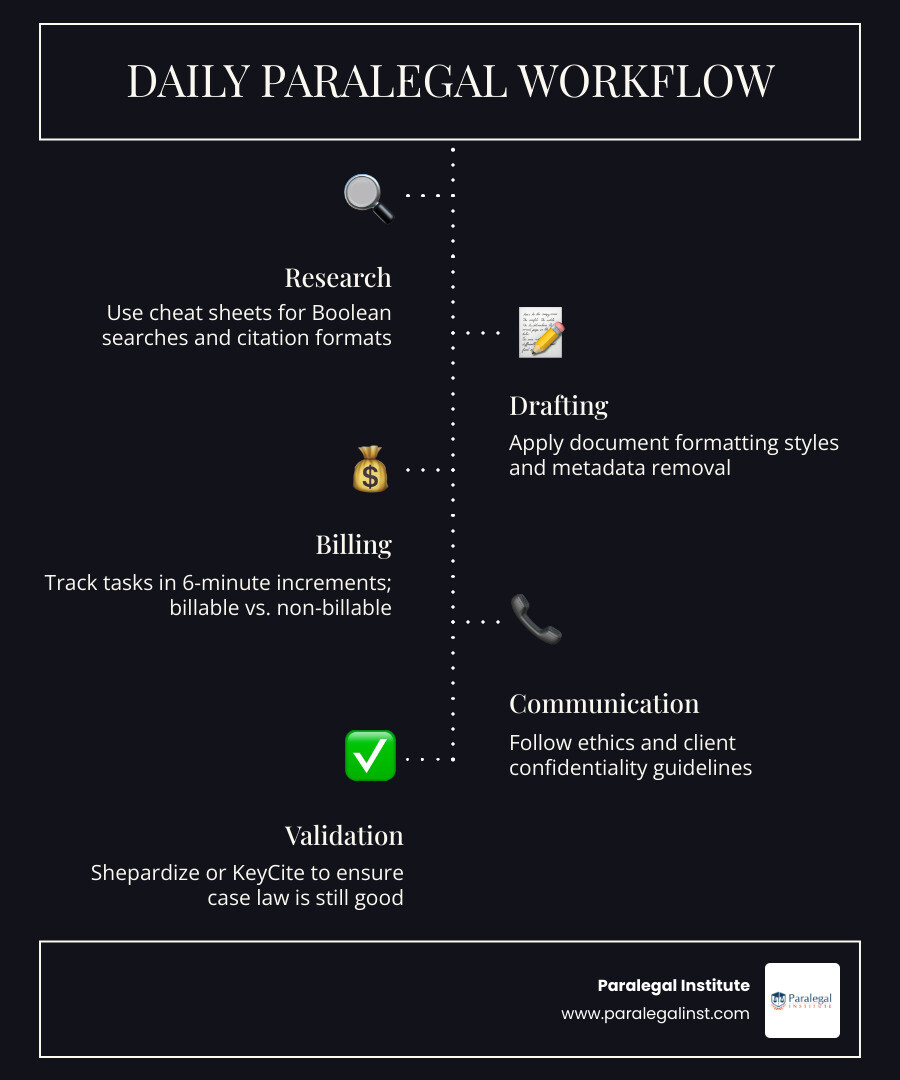
Essential Paralegal Cheat Sheets for Daily Law Office Work
When you walk into a busy law firm in Las Vegas, you quickly realize that the difference between an overwhelmed paralegal and an indispensable superstar comes down to organization. You do not have time to re-learn how to format a pleading or track down standard legal terms for every new case file.
To stay ahead, we recommend building a physical or digital "survival binder." This binder should contain condensed, high-yield reference tools tailored to your daily workflows. Utilizing standardized Templates and Tools in Paralegal Work allows you to bypass repetitive steps and focus on high-value casework.
One of the most immediate areas where cheat sheets save time is document formatting. Law firms are notoriously particular about how pleadings and briefs look before they are submitted to a judge. Instead of manually adjusting margins, tabs, and line spacing every time you start a new draft, you should master Microsoft Word's built-in styles.
| Formatting Method | Manual Formatting (The Slow Way) | Automated Styles (The Professional Way) |
|---|---|---|
| Paragraph Spacing | Hitting "Enter" multiple times to create vertical space. | Setting paragraph attributes to automatically add 12pt space after headings. |
| Indents & Lists | Pressing the Spacebar or Tab key repeatedly to align text. | Using the "Hanging Indent" and "Styles" pane to standardize lists. |
| Table of Contents | Typing out section titles and manually adding dot leaders. | Generating an automated Table of Contents that updates with one click. |
| Page Numbering | Manually typing numbers on every page, breaking when sections change. | Inserting dynamic page numbers using Section Breaks (Next Page). |
How to Use Legal Research Paralegal Cheat Sheets
Legal research is a massive component of a paralegal's daily routine. When an attorney asks you to find case law or analyze a statute, you need a systematic game plan. If you simply type a general query into a search engine, you will likely end up with irrelevant or outdated information.
Instead, a structured legal research cheat sheet should prompt you to work from the outside in. This means starting with secondary sources to get your bearings before diving into primary authority.
- Step 1: Consult Secondary Sources. Start with legal encyclopedias like Corpus Juris Secundum (CJS) or American Jurisprudence (Am. Jur. 2d) to understand the general legal concepts.
- Step 2: Utilize American Law Reports (ALR). Use ALR annotations to find summaries of cases from various jurisdictions that address your specific legal issue.
- Step 3: Locate Primary Authority. Once you have a grasp of the legal theories, look up the actual statutes, administrative regulations, and case law that apply to your jurisdiction.
- Step 4: Validate the Authority. Never cite a statute or case without verifying that it is still good law.
For a highly condensed, textbook-aligned study tool, you can download the Legal Research Cheat Sheet by Wolf25 to keep key search methodologies and statutory anatomy at your fingertips. To further sharpen your skills and master the art of finding controlling law, check out our comprehensive Legal Research Guide for Paralegals.
Mastering Document Formatting and Microsoft Word
Most law firms use Microsoft Word as their primary document management tool. However, very few people actually know how to use Word's advanced features properly. This leads to broken formatting, messy layouts, and hours of wasted time.
To prevent formatting disasters, we suggest adding these technical Microsoft Word hacks to your paralegal cheat sheets:
1. Turn on Hidden Formatting Symbols
Click the pilcrow symbol ( ¶) on your toolbar. This reveals hidden formatting symbols like spaces, tabs, and paragraph breaks. If your document's layout looks strange, turning this on will instantly show you if someone used manual spaces instead of proper tabs or indents.
2. Use Non-Breaking Spaces and Hyphens
To prevent Word from awkwardly splitting a client's name, a date, or a legal citation across two lines, use non-breaking spaces.
- On PC:
Press
Ctrl + Shift + Space - On Mac:
Press
Option + SpaceThis keeps terms like "April 10, 1921" or "10 U.S.C. § 101" together on a single line, preserving the professional appearance of your brief.
3. Master Section Breaks
Never use standard page breaks when formatting complex legal briefs. Instead, use Layout > Breaks > Section Breaks (Next Page). This allows you to format independent sections of your document, such as using Roman numerals for your Table of Contents and standard Arabic numerals for the body of your brief.
4. Leverage the Navigation Pane
Go to View > Navigation Pane to open a sidebar that displays your document's outline based on your heading styles. This allows you to jump instantly to different sections of a fifty-page brief without scrolling endlessly.
5. Clean Up and Remove Metadata
Before emailing a document to opposing counsel or the court, you must remove hidden metadata to protect client confidentiality. On a PC, go to File > Info > Check for Issues > Inspect Document and remove all personal information, revision history, and hidden text.
Best Practices for Accurate and Ethical Legal Billing
If you work in a private law firm, tracking your billable time is just as important as the legal work itself. Many firms require paralegals to meet an annual billable hour target of roughly 1,500 hours. That breaks down to about 29 billable hours every single week. This target only counts substantive legal work — internal meetings, administrative tasks, and training do not count toward this goal.
To ensure your time is captured accurately and ethically, you should utilize a Paralegal Billing Cheat Sheet Template and Tips to log your daily tasks in real time.
The standard legal billing increment is the six-minute interval, which represents one-tenth (0.1) of an hour.
- 1–6 minutes= 0.1 hours
- 7–12 minutes= 0.2 hours
- 13–18 minutes= 0.3 hours
- 19–24 minutes= 0.4 hours
- 25–30 minutes= 0.5 hours
Waiting until the end of the day or week to reconstruct your time log is a recipe for disaster. You will inevitably forget tasks, resulting in lost revenue for the firm or inaccurate bills sent to clients.
Differentiating Billable vs. Non-Billable Tasks
One of the most common mistakes new paralegals make is failing to understand what tasks are legally billable to a client. Under standard legal ethics guidelines, a law firm can only charge a client for paralegal hours if the work performed is substantive legal work that would otherwise have to be performed by an attorney.
- Billable Tasks: Drafting pleadings, reviewing discovery responses, conducting legal research, summarizing deposition transcripts, and communicating with clients about their case status.
- Non-Billable Tasks: Photocopying, scheduling appointments, organizing office supplies, correcting billing errors, or performing general administrative duties.
Additionally, you must avoid the practice of block billing — which means grouping multiple distinct tasks into a single time entry (e.g., logging 4.0 hours for "Worked on case file, drafted motion, and called client"). Clients and insurance companies frequently reject block-billed invoices. Instead, break down your tasks into separate, detailed entries:
- Drafted Motion to Compel discovery responses: 2.5 hours
- Prepared evidence exhibits for trial packet: 1.0 hours
- Telephone conference with client regarding deposition schedule: 0.5 hours
Integrating Technology Tools into Your Paralegal Cheat Sheets
Modern law offices rely heavily on legal technology to streamline workflows and improve collections. Incorporating these digital tools into your daily reference guides can save your firm hours of administrative headache.
For example, implementing digital payment systems like LawPay allows law firms to accept online credit card and eCheck payments securely. Studies show that firms utilizing modern payment processors get paid up to 39% faster. Furthermore, automating your billing and invoicing processes can help a mid-sized firm reclaim significant lost billable revenue and drastically reduce the hours spent on manual invoicing each year.
When utilizing digital payment systems, always ensure that your workflows comply with state bar and Interest on Lawyers' Trust Accounts (IOLTA) guidelines. Specifically, credit card processing fees must never be deducted from a client trust account; they must be pulled from the firm's operating account to avoid ethical violations.
To explore more ways technology can elevate your daily efficiency, read about the Best Tools and Resources for Paralegal Students.
Navigating Legal Research, Citations, and Key Resources
As a paralegal, your written work product represents your supervising attorney. This means your legal citations must be flawless. In the legal world, we rely on The Bluebook: A Uniform System of Citation as the gold standard for formatting citations.
Because The Bluebook is incredibly dense, keeping a citation cheat sheet on your desk is a lifesaver. Your cheat sheet should have quick examples of how to format primary sources:
- Federal Case Law: Brown v. Board of Educ. , 347 U.S. 483 (1954)
- Federal Statute: 42 U.S.C. § 1983
- Nevada Supreme Court Case: State v. Eighth Judicial Dist. Court , 134 Nev. 104, 412 P.3d 18 (2018)
In addition to formatting, your research workflow must include Shepardizing(if using Nexis Uni) or KeyCiting(if using Westlaw). This is the process of checking a case's history to ensure it hasn't been overturned, vacated, or superseded by subsequent legislation. Citing "bad law" in a court brief is one of the fastest ways to lose a judge's respect and damage your firm's reputation.
For free public access to statutes, regulations, and constitutional provisions, we highly recommend bookmarking the Legal Information Institute (LII). It is an invaluable, free academic database that is incredibly reliable for quick reference. For a curated list of essential databases and websites, explore our Paralegal Resources.
Avoiding Common Pitfalls: Ethics, UPL, and Client Communication
Perhaps the most critical cheat sheet you will ever create is one that keeps you and your firm ethically compliant. As a non-lawyer, you must navigate strict boundaries to avoid the Unauthorized Practice of Law (UPL).
UPL is not just an ethical violation; in many states, including Nevada, it is a legal offense. To protect yourself, always adhere to the following rules:
- Disclose Your Status: Always make it clear in every email, phone call, and meeting that you are a paralegal, not an attorney. Your email signature should explicitly state your title.
- Never Give Legal Advice: If a client asks, "What do you think I should do?" or "What are my chances of winning?", you must politely decline to answer. You can say: "I will discuss that with the attorney and have them get back to you."
- Work Under Direct Supervision: A licensed attorney must review and approve all legal documents, pleadings, and correspondence before they are sent out.
Beyond UPL, managing client communications requires immense skill. When dealing with emotional or irate clients, your communication cheat sheet should remind you to remain calm, show empathy, and set clear professional boundaries.
For a practical guide to managing client expectations, courtroom protocol, and office administration, review the Legal Communication Cheat Sheet by spekties. If you are working on personal injury matters, you can also keep your casework organized and on track using our specialized Personal Injury Case Checklist.
Frequently Asked Questions about Paralegal Workflows
How do I differentiate billable and non-billable hours?
Billable hours consist of substantive legal tasks that directly advance a client's case and require specialized legal knowledge (such as drafting a complaint or conducting legal research). Non-billable hours are administrative or clerical tasks (such as filing papers, scheduling, or photocopying) that do not require legal training. Always consult your firm's specific billing guidelines to ensure compliance.
What is the best way to verify if a case is still good law?
You must run the case through a legal validation service. If you are using Nexis Uni, this is called "Shepardizing." If you are using Westlaw, it is called "KeyCiting." Look for red or yellow warning indicators that signal if a case has been overturned, questioned, or modified by a higher court.
How do I avoid the unauthorized practice of law (UPL)?
To avoid UPL, always work under the direct supervision of a licensed attorney, clearly disclose your title as a paralegal in all communications, and never give legal advice, set legal fees, or represent a client in a court proceeding.
Conclusion
Mastering legal billing, document formatting, and legal research is the key to building a successful, high-impact career in the legal field. While keeping handy paralegal cheat sheets on your desk will help you navigate your daily tasks with confidence, the best way to truly stand out is with comprehensive, practical training.
Unlike traditional academic programs that focus heavily on theory and take years to complete, the Paralegal Institute offers an accelerated 15-week paralegal program designed to get you career-ready quickly and cost-effectively. Our curriculum is taught live by practicing legal professionals who understand exactly what law firms are looking for. Whether you choose our live online instruction or join us for in-person classes, you will gain the hands-on skills needed to hit the ground running on day one.
Are you ready to take the next step toward a rewarding legal career? Start your legal education journey today and discover how our affordable, accelerated program can help you reach your professional goals.