
The modern legal landscape relies heavily on skilled legal support professionals. Law firms, corporate legal departments, and government agencies are constantly seeking individuals who can hit the ground running. When managing heavy litigation dockets or navigating complex corporate transactions, attorneys need trained legal support staff to keep operations moving efficiently.
Navigating a successful Paralegal Job Search requires understanding market dynamics. Legal employers are prioritizing candidates who possess practical, hands-on training over those with purely theoretical degrees. They want professionals who understand how to draft pleadings, manage electronic discovery, organize trial materials, and maintain precise case calendars from day one.
Key Practice Specializations for Paralegal Jobs
Not all paralegal jobs are created equal. The specific duties, tools, and workflows you encounter depend largely on the practice area you enter. Here are the primary specializations driving hiring in today's legal market:
- Litigation Support: Litigation remains one of the largest practice areas. Litigation support professionals assist attorneys through every phase of a lawsuit, including drafting pleadings, preparing discovery requests, indexing deposition transcripts, and organizing trial exhibits.
- Corporate Law: Corporate legal teams manage entity formations, contract reviews, corporate governance, and regulatory filings. Professionals in this space coordinate contract administration and maintain corporate records.
- Intellectual Property (IP): IP positions focus on patent prosecution, trademark registration, and copyright protection. Tasks include docketing critical deadlines with regulatory bodies and managing foreign associate communications.
- Family Law: Family law roles involve handling sensitive domestic relations matters, such as divorces, child custody disputes, and prenuptial agreements, requiring strong communication and document organization.
- Real Estate: Real estate legal support involves reviewing title documents, drafting lease agreements, assisting with closing packets, and coordinating with lenders and title companies.
- Employment Law: Labor and employment roles focus on workplace disputes, discrimination claims, wage-and-hour compliance, and administrative reporting. Candidates looking at specialized roles like Litigation and Labor & Employment Openings will find high demand across both law firms and corporate HR legal departments.
Law Firms, Corporate Legal Departments, and Government Sector
Where you choose to work shapes your daily routine, firm culture, and career trajectory. Legal support professionals generally work across three primary employer types:
- Private Law Firms: Ranging from boutique single-attorney practices to massive multi-office firms. Law firm roles frequently focus on billable casework, direct client interaction, and litigation or transactional dockets.
- Corporate Legal Departments: In-house corporate roles focus on risk management, internal compliance, contract coordination, and oversight of outside counsel. Corporate roles often trade billable hour pressures for cross-functional collaboration with business teams, HR, and executive leadership.
- Government and Public Sector: Municipalities, state agencies, and public defense or prosecution offices employ legal support staff to manage public records, draft administrative filings, process government contracts, and support public sector attorneys.
5 Simple Steps to Land High-Paying Legal Support Positions
Transitioning into the legal field does not require spending years in traditional degree programs. By following a structured approach focused on practical skills and targeted application strategies, you can position yourself as a competitive candidate quickly. Here are five straightforward steps to launch your career.
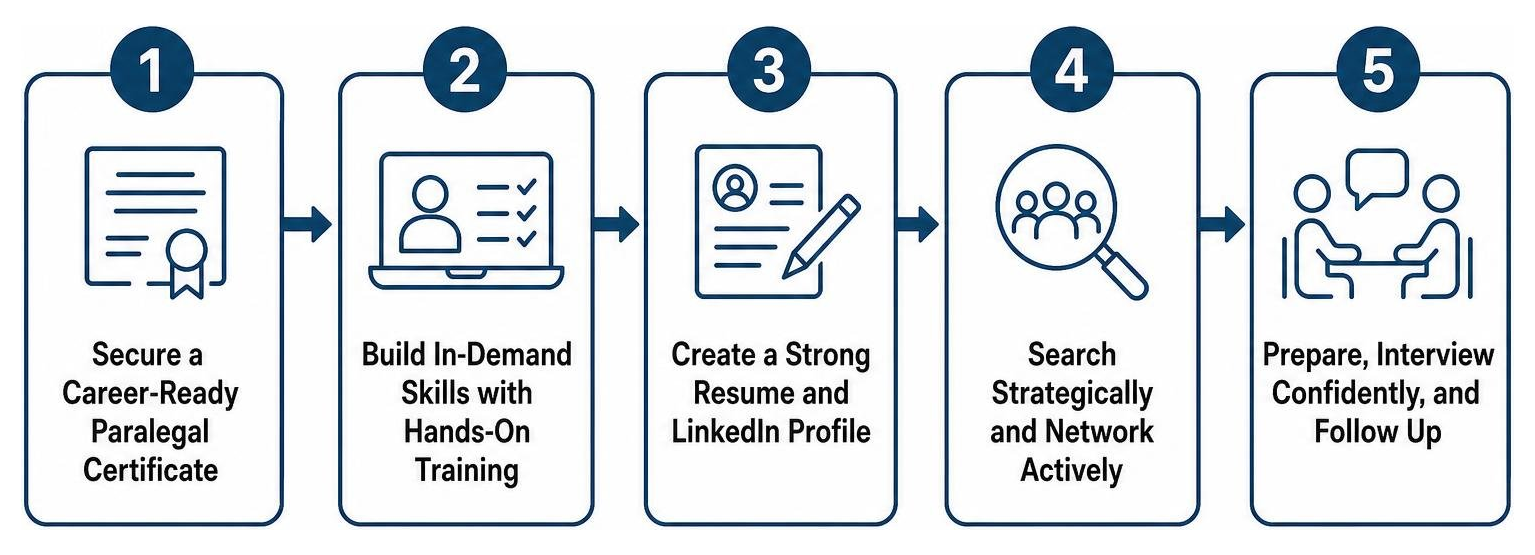
Step 1: Secure a Career-Ready Paralegal Certificate
The most direct route into the legal industry is through practical education. While some candidates spend years pursuing general legal studies degrees, employers consistently prioritize job-ready skills over lengthy theoretical coursework.

At the Paralegal Institute, we offer an accelerated 15-week paralegal certificate program designed for immediate workforce entry. Our unique selling proposition centers on an accelerated, hands-on curriculum designed and taught by practicing legal professionals like myself. We teach you how casework actually functions in a real law office.
We offer two distinct learning formats tailored to fit your life:
- Online with Live Instruction: Connect with practicing attorneys in real time, ask questions live, and collaborate with peers from anywhere.
- In-Person Classes: Learn inside a physical classroom environment at our Las Vegas, NV location.
Our program equips you with core legal research skills, precise document drafting techniques, and practical casework management abilities without wasting years of your time.
Step 2: Master Essential Technology and AI Legal Tools
Technology has transformed modern legal practice. Employers expect support staff to be comfortable navigating cloud-based case management systems, electronic filing portals, and modern document assembly tools.
To succeed in today's law office, you should build familiarity with:
- E-Filing Systems: Navigating state and federal electronic filing systems to submit pleadings, motions, and trial exhibits accurately.
- Document Management & Assembly: Using digital tools to organize vast record libraries, redact sensitive information, and auto-generate routine legal correspondence.
- Court Docketing Software: Tracking mandatory court deadlines, appearance dates, and statute of limitations timelines without error.
- Legal AI Tools: Modern practices are increasingly leveraging artificial intelligence to streamline preliminary record summaries and first-pass discovery organization. Understanding AI Tools for Paralegals prepares you to work alongside tech-forward legal teams.
Firms actively search for candidates who can reduce administrative drag. Exploring Remote Tech-Forward Legal Listings shows how automated drafting workflows and shared digital services allow legal support teams to focus on substantive strategy rather than manual paperwork.
Step 3: Navigating In-Person and Remote Paralegal Jobs
The modern workplace offers more flexibility than ever before. Depending on your lifestyle and career goals, you can explore traditional on-site positions, hybrid structures, or fully remote roles.

Remote and work-from-home positions have expanded rapidly, particularly in litigation and employment law practice areas. If you are interested in working virtually, reviewing our guide on Work From Home Paralegal options will give you clear insights into setting up a compliant home office workspace.
Many remote roles require state-specific knowledge. For instance, positions like those found in Employment Litigation Paralegal Opportunities require candidates who understand specific state court rules, local electronic filing guidelines, and regional employment laws while working completely from home.
Step 4: Tailor Your Resume for Specialized Casework
A generic resume will not stand out in a stack of applications. To capture the attention of legal recruiters and hiring partners, you must explicitly highlight your practical capabilities and familiarity with legal workflows.
When building your resume, emphasize specific, task-oriented accomplishments:
- Pleadings & Document Drafting: Detail your ability to prepare complaints, answers, subpoenas, and routine motions under attorney supervision.
- Discovery Management: Highlight experience organizing interrogatories, requests for production, and indexing document distributions.
- Trial Preparation: Mention your proficiency in assembling trial notebooks, organizing exhibit lists, and coordinating witness schedules.
- Matter & Docket Tracking: Show how you maintain strict calendaring discipline to prevent missed court appearances or filing deadlines.
Matching your resume keywords directly to the specific practice area of the posting shows the employer you understand their day-to-day operational needs.
Step 5: Execute an Effective Job Search and Interview Strategy
Finding the right position requires an active, structured search strategy. Rather than relying solely on massive job boards, target specialized legal resources and direct law firm outreach.

- Targeted Job Boards: Utilize specialized legal job listings, such as State Bar Legal Support Career Listings, to identify localized openings in private practice, state departments, and corporate legal groups.
- Direct Firm Outreach: Research law firms specializing in practice areas that align with your interest. Sending a tailored resume and cover letter directly to firm administrators often yields results before positions are broadly advertised.
- Prepare for Practical Interview Questions: Legal interviews often go beyond standard questions. Be ready to discuss how you prioritize competing court deadlines, organize high-volume record sets, and handle confidential client communications.
Practicing mock interviews with peers or instructors can help you articulate your technical skills clearly and confidently.
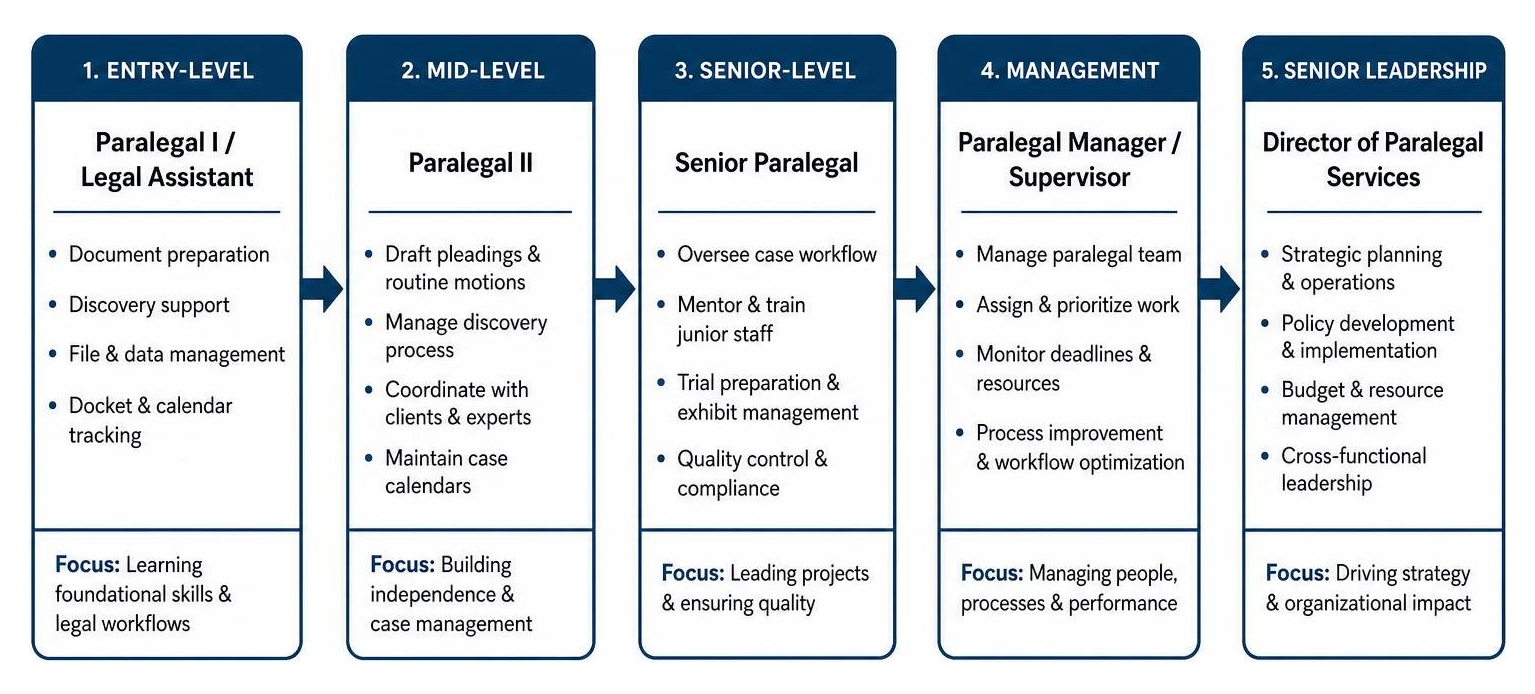
Key Responsibilities and Advancement Pathways in Legal Practice
Understanding what a legal support professional does day-to-day helps you hit the ground running on your first day. For a detailed breakdown of core duties across various legal settings, check out our Paralegal Job Description Complete Guide.
Daily Duties from Discovery to Trial Preparation
The day-to-day tasks of legal support staff vary based on practice area and case phase. The table below compares common responsibilities during the pre-trial discovery phase versus active trial preparation:
| Work Phase | Core Responsibilities | Key Deliverables |
|---|---|---|
| Pre-Trial & Discovery | • Conducting factual investigations • Drafting subpoena responses • Gathering and summarizing medical/corporate records • Coordinating client discovery interviews |
• Fact chronologies • Subpoena packets • Discovery response indexes • Record summaries |
| Trial Preparation & Hearing Support | • Assembling physical and digital trial notebooks • Marking and indexing trial exhibits • Preparing Rule 26(f) reports and ADR stipulations • Managing courtroom technology and exhibit display |
• Master exhibit binders • Witness outline packets • Courtroom presentation files • E-filing confirmation logs |
Handling these operational tasks effectively reduces administrative burden for attorneys, allowing the legal team to focus on oral advocacy and case strategy.
Career Progression to Senior Roles and Legal Management
A career in legal support offers robust pathways for long-term growth. As you gain hands-on experience and demonstrate mastery over complex casework, you can transition into higher-level specialized roles:
- Senior Litigation Paralegal: Managing complex, multi-party dockets, delegating tasks to junior staff, and assisting lead attorneys directly inside the courtroom during trials.
- Legal Operations Manager: Overseeing law firm technology adoption, vendor management, billing workflows, and operational efficiency across the firm.
- Practice Area Lead: Supervising dedicated teams within specific firm departments, such as personal injury intake, corporate governance, or intellectual property docketing.
- Compliance & Risk Specialist: Transitioning into corporate compliance departments to monitor regulatory changes, track ethics hotlines, and maintain internal policy alignment.
Building a clear roadmap early in your career helps you make informed choices about specialization. Reviewing professional Paralegal Career Advice can provide guidance as you plan your long-term progression.
Frequently Asked Questions About Paralegal Jobs
Can I land entry-level paralegal jobs without prior law firm experience?
Yes. Many legal employers are willing to hire entry-level candidates who possess practical, structured training. While prior law firm experience is helpful, having a certificate from a hands-on program demonstrates that you already understand legal document structure, court filing procedures, and terminology.
Highlighting transferable skills from past administrative, customer service, or analytical roles alongside your formal training can help you secure an Entry Level Paralegal Job.
What core technology skills do modern legal employers expect?
Employers expect proficiency in standard office suites along with legal-specific platforms. Key technical requirements include:
- Electronic Court Filing (ECF): Comfort navigating court portals to upload filings according to local court rules.
- Case Management Platforms: Understanding how to track time, manage client files, and calendar deadlines in central digital software.
- Document Manipulation Software: Expertise in PDF editing tools for bates-stamping, redacting confidential information, and creating hyperlinked hearing exhibits.
How do remote paralegal roles differ from on-site law firm positions?
While core legal duties remain similar, remote legal positions require higher individual autonomy and tech self-sufficiency. In a remote role, you manage dockets using cloud-based practice management tools, communicate primarily through secure video and messaging platforms, and coordinate client electronic signatures digitally.
On-site positions often involve more direct physical document handling, courtroom runs, and face-to-face client interaction.
Conclusion
The legal sector continues to expand, creating exceptional opportunities for individuals who possess practical, job-ready skills. By securing a practical certificate, mastering core technologies, tailoring your application materials, and executing a targeted search strategy, you can position yourself for a rewarding legal career quickly.
At the Paralegal Institute, we believe quality legal education should be fast, affordable, and focused on real-world application. Our 15-week paralegal certificate program offers live instruction taught by practicing attorneys, giving you the direct mentorship and practical skill set needed to stand out to employers.
If you are ready to take the next step toward landing your ideal position, explore our Paralegal Job Complete Guide to learn how our accelerated, live programs can help you reach your career goals today.