What It Actually Takes to Become a Corporate Paralegal
Corporate paralegal requirements can feel overwhelming at first glance — but they break down into three clear categories:
| Requirement | What Employers Typically Expect |
|---|---|
| Education | Paralegal certificate strongly preferred or required |
| Experience | 2–5+ years for most roles; entry-level positions available with a certificate |
| Skills | Legal research, document drafting, entity management, Microsoft Office, attention to detail |
Roughly 68% of corporate paralegal job listings either require or strongly prefer candidates who have completed specialized paralegal training. And with over 5,000 entry-level positions currently open nationwide, the demand is real — the question is just how to position yourself to land one.
The good news? You don't need a three-year law degree to get there. The right certificate program and a focused approach can get you job-ready faster than most people expect.
I'm Matthew Pfau, a practicing attorney and paralegal instructor who has hired and trained paralegals — and I've helped hundreds of students navigate corporate paralegal requirements to launch successful legal careers. That experience shapes everything I'll walk you through here.
Understanding the Core Corporate Paralegal Requirements
To build a successful career in corporate law, you must understand what corporate legal departments and law firms are actually looking for. Unlike litigation, which revolves around court deadlines, trials, and disputes, corporate law is transactional. It is about building businesses, keeping them compliant, and executing deals.
Because of this, the core corporate paralegals requirements focus heavily on organizational skills, business literacy, and administrative precision. Employers want professionals who can walk into an office and immediately understand how a business is structured, how contracts flow, and how to keep a legal entity in good standing with state agencies.
The primary requirements fall into three main buckets:
- Academic Foundation: Knowing the language of the law and business operations.
- Technical Competence: The ability to draft documents, manage entity databases, and research state laws.
- Practical Experience: Demonstrating that you can handle real-world tasks under the supervision of a licensed attorney.
If you are looking to enter this field in Nevada, aligning your training with local expectations is key. Reviewing Nevada legal standards provides an excellent framework for understanding the professional expectations in our local legal community.
Educational Pathways to Meet Corporate Paralegal Requirements
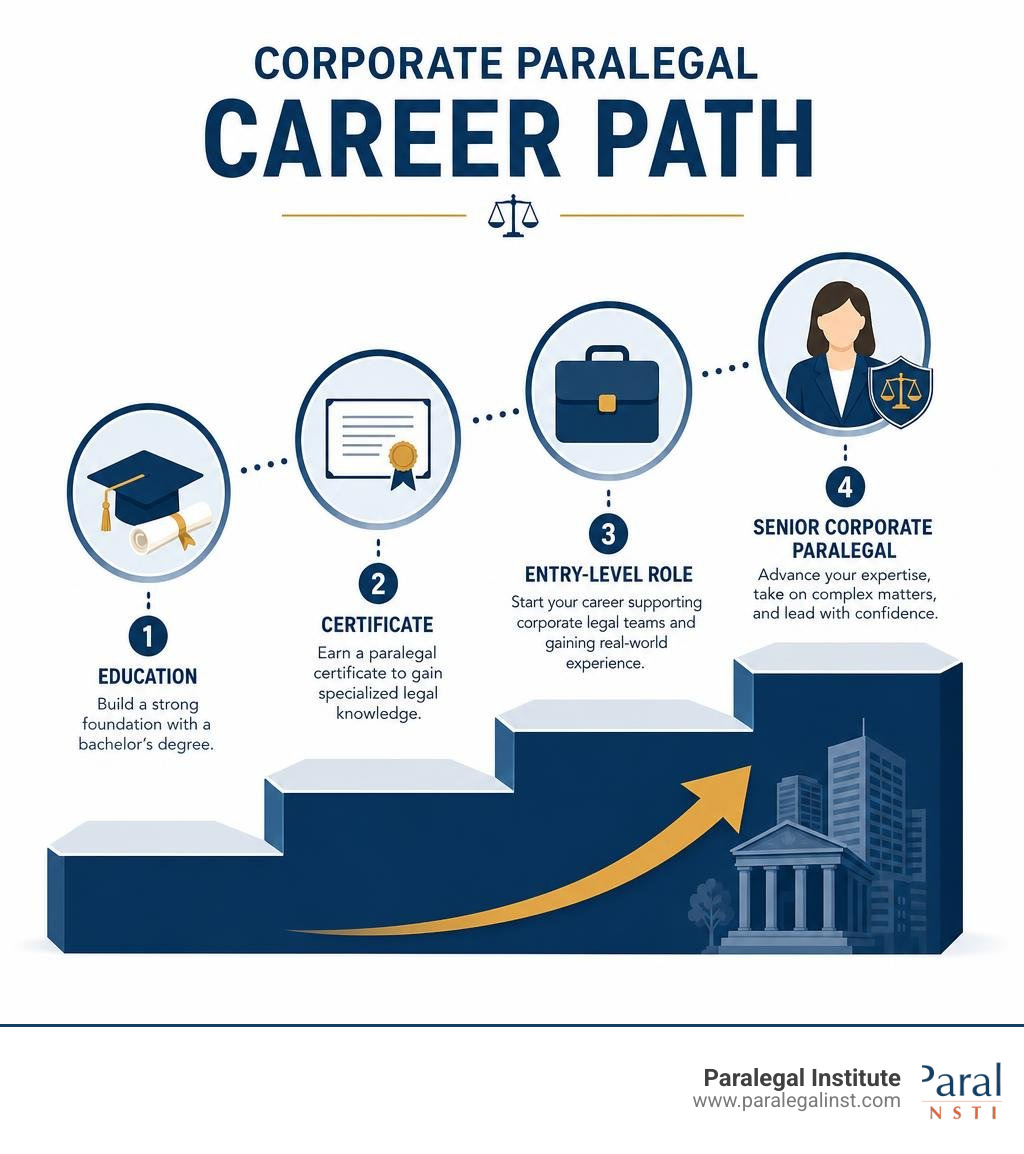
When it comes to formal education, aspiring corporate paralegals generally face a choice between two paths: a traditional multi-year degree or an accelerated paralegal certificate.
A traditional multi-year degree in paralegal studies or business administration is a common route, but it requires a massive commitment of time and resources. For many adults looking to transition into a new career, spending years in school simply is not practical.
This is why an accelerated paralegal certificate has become the preferred choice for those seeking a faster, smarter path. When comparing a paralegal certificate or degree, the certificate program stands out as a highly efficient way to meet employer demands without spending years in a classroom.
At the Paralegal Institute, we offer a 15-week paralegal certificate program designed specifically for immediate workforce entry. We focus on real-world legal training taught by practicing legal professionals. Whether you choose our online format with live instruction or our in-person classes right here in Las Vegas, you get real-time interaction and practical coursework that prepares you for the actual job on day one.
Professional Experience and Corporate Paralegal Requirements
While many job postings list multiple years of experience as a requirement, do not let that discourage you. The legal market has a constant need for fresh talent, and there are thousands of entry-level corporate paralegal jobs available for candidates who can demonstrate they have the right training.

If you are starting with zero law firm experience, you can build a competitive resume through several strategic steps:
- Target Entry-Level Roles: Look for positions titled "Junior Paralegal," "Legal Assistant," or "Corporate Practice Assistant." These roles are designed to train you on the job while utilizing your basic legal education.
- Utilize Staffing Agencies: Legal staffing agencies in Las Vegas frequently place contract or temporary paralegals. Many of these temporary assignments convert into permanent, full-time positions once you prove your work ethic and attention to detail.
- Highlight Transferable Skills: If you have worked in office administration, customer service, or corporate operations, emphasize those experiences. Managing corporate calendars, drafting business correspondence, and coordinating project logistics are highly relevant to corporate legal work.
Essential Skills and Technical Competencies for Corporate Practice
To thrive as a corporate paralegal, you must master a specific set of technical tools and soft skills. Attorneys rely on their paralegals to be the organized backbone of every transaction. If a document is missing a signature or an entity filing is late, the entire deal can fall through.
To help you understand the skills required, we have put together a comparison of how corporate paralegal requirements differ from those in litigation:
| Skill Area | Corporate Paralegal | Litigation Paralegal |
|---|---|---|
| Primary Focus | Business transactions, compliance, corporate governance | Court filings, trials, dispute resolution, discovery |
| Document Types | Articles of incorporation, bylaws, board resolutions, contracts | Pleadings, motions, subpoenas, trial briefs |
| Key Software | Entity management platforms, contract lifecycles, virtual data rooms | E-discovery databases, trial presentation software |
| Core Research | State statutes, corporate filing requirements, SEC regulations | Case law, court rules, judicial precedents |
To validate these competencies to potential employers, pursuing a paralegal skills certificate can be an excellent way to show you have mastered the practical tools of the trade.
Corporate Governance and Compliance Support
One of the most critical responsibilities of a corporate paralegal is supporting corporate governance and entity compliance. Businesses must follow strict state and federal rules to maintain their legal status. If they fail to do so, they risk losing their limited liability protection.
As a corporate paralegal, your day-to-day compliance duties will include:
- Entity Formation: Drafting and filing Articles of Incorporation, Articles of Organization, and operating agreements with state agencies, such as the Nevada Secretary of State.
- Corporate Maintenance: Preparing annual reports, maintaining corporate minute books, and tracking state filing deadlines to ensure all business entities remain in good standing.
- Board and Committee Administration: Organizing board meetings, drafting resolutions, preparing meeting agendas, and writing detailed board minutes.
- Regulatory Filings: Preparing and submitting required filings with state and federal agencies to maintain necessary business licenses and permits.
For a deeper look at what these responsibilities look like in practice, check out our essential corporate paralegal job duties guide.
Mergers, Acquisitions, and Contract Management
Corporate paralegals play an indispensable role in mergers, acquisitions, and corporate finance transactions. When businesses buy other businesses or raise capital, the legal paperwork is massive. Attorneys rely on paralegals to keep the transaction organized from start to finish.
During a corporate transaction, an entry-level corporate paralegal will typically assist with:
- Due Diligence: Organizing and reviewing corporate records, financial statements, and material contracts in virtual data rooms to identify potential legal liabilities.
- Public Searches: Coordinating UCC financing statement searches, tax lien searches, judgment searches, and bankruptcy searches to verify a target company's financial status.
- Closing Support: Preparing signature packets, drafting closing checklists, and compiling the final closing binders once a deal is finalized.
- Contract Lifecycle Management: Drafting initial contract templates, tracking renewal dates, and maintaining a centralized database of all active agreements.
For a comprehensive template of how these duties are structured in corporate legal departments, you can review this Corporate Paralegal Job Description.
How Corporate Paralegal Roles Differ from Other Specialties
Many people picture courtroom drama when they think of legal careers. However, corporate paralegal work is entirely different from litigation, real estate, or family law.
The most significant difference is the environment and the schedule. Litigation paralegals are often at the mercy of unpredictable court calendars, emergency motions, and trial prep that can require long nights and weekend work. Corporate paralegals, on the other hand, typically enjoy a much more predictable, business-oriented schedule. While transaction closings can occasionally create busy periods, the day-to-day workflow is generally stable and follows standard corporate business hours.

Furthermore, corporate paralegals develop deep business knowledge rather than focusing on adversarial court procedures. You will work closely with corporate executives, in-house counsel, and business teams to help the organization achieve its commercial goals.
If you are trying to decide which legal path is right for you, our paralegal positions guide breaks down the various specialties in detail to help you find the perfect fit.
Ethical Standards and Confidentiality in Corporate Law
Because corporate paralegals handle highly sensitive business information — including upcoming mergers, trade secrets, financial records, and executive discussions — ethical standards are paramount. A single slip of the tongue or a leaked document can have massive financial and legal consequences for a company.
Key ethical responsibilities for corporate paralegals include:
- Maintaining Strict Confidentiality: Protecting all proprietary business data and client information from unauthorized disclosure.
- Identifying Conflicts of Interest: Ensuring that the law firm or corporate legal department does not represent parties with conflicting business interests.
- Avoiding the Unauthorized Practice of Law (UPL): Remembering that paralegals are legal professionals who work under the direct supervision of licensed attorneys. You cannot give legal advice, sign legal pleadings, or set legal fees.
- Data Security Compliance: Utilizing secure document management systems and following company protocols for handling sensitive digital files.
To learn more about the ethical boundaries and professional expectations of the role, refer to our paralegal job guide.
Frequently Asked Questions About Corporate Paralegal Careers
Navigating a career change can bring up a lot of questions. Here are some of the most common questions we hear from aspiring corporate paralegals.
Do I need a law degree to become a corporate paralegal?
No, you absolutely do not need a law degree to become a corporate paralegal. Law degrees are for practicing attorneys. Paralegals are highly skilled legal professionals who support attorneys.
To enter this field, the most efficient and practical path is to earn a paralegal certificate. This credential demonstrates to employers that you have received targeted, hands-on training in corporate law, document drafting, and legal research. For more insights on how to map out your career transition, check out our paralegal career advice.
Is remote work common for corporate paralegals?
Yes, remote and flexible work setups are increasingly common in corporate law. Because corporate paralegals deal primarily with transactional documents, digital entity management systems, and virtual data rooms, much of the work can be completed from anywhere with a secure internet connection.
While many entry-level roles may require some initial in-office training to learn the company's systems, many established corporate legal departments offer flexible remote or split-schedule arrangements. You can learn more about finding these flexible opportunities in our guide to entry-level corporate paralegal roles.
What is the difference between a corporate paralegal and a legal assistant?
While some smaller offices use these terms interchangeably, there is a distinct difference in a professional corporate setting.
A legal assistant typically handles administrative and clerical tasks, such as scheduling meetings, answering phones, formatting letters, and managing physical files. A corporate paralegal, however, performs substantive legal work. This includes drafting legal contracts, conducting legal research, managing corporate entity compliance, and coordinating due diligence for major transactions.
For a detailed breakdown of these differences, read our paralegal job description guide.
Conclusion
Meeting every corporate paralegal requirement does not have to be an overwhelming, multi-year ordeal. By focusing on practical, real-world skills and choosing an accelerated, career-ready educational path, you can position yourself for immediate success in this growing legal specialty.
If you are ready to take the next step in your career, the Paralegal Institute is here to help. Our 15-week paralegal certificate program is designed and taught by practicing legal professionals who know exactly what employers are looking for. With options for live online instruction or in-person classes in Las Vegas, we provide the affordable, fast, and highly interactive training you need to launch your career with confidence.
Are you ready to build a career you love? Launch your career with our Paralegal Certificate program today.