The Unsung Heroes of Personal Injury Law
Can paralegals do personal injury work? Absolutely. They are the backbone of successful personal injury law firms, managing the critical tasks that move cases toward resolution.
Personal injury paralegals are responsible for:
- Client Communication: Serving as the primary contact for case updates.
- Document Management: Organizing medical records, police reports, and filings.
- Case Investigation: Gathering evidence and interviewing witnesses.
- Legal Research: Researching case law and legal precedents.
- Discovery Support: Drafting requests and preparing for depositions.
- Settlement Assistance: Helping calculate damages and prepare documents.
The film Erin Brockovich showcased how dedicated legal support staff can build life-changing cases. Today's personal injury paralegals continue this tradition of investigation and client advocacy.
Personal injury law involves tort cases —civil lawsuits where a person seeks compensation for harm caused by another's negligence. These cases demand meticulous attention to detail, from understanding medical terms to managing strict deadlines.
As one experienced paralegal noted, "The line between professional and personal in this job is so thin it's transparent." Paralegals become trusted advocates who guide clients through difficult times.
I'm Matthew Pfau, and after years practicing personal injury law and training paralegals, I've seen how effective they are with the right skills. My experience has shown me what aspiring paralegals need to succeed in this rewarding field.
The Paralegal's Central Role: Core Responsibilities in a PI Case
When people ask "can paralegals do personal injury" work, the answer is a resounding yes. They are essential to every successful case and the true engine of any law firm, handling the details that keep cases moving forward while attorneys focus on legal strategy. From the initial client call until the final settlement, paralegals are involved every step of the way. For a complete breakdown of what this role entails, check out our Personal Injury Paralegal Job Description.
Managing Client Communication and Case Updates
Paralegals are often the first person a potential client speaks with. They conduct the initial screening with compassion and skill, assessing if a viable case exists while making the injured person feel heard.
Once a case is accepted, the paralegal becomes the client's primary point of contact. While attorneys are often in court, the paralegal is consistently available to answer questions, explain procedures, and manage expectations. This role requires exceptional communication skills and professional empathy, as they provide regular case updates, coordinate appointments, and serve as a bridge between clients and busy attorneys.
The Masters of Organization: Documentation and Scheduling
Successful personal injury cases are built on details, and paralegals are the masters of managing those details. They gather and assemble all the pieces to create a complete picture of the client's case.

Medical record retrieval is a critical task. Paralegals request and organize records from all providers, creating summaries that help attorneys quickly grasp the extent of the injuries. They also gather police reports, witness statements, and insurance policies.
Calendaring deadlines is equally crucial, as missing a statute of limitations can end a case. Paralegals track these dates and ensure attorneys have ample notice. They also handle the complex logistics of coordinating depositions, mediations, and court hearings, allowing attorneys to focus on legal strategy.
Paralegal vs. Case Manager: Understanding the Key Differences
While the terms "paralegal" and "case manager" are sometimes used interchangeably, they have distinct roles.
| Feature | Personal Injury Paralegal | Personal Injury Case Manager |
|---|---|---|
| Primary Focus | Substantive legal work, research, drafting, trial prep. | Administrative support, client liaison, records/billing. |
| Training | Formal legal education (paralegal training). | Often administrative or client service background. |
| Key Tasks | Drafting pleadings, legal research, deposition summaries. | Client intake, obtaining medical records, tracking treatment. |
| Legal Authority | Performs substantive legal tasks under attorney supervision. | Primarily administrative tasks. |
| Client Interaction | High, discussing legal strategy and case progression. | High, focusing on treatment, billing, and general updates. |
The key difference is that paralegals perform substantive legal work, such as drafting legal documents and researching case law. Case managers focus more on administrative tasks like tracking medical treatment and communicating with providers. In smaller firms, one person may handle both roles, but paralegals require formal legal training to manage the complex legal tasks their position demands.
From Intake to Settlement: A Paralegal's Journey Through a PI Case
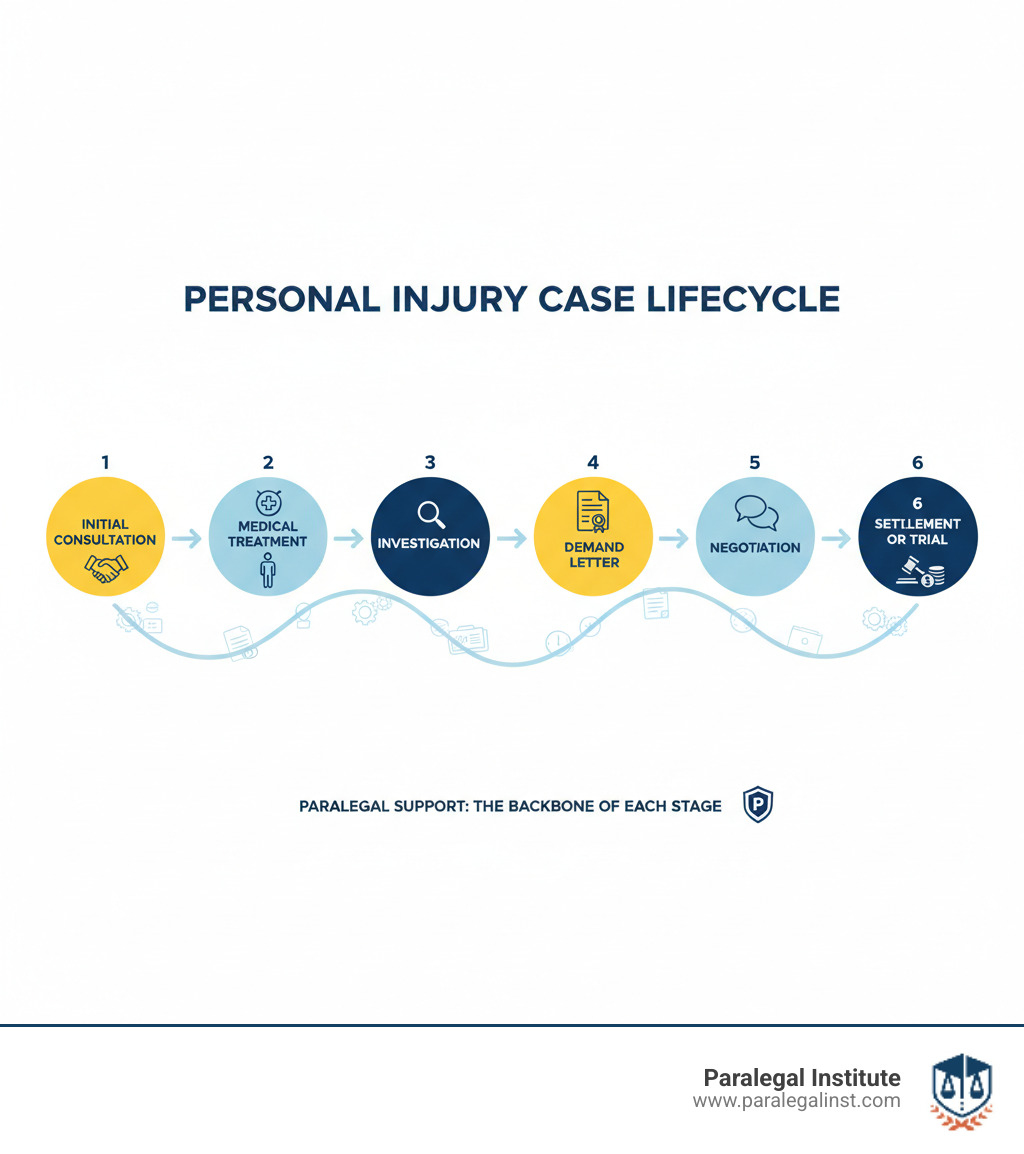
Can paralegals do personal injury work at every stage of a case? Absolutely. They are essential at each milestone, from intake to settlement.
Personal injury cases move through distinct phases: pre-litigation, litigation, settlement negotiations, and sometimes trial preparation. Paralegals keep everything organized and moving forward throughout this journey. The variety of tasks, from client interviews to drafting settlement documents, keeps the work engaging. Our Building Practical Skills in Paralegal Training program emphasizes this hands-on experience.
Initial Case Investigation and Fact-Finding
The paralegal's investigative work begins with the first client call, setting the foundation for the entire case.
During client intake interviews, paralegals gather essential details about the incident with sensitivity and skill. Screening potential cases involves helping attorneys assess merit by considering the statute of limitations, injury severity, and ability to prove fault.
The gathering of initial evidence is like detective work. Paralegals obtain police reports, accident photos, witness information, and initial medical reports. They also assist in identifying defendants and reviewing insurance policies to determine who is responsible and what coverage is available.
The Heart of the Matter: The Paralegal's Role in Discovery
Discovery is the formal exchange of information between parties, and it's where paralegals act as master organizers.

- Drafting discovery requests: Paralegals strategically draft interrogatories (written questions) and requests for documents to obtain evidence that strengthens the client's case.
- Responding to interrogatories: They work with clients to provide accurate answers to the opposing counsel's questions, ensuring responses do not harm the case.
- Document production: They organize and produce all requested materials, such as medical and employment records, ensuring nothing is lost.
- Deposition summaries: After depositions, paralegals create concise summaries that highlight key testimony and inconsistencies for attorneys.
- Organizing exhibits: They carefully mark and organize exhibits for use in depositions, mediation, or trial.
Assisting with Settlement and Preparing for Trial
Most personal injury cases settle, but paralegals must prepare for either outcome.
Drafting demand letters is a key task. These documents tell the client's story, detail the injuries, and present a clear demand for compensation. A well-written demand can lead to a favorable settlement.
Paralegals also assist in calculating damages, documenting all economic losses like medical bills and lost wages, and helping quantify non-economic damages like pain and suffering. When a settlement is reached, they handle the preparation of settlement documents.
For cases heading to trial, paralegals create trial notebooks and compile witness and exhibit lists, ensuring the attorney has everything needed to focus on courtroom strategy.
So, Can Paralegals Do Personal Injury? The Essential Skills and Knowledge Needed
The answer to "can paralegals do personal injury" is a firm yes, but success requires a unique mix of legal expertise, medical knowledge, and interpersonal skills. While attorneys focus on legal strategy, paralegals understand every case detail, from interpreting an MRI to tracking down a crucial piece of evidence. Our Legal Research Skills Training helps build this foundation.
Essential Legal Knowledge for Personal Injury Paralegals
Paralegals must understand the legal principles that drive personal injury cases to anticipate attorney needs and draft effective documents.
- Tort law: This is the backbone of personal injury. Paralegals need to understand different types, from negligence to strict liability.
- Negligence theory: A skilled paralegal understands the four elements—duty, breach, causation, and damages—and can spot where evidence supports or weakens a claim.
- Civil procedure: Knowledge of filing deadlines, document formatting, and court rules is essential to keep cases on track.
- Case law research: The ability to find and understand relevant court decisions provides tremendous value.
- Statutes of limitations: Understanding these deadlines is critical to protecting clients and firms from malpractice.
Why Medical Fluency is a Paralegal's Superpower
In personal injury, understanding medicine is often as important as understanding law. Every case revolves around injuries and medical records.
A paralegal who is fluent in medical abbreviations(like 'fx' for fracture) and medical terminology can quickly decipher records. Knowledge of anatomy and physiology helps them grasp the full impact of injuries and identify inconsistencies.
Medical chart review is a key skill. Experienced paralegals can efficiently pull the most important information from hundreds of pages of records. Understanding specific conditions like radiculopathy allows them to communicate the real-world impact on a client's life to insurance adjusters and opposing counsel. As one veteran paralegal said, "The medicine is where cases are won or lost."
What a paralegal can do in a personal injury case to become a 'rockstar'
Exceptional paralegals are proactive and strategic.
- Master medical knowledge: Treat it like a second specialty to become more valuable.
- Become the statute of limitations expert: Know all deadlines, exceptions, and special circumstances.
- Develop template systems: Create and refine form letters and outlines to improve efficiency.
- Build expert databases: Track information on medical specialists and other experts.
- Perfect medical record retrieval: Develop relationships and systems to avoid bottlenecks.
- Understand litigation processes: Knowing what happens if a case doesn't settle improves preparation.
- Anticipate attorney needs: Think several steps ahead to provide proactive support.
This proactive approach makes a paralegal an indispensable problem-solver.
Building a Career as a Personal Injury Paralegal
If you're wondering can paralegals do personal injury work as a long-term career, the answer is yes. It is one of the most rewarding paths in the legal field, offering a chance to make a real difference in people's lives while building a stable, well-compensated career. You help families rebuild, ensure injured workers get care, and hold negligent parties accountable. For those considering this path, our guide on How to Get a Paralegal Job provides valuable insights.
Educational Pathways and Essential Training
A successful career starts with proper training that emphasizes practical skills. Personal injury work demands that you hit the ground running.
Paralegal training programs are designed to provide the essential legal knowledge and hands-on experience for this role. The best programs focus on real-world applications, teaching you to draft pleadings, manage medical records, and communicate with clients. The curriculum should cover legal research, legal writing, civil procedure, and tort law, along with client communication and case management.
The key is finding a program taught by practicing legal professionals who know what skills employers need. Theory is important, but knowing how to draft a compelling demand letter is what makes you valuable from day one.
Career Outlook and Growth in the Field
The career outlook for personal injury paralegals remains exceptionally strong. The U.S. Bureau of Labor Statistics projects employment growth of 12% through 2033 for paralegals and legal assistants, much faster than the average for all professions.
This growth reflects the increasing complexity of personal injury cases and the value skilled paralegals provide. The median annual salary for paralegals is substantial, and specializing in personal injury often commands higher compensation, particularly in metropolitan areas.
Specialization within personal injury opens more opportunities, whether at plaintiff firms representing individuals or defense firms representing insurance companies. The growing reliance on paralegals as a cost-saving measure continues to expand the scope of their work, making experienced paralegals indispensable. The field also offers excellent career advancement opportunities for those who continuously improve their skills. Many become senior paralegals, supervisors, or office managers.
Frequently Asked Questions about Personal Injury Paralegals
Let's address the most common questions people ask about can paralegals do personal injury work and what it takes to succeed.
What are the legal limitations for a personal injury paralegal?
While paralegals handle critical work, they must respect clear ethical boundaries. They cannot practice law.
- Paralegals cannot give legal advice. They can explain a legal concept, but cannot advise a client on a course of action, such as whether to accept a settlement.
- They cannot set legal fees or negotiate fee agreements with clients.
- Court representation is off-limits. They cannot speak for a client in court.
- All work must be supervised by a licensed attorney. The supervising lawyer must review and approve all substantive work.
These limitations create a clear framework that allows paralegals to perform meaningful work while ensuring clients receive proper legal representation.
How long does it take to get the training to become a personal injury paralegal?
You don't need years of schooling to start a career as a personal injury paralegal. Many successful paralegals complete their training in just 15 weeks through focused, intensive programs.
These accelerated programs teach the practical skills you need on the job, such as drafting demand letters and organizing medical records. The key is finding training that emphasizes hands-on experience and is taught by practicing legal professionals who can provide real-world insights. For those eager to start a stable career helping injured clients, these focused programs offer the fastest path to employment.
Why are paralegals so important for the success of a personal injury case?
Personal injury attorneys cannot handle complex cases effectively without skilled paralegals.
- Cost-effectiveness: Using paralegals for tasks like document review and client communication reduces the overall cost of legal services for the client.
- Improved efficiency: Paralegals keep cases moving forward by handling administrative and organizational tasks while the attorney focuses on legal strategy.
- Better client service: As the primary point of contact, paralegals build strong relationships and provide consistent updates and reassurance to clients.
- Thorough case preparation: Paralegals are the ones who master the details of a case, from spotting inconsistencies in medical records to organizing trial exhibits. This detailed work is often the difference between a good settlement and a great one.
Paralegals are not just support staff; they are essential partners in achieving justice for injured clients.
Your Path to Becoming an Indispensable Legal Professional
So, can paralegals do personal injury work? The answer is clear: they are absolutely essential to every successful case. These dedicated professionals are the backbone of legal teams, managing everything from client intake to settlement negotiations.
A paralegal's unique combination of legal knowledge, medical fluency, and organizational skill creates the foundation for winning strategies. They provide practical support and emotional reassurance to clients navigating a difficult time. The best paralegals become indispensable advisors who understand both the legal and human elements of a case.
At The Paralegal Institute, our 15-week paralegal training program is designed to prepare you for this demanding and rewarding career. Taught by practicing legal professionals, our program focuses on the practical, hands-on skills that law firms need now.
Law firms recognize that skilled paralegals improve outcomes. When you can draft a compelling demand letter, organize complex medical records, and communicate effectively with clients, you become the kind of professional every personal injury firm wants.
Your journey toward becoming an indispensable legal professional starts with the right training. Ready to transform your passion for helping others into a powerful profession? Explore our legal support staff training options to build the skills that make personal injury paralegals so essential to the legal system.