
Charting Your Course: The Power of Legal Office Training
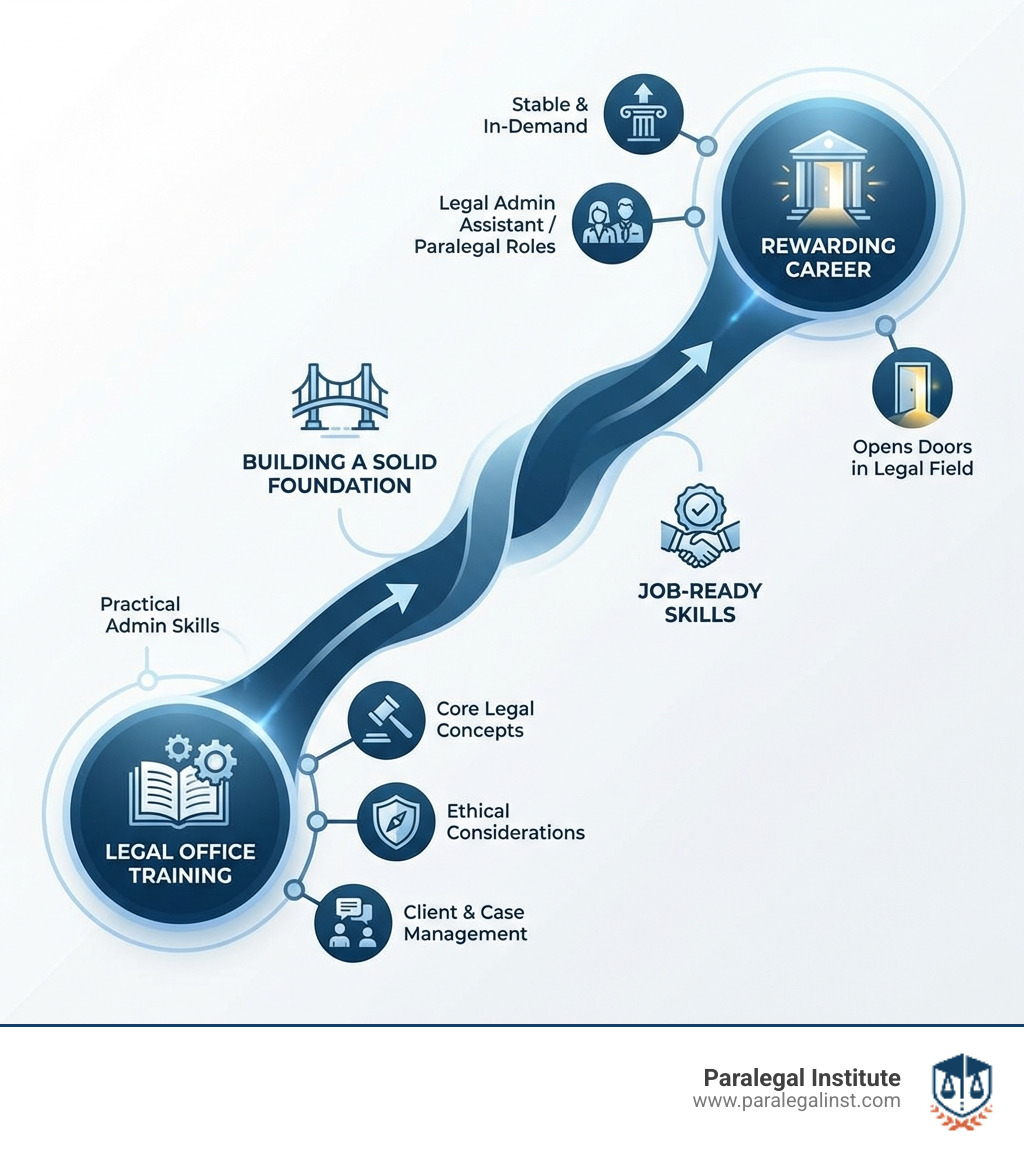
Looking for training that opens doors in the legal field? Legal office training is your direct path to a rewarding career. It equips you with:
- Practical administrative skills
- Core legal concepts and terminology
- Ethical considerations and professional conduct
- Client communication and case management expertise
Starting on a new career path can feel overwhelming. But understanding the vital skills, knowledge, and ethical practices needed to thrive in a legal setting doesn't have to be. This guide will help you build a solid foundation for a stable and in-demand profession, preparing you for roles like legal administrative assistant or paralegal.
I'm Matthew Pfau, a practicing U.S. attorney and instructor. My experience hiring and training legal professionals inspired me to develop Paralegal Institute's curriculum, offering hands-on legal office training for aspiring legal careers.
Understanding Key Roles in a Legal Office
The legal field is a dynamic environment, supported by a team of dedicated professionals. While attorneys lead the charge, the efficiency and success of any law firm or legal department heavily rely on the expertise of its support staff. Understanding the distinct roles and responsibilities within a legal office is the first step toward finding your niche and pursuing effective legal office training.
At the Paralegal Institute, we understand that each role, from legal administrative assistant to paralegal, contributes uniquely to the overall function. These positions often overlap, but each carries specific duties that require specialized skills and knowledge. We aim to equip our students with the foundational skills that are transferable and adaptable across these vital roles, ensuring they are job-ready from day one.

BLS projects little or no change in paralegal employment from 2025 to 2035, but still expects about 40,800 openings a year, mostly as people retire or change careers ( BLS). For a deeper dive into how these roles compare, explore our guide on Legal Secretary vs Paralegal.
The Legal Administrative Assistant
Often the first point of contact in a legal office, the legal administrative assistant (LAA) is the organizational linchpin. Their role is primarily administrative, ensuring the smooth day-to-day operations of the office. Essential skills for an LAA include impeccable client communication, managing busy schedules, and handling general office administration.
LAAs are responsible for tasks such as:
- Client Communication: Answering phones, greeting clients, managing correspondence, and maintaining healthy client relations. Effective communication skills are paramount in this role to uphold professionalism within the legal sector.
- Scheduling and Calendaring: Keeping track of appointments, court dates, deadlines, and meetings for attorneys and paralegals.
- Office Administration: Managing supplies, maintaining office equipment, organizing physical and digital files, and processing routine information requests.
- Basic Document Preparation: Preparing and filing legal documents, which involves formatting, proofreading, and ensuring proper citations. They simplify complex processes used to prepare legal documents and implement robust filing systems.
Legal administrative assistants are crucial for managing workload and staying organized in the demanding legal field. Their efficiency allows lawyers and paralegals to focus on more substantive legal work. If you're looking for an entry point into the legal world with a strong administrative focus, this could be your calling. Find more about opportunities in this area with our resources on entry level legal assistant jobs near me.
The Paralegal
A paralegal performs substantive legal work under the supervision of an attorney. Unlike legal administrative assistants, paralegals are deeply involved in the legal aspects of a case, requiring a more extensive understanding of legal principles and procedures. Their work is critical to case progression and strategy.
Key responsibilities and skills for paralegals include:
- Legal Research: Conducting thorough research using various resources, including computerized legal research databases, to find relevant statutes, case law, and regulations.
- Document Drafting: Preparing a wide array of legal documents, such as pleadings, motions, discovery requests, subpoenas, contracts, and wills. This requires strong legal writing skills and an understanding of specific legal terminology and formats.
- Case Management: Organizing and managing case files, tracking deadlines, coordinating with clients and witnesses, and maintaining all relevant documentation. Effective case management strategies are vital.
- Client Interviews: Assisting attorneys in interviewing clients and witnesses, gathering crucial information for cases.
- Trial Preparation: Assisting with all aspects of trial preparation, including organizing exhibits, preparing witness lists, and drafting trial briefs.
Paralegals are the backbone of legal teams, providing essential support that directly impacts legal outcomes. Their ability to understand legal procedures and terminology makes them indispensable. For those interested in a more hands-on legal role, becoming a paralegal offers a challenging and rewarding career. To learn more about the extensive contributions of paralegals, explore the role of paralegals in law firms.
Foundational Legal Office Training: Core Skills and Knowledge
Effective legal office training goes beyond simply learning tasks; it's about developing a comprehensive skill set that blends administrative proficiency with a solid understanding of legal concepts and ethical conduct. At the Paralegal Institute, we focus on building practical skills for immediate workforce entry, ensuring our graduates are not just knowledgeable, but truly job-ready.
Our curriculum is designed by practicing legal professionals, offering a real-world perspective on what it takes to succeed. This means you'll gain both the hard skills—like document drafting and legal research—and the soft skills—such as critical thinking, communication, and attention to detail—that are essential in any legal setting. We believe that hands-on, practical application is key to building confidence and competence. Find how we focus on building practical skills in paralegal training.

Essential Administrative and Technical Skills
The smooth operation of any legal office hinges on efficient administrative and technical support. Our legal office training emphasizes these foundational skills, ensuring you can manage the day-to-day demands with confidence and precision.
Key administrative and technical skills include:
- Legal Document Formatting: Mastering the specific layouts and conventions for various legal documents, from pleadings to contracts. This ensures all paperwork is professional and compliant.
- Filing Systems: Implementing and maintaining robust physical and electronic filing systems for case files, client communications, and other essential documents. Organized records are crucial for efficient legal practice.
- Billing Procedures: Understanding and assisting with client billing, expense tracking, and other financial aspects of running a legal office.
- Time Management: Effectively prioritizing tasks, managing deadlines, and optimizing workflows to support multiple attorneys and cases simultaneously. This is critical in a legal environment.
- Records Management: Ensuring the proper creation, use, maintenance, and disposition of legal records, adhering to retention policies and confidentiality requirements.
- Technology Proficiency: Gaining familiarity with commonly used word and data processing programs, and other office technology essential for legal practice. While we don't focus on specific proprietary software, we ensure you have a strong grasp of the underlying principles. To learn more about digital tools in the legal field, visit legal technology for paralegals.
These skills are not just about routine tasks; they are about contributing to the overall organization and efficiency of the legal practice. Mastering them means you become an indispensable asset. For tips on keeping everything in order, check out strategies for paralegals to stay organized.
Key Legal Concepts and Research
Beyond administrative duties, a successful legal professional needs a strong grasp of fundamental legal concepts and the ability to conduct thorough legal research. Our legal office training provides an overview of the legal system, ensuring you understand the context in which you'll be working.
Core legal concepts and research skills covered include:
- U.S. Judicial System: Understanding the structure of our government and the judicial system, including federal and state courts, jurisdiction, and venue.
- Legal Terminology: Becoming fluent in the specialized language of the law, which is essential for accurate communication and document drafting.
- Torts: Learning about civil wrongs that cause someone to suffer loss or harm, resulting in legal liability for the person who commits the tortious act.
- Contracts: Understanding the basics of legally binding agreements, including formation, acceptance, consideration, enforcement, and breach.
- Civil Litigation Process: Gaining knowledge of the steps involved in a civil lawsuit, from the initial client overview and investigation stage to pretrial litigation, pleadings, discovery, settlement, and trial/appeal.
- Legal Writing: Developing clear, concise, and persuasive legal writing skills, including drafting various legal documents and preparing memoranda. We focus on effective sentences, defined terms, and reviewing legal documents for accuracy and impact. Improving your legal writing skills is crucial; find out more at improving your legal writing skills in paralegal courses.
- Legal Research: Learning how to effectively find and analyze legal authorities, including statutory and case law, using various resources. Our comprehensive guide on legal research guide for paralegals offers in-depth insights. For example, understanding constitutional law principles, such as those discussed in cases like Miranda v. Arizona (FLETC Talk), is foundational for many legal support roles.

A strong foundation in these areas allows you to contribute meaningfully to legal strategy and case progression, moving beyond purely administrative support.
Ethical and Professional Conduct
The legal profession is built on trust and integrity. Therefore, ethical considerations are not just a component of legal office training; they are the bedrock upon which all legal work rests. At the Paralegal Institute, we instill a deep understanding of professional responsibility.
Key ethical principles and considerations include:
- Attorney-Client Privilege: Understanding the confidential nature of communications between attorneys and their clients, and the importance of safeguarding this privilege.
- Confidentiality: Maintaining strict confidentiality regarding all client matters and sensitive information encountered in the legal office. Breaching confidentiality can have severe consequences for both the firm and the individuals involved.
- Conflict of Interest: Recognizing and avoiding situations where a legal professional's personal interests or duties to another party could conflict with the interests of a client.
- Unauthorized Practice of Law (UPL): Clearly understanding the boundaries of a paralegal's role and refraining from performing duties that constitute the practice of law, which are reserved for licensed attorneys.
- Professionalism: Adhering to high standards of conduct, demeanor, and communication in all interactions with clients, colleagues, opposing counsel, and the court.
Ethical actions and professional conduct are paramount for preserving public trust and confidence in the judiciary and the value of the rule of law. This demonstrates a legal professional's pledge to clients, attorneys, and the public. Our training emphasizes these crucial aspects to ensure you uphold the highest standards throughout your career. Dive deeper into these critical topics with our insights on legal ethics in paralegal training.
Choosing Your Training Path: Programs and Formats
Deciding on the right legal office training program is a pivotal step towards launching your career. With various options available, select a path that aligns with your career goals, learning style, and timeline. At the Paralegal Institute, we pride ourselves on offering an accelerated, practical, and career-focused approach designed to get you job-ready quickly.
When identifying the best paralegal program for your career goals, consider the duration, curriculum focus, and instructional methods. We believe in providing a clear, direct route into the legal field.
Types of Legal Office Training Programs
The landscape of legal education offers different avenues, each with its own advantages. We specifically focus on providing an accelerated path that prioritizes practical skills and immediate workforce entry.
Our 15-week paralegal program is specifically designed for adults seeking a fast, affordable, career-ready path into the legal field. Unlike longer programs that often include extensive general education courses, our curriculum is laser-focused on the essential legal knowledge and practical skills you'll use every day in a legal office. We eliminate the fluff and get straight to what matters, making us a superior choice for those ready to jumpstart their legal career. For a more comprehensive understanding of your options, consult our guide to paralegal programs.
The Advantage of Live Instruction
In the field of legal office training, the method of instruction can significantly impact your learning experience and readiness for the workforce. While many online programs are self-paced and asynchronous, we firmly believe in the power of live instruction, whether in-person or online.
Here's why live instruction is a game-changer:
- Real-time Feedback: Our instructors, who are practicing legal professionals, provide immediate feedback on assignments, questions, and discussions. This direct interaction helps clarify complex concepts and refine your understanding on the spot.
- Interactive Learning: Live classes foster dynamic discussions, allowing you to engage with the material and your peers actively. This collaborative environment simulates a real legal office, preparing you for teamwork and professional interaction.
- Networking with Peers: Building connections with your classmates can lead to valuable professional relationships and support networks as you start on your career.
- Direct Access to Instructors: You have the opportunity to ask questions, seek mentorship, and benefit from the real-world experience of your instructors in real-time. This is invaluable for gaining practical insights that textbooks can't provide.
At the Paralegal Institute, we offer both in-person classes in Las Vegas, NV, and online classes with live instruction. Our online format is not just a series of videos; it's a live, interactive classroom experience delivered remotely. This ensures that regardless of your location, you receive the same high-quality, engaging education as our in-person students. This live interaction is a cornerstone of our curriculum, distinguishing us from many other programs. To learn more about our live online offerings, visit our online paralegal program page.
Career Outlook and Professional Growth
The legal field offers a steady job market for skilled administrative professionals and paralegals. Pursuing comprehensive legal office training is not just about acquiring skills; it's about investing in a stable and rewarding career.
Even with flat overall growth, BLS expects about 40,800 paralegal openings a year through 2035.
This positive outlook means that individuals with the right training and practical skills are highly sought after. Continuous learning and professional development are also key to advancing your career in this dynamic field. For more detailed insights into career paths, explore our paralegal career information.
Why Legal Office Training is a Smart Career Move
Choosing the right legal office training program is a strategic decision that can dramatically accelerate your entry into a fulfilling career. Our approach at the Paralegal Institute is specifically designed to maximize your career prospects.
Here's why our legal office training is a smart career move:
- Faster Entry into the Legal Field: Our accelerated 15-week program means you can transition from student to working professional much quicker than with traditional, longer programs. This allows you to start earning and gaining real-world experience sooner.
- Practical Skill Development: Our curriculum, designed and taught by practicing legal professionals, focuses exclusively on the hands-on skills employers demand. You'll learn what you need to know to be effective from day one, without spending time on irrelevant academic coursework.
- Steady Opportunity: With openings arising each year as people retire or change careers, your investment in specialized legal office training positions you well to compete for them.
- Foundation for Future Legal Careers: This training is an excellent stepping stone. The comprehensive understanding of legal concepts, procedures, and ethics you gain provides a solid foundation for continued professional development and advancement within the legal sector. Continuous learning is vital for long-term success.
We are dedicated to providing an affordable, career-ready path that equips our students with the confidence and competence to excel. Our high job placement rates are a testament to the effectiveness of our practical, live-instruction model.
Conclusion: Start Your Legal Career with the Right Training
Starting on a career in the legal field is an exciting and rewarding endeavor. Through comprehensive legal office training, you can equip yourself with the essential skills, knowledge, and ethical grounding needed to thrive in roles such as a legal administrative assistant or paralegal. We've explored the distinct responsibilities of these crucial positions, the foundational administrative and legal skills required, and the paramount importance of ethical conduct.
At the Paralegal Institute, we believe in providing a direct, accelerated path to success. Our 15-week program, taught by practicing legal professionals, focuses on practical, hands-on training and live instruction, ensuring you gain the confidence and competence to immediately contribute to a legal office. This career-focused approach distinguishes us from longer, more theoretical programs, getting you job-ready faster and more affordably.
The legal profession is growing, with a strong demand for skilled support staff. By choosing the right legal office training, you're not just starting a job; you're building a foundation for a resilient and impactful career. Are you ready to take the next step toward legal prowess?
Explore our hands-on paralegal training courses and find how we can help you achieve your career aspirations.