
Why Legal Research Platforms Matter for Modern Legal Practice
Legal research platforms are specialized tools that help legal professionals quickly find and analyze case law, statutes, regulations, and secondary sources. Unlike general search engines, these platforms provide curated legal content, strong filtering, and citation tools that support accurate, defensible research.
Key differences between legal research platforms:
| Platform Type | Cost | Best For | Key Features |
|---|---|---|---|
| Premium Paid(LexisNexis, Bloomberg Law) | Subscription-based | Larger firms, complex matters | Deep libraries, citators, litigation tools, AI features |
| Mid-Tier(Fastcase, Casetext) | Lower cost or bar-member access | Solo and small firms | Broad primary law, practical tools, streamlined research |
| Free(Google Scholar, CourtListener, LII) | No cost | Students, public, tight budgets | Core primary law, basic filters, limited analysis |
The legal profession has moved from physical libraries to digital research. In practice, the difference is simple: good platform skills save time and reduce risk. For paralegals, that means faster casework support, better cite checking, and more reliable research trails.
I am Matthew Pfau, a practicing attorney who teaches at the Paralegal Institute in Las Vegas, Nevada. In my work supervising legal teams, I have seen that comfort with legal research platforms is one of the clearest indicators that a new paralegal is ready to contribute on day one.
The Impact of AI on Modern Research
AI has reshaped legal research platforms, moving them beyond keyword search into tools that can summarize, organize, and surface patterns across large sets of legal authorities. For paralegals, the practical takeaway is that AI can speed up first-pass research, but it does not replace careful verification.

Here is what AI is doing inside modern platforms:
- Natural-language search: Instead of only Boolean strings, many tools let you ask questions in plain English and return more targeted results.
- Automated summarization: AI can produce quick summaries of opinions and pull out key holdings, facts, and procedural posture, which helps you decide what to read first.
- Brief and document analysis: Some systems can review a draft and identify cited authorities, missing citations, or additional on-point cases to consider.
- Issue spotting and connections: AI may identify related concepts and authorities you might not think to search, which can improve completeness.
Important limitation: AI output must be checked against primary law. Paralegals should still verify quotes, citations, and whether a case remains good law using the platform's citation tools.
At the Paralegal Institute, we focus on using these tools the way real legal employers expect: efficient first-pass research plus careful validation. For more background, see AI in Legal Field and AI Tools for Paralegals.
Top-Tier Paid Platforms for Law Firms
For many law firms and legal departments, paid legal research platforms are a practical necessity. They typically provide broader coverage, stronger editorial improvements, and dependable citator functionality for validating authorities.
Among commonly used paid options, LexisNexis, Bloomberg Law, and Fastcase are frequently considered:
- LexisNexis: A major provider of legal research content across jurisdictions, with extensive primary and secondary materials and built-in tools for validating and tracking citations. Learn more at LexisNexis Advance.
- Bloomberg Law: Combines legal research with litigation-focused resources and a large docket and filings collection.
- Fastcase: Widely used and, in some cases, available through bar membership arrangements. It can be a cost-conscious way to access a broad primary-law database.
For paralegals, the goal is not brand loyalty. It is competence: knowing how to find controlling authority, confirm currency, and document your research path. If you are building those skills for entry-level work, our training emphasizes hands-on use of modern tools and workflows. See Legal Technology for Paralegals.
How is AI changing the landscape of legal research platforms?
AI features vary by vendor, but the most useful changes are practical:
- Natural language processing (NLP): More flexible searching when you start with a plain-English legal question.
- Automated summarization: Faster review of long cases so you can prioritize what to read in full.
- Brief analysis: Tools that compare a draft to relevant authority and highlight potential gaps.
- AI research assistants: Some platforms offer assistants that help generate a starting research trail or organize results. Treat this as a starting point and always verify with primary sources and citator tools.
When used correctly, these tools help paralegals work faster while maintaining accuracy. For additional context, see Legally AI.
Advanced litigation analysis in legal research platforms
Some platforms go beyond research and support litigation-focused work such as:
- Docket tracking: Monitoring filings and deadlines across cases.
- Expert witness information: Databases and history to support vetting and preparation.
- Judicial analytics: Data-driven summaries of prior rulings and patterns.
These features can be powerful, but they do not change the basics: confirm jurisdiction, confirm currency, and confirm that your citations support the proposition you are using. For a step-by-step approach, review our Legal Research Guide for Paralegals.
Essential Free Legal Research Platforms for Professionals
Not every student or entry-level professional has immediate access to paid legal research platforms. Free resources can still be extremely useful for learning core research skills, pulling primary law, and double-checking citations.
Here are several strong free options:
- Google Scholar Case Law: Helpful for quick case lookups and jurisdiction filtering. It can be a solid starting point, especially when you already have a party name or citation.
- CourtListener: Provided by the Free Law Project, with a large collection of federal and state opinions and search tools.
- Caselaw Access Project (CAP): A Harvard Law School project focused on digitized historical U.S. case law.
- Legal Information Institute (LII): Cornell's Legal Information Institute (LII) provides free access to many core U.S. legal materials and includes Wex, a helpful legal dictionary and encyclopedia.
Free tools are best used as part of a careful workflow, especially when you need to be certain your authorities are current and still good law. For more guidance, see Reliable Sources for Paralegal Research.
How do free and paid legal research platforms differ?
The biggest differences are usually:
- Content depth
- Paid platforms often include more complete coverage plus integrated secondary sources (treatises, practice guides, and editorial improvements).
- Free platforms are often strongest on primary law, with less integrated analysis.
- Citator reliability
- Paid platforms typically have robust citator tools to help you validate authorities.
- Free platforms may show citing references, but they generally require more manual checking.
- Workflow tools and efficiency
- Paid platforms often include better filtering, alerting, saving, and organization features.
- Free platforms can work well, but may require more steps to reach the same confidence level.
If you are training for real-world legal work, it helps to know how to use both: free tools for access and quick checks, and paid tools when your employer provides them. For students building a toolkit, see Best Tools and Resources for Paralegal Students.
Critical Features for Platform Evaluation
When evaluating legal research platforms, look past the brand name. The best choice is the one that matches your jurisdictional needs, practice area, and day-to-day workflow.
Key features to evaluate:
- Content coverage
- Primary law: cases, statutes, regulations, rules
- Secondary sources: treatises, practice guides, legal encyclopedias, and analysis
- Citation validation (citator tools): A dependable method to confirm whether a case is still good law and how it has been treated.
- Search functionality
- Boolean and proximity searching
- Filters by jurisdiction, court, date range, document type
- AI capabilities (where available)
- Natural-language search
- Summaries and document analysis
- Research assistants (always verify results)
- Usability: Clean interface, easy saving and organization, and research history that can be documented.
- Mobile access: Useful when you need to check an authority away from your desk.
Here is a simplified comparison of content coverage and AI capabilities:
| Feature/Platform Type | Premium Paid (e.g., LexisNexis, Bloomberg Law) | Mid-Tier (e.g., Fastcase, Casetext) | Free (e.g., LII, Google Scholar) |
|---|---|---|---|
| Content Coverage | Extensive primary and secondary materials | Broad primary, some secondary | Core primary, limited secondary |
| AI Capabilities | Advanced NLP, summaries, assistants (varies) | AI-supported search (varies) | Limited AI; basic search tools |
At the Paralegal Institute, we train students to think like working legal researchers: start with a clear issue, search efficiently, and verify every authority. That is the difference between casual searching and professional-grade legal research. See Legal Research Skills Training.
Frequently Asked Questions about Legal Research
What are the primary benefits of using dedicated platforms over general search engines?
Dedicated legal research platforms are built for accuracy and professional workflow.
- Authoritative content: Curated statutes, regulations, and opinions, rather than whatever happens to rank in web search.
- Comprehensive coverage: Better jurisdiction coverage and historical materials when you need them.
- Legal-specific search tools: Court, jurisdiction, date, and document filters plus advanced search operators.
- Citator functionality: Tools to help confirm whether a case remains good law.
- Efficiency: Faster research trails and better organization for memos, briefs, and casework.
How do these platforms ensure the accuracy and reliability of information?
Commercial platforms generally emphasize reliability through:
- Sourcing from official and licensed publishers: Courts, government bodies, and established legal publishers.
- Editorial review and metadata: Human review for citation formatting, court information, and document classification.
- Frequent updates: New opinions, statutory changes, and regulatory updates are incorporated as they are released.
- Citator systems: Ongoing tracking of how later cases treat an authority.
- Guardrails around AI tools: Many providers describe human oversight and policies designed to reduce errors. Even so, users must verify.
What role do secondary sources play in a comprehensive research strategy?
Secondary sources are often the fastest way to understand an issue and find the right primary authority.
- Context and terminology: Definitions, elements, and frameworks for unfamiliar topics.
- Roadmaps to primary law: Citations to leading cases, statutes, and regulations.
- Issue framing: Helps you spot sub-issues you might otherwise miss.
- Persuasive support (when appropriate): Some secondary sources can be cited persuasively, depending on court and context, but primary law controls.
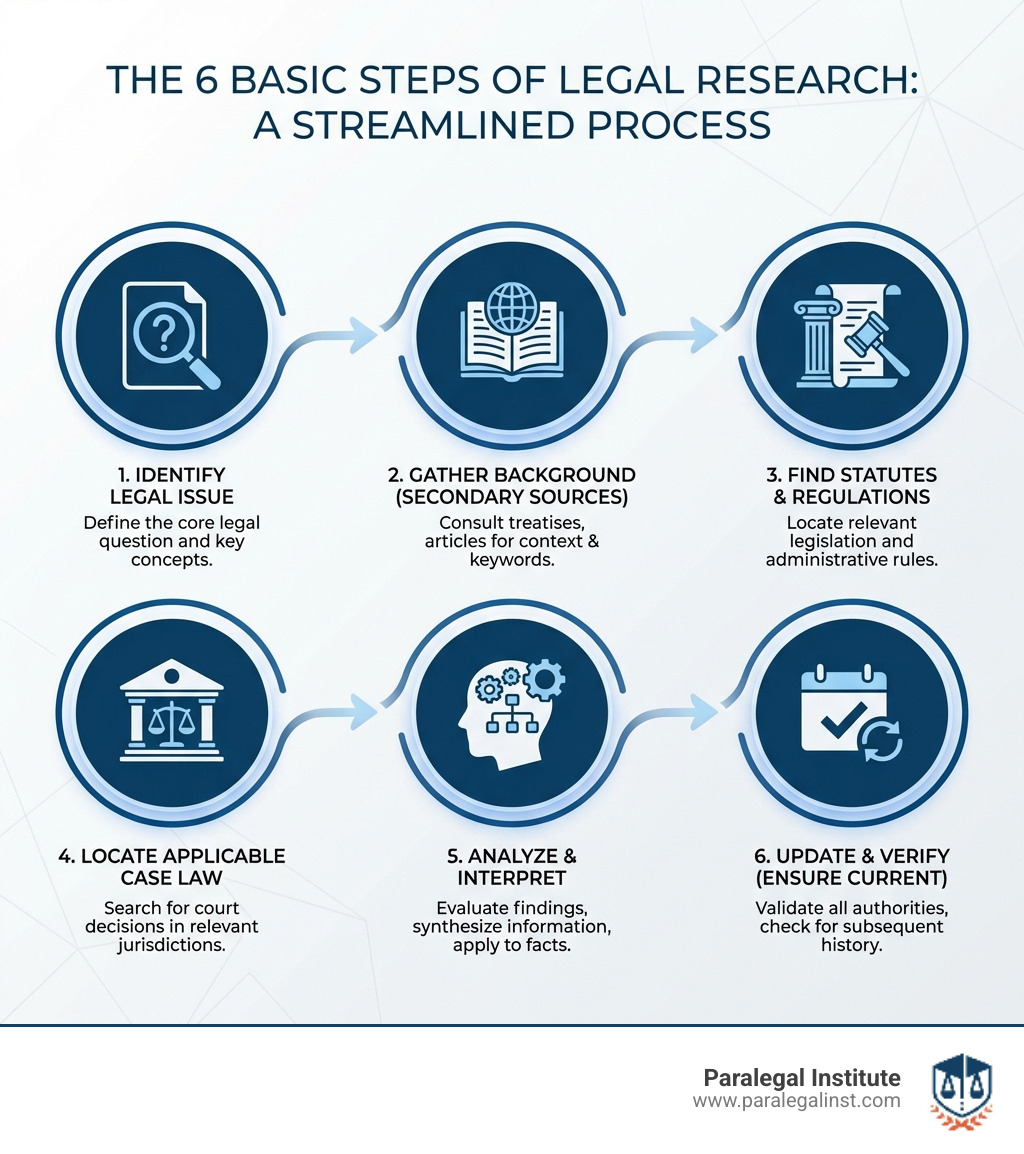
A strong workflow is: start with a credible secondary source for orientation, pull and read the primary law, then validate everything with a citator and update checks.
Conclusion
Legal research has moved from physical libraries to fast, AI-supported legal research platforms. For paralegals, platform skill is not optional. It directly affects how quickly you can find controlling authority, confirm it is current, and support attorneys with reliable research.
At the Paralegal Institute in Las Vegas, Nevada, I teach an accelerated, practical approach to legal research that mirrors what employers expect. Our 15-week paralegal certificate program is designed and taught by practicing legal professionals, and students can attend:
- Online with live instruction (real-time classes)
- In-person classes
If you are choosing between a long academic path and a faster, career-focused option, our program is built to get you job-ready sooner with hands-on training.
To learn more about how paralegals contribute in real legal settings, visit Role of Paralegals in Law Firms.