Why Court Filing Procedures Are Essential Skills for Every Paralegal
Court filing procedures are the step-by-step rules that govern how legal documents are submitted to a court — and getting them right is one of the most critical responsibilities a paralegal will have.
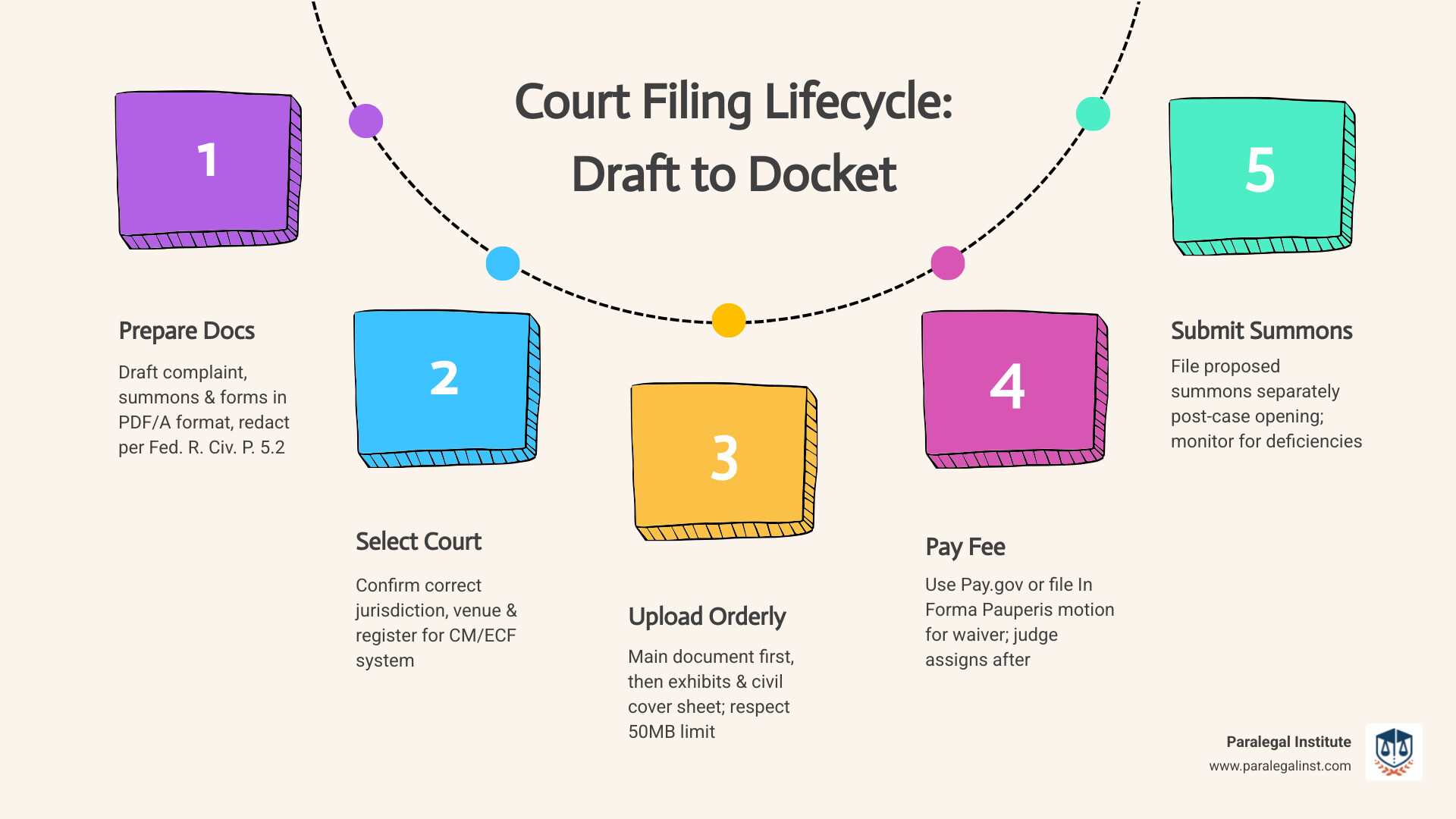
Here's a quick overview of what the process typically involves:
- Prepare your documents — Draft the complaint, summons, and any supporting forms in PDF format, properly redacted per Fed. R. Civ. P. 5.2
- Choose the right court — File in the correct jurisdiction and venue for your case type
- Register for the filing system — Attorneys in federal court use CM/ECF (Case Management/Electronic Case Files), which requires a court-specific local account
- Upload documents in the correct order — Main document first, then exhibits, then the civil cover sheet (where required)
- Pay the filing fee — Via Pay.gov, or submit an In Forma Pauperis (IFP) motion to request a fee waiver
- Await judge assignment — A judge is randomly assigned only after the fee is paid or waived
- Submit the proposed summons — Filed separately after the case is opened, not attached to the complaint
Filing errors don't just cause delays — they can trigger deficiency notices, corrective filings, or even case dismissal. Whether you're filing in a federal district court, a state superior court, or the U.S. Supreme Court, each system has its own rules, deadlines, and technical requirements.
I'm Matt Pfau, a practicing attorney who has navigated court filing procedures across multiple jurisdictions — from trial-level filings to appellate submissions — and I now bring that hands-on experience directly into the classroom at Paralegal Institute. If you're preparing to enter the legal field, understanding these procedures from day one will set you apart from the competition.
Understanding General Court Filing Procedures in Federal Courts
Navigating the federal court system requires more than just knowing the law; it requires mastering the technology that keeps the wheels of justice turning. As of May 2026, the vast majority of federal litigation is handled through electronic systems.
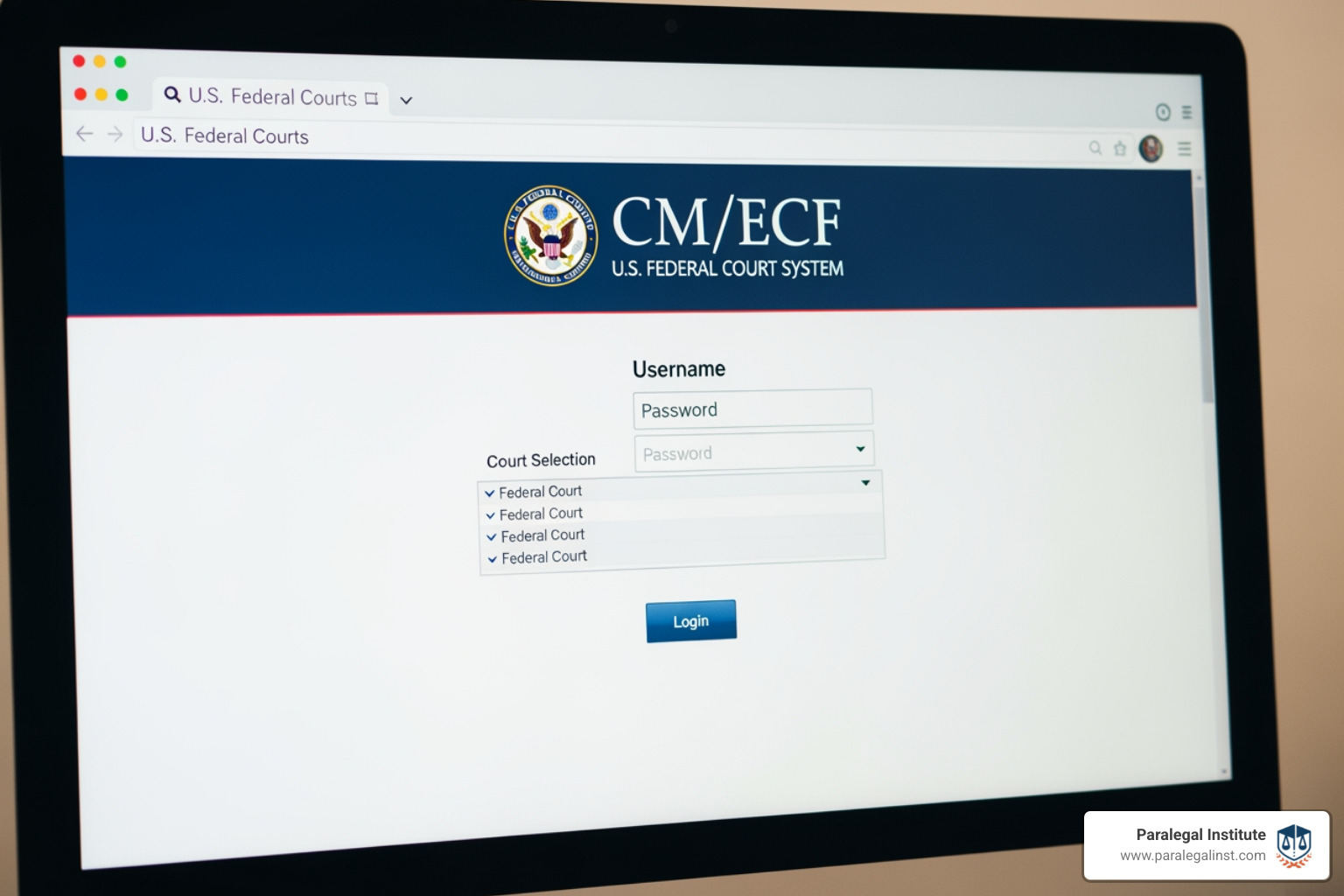
The backbone of federal court filing procedures is the CM/ECF (Case Management/Electronic Case Files) system. This platform allows us to maintain electronic case files and offer online filing 24 hours a day, seven days a week. For a paralegal, this means no more racing to the courthouse before the clerk's office closes at 4:00 PM—though we still don't recommend waiting until 11:59 PM to hit "submit"!
In the federal system, we also deal with NextGen PACER. While the "CurrentGen" systems required separate logins for every district, NextGen allows for a single, upgraded PACER account to access multiple courts. However, don't let that fool you—most districts, like the Northern District of California, still require a unique local registration to actually file documents.
All of these actions are governed by the Federal Rules of Civil Procedure (FRCP). These rules dictate everything from how a complaint is structured to how much time we have to respond to a motion. For a deeper dive into how these systems interact, you can explore our Litigation Support Complete Guide. You can also find a helpful Overview of the Case Filing Process provided by the District of Montana to see how these rules are applied in practice.
Technical Requirements for Federal E-Filing
When we talk about "filing a document," we aren't just uploading a random Word file. Federal courts have very strict technical standards. Most courts require documents to be in PDF/A format, which is a standardized version of PDF specialized for long-term archiving.
Key technical constraints include:
- Size Limits: Most federal districts, including the Northern District of California, set a maximum file size of 50MB per upload. If your exhibit list is massive, we have to split those documents into smaller parts.
- OCR (Optical Character Recognition): Your PDFs must be searchable. This means you can't just scan a piece of paper and upload the image; the system must be able to "read" the text.
- Document Sequencing: The order matters. Generally, you upload the main document (like the Complaint) first, followed by exhibits, and finally the civil cover sheet.
Mastering these technical nuances is a core part of being a Litigation Support Professional.
Privacy and Redaction Standards
One of the most important court filing procedures involves protecting sensitive information. Under Fed. R. Civ. P. 5.2, it is the filer's responsibility—not the court's—to redact personal identifiers. If we miss a Social Security number, we aren't just making a mistake; we are potentially violating federal privacy rules.
You must redact:
- Social Security numbers: Only the last four digits should be visible.
- Financial account numbers: Only the last four digits.
- Names of minor children: Use initials only.
- Dates of birth: Use the year only.
Failure to follow these standards can lead to the court striking your filing from the record. To ensure you're up to speed on all compliance requirements, check out our Legal Research Skills Complete Guide.
Initiating a New Civil Case: Required Documents and Steps
Starting a new lawsuit is like launching a rocket—everything has to be in the right place before ignition. In federal court, "opening a case" involves a specific bundle of documents that must be filed simultaneously.
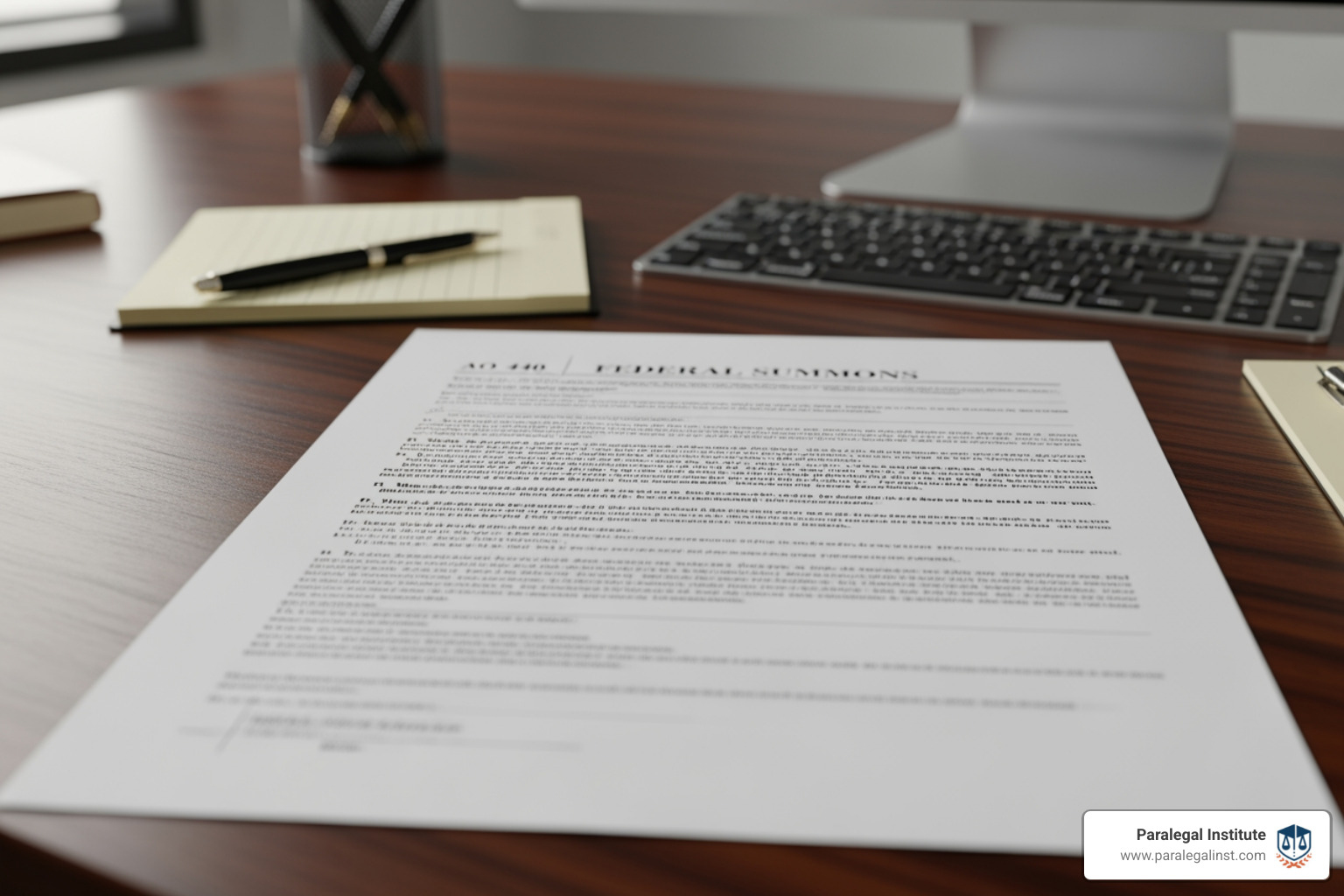
The standard "initiating package" includes:
- The Complaint: The legal document that lays out the claims against the defendant.
- The Summons (AO 440): The official notice to the defendant that they are being sued.
- The Civil Cover Sheet (JS-44): A statistical summary of the case (though some courts, like the Northern District of California, have updated their rules as of April 2025 to automate this for attorney filings).
- The Filing Fee: A standard fee is required for most new filings, though the exact amount can vary slightly by district.
For more on the documents required in specific districts, the District of Maryland provides an excellent breakdown of electronic filing in civil cases. Understanding these moving parts is essential for Paralegal Litigation Support.
Electronic Court Filing Procedures for Attorneys
For attorneys (and the paralegals who assist them), e-filing is usually mandatory. In the Northern District of California, for example, the process is highly automated. Once you upload the complaint and pay the fee via Pay.gov, the system performs an automated judge assignment.
It’s important to note that a judge is typically not assigned until the fee is confirmed. If you’re filing an emergency motion for a Temporary Restraining Order (TRO), you have to be lightning-fast with the payment to get a judge on the case immediately.
| Feature | Federal CM/ECF | State E-Filing Portals (e.g., CA) |
|---|---|---|
| Login Type | PACER / Local ECF | Third-party vendors (e.g., OneLegal) |
| Availability | 24/7 | 24/7 (varies by vendor) |
| File Format | PDF (Searchable) | PDF (Searchable/Text-based) |
| Fee Payment | Pay.gov integration | Credit card / Vendor account |
Managing Pro Se Court Filing Procedures
Not everyone has an attorney. Pro se litigants(people representing themselves) often have different court filing procedures. In many federal districts, pro se parties are actually exempt from mandatory e-filing and must submit paper documents.
When a pro se party submits paper filings, the Clerk’s Office scans them into the electronic system so they are available on the public docket. If a party cannot afford the filing fee, they must file a motion to proceed In Forma Pauperis (IFP). If the judge grants this, the fee is waived. You can learn more about these self-help options through the California Courts Self Help Guide.
Navigating the U.S. Supreme Court and Appellate Systems
When a case moves to the appellate level, the rules change significantly. The U.S. Supreme Court and the various Circuit Courts of Appeals have their own distinct cultures and requirements.
In the Supreme Court, for instance, Rule 33.1 dictates a very specific "booklet format" for many filings. This isn't just a standard PDF; it involves specific margins, paper types, and binding. Even in our digital age, the Supreme Court still operates on a hybrid filing system. For represented parties, paper remains the official form of filing, but an electronic version must also be submitted.
The Second Circuit has its own set of Local Rules and Internal Operating Procedures (IOPs). If you miss a briefing deadline in an appellate court, the consequences are severe—ranging from sanctions for the attorney to the outright dismissal of the appeal. For more details on appellate filings, see the Second Circuit's Case Filing Information and our Legal Research Guide For Paralegals.
Supreme Court Rules and 2026 Updates
Effective March 16, 2026, the Supreme Court adopted updated Rules of the Court and Electronic Filing Guidelines. These updates aimed to further integrate electronic submissions while maintaining the tradition of paper records.
Key points of the 2026 guidelines include:
- Represented Parties: Mandatory electronic submission in addition to paper booklets.
- Pro Se Parties: Continue to file on paper only; the Clerk's Office digitizes these for public access.
- Public Access: Electronic filings are accessible for free on the public docket, promoting transparency.
Keeping up with these changes is why Legal Research Skills Training is so vital for modern paralegals.
Appellate Briefing and Deadlines
In the appellate world, the Federal Rules of Appellate Procedure (FRAP) are your bible. One of the biggest hurdles for new paralegals is the "Appendix"—a collection of documents from the lower court record that the appellate judges need to see.
Under NextGen CM/ECF, you must ensure your attorney's PACER account is properly linked to the specific circuit court. If the accounts aren't linked, you might find yourself unable to file a brief at 11:55 PM on the day it's due! This intersection of tech and law is a major focus in Legal Research In Online Paralegal Programs.
State Court Variations and Local Rules
While federal rules provide a level of consistency across the country, state courts are a patchwork of different systems. In our home base of Las Vegas, NV, or in neighboring California, the rules can change simply by crossing a county line.
In California, for example, the San Francisco Superior Court has required mandatory e-filing for civil cases since 2014. However, they don't have their own portal; they use third-party vendors. If you're filing a case that involves a hardship, you might have to file an ex parte application in a specific department to get an exemption from e-filing.
In Las Vegas, the Eighth Judicial District Court and the Las Vegas Justice Court have their own specific portals and local rules. You can find specific details on File and Serve (E-File) - Las Vegas Justice Court.php). Navigating these local variations is much easier when you're familiar with different Legal Research Platforms.
Local Rules and Court Filing Procedures
Under 28 U.S.C. § 2071, federal courts are allowed to create their own local rules as long as they don't contradict the national rules. The E-Government Act also requires these local rules to be posted online.
As a paralegal, you must check the "Local Rules" section of a court's website every single time you file in a new district. One court might require a "Chambers Copy" (a physical paper copy delivered to the judge), while another might strictly forbid it. For those working in Southern Nevada, the Eighth Judicial District Court filing page is an essential bookmark.
Consequences of Filing Errors and Corrections
We all make mistakes, but in the legal world, mistakes have a "paper trail." If you file a document incorrectly, you will likely receive a Notice of Deficient Filing.
Common errors include:
- Incorrectly naming a party (e.g., using all caps when not required).
- Failing to redact sensitive info.
- Selecting the wrong "event" in the CM/ECF dropdown menu.
- Uploading a corrupted PDF.
To fix these, you may need to file a "Corrective Entry" or, in extreme cases, file an ex parte application to ask the judge for permission to fix the record. Always keep track of your transaction numbers —these 8-digit codes are the only way the clerk can help you find your specific filing in the system. For a comprehensive look at avoiding these pitfalls, check out the Paralegal Legal Research Complete Guide.
Frequently Asked Questions about Court Filings
What is the difference between CM/ECF and PACER?
Think of CM/ECF as the "upload" side—it's the system attorneys and paralegals use to file documents and manage cases. PACER(Public Access to Court Electronic Records) is the "download" side—it's the system used by the public and legal professionals to search for and view dockets and filed documents.
How do I apply for a filing fee waiver (In Forma Pauperis)?
You must file a specific motion called an Application to Proceed In Forma Pauperis. This includes a financial affidavit where the party swears under penalty of perjury that they cannot afford the court costs. In federal court, a judge must sign an order granting this motion before the case can officially proceed without payment.
Are there different rules for filing bankruptcy cases in 2026?
Yes! Following amended rules that became effective on December 1, 2025, Bankruptcy Rules 3002.1 and 8006 were updated. These changes affected how claims are handled and how the record is prepared on appeal. Always check the current Federal Rules of Bankruptcy Procedure for the most up-to-date forms.
Conclusion
Mastering court filing procedures is a journey of precision, technical skill, and constant learning. From understanding the 50MB limit in a federal district court to formatting a booklet for the Supreme Court, these skills are what make a paralegal indispensable to a law firm.
At the Paralegal Institute, we don't just teach you the theory behind these rules; we give you the practical training you need to hit the ground running. Our 15-week paralegal certificate program is designed and taught by practicing legal professionals—like me—who deal with these systems every day. Whether you choose our online classes with live instruction or join us in-person in Las Vegas, NV, you'll get the real-world skills that employers value.
If you're ready to start your career and want an accelerated, affordable path into the legal field, you're in the right place. Understanding the Role of Paralegals in Law Firms is the first step toward a rewarding new career. We look forward to helping you master the dockets!