
Why Paralegal Legal Research is the Foundation of Every Strong Legal Case
Paralegal legal research is the systematic process of identifying, retrieving, and analyzing legal information—including statutes, case law, regulations, and secondary sources—to support legal decision-making and case strategy. It involves:
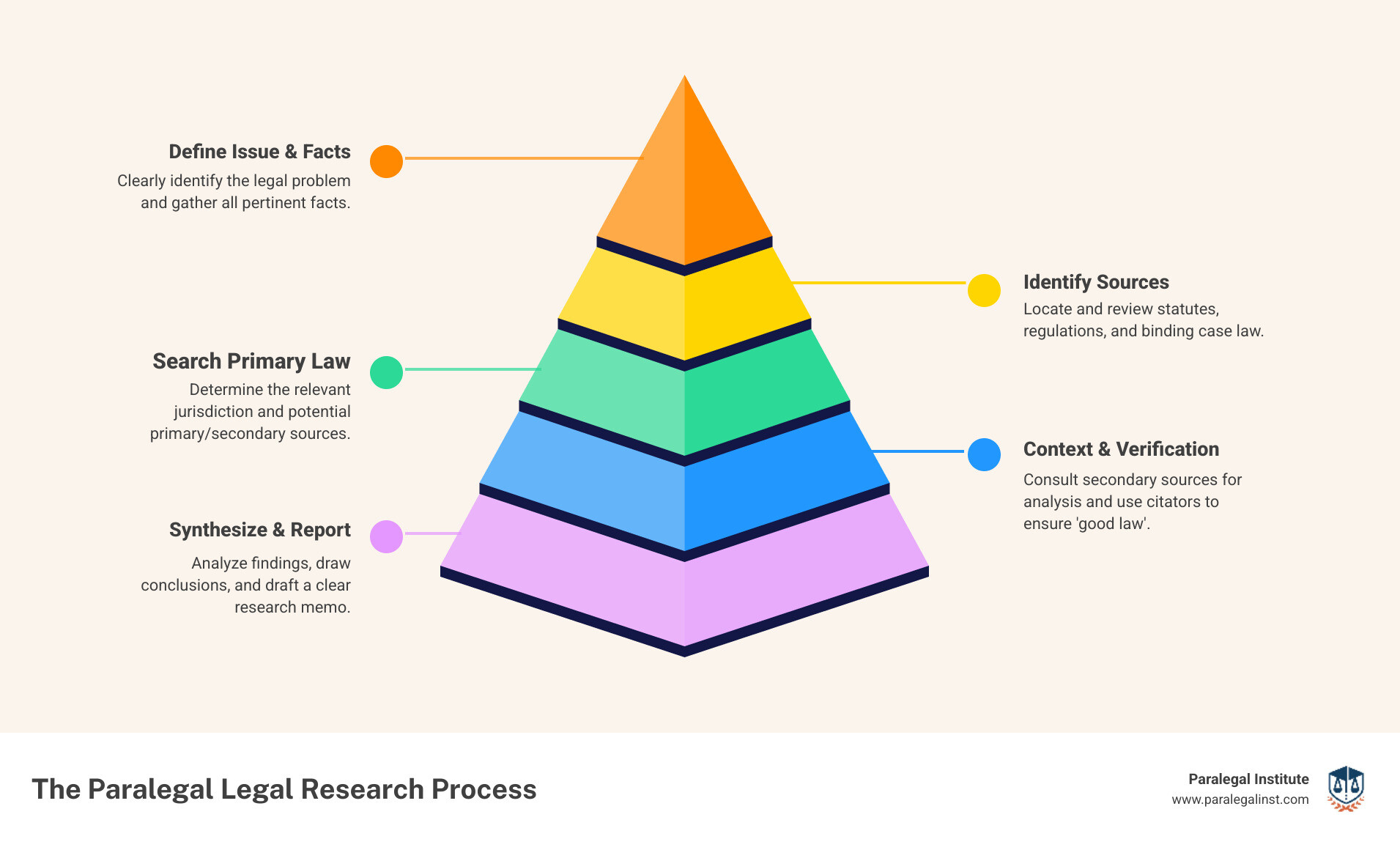
- Defining the legal issue and identifying relevant facts
- Locating primary sources(constitutions, statutes, regulations, case law)
- Consulting secondary sources(legal encyclopedias, treatises, practice guides)
- Verifying currency using citators to ensure authorities are still "good law"
- Synthesizing findings into clear, actionable reports for attorneys
Legal research is not just about finding information—it's about finding the right information that can make or break a case. A paralegal who uncovers a single overlooked precedent can shift an entire legal strategy. One who fails to verify that a statute has been repealed can undermine months of work.
In today's legal landscape, where California alone passed nearly 1,000 new laws in a single year and federal legislation added hundreds more, the ability to steer this constant flood of legal authority is what separates a good paralegal from an indispensable one.
This skill directly impacts case outcomes, firm efficiency, and client success. It's the backbone of drafting motions, preparing for trial, supporting client consultations, and developing winning legal strategies. Effective legal research saves time, prevents costly mistakes, and builds the foundation for every legal argument.
Yet many aspiring paralegals worry they lack the skills to conduct this critical work. The truth is that legal research is a learnable, structured process —not an innate talent. With the right training and tools, anyone can master it.
I'm Matthew Pfau, a practicing attorney who has hired, trained, and worked alongside dozens of paralegals throughout my career. Through my experience in both estate planning and personal injury law, I've seen how paralegal legal research skills directly determine a team's effectiveness and a client's outcome.
Foundational Knowledge: Understanding the Sources of Law
Before we dive into the "how-to" of paralegal legal research, it's crucial to understand the "what." What exactly are we researching? The legal system is built on a hierarchy of authoritative texts, and knowing these sources is our starting point.
Legal sources are broadly categorized into two types: primary and secondary.
Primary Sources are the actual law itself. These are the binding rules that courts must follow. They include:
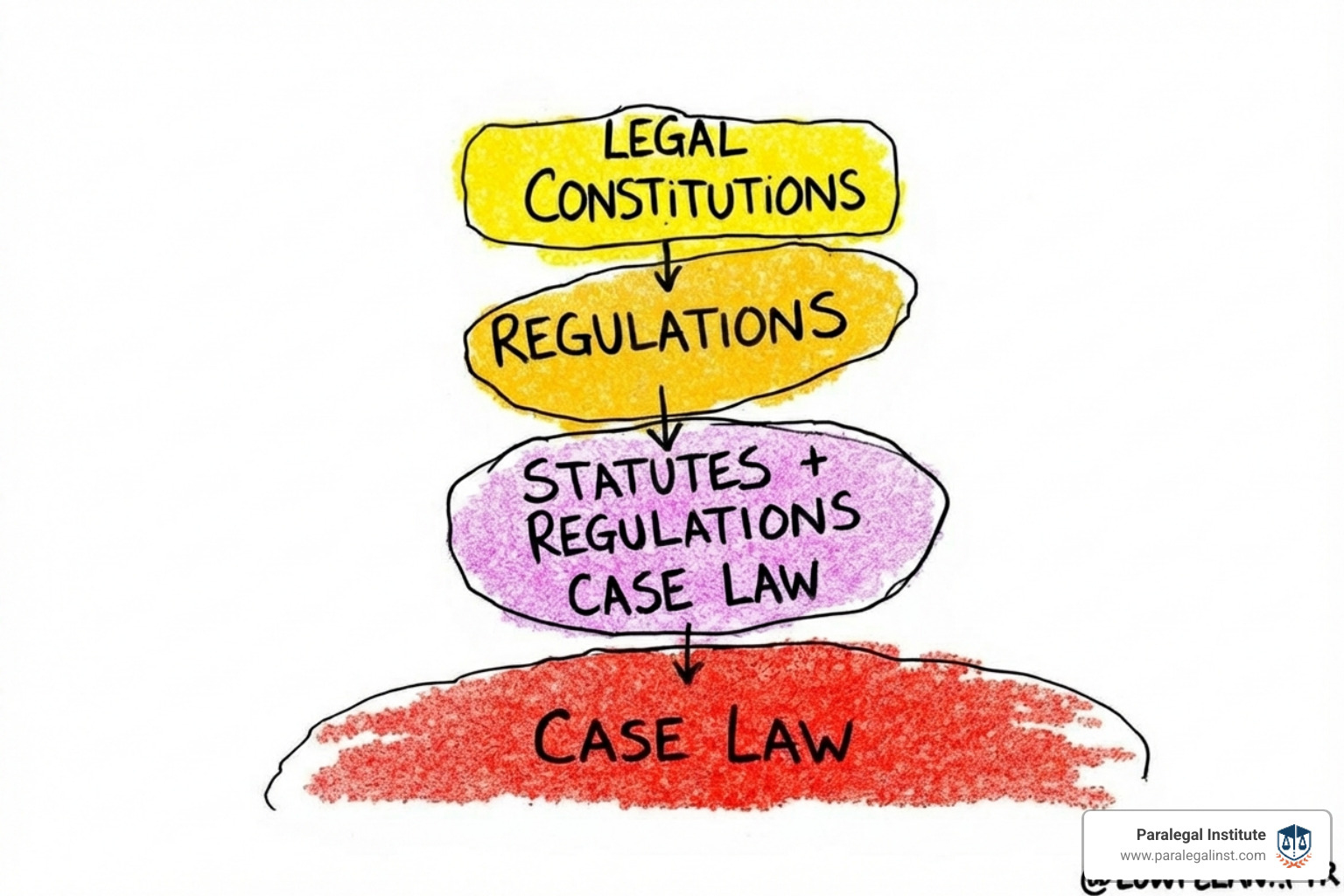
- Constitutions: The U.S. Constitution and individual state constitutions are the supreme law of their respective jurisdictions. No other law can contradict them. You can review the full text of the U.S. Constitution on Wikipedia's U.S. Constitution page as a general reference.
- Statutes: Laws passed by legislative bodies, such as the U.S. Congress or the Nevada Legislature. These are codified into organized codes (e.g., the U.S. Code, Nevada Revised Statutes).
- Administrative Regulations: Rules and decisions issued by federal and state administrative agencies (e.g., IRS, FDA, Nevada Public Utilities Commission). These agencies are empowered by statutes to create detailed regulations to implement broader laws.
- Case Law (Common Law): Decisions issued by courts. When a court interprets a statute or constitution, or when it establishes a legal principle in the absence of a statute, that decision becomes precedent. This precedent is binding on lower courts within the same jurisdiction under the principle of stare decisis (to stand by things decided).
Secondary Sources are not the law itself, but rather explanations, analyses, and criticisms of primary law. They are valuable for understanding a topic, identifying relevant primary sources, and gaining background context, especially when approaching an unfamiliar area of law. Examples include:
- Legal Encyclopedias: Such as American Jurisprudence (Am. Jur.) or Corpus Juris Secundum (C.J.S.), which provide broad overviews of legal topics.
- Law Review Articles: Scholarly pieces written by legal experts, often published in academic journals, offering in-depth analysis of specific legal issues. For a deeper explanation of how legal scholarship works, see Wikipedia's article on law review.
- Treatises: Multi-volume works that provide comprehensive coverage of a particular area of law (e.g., Corbin on Contracts ).
- Practice Guides: Practical resources designed for attorneys, offering step-by-step guidance on legal procedures and substantive law.
We often begin our research with secondary sources when we are unfamiliar with a topic, as they can quickly bring us up to speed and point us toward the most relevant primary sources. However, we must always remember that secondary sources are not binding; our ultimate goal is to find and analyze the primary law. For more on this, we dig into Reliable Sources for Paralegal Research.
Mandatory vs. Persuasive Authority
Understanding the distinction between primary and secondary sources is fundamental, but so is recognizing the difference between mandatory and persuasive authority:
- Mandatory Authority(or binding authority) refers to legal precedents that a court must follow. This typically includes decisions from higher courts within the same jurisdiction. For example, a ruling by the Nevada Supreme Court is mandatory authority for all lower courts in Nevada. A statute passed by the U.S. Congress is mandatory authority for federal courts and, if applicable, state courts.
- Persuasive Authority refers to legal precedents that a court may consider but is not required to follow. This often includes decisions from courts in other jurisdictions (e.g., a California Supreme Court decision might be persuasive in a Nevada court), decisions from lower courts, or even scholarly articles. While not binding, persuasive authority can be very influential, especially in cases of first impression where no mandatory authority exists.
The concept of jurisdiction is key here. Jurisdiction defines the geographical area or the types of cases over which a court or legal body has authority. For example, a Nevada state court has jurisdiction over state law matters within Nevada, while a U.S. District Court in Las Vegas has jurisdiction over federal law matters. Understanding jurisdiction helps us determine whether a source is mandatory or merely persuasive.
The Strategic Process of Paralegal Legal Research
Now that we understand the types of legal sources, let's turn our attention to the strategic process of conducting paralegal legal research. This isn't a haphazard search; it's a methodical, step-by-step approach designed to be thorough, efficient, and cost-effective.
Step 1: Defining the Scope and Framing the Question
The first and most critical step in any legal research endeavor is to clearly define what we're looking for. Without a clear objective, we risk wasting valuable time and resources.
- Collaborating with Attorneys: Our journey often begins with an assignment from an attorney. This initial meeting is crucial. We must listen carefully, take detailed notes, and ask clarifying questions to ensure we fully grasp the attorney's needs. What are the key facts? What specific legal questions need to be answered? What is the client's ultimate goal? We might even summarize our understanding of the assignment to the attorney to confirm we're on the right track.
- Identifying Legally Significant Facts: Not all facts are created equal. We must sift through the information to identify those facts that are legally relevant. These are the "who, what, when, where, and how" that directly impact the legal issues at hand.
- Framing the Legal Issue: Once we have the significant facts, we articulate the precise legal question that needs to be answered. This often takes the form of an "IRAC" (Issue, Rule, Application, Conclusion) statement, which helps to focus our research. For instance, instead of "dog bite case," we might frame it as "Under Nevada law, is a dog owner strictly liable for injuries caused by their dog on public property?"
- Creating a Research Plan: With a clear issue, we develop a strategic research plan. This involves brainstorming keywords and phrases, identifying potential primary and secondary sources, and outlining the order in which we'll consult them. A well-structured plan helps us stay organized and ensures we don't overlook crucial avenues of inquiry. It's a living document that we can adjust as our research evolves.
- Time Management: In a law office, time is money. Unlike academic research where trial and error might be encouraged, we must aim to get our research right the first time. This means being efficient, using our research plan to guide us, and knowing when to consult the attorney for clarification rather than spinning our wheels.
Step 2: Executing the Search with Essential Tools and Techniques
With a clear plan in hand, we move to the actual search. Modern paralegal legal research relies heavily on technology, but effective searching also requires strategic thinking.
- Legal Databases: These are our workhorses. Platforms like Westlaw and LexisNexis provide access to vast libraries of primary and secondary legal materials, including statutes, case law, regulations, and law review articles. These services are comprehensive, constantly updated, and offer sophisticated search capabilities. While these are typically paid services, their efficiency and thoroughness make them indispensable in professional settings.
- Free Online Resources: For certain types of research, or for those in training, free resources can be incredibly valuable. Websites like the Legal Information Institute (LII) at Cornell Law School, Justia, and Google Scholar offer access to statutes, case law, and some secondary materials. Government websites, such as Congress.gov for federal legislation or the Nevada Legislature's site for state statutes, are also excellent direct sources.
- Boolean Operators: These are the building blocks of effective legal searching. Using "AND," "OR," and "NOT" allows us to combine or exclude search terms to narrow or broaden our results. For example, "negligence AND (dog OR canine)" will find documents containing "negligence" and either "dog" or "canine." We can also use proximity connectors (e.g., "dog /s bite" to find "dog" within the same sentence as "bite") and exact phrases ("strict liability") to refine our searches. Mastering these techniques is critical for achieving efficient and accurate results.
- Keyword Brainstorming: Before typing anything into a search bar, we brainstorm all possible keywords and synonyms related to our legal issue. This ensures we don't miss relevant documents due to variations in terminology.
- AI Tools for Paralegals: The legal landscape is rapidly evolving with artificial intelligence. AI-powered tools can assist with tasks like summarizing case information, identifying key findings, and even predicting case outcomes. These tools, while not replacing our critical thinking, can significantly improve our efficiency and analytical capabilities, as we explore in AI Tools for Paralegals. For a broader look at the resources available, see our guide on the Best Tools and Resources for Paralegal Students.
Step 3: Analyzing, Synthesizing, and Presenting Your Findings
Finding the information is only half the battle. The real value of paralegal legal research comes from our ability to analyze, synthesize, and present our findings in a clear, concise, and actionable way for the attorney.
- Critical Analysis of Sources: We don't just collect information; we critically evaluate it. We assess the authority, credibility, currency, authenticity, relevance, and potential bias of each source. Is it a primary or secondary source? Is it mandatory or persuasive authority? Is the court decision from a relevant jurisdiction and level?
- Synthesizing Information: This means putting the pieces together. We identify patterns, reconcile conflicting information, and draw logical conclusions from the various sources we've found. How do different statutes and cases interact? What is the overarching legal principle that emerges?
- Using Citators: This is a crucial step to ensure we are using "good law." Citator services like Shepard's (LexisNexis) or KeyCite (Westlaw) allow us to check the subsequent history of a case or statute. They tell us if a case has been affirmed, reversed, overruled, or questioned by later decisions. Relying on overruled law can be disastrous for a case, so this step is non-negotiable.
- Verifying "Good Law": A case from decades ago can still be "good law" if it hasn't been overturned and fits our fact pattern. Conversely, a recent case might be overturned quickly. Citators are our safeguard against using invalid legal authority.
- Drafting Research Memos: Our findings are typically presented to the attorney in a legal research memorandum. This document clearly states the legal question, provides a concise answer, details the relevant facts, analyzes the applicable law, and applies that law to the facts to reach a conclusion. It's a structured way to communicate complex legal analysis.
- Proper Legal Citation: Accuracy in citation is paramount. We use standardized formats like The Bluebook or the ALWD Guide to Legal Citation to ensure that all references are accurately cited. This allows attorneys (and courts) to easily locate and verify our sources, lending credibility to our work.
- Legal Technology for Paralegals: Beyond search engines, technology aids in organizing, analyzing, and presenting our research. Document management systems, legal writing software, and AI-powered summarization tools all contribute to a more efficient and polished final product. For more insights, refer to Legal Technology for Paralegals.

The Impact of Effective Research on Legal Practice
The skills we develop in paralegal legal research are not abstract academic exercises. They have tangible, immediate impacts on the day-to-day operations of a law firm and the outcomes for our clients. Strong research skills directly translate into a paralegal's value, influencing case strategy, firm efficiency, and client success.
Enhancing Case Preparation and Document Drafting
Our research forms the bedrock upon which legal arguments are built.
- Supporting Motions and Briefs: When an attorney files a motion (e.g., a motion to dismiss, a motion for summary judgment), it must be supported by legal authority. Our research identifies the relevant statutes, regulations, and case law that demonstrate why the court should grant the motion. We help draft the factual and legal arguments, ensuring every claim is backed by credible sources.
- Developing Legal Strategy: Thorough research allows us to identify relevant precedents, understand the complexities of a case, and even anticipate opposing arguments. By analyzing similar cases, we help attorneys understand potential outcomes, assess risks, and formulate the most effective strategy for the client. This includes preparing for depositions and trials, where knowing the law inside and out is critical.
- Drafting Accurate Pleadings: Every pleading filed with the court—from the initial complaint to answers and counterclaims—must adhere to legal standards. Our research ensures that the claims asserted are legally sound and that the language used is precise and accurate, strengthening the attorney's case from the outset.
- Informing Contract Creation: In transactional law, accurate legal research is vital for drafting contracts, agreements, and other legal documents that are legally enforceable and protect our clients' interests. We research statutory requirements, regulatory compliance, and relevant case law to ensure the documents reflect current legal standards.
- Strengthening Legal Arguments: Our research provides the evidence that makes an attorney's arguments persuasive. Well-researched legal documents and briefs are credible, authoritative, and more likely to sway a judge or jury.
Improving Efficiency and Client Outcomes
Beyond direct case support, effective research streamlines the entire legal process.
- Streamlining the Legal Process: By efficiently identifying and analyzing relevant information, we prevent unnecessary work and reduce the likelihood of overlooking essential facts or legal nuances. This saves the firm time and resources, which can be passed on to the client.
- Supporting Client Consultations: Before an attorney meets with a client, we can provide background information and legal insights by researching relevant laws and previous case histories. This helps the attorney offer evidence-based advice, manage client expectations, and build client confidence in the firm's expertise. Clients appreciate receiving informed and well-reasoned guidance.
- Building Client Confidence: When clients see that their legal team is thoroughly prepared and knowledgeable about the law pertaining to their case, their confidence in the legal process and their representation grows. This trust is invaluable.
- Increasing Firm Efficiency: A paralegal who can quickly and accurately conduct legal research frees up the attorney to focus on higher-level strategic thinking, client advocacy, and court appearances. This division of labor makes the entire legal team more productive and profitable.
- Positively Impacting Case Results: The quality of our paralegal legal research can be a decisive factor in the success or failure of a legal case. Identifying a key precedent, uncovering a critical statute, or correctly interpreting complex regulations can be the difference between winning and losing.
Upholding Ethical Standards in Paralegal Legal Research
Our role in legal research comes with significant ethical responsibilities. The integrity of the legal profession depends on adherence to these standards.
- Client Confidentiality: All information we encounter during research, particularly client-specific details, is strictly confidential. We must safeguard this information and ensure it is not disclosed inappropriately. This extends to how we store and access research materials.
- Avoiding the Unauthorized Practice of Law (UPL): As paralegals, we work under the direct supervision of an attorney. While we conduct research and analyze findings, we do not provide legal advice to clients or represent them in court. Our role is to assist the attorney, not to practice law ourselves. We must clearly understand the boundaries of our responsibilities.
- Diligence and Competence: We have an ethical duty to conduct our research thoroughly and competently. This means using reliable sources, verifying information, and ensuring our findings are accurate and up-to-date. Sloppy or incomplete research can lead to significant harm for a client.
- Accurate Reporting of Findings: We must present our research findings honestly and objectively to the attorney, even if the results are unfavorable to the client's position. Manipulating or omitting information to fit a desired outcome is a serious ethical breach. This also includes properly attributing all sources to avoid plagiarism.
- Competency and Continuous Learning: The legal profession demands a high standard of competency, emphasizing not just technical skills but also the ethical application of information. As a paralegal, you have a duty to stay current with the law. Continuous learning and adherence to these high standards are vital, which is why programs like ours at the Paralegal Institute emphasize Legal Research Skills Training.
Advancing Your Career with Specialized Research Skills
As we've seen, paralegal legal research is a core competency. But for those looking to truly excel and advance their careers, specializing in research within particular legal fields can open significant doors.
- Value of Specialization: Just as attorneys specialize, so too can paralegals. By focusing on a specific area like intellectual property, family law, or corporate law, we can hone our research skills to a razor-sharp edge. This allows us to gain critical insights into the nuances of specific regulations, common precedents, and emerging trends within that field. A specialized paralegal becomes an invaluable resource to attorneys, increasing efficiency and contributing to better client outcomes. This focused expertise can lead to greater responsibilities and career growth.
- Paralegal vs. Legal Researcher Role: It's important to distinguish between a general paralegal and a dedicated legal researcher. While all paralegals perform some level of research, a legal researcher is a specialist whose primary role is in-depth investigation and analysis of laws, precedents, and legal trends. Legal researchers often dig deeper into complex statutory interpretations or historical case law, and they may even be skilled in data visualization to present their findings. However, paralegals offer greater versatility to a legal team, balancing research with broader case management, client communication, and document support. Our program trains paralegals to be versatile, equipped with strong research skills as part of a comprehensive skill set.
- Versatility of Paralegals: The strength of a paralegal lies in our ability to adapt and contribute across multiple facets of legal practice. We can conduct targeted research for a specific motion, then transition to drafting client correspondence, and then prepare trial exhibits. This broad skill set, underpinned by solid research capabilities, makes us indispensable members of any legal team.
- Staying Current with New Laws: The legal environment is constantly changing. In 2022 alone, California's Governor signed nearly 1,000 bills into law, and the federal government passed hundreds more. This constant flux means that what was "good law" yesterday might be outdated today. We must commit to continuous learning, regularly monitoring legislative changes and new court decisions. This involves reading legal news, subscribing to legal updates, and participating in ongoing professional development. Our commitment to staying current ensures our research findings are always accurate and reliable. We emphasize this adaptability and continuous learning throughout our program, including discussions on Legal Research in Online Paralegal Programs.
- Career Advancement: For those who develop exceptional paralegal legal research skills, the career prospects are strong. While job growth for paralegals is positive, specializing and demonstrating mastery in research can position us for more complex and rewarding roles. Our expertise allows us to take on more significant responsibilities, making us key players in developing legal strategy and achieving successful outcomes for clients.
Frequently Asked Questions about Paralegal Legal Research
We often hear similar questions from aspiring paralegals about the nuances of legal research. Here are some of the most common ones:
What's the difference between a paralegal and a legal researcher?
While both roles involve legal research, their scope and primary focus differ significantly. A paralegal's role is broad, encompassing case management, client communication, and document drafting, with legal research being one of many key skills. We are the versatile support staff, helping attorneys with nearly every element of a case. A legal researcher's role is highly specialized and focused almost exclusively on in-depth research and analysis, often for complex legal questions or to identify broader legal trends. They may transform data into visual formats or analyze historical case patterns. While legal researchers can dig into very specific legal issues, paralegals offer greater versatility to a legal team by integrating research findings into the broader context of case preparation and client support.
What are the most important tools for paralegal research?
The essential tools for paralegal legal research include:
- Online Legal Databases: Platforms like Westlaw and LexisNexis are indispensable for accessing comprehensive statutes, case law, regulations, and secondary sources.
- Citator Services: Tools like Shepard's or KeyCite are crucial for verifying that the law we find is still "good law" and hasn't been overturned or modified.
- Public Records Databases: For investigating individuals, businesses, or property information relevant to a case.
- Government Websites: Official sites for federal and state legislatures, courts, and administrative agencies provide direct access to primary law.
- AI-powered tools: Increasingly, AI tools for paralegals are becoming vital for efficiency, helping with summarization, document review, and identifying key information.
How can a paralegal ensure their research is still "good law"?
To ensure our research is still "good law," we use a critical tool called a citator. This service (integrated into major legal databases like Westlaw and LexisNexis) tracks the history of a case or statute. It shows if a case has been appealed, reversed, overruled, or significantly criticized by a later court decision. For statutes, it indicates if they have been amended, repealed, or declared unconstitutional. By checking a citator, we can confidently verify that the legal authority we intend to rely on is still valid and applicable.
Conclusion: From Student to Indispensable Legal Professional
Mastering legal research transforms a paralegal from a support role into an indispensable member of the legal team. This skill is not just learned from books; it is honed through practical, hands-on training. The Paralegal Institute's accelerated program provides this real-world experience, with live instruction from practicing legal professionals to ensure you are job-ready. Ready to build the skills that will define your legal career? Explore our paralegal program.