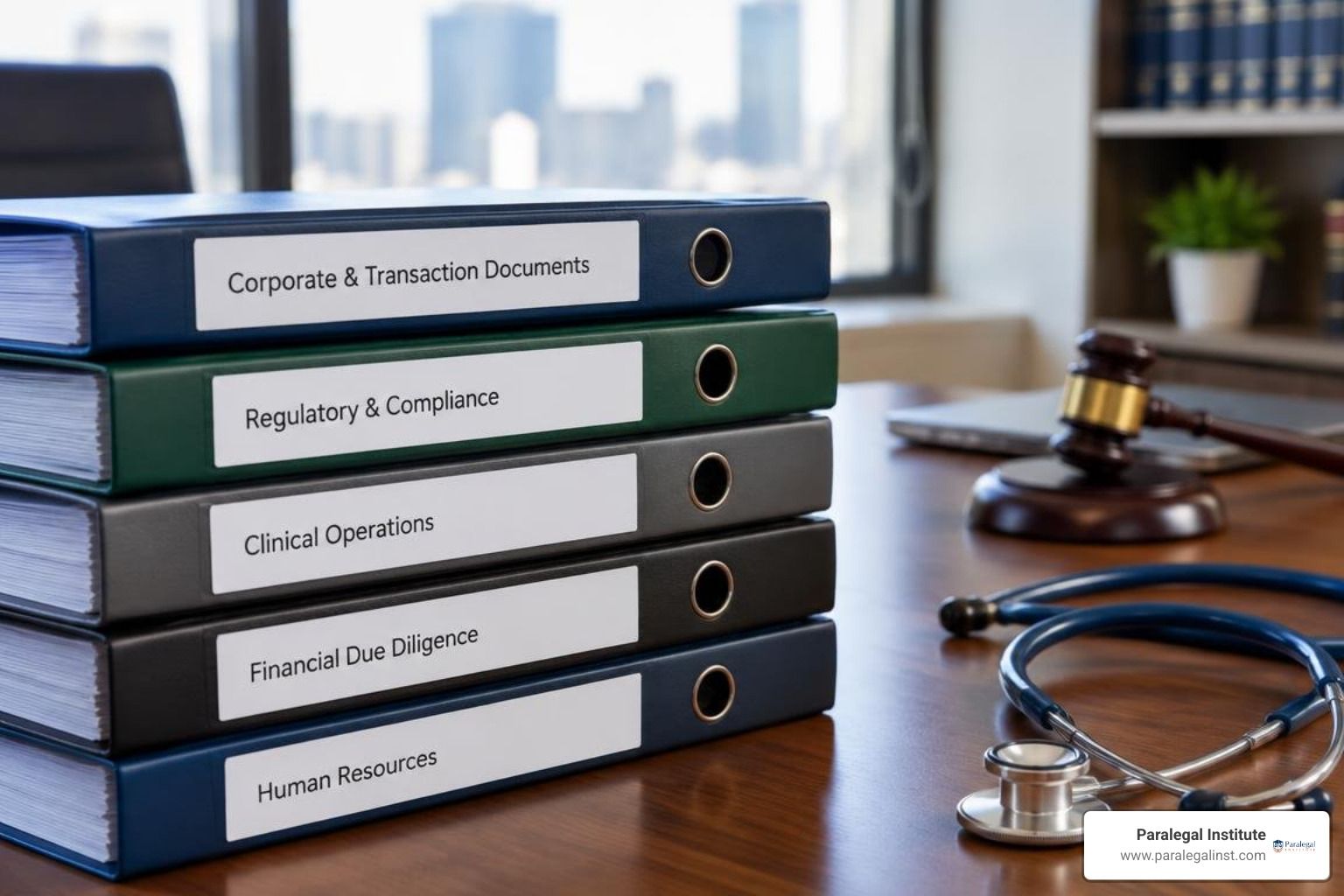
Why Paralegal Case Management Is Essential to Legal Practice
Paralegal case management is the systematic process of organizing, tracking, and maintaining legal case files from intake to resolution. Mastering these skills is crucial for your value to any law firm, whether you handle 5 cases or 250.
Key Components of Effective Paralegal Case Management:
- Case Intake & File Setup- Gathering client information, opening files, and establishing initial organization
- Document Management- Organizing both physical and digital files with consistent naming and filing systems
- Deadline Tracking- Calendaring court dates, statutes of limitations, and critical milestones
- Communication Protocols- Maintaining clear channels with attorneys, clients, and third parties
- Task Prioritization- Managing multiple cases while meeting urgent deadlines
- Technology Utilization- Leveraging tools for efficiency, security, and accessibility
- Ethical Compliance- Understanding boundaries and maintaining confidentiality
While many paralegal training programs only cover case management briefly, your practical ability to manage casework efficiently is what directly impacts case outcomes, client satisfaction, and your career. Attorneys often manage a lot of cases at once, and the paralegal is the organizational force keeping it all on track.
The challenge is real. You will juggle multiple files, deadlines, and priorities daily. Without a clear system, you'll spend valuable time searching for documents, missing critical dates, or duplicating work. Effective case management is widely considered one of the most critical skills for paralegal success.
I'm Matt Pfau, a practicing attorney and an instructor at the Paralegal Institute in Las Vegas, Nevada. I teach live paralegal courses both online and in person, and I helped design our accelerated 15-week paralegal program to focus on exactly these kinds of real-world skills. Having hired and supervised many paralegals, I've seen that strong case management skills are what separate job-ready, high-performing paralegals from the rest.
This guide breaks down the essential strategies, tools, and best practices that will help you develop a consistent methodology, stay organized under pressure, and deliver the level of professional support that makes you indispensable to your legal team. If you're exploring paralegal education, you'll also see how our practical, hands-on training at the Paralegal Institute is built around these core, career-ready competencies.
The Foundation: Core Components of Effective Paralegal Case Management
Effective paralegal case management relies on a solid foundation. A structured approach from the moment of client intake is essential for success, requiring clear processes for file organization, document management, calendaring, and communication. This initial step is crucial for identifying any missing details early, which can save immense time and money. Once information is collected, a consistent file organization system for both physical and electronic documents must be established.
Document management is about accessibility and security, allowing for the quick retrieval of any pleading, piece of evidence, or client correspondence. Equally important is the meticulous tracking of all court dates, statutes of limitations, and other critical deadlines. Missing a deadline can have severe consequences, so precision is paramount. Finally, clear communication protocols ensure that the legal team and the client are always informed.

Developing a Consistent Methodology for Paralegal Case Management
The goal of paralegal case management is consistent organization. This requires a personal, adaptable methodology that works for you and your firm. Since many paralegal training programs only touch on this topic theoretically, developing your own practical system is vital. This could be a color-coding system for files or a method for flagging priority emails. The key is consistency across every case, as this meticulous approach helps detect errors early.
Don't be afraid to advocate for change if you inherit a system that isn't working. Ask experienced paralegals how they organize their files; many have developed highly efficient personal systems over time. The goal is to organize files so that the same types of information are always in the same areas, regardless of the case.
Customizable checklists are another powerful tool. For each case type, create a checklist that outlines every step of the workflow to ensure no repetitive tasks are missed. Uniform naming conventions for electronic files (e.g., ClientName_CaseNumber_DocumentType_Date
) are non-negotiable for easy retrieval.
At the Paralegal Institute, we emphasize practical skills. Learning to develop and implement these consistent methodologies is a core part of becoming a highly effective paralegal. For more insights on maintaining order, explore our guide on Strategies for Paralegals to Stay Organized.
Best Practices for Organizing and Securing Case Files
Organizing and securing case files is about safeguarding critical legal information and ensuring compliance with ethical standards. For physical files, best practices include well-labeled filing cabinets, a check-out system to prevent misplacement, and secure, locked storage for all sensitive information to protect against unauthorized access or damage.
For electronic files, robust digital security measures are essential to maintain data security and confidentiality. This includes:
- Encryption: Use encryption for all sensitive digital files and communications to ensure only authorized parties can read the data.
- Access Controls: Set up user authentication and permission settings so only those with a legitimate need can view or modify specific files.
- Regular Backups: Perform frequent backups of all digital files and have a comprehensive disaster recovery plan to prevent data loss.
- Version Control: Track document revisions to ensure the latest version is always accessible and that previous versions can be retrieved if necessary.
- Archiving Inactive Files: Regularly move closed or inactive files to a secure archive to declutter active storage and improve system performance.
These practices are fundamental to our ethical obligations as legal professionals. For a deeper dive into managing critical information, consider our resources on Evidence Management Paralegal Success.
Mastering Your Workflow: Prioritization, Deadlines, and Communication
In the legal world, we often find ourselves juggling a whole caseload of matters. With attorneys managing dozens of cases on average, the paralegal's ability to prioritize tasks, meet deadlines, and communicate effectively becomes the foundation of a successful practice. This is where practical application is most evident in paralegal case management. Our goal is to transform potential overwhelm into organized efficiency.
Task prioritization is about understanding the "what" and "when" for each case. It's not just about what's urgent, but what's important. This requires constant communication with supervising attorneys to understand their priorities and any upcoming critical deadlines.
Deadline management is non-negotiable. Every legal case is a complex schedule of dates--filing deadlines, court appearances, discovery responses, and statutes of limitations. Missing even one can jeopardize a client's case. We need robust systems to track these dates and ensure proactive action.
Finally, communication is the glue that holds everything together. Clear, concise, and timely communication with attorneys, clients, and third parties ensures that everyone is on the same page and the case moves forward smoothly.

The Art of Prioritization for Paralegals
Prioritization is one of the most crucial skills in paralegal case management. When you're managing multiple cases, your approach needs to be strategic, not reactive.
First, maintain a system that provides a constant overview of all your cases. Communicate openly with your attorney to understand case priorities and upcoming deadlines. This proactive approach helps you focus on the highest-value work and avoid last-minute emergencies.
We often use an "Urgent vs. Important" matrix to help prioritize. Urgent tasks demand immediate attention, but important tasks contribute to long-term goals and prevent future crises. Ideally, we focus on important tasks before they become urgent.
Breaking down large projects into smaller, specific tasks is also effective. For example, instead of one item for "Interrogatories," create separate tasks for client calls, document review, drafting, and attorney review. This makes your to-do list manageable and provides a clear sense of progress.
Finally, we prioritize our workday. Tackle the most important and urgent projects first, ensuring that critical tasks are completed before less pressing matters. For further guidance on making the most of your workday, explore our tips on how to Prioritize Tasks Effectively as Paralegal.
Never Miss a Beat: Tracking Deadlines and Case Progress
In legal practice, deadlines are absolute. Our ability to track them carefully is a hallmark of excellent paralegal case management. We must be the firm's early warning system.
Effective deadline management requires robust calendaring. Use a digital calendar, case management software, or a tickler system to log every court date, filing deadline, statute of limitations, and internal deadline for tasks like discovery responses. Many firms use docketing software for automated reminders, and a simple check-off system, like initialing a pleading after calendaring, ensures nothing is missed.
Proactive follow-ups are also crucial. Don't just log a deadline; set reminders to begin working on the associated task well in advance. This prevents last-minute rushes and allows ample time for attorney review.
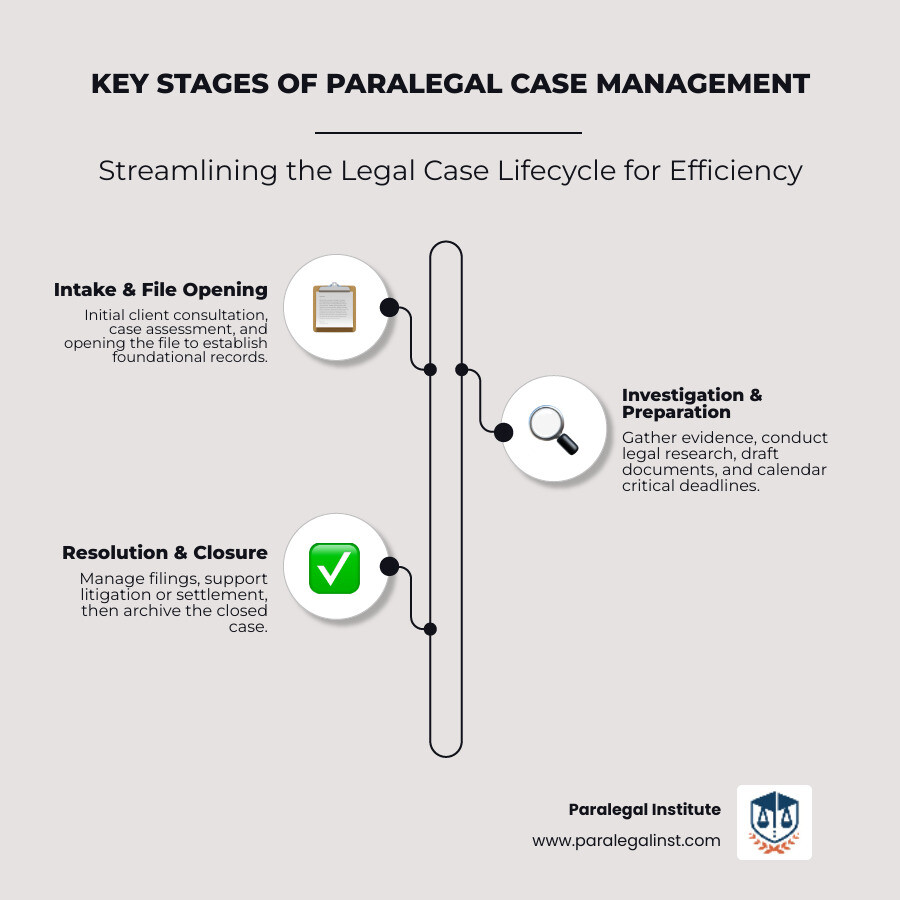
Regularly tracking case progress involves more than just deadlines. We need to know where each case stands in its lifecycle--from initial intake through investigation, discovery, and pre-trial phases. This means maintaining detailed records, updating case status in our systems, and preparing status reports for attorneys.
Maintaining an accurate and up-to-date calendar is the primary system of our case management. For more tips on managing your time effectively, check out our insights on Time Management in Online Paralegal Programs.
Leveraging Technology and Practical Tools in Legal Workflows
The legal landscape is constantly evolving, and today, effective paralegal case management benefits from smart technology utilization and well-built internal systems. The sheer volume and complexity of modern legal cases demand organized digital workflows. Using the right tools isn't about being trendy--it's about being efficient, secure, and consistent.
Trying to manage dozens of cases with paper files and sticky notes is a recipe for missed deadlines and lost documents. Practical digital workflows offer a way to centralize information, reduce duplicative work, and improve collaboration across a legal team. When your documents and deadlines are organized the same way on every file, your day becomes more predictable--and your work becomes easier to review.
From secure file storage to document scanning and automation tools, modern workflows can streamline routine tasks and reduce errors. The goal is simple: keep the case moving forward, protect confidential information, and make sure attorneys have what they need when they need it.
How Technology Boosts Paralegal Efficiency
Technology supports paralegal case management when it helps you find information quickly, maintain confidentiality, and stay consistent across every matter.
Secure digital storage solutions can be transformative when they're set up correctly. They help protect sensitive client data through access controls and allow authorized team members to retrieve materials quickly when deadlines are tight.
Document scanning with Optical Character Recognition (OCR) is another powerful tool. It converts physical documents into searchable digital files, allowing you to find specific keywords within hundreds of pages almost instantly. This also helps when you're organizing large discovery productions, medical records, employment files, or other document-heavy casework.
These workflow upgrades lead to time savings for law firms and reduce preventable mistakes--freeing you up to focus on higher-value legal support tasks.
Streamlining Your Work with Templates and Checklists
One of the most effective ways to streamline paralegal case management is through the intelligent use of templates and checklists. This is about standardizing quality and freeing up time for more complex work.
Document templates are invaluable for routine correspondence, such as letters confirming court dates, requests for records, or follow-up communications with opposing counsel. Instead of drafting each document from scratch, you fill in the specific case details. This speeds up the process and ensures consistency.
Standardized forms for client intake, witness interviews, or discovery organization help ensure that all necessary information is gathered consistently, reducing the chance of missing critical details.
Checklists can also be built into your personal workflow. For each case type, you can maintain a repeatable list for intake, initial disclosures, discovery responses, pretrial preparation, and closing the file. When used consistently, checklists reduce missed steps and make it easier for an attorney to review your work.
At the Paralegal Institute, we focus on practical, career-ready systems like these because they mirror what real law offices expect. With live online instruction (real-time, interactive classes) and in-person classes, students learn how to build repeatable workflows that translate directly to day-one job readiness. Compared to longer programs that may emphasize theory over practice, our accelerated program gets you into the workforce faster with the hands-on skills employers are looking for.
The Professional Framework: Ethics, Client Relations, and Career Growth
As paralegals, our role in paralegal case management extends beyond organizational tasks. We operate within a professional framework defined by strict ethical guidelines, a commitment to client satisfaction, and a drive for professional growth. This framework ensures we support our attorneys effectively and uphold the integrity of the legal system.
Upholding ethical standards is non-negotiable. Our actions directly reflect on our supervising attorneys and the firm. Understanding and adhering to these boundaries protects our clients, our firms, and our own professional standing.
Enhancing the client experience is another critical aspect. Effective case management translates into better client service. When we are organized and communicative, clients feel informed and confident in their legal representation. Finally, continuously improving our skills is vital for career longevity in a dynamic legal field.
Ethical Boundaries in Paralegal Case Management
Ethical considerations are the cornerstone of paralegal case management. As paralegals, we are integral to the legal team, but our roles have specific boundaries that we must always respect to protect our clients, our attorneys, and the integrity of the legal profession.
The most fundamental ethical boundary is avoiding the Unauthorized Practice of Law (UPL). According to guidelines from the American Bar Association (ABA), paralegals cannot give legal advice, set legal fees, or represent clients in court. All substantive legal work must be performed under the direct supervision of a licensed attorney.
Client confidentiality and attorney-client privilege are paramount. We handle highly sensitive information and have an ethical duty to protect it. This means exercising extreme caution with all case files and communications to ensure only authorized individuals have access. It also extends to performing thorough conflict of interest checks before taking on new clients.
The Paralegal Institute emphasizes a strong foundation in Legal Ethics in Paralegal Training because a deep understanding of these principles is essential for every aspiring paralegal.
Paralegal Roles: Understanding Your Scope and Value
Understanding the distinct role of a paralegal in paralegal case management is crucial for both professional development and the efficient operation of a law firm. Our value lies in our specialized legal training and ability to perform substantive legal tasks.
People often ask about the difference between a case manager and a paralegal. While a paralegal performs many case management duties, the roles differ in training and core responsibilities. Case managers often handle administrative and logistical tasks, such as client communication and coordinating with third parties, and typically do not have formal legal training.
Paralegals, on the other hand, perform specific legal tasks under attorney supervision, which requires legal knowledge gained through a specialized paralegal program. We are involved in drafting legal documents, conducting legal research, assisting with discovery, and preparing for trial. A firm might need one or both roles depending on its practice area and caseload.
By efficiently managing cases and performing substantive legal work, we free up attorneys to focus on strategy and court appearances, improving the firm's productivity and making us an indispensable part of the legal team. To gain a deeper understanding of our profession, we encourage you to Learn about the role of paralegals in law firms.
Enhancing Client Satisfaction and Your Professional Skills
Effective paralegal case management is a direct pathway to enhancing client satisfaction and advancing our own professional skills. Proactive communication is one of the most impactful ways to improve client satisfaction. Regular, clear updates on case progress--even if there are no new developments--help manage expectations and reduce client anxiety. Setting clear expectations from the start about legal processes and timelines is also key.
Professional communication involves active listening, empathy, and responsiveness. When clients feel heard and their concerns are addressed promptly, their trust in the legal team grows. Post-case surveys can be invaluable for gathering feedback and refining communication strategies.
To continuously improve our case management skills, we must accept lifelong learning and adapt to new technology. The Paralegal Institute, with its focus on practical, hands-on training in both live online and in-person formats, prepares students with these adaptable skills. Our accelerated program is designed for career-focused adults who want a faster, more affordable path into the legal field compared to lengthier alternatives. Staying informed through continued education ensures we remain at the forefront of paralegal case management. For resources to support your continued development, explore continued learning opportunities for paralegals.
Conclusion: Building a Foundation for a Successful Paralegal Career
We've explored the essentials of paralegal case management, from organizational systems and technology to prioritization and deadline tracking. While juggling multiple cases can seem daunting, improving your case management system is a continuous process of refinement, not an overwhelming overhaul.
At its core, effective case management is about bringing order to complexity, ensuring every document is in place, every deadline is met, and every client feels valued. These skills are fundamental to the success of any legal practice and directly impact case outcomes and client satisfaction.
For paralegals, mastering these skills is about building a foundation for a successful and impactful career. When we excel at case management, we become indispensable members of our legal teams, freeing up attorneys to focus on high-level strategy. We become the organizational force that keeps the legal machine running smoothly.
At the Paralegal Institute in Las Vegas, NV, we understand the importance of these practical skills. Our 15-week paralegal program provides accelerated, hands-on training taught live by practicing legal professionals, both online and in person. We focus on real-world legal training, equipping students with the paralegal case management abilities needed for immediate workforce entry. Our live instruction, interactive coursework, and emphasis on practical exercises prepare you for a career where your organizational skills will be a true asset. Compared to longer alternatives, our program offers a faster, more affordable path to earning your paralegal certificate and launching your legal career.
This guide has delivered tools to help you stay organized and in control throughout the life of a case. Accept these strategies and commit to continuous improvement, and you will become an invaluable asset in any law firm. Your ability to manage cases with efficiency and precision will pave the way for a rewarding paralegal career.
To find more about the essential contributions paralegals make to the legal field and how you can become a part of this vital profession, we invite you to Learn more about the role of paralegals in law firms.