What Paralegals Really Do in Personal Injury Law
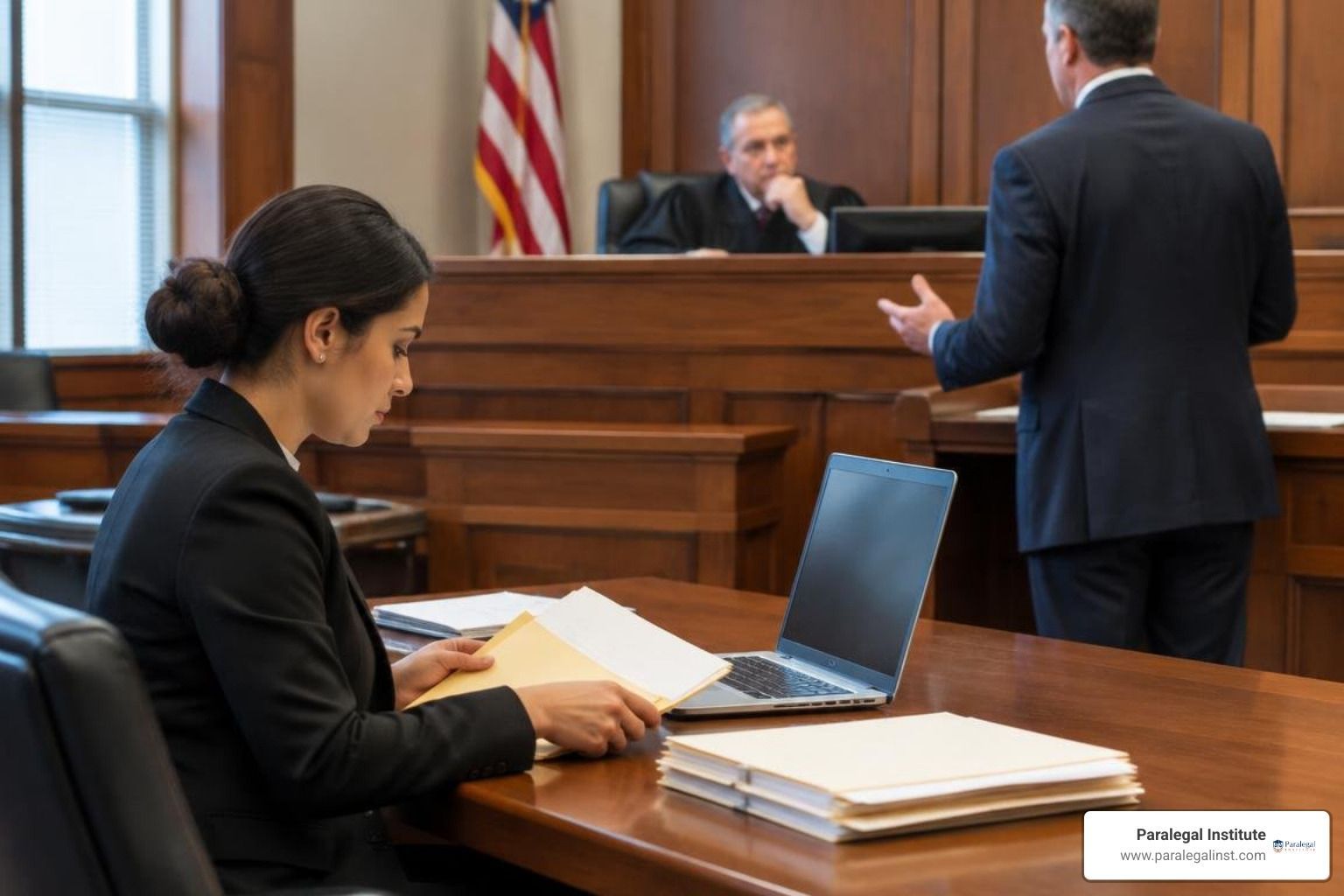
Can a paralegal do personal injury work? Yes, but with important limitations. Paralegals play a vital role in personal injury cases, handling substantial legal work from client intake through trial preparation. However, they must always work under attorney supervision and cannot give legal advice, set fees, or represent clients in court.
Here's what personal injury paralegals can and cannot do:
| Paralegals CAN Do | Paralegals CANNOT Do |
|---|---|
| Interview clients and witnesses | Give legal advice |
| Gather and organize evidence | Set legal fees |
| Draft legal documents | Accept cases on behalf of the firm |
| Manage medical records | Represent clients in court |
| Prepare settlement demands | Make strategic legal decisions |
| Coordinate with insurance companies | Sign pleadings |
| Assist with trial preparation | Practice law independently |
If you've been in an accident and wonder whether the paralegal handling your file is qualified to do so, the answer is yes—they're trained professionals doing critical work. But there's always an attorney ultimately responsible for your case.
Personal injury firms rely heavily on paralegals. These legal professionals often manage over 100 case files at once, serving as the backbone of busy law practices. They bridge the gap between complex legal procedures and compassionate client care, ensuring nothing falls through the cracks.
I'm Matthew Pfau, a practicing attorney who teaches paralegals at the Paralegal Institute, and I've hired and trained dozens of paralegals throughout my career. My experience running a personal injury firm taught me that understanding can a paralegal do personal injury work effectively is crucial for anyone entering this field or working with a legal team after an accident.
If you want additional context on how paralegals fit into the broader legal system, you can also review the overview of paralegal roles on Wikipedia’s paralegal page. That general background, combined with this guide’s focus on personal injury work and hands-on training, will give you a well-rounded picture of the profession.
The Paralegal’s Role: A Lawyer’s Right-Hand in Personal Injury Law
When we talk about the legal field, it's easy to focus solely on lawyers. However, behind every successful attorney is a dedicated team, and the paralegal is often the most critical member. In personal injury law, paralegals are the engine that keeps cases moving forward. They are trained legal professionals who assist attorneys in managing cases involving accidents, injuries, and negligence claims. Their work is extensive and varied, but it always operates under a crucial distinction: paralegals do not practice law.
This means that while a paralegal performs substantive legal work—tasks that require knowledge of legal concepts and procedures—they do so under the direct supervision of an attorney. This isn't just a formality; it's an ethical and legal requirement. The attorney remains ultimately responsible for the case, providing legal advice, making strategic decisions, and representing clients in court. The paralegal's role is to support these functions, allowing the attorney to focus on the high-level legal strategy and court appearances.
Ethical boundaries are a cornerstone of the paralegal profession. Paralegals are strictly prohibited from engaging in the unauthorized practice of law (UPL). This includes giving legal advice, setting legal fees, or representing clients in court. Their expertise lies in the meticulous preparation and management of cases, ensuring that attorneys have all the necessary information and documentation to advocate effectively for their clients.
Our experience has shown us that paralegals are essential to a successful personal injury firm. They are the ones who manage all documents, obtain copies of medical records, and file paperwork with the court. Without their diligent work, the complex machinery of a personal injury case would grind to a halt. They are truly the lawyer's right-hand, making sure every detail is covered so that justice can be pursued.

A Day in the Life: Core Responsibilities of a Personal Injury Paralegal
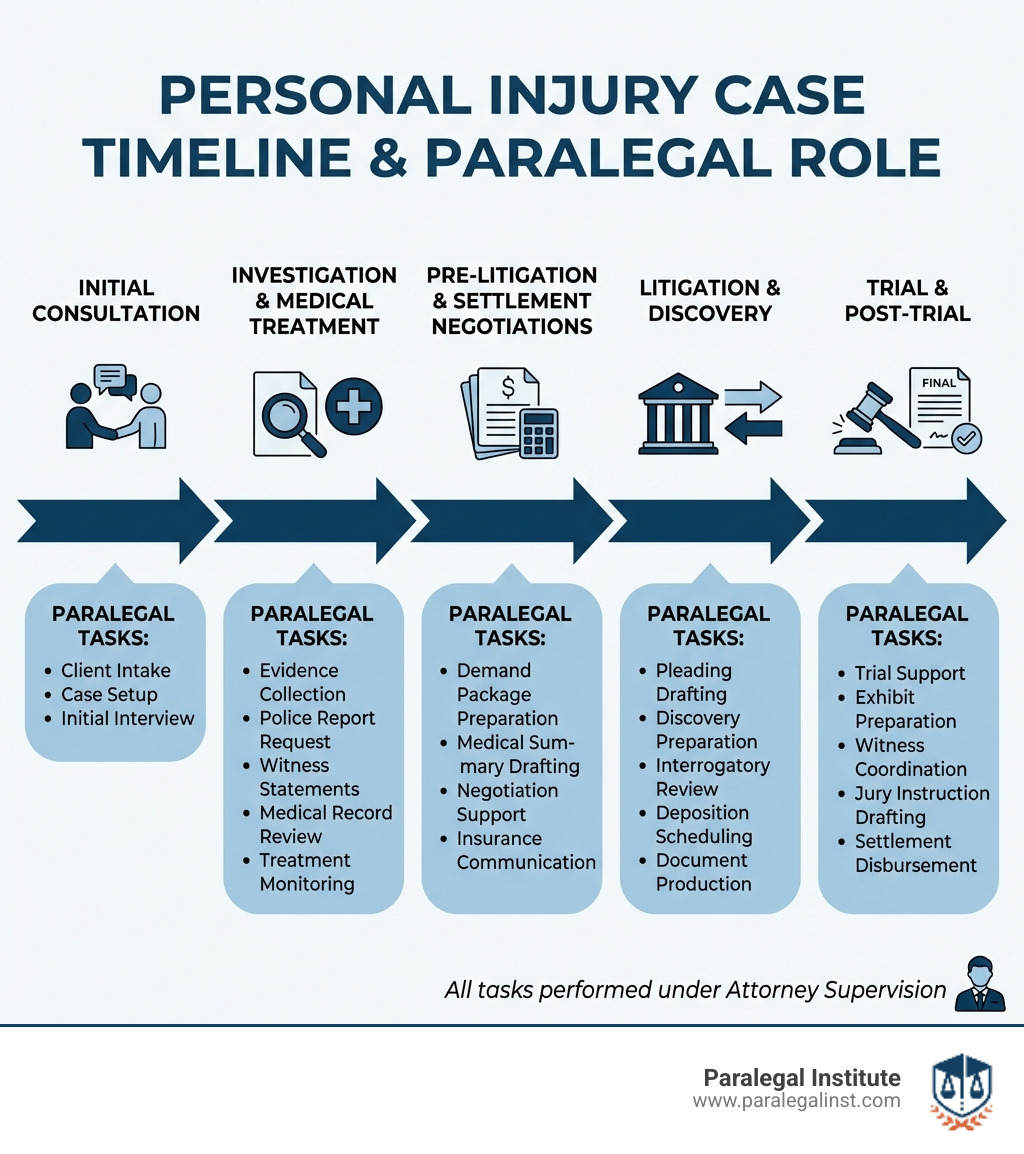
A personal injury paralegal's day is rarely dull. Their responsibilities span the entire lifecycle of a case, from the moment a potential client first calls to the final settlement or trial. They juggle multiple tasks, often managing upwards of 100 case files simultaneously, making them indispensable to law firms. Their work is action-packed and the stories are always interesting, as they steer the complexities of each unique personal injury claim.
In the pre-litigation phase, their focus is on gathering information, organizing evidence, and preparing the groundwork for a potential lawsuit. Once a case moves into litigation, their duties shift to discovery, trial preparation, and ongoing client communication. Regardless of the phase, their goal is to support the attorney in building the strongest possible case for the client.
Client Intake and Initial Case Screening
Often, a paralegal is the first point of contact for someone who has suffered an injury. This is a critical role, as they must be adept at both probing for facts and showing compassion to potentially fragile clients. They conduct initial interviews, gathering crucial facts about the incident, the injuries sustained, and the client's losses. This involves asking probing questions to assess the viability of a potential personal injury claim.
During this stage, paralegals are also acutely aware of statutes of limitations, which restrict the period of time during which plaintiffs can seek redress. Missing a deadline can be fatal to a case, so paralegals play a key role in tracking these critical dates from the outset. Their ability to screen potential clients and cases is vital for personal injury firms, especially those operating on contingency fees, as it helps determine which cases have the best chance of success.
Evidence Gathering and Document Management
Once a case is opened, the paralegal becomes the central hub for all evidence and documentation. Personal injury claims are known for generating large volumes of paperwork, and paralegals are responsible for managing it all. This includes collecting police reports, obtaining witness statements, and gathering photographic or video evidence from the scene of the accident. They must be meticulous in organizing these documents, ensuring that every piece of evidence is properly cataloged and accessible.
Their role extends to obtaining copies of medical records and filing paperwork with the court. They have organized systems to keep track of all paperwork, assisting in drafting legal documents, such as initial complaints or correspondence. This constant flow of information requires exceptional organizational skills and attention to detail.
Managing Medical Records and Terminology
Medical records deserve special attention in personal injury cases because they are often the backbone of proving damages. A personal injury paralegal must understand exactly when and how to request these records, what authorizations are needed, and how to handle protected health information properly. This means a thorough understanding of HIPAA regulations is essential.
While a medical degree isn't required, a strong working knowledge of basic human anatomy, common injuries, and medical terminology is invaluable. Paralegals learn to decipher medical abbreviations like "Fx" for fracture, "dx" for diagnosis, "Rx" for prescriptions, and "Hx" for history. They summarize complex medical charts, translating medical jargon into understandable terms for attorneys and clients. This medical literacy allows them to effectively communicate with healthcare providers and understand the full extent of a client's injuries, ensuring all damages are accounted for.
Assisting with Discovery, Trial Prep, and Settlement
As a case progresses, paralegals become deeply involved in the discovery process, which is how opponents in a lawsuit gather information from each other. They assist attorneys in drafting interrogatories (written questions), requests for production (requests for documents), and requests for admissions. They also help organize and review the responses received from the opposing party.
Paralegals are instrumental in preparing for trial. This can include preparing witnesses for depositions, organizing trial exhibits, and coordinating with expert witnesses. They also handle all necessary scheduling for attorney meetings, depositions, mediations, court hearings, or even trials, ensuring that all parties are aware of critical dates and deadlines.
A crucial pre-settlement task is drafting settlement demand letters or packages. This comprehensive document presents the client's case to the insurance company, outlining the facts, injuries, damages, and a demand for compensation. The paralegal gathers all supporting evidence, including medical bills, lost wage documentation, and other expenses, to create a compelling demand package that supports the client's claim.
Plaintiff and Defense Work: Versatility in Personal Injury Law
One of the fascinating aspects of personal injury law for paralegals is the opportunity to work on both sides of a case: plaintiff and defense. While the core skills of organization, legal research, and communication remain consistent, the strategic goals and daily tasks can differ significantly. This versatility means that a personal injury paralegal often possesses highly transferable skills, making them valuable across various legal settings.
The Plaintiff’s Paralegal: Championing the Injured
A plaintiff paralegal works for the injured individual, advocating on their behalf to recover compensation for their losses. Their mission is to build the strongest possible case to maximize the client's recovery. This involves a deep dive into the client's experience, carefully documenting every aspect of their injury and its impact on their life.
Plaintiff paralegals often develop strong empathetic connections with clients, as they are frequently the primary point of contact and source of support. They are instrumental in gathering all evidence of damages, from medical bills and lost wages to evidence of pain and suffering. Their work culminates in preparing comprehensive demand packages, which are crucial for negotiating fair settlements with insurance companies.
The Defense Paralegal: Analyzing Claims and Minimizing Liability
On the other hand, a defense paralegal works for legal teams representing the party accused of causing the injury, often an insurance company or a corporation. Their primary objective is to analyze the plaintiff's claims, identify any inconsistencies, and assist in minimizing the client's liability. This often involves scrutinizing medical records, accident reports, and witness statements to challenge the plaintiff's version of events or the extent of their claimed damages.
Defense paralegals play a vital role in verifying the details of a claim, ensuring that the evidence supports the defense's position. They assist in developing defense strategies, preparing responses to discovery requests, and coordinating with expert witnesses who can provide counter-arguments to the plaintiff's claims. While the approach differs, the need for meticulous detail and strong legal acumen is equally high.
How to Become a Successful Personal Injury Paralegal
The path to becoming a successful personal injury paralegal requires a combination of specific knowledge, practical skills, and a commitment to professional development. For adults seeking a fast, affordable, and career-ready entry into the legal field, choosing the right educational path is paramount. Our Paralegal Institute offers an accelerated, live-instruction program designed to equip you with the exact skills needed for this demanding role.
Essential Skills That Set You Apart
In the competitive world of personal injury law, certain skills will undoubtedly set you apart. These include:
- Attention to Detail: As we've discussed, managing hundreds of documents and tracking critical deadlines means meticulousness is not just a virtue, but a necessity. Exceptional paralegals are distinguished by their attention to detail, which can be the difference between a successful settlement and a missed opportunity.
- Strong Organizational Skills: Personal injury paralegals often manage upwards of 100 case files simultaneously. Effective organization is key to keeping track of documents, deadlines, and communications for each case.
- Excellent Written and Verbal Communication: You'll be communicating with clients, witnesses, attorneys, and court personnel. Clear, concise, and empathetic communication is vital. This includes drafting legal documents and correspondence that are both accurate and persuasive.
- Empathy: Dealing with injured clients often means navigating sensitive emotional situations. A personal injury paralegal must possess empathy and compassion while still obtaining factual accounts impartially.
- Legal Research and Writing Proficiency: While attorneys make the final legal arguments, paralegals conduct the foundational research. This involves researching relevant laws, regulations, and case precedents to support the attorney's strategy. Our training at the Paralegal Institute emphasizes practical legal research and writing, ensuring you develop these critical skills.
Our program at the Paralegal Institute focuses on developing these practical skills. Our instructors, who are practicing legal professionals, teach you the real-world applications of legal theory, preparing you for the challenges you'll face daily.
The Advantage of Practical, Hands-On Training
When considering a career as a personal injury paralegal, the choice of education is crucial. While longer academic programs exist, they often focus heavily on theoretical knowledge. We believe that for career-focused adults, a practical, hands-on approach is far more effective for immediate job readiness.
Our Paralegal Institute provides an accelerated paralegal program. Our live-instruction format, whether online or in-person, ensures real-time learning and direct interaction with experienced legal professionals. This isn't just about memorizing legal terms; it's about learning how to apply them in real-world scenarios. We focus on training that translates directly into job competence, offering a smarter, faster path into the legal field compared to lengthy, expensive academic programs. This practical training means you enter the workforce with the confidence and skills employers are looking for, making it a truly smart investment in your future.
Frequently Asked Questions about Personal Injury Paralegals
We often hear similar questions from aspiring paralegals and those curious about the role. Here are some of the most common inquiries regarding personal injury paralegals:
What medical knowledge does a personal injury paralegal really need?
Personal injury paralegals don't need to be medical professionals, but they absolutely need more medical knowledge than most people realize. This includes understanding basic human anatomy (e.g., the difference between a cervical and lumbar spine injury) and being fluent in medical terminology and abbreviations found in medical records. They must be able to read and interpret medical charts, bills, and reports to identify key information that supports the client's injuries and damages. The depth of knowledge needed often depends on the firm's specific focus, but a solid foundation is essential for effective case management and communication with both clients and medical providers.
How do paralegals assist in settlement negotiations?
Paralegals play a crucial, albeit indirect, role in settlement negotiations. Their primary contribution is the meticulous preparation of the demand package, which is the comprehensive document sent to the opposing party's insurance company. This package includes all supporting evidence: medical records, medical bills, lost wage documentation, police reports, witness statements, and a detailed narrative of the incident and injuries. By ensuring this package is thorough, well-organized, and compelling, the paralegal provides the attorney with the strongest possible foundation for negotiations. While they do not engage in the actual negotiation of legal terms or dollar amounts, they may communicate with insurance adjusters on factual matters and relay offers and counter-offers under the attorney’s direct supervision and strategy.
Can a paralegal work on both plaintiff and defense cases?
Absolutely! Many personal injury paralegals gain experience working on both the plaintiff and defense sides throughout their careers. The core skills required—such as attention to detail, organization, legal research, document management, and client communication—are highly transferable between the two roles. While the strategic objectives differ (advocating for the injured vs. minimizing liability), the underlying processes and the types of documents handled are very similar. Often, paralegals may start on one side and later transition to the other, broadening their understanding of the entire personal injury landscape and enhancing their career flexibility.
Conclusion: The Indispensable Role of the Personal Injury Paralegal
As we've explored, can a paralegal do personal injury work? Yes, they are absolutely integral to the personal injury legal process. They are the unsung heroes of the legal world, performing extensive, substantive work that is critical for the success of any personal injury claim. From the initial client intake to meticulous evidence gathering, managing complex medical records, and preparing for discovery, settlement, or trial, their contributions are indispensable. However, it's crucial to remember that this vital work is always performed under the direct supervision of a licensed attorney, ensuring ethical practice and legal accountability.
The personal injury paralegal profession offers a challenging and rewarding career path for individuals with a passion for law and a desire to make a tangible difference in people's lives. It requires a unique blend of organizational prowess, legal acumen, medical literacy, and strong interpersonal skills.
If you are a career-focused adult looking for a fast, affordable, and career-ready entry into this dynamic field, our Paralegal Institute offers the perfect solution. Our accelerated paralegal program, with its live instruction and practical, hands-on curriculum, is specifically designed to provide you with the real-world skills needed to excel as a personal injury paralegal. We pride ourselves on offering an educational path that leads directly to job readiness, allowing you to quickly become a valuable asset to any legal team.
For more information about our legal support staff training and how we can help you launch your career, visit our website today: legal support staff training.