
Why Understanding Paralegals and AI Matters Now
Paralegals and AI are reshaping the legal profession in ways that go far beyond the headlines. If you're considering a paralegal career or already working in the field, you need to know what AI can actually do, what it can't replace, and how to position yourself for success.
Here's what you need to know about paralegals and AI:
- AI augments, not replaces- 69% of paralegal billable work could be automated, but human oversight remains essential
- Your role is evolving, not disappearing- AI handles repetitive tasks while paralegals shift to higher-value strategic work
- New skills are critical- 73% of paralegal programs now include AI training; tech literacy and critical thinking are becoming as important as legal knowledge
- Ethical risks require human judgment- 67% of legal departments cite data privacy concerns; paralegals serve as the essential checkpoint for AI accuracy and confidentiality
- Job outlook remains stable- Despite automation concerns, experts don't foresee massive layoffs of the roughly 300,000 U.S. paralegals
The legal industry is at a turning point. AI-powered tools can now complete document review 58% faster than traditional methods and reduce document preparation costs by 32%. Yet the same technology that processes thousands of documents in seconds can also fabricate case citations, compromise client confidentiality, or miss critical legal nuances that only a trained human can catch.
This isn't a story about robots taking jobs. It's about a profession changing—where paralegals who understand how to leverage AI while providing irreplaceable human judgment, empathy, and strategic thinking will become more valuable, not less.
The reality is simple: AI is a powerful assistant, but it requires skilled human operators who understand both its capabilities and its limitations. The paralegals who thrive in the coming years will be those who accept technology as a tool while strengthening the uniquely human skills that no algorithm can replicate.
I'm Matthew Pfau, a practicing attorney who has hired and trained numerous paralegals throughout my career, and now I teach aspiring legal professionals at the Paralegal Institute. My experience hiring paralegals in an increasingly tech-driven legal landscape has shown me how paralegals and AI work together—and what skills truly matter when technology handles the routine work. Let me guide you through what's actually happening in the field, beyond the hype and fear, so you can build a career that's future-proof.
Augmentation, Not Replacement: The True Role of AI in the Legal Field
One of the most pressing questions we hear about paralegals and AI is whether artificial intelligence will replace human legal professionals. Our answer, backed by industry experts and our own experience, is a resounding "No." AI will not replace paralegals; rather, it will augment their roles, making them more efficient, productive, and ultimately, more valuable. The key is to view AI as a sophisticated tool, much like a powerful word processor or advanced legal research database, designed to improve human capabilities, not supplant them.
A majority of lawyers believe that generative AI can be applied to legal work, but very few believe it should replace legal personnel entirely. As one legal tech expert put it, "AI Won’t Replace Paralegals, But Experts Say It’s Likely to Redefine the Role." This redefinition is crucial. It means that while some tasks may be automated, the core essence of the paralegal role—requiring nuanced judgment, client empathy, and strategic thinking—remains firmly in human hands.

What AI Can Do: Automating Repetitive Tasks
The real power of AI for paralegals lies in its ability to automate time-consuming, repetitive tasks that often consume a significant portion of a paralegal's day. Think of it as having a tireless assistant who can sift through mountains of data at lightning speed.
Here are some specific tasks currently performed by paralegals that are most susceptible to automation by AI:
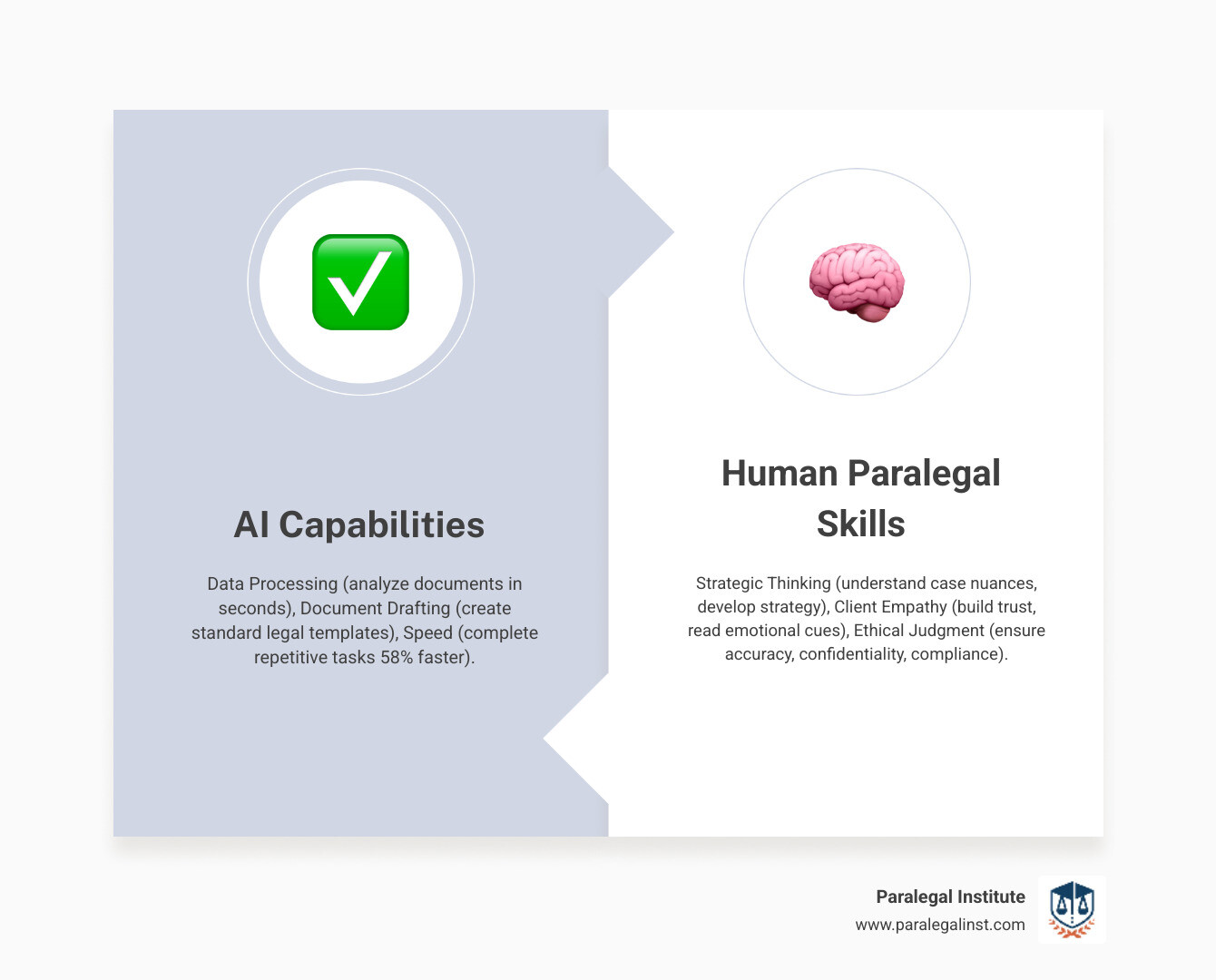
- Document Review: AI can scan and analyze thousands of documents to identify relevant information, keywords, themes, and patterns. This vastly accelerates a process that traditionally required hours of manual labor. In fact, AI-assisted paralegals have completed routine document review tasks 58% faster than those using traditional methods, all while maintaining comparable accuracy rates.
- Legal Research: AI-powered legal research platforms can quickly identify relevant case law, statutes, regulations, and legal precedents, summarizing key points and highlighting connections that might take a human much longer to uncover.
- Contract Analysis: AI tools can review contracts to extract key clauses, identify anomalies, flag potential risks, and ensure compliance with specific terms. This is invaluable for due diligence and contract management.
- Data Entry and Organization: AI can automate the extraction of data from documents and populate databases, reducing human error and freeing up time.
- Drafting Standard Documents: For routine legal documents like non-disclosure agreements, simple contracts, or initial drafts of pleadings, AI can generate templates and suggestions, significantly speeding up the drafting process. This has led to an average cost reduction of 32% for standard legal document preparation.
It's important to understand the scope of this automation. Estimates suggest that as much as 69% of the hourly billable work performed by paralegals could be automated by AI. This isn't a threat; it's an opportunity. By taking over these rote tasks, AI allows paralegals to redirect their energy toward more complex, analytical, and client-focused work. To learn more about how AI can streamline your workflow, explore our insights on Paralegal Automation.
What AI Can't Do: The Irreplaceable Human Element
While AI excels at processing information and automating tasks, there are fundamental aspects of legal work that remain uniquely human—and these are precisely where the paralegal's value becomes irreplaceable. AI cannot replicate:
- Client Communication and Empathy: Building trust, understanding a client's emotional state, and providing sensitive, nuanced communication are skills that AI simply cannot possess. AI lacks the capacity for empathy, to "read the room," or to gauge emotional triggers, which are critical for effective client interaction.
- Strategic Case Analysis: While AI can present data, it cannot formulate a winning legal strategy. That requires a deep understanding of human motivations, legal precedents, and the ability to connect disparate pieces of information in a creative and insightful way that only a human mind can achieve. AI lacks contextual knowledge and higher reasoning capacity needed for complex legal nuances.
- Ethical Reasoning and Judgment: Legal practice is steeped in ethical considerations. AI operates based on algorithms and data; it cannot exercise ethical judgment, understand the moral implications of a decision, or steer the complex ethical dilemmas that arise in legal cases.
- Nuanced Legal Judgment: The law is rarely black and white. It often involves interpreting ambiguities, understanding subtle semantics, and applying principles to unique factual scenarios. AI, operating on predictive text models, can miss these nuances.
- Critical Thinking and Problem-Solving: When faced with novel legal issues or unforeseen challenges, paralegals apply critical thinking to devise solutions. AI can only process what it has been trained on; it struggles with truly novel problems that require creative human insight.
The prevailing sentiment among legal professionals is that these human elements—judgment, critical thinking, and interpersonal skills—are crucial in legal services and remain difficult to automate. Your role in the firm, as we often discuss at the Paralegal Institute, is about providing this essential human layer of support. For a deeper dive into the enduring importance of these human skills, visit our page on the Role of Paralegals in Law Firms.
The Evolving Skillset: How to Thrive as a Paralegal in the AI Era
The integration of AI into legal practice means that the skills paralegals need to succeed are evolving. It's no longer enough to be proficient in traditional legal tasks; future-ready paralegals must also be comfortable working alongside technology. This isn't about becoming a programmer, but about becoming a skilled user and critical evaluator of AI tools.
This shift is already reflected in education: 73% of paralegal educational programs now include some form of AI training in their curriculum. This demonstrates a clear industry-wide recognition that AI literacy is no longer optional.

At the Paralegal Institute, we emphasize that mastering these new competencies, combined with sharpening your inherent human skills, will make you an indispensable asset in any legal team. This dual approach ensures that you are not only efficient but also effective and strategically valuable. To understand more about how technology is shaping the profession, explore our resources on Legal Technology for Paralegals.
Mastering the Tech: Essential AI and Digital Competencies
To effectively leverage AI, paralegals need to develop a new set of technical skills. These aren't about building AI, but about intelligently interacting with it:
- Prompt Engineering: This is the art of crafting clear, precise, and effective instructions for AI tools to get the best possible output. A well-constructed prompt can guide an AI to identify key clauses in contracts or find specific legal precedents, while a poorly constructed one can lead to irrelevant or inaccurate results.
- AI Tool Evaluation: With a proliferation of AI tools entering the market, paralegals need to know how to assess their capabilities, limitations, and suitability for specific tasks. This includes understanding the underlying algorithms and potential biases.
- Data Verification: AI-generated outputs, especially from generative AI, are not always accurate. Paralegals must develop robust data verification skills to fact-check, cross-reference, and ensure the reliability of information provided by AI.
- Understanding Algorithms (at a high level): While you don't need to code, understanding how AI learns and processes information helps you anticipate its strengths and weaknesses, allowing you to use it more effectively and critically.
The real value here is knowing how to use AI effectively and critically. The more we use AI tools, the better we become at training them to be more accurate and efficient. This makes us, as paralegals, more valuable. We can also play a crucial role in verifying client identity, catching fraud, and understanding potential legal liability in the AI value chain. For insights into specific tools, visit our page on AI Tools for Paralegals.
Sharpening Your Human Edge: Skills AI Can't Replicate
As AI takes over more routine work, the uniquely human skills that AI cannot replicate become even more critical. These are the soft skills, the interpersonal abilities, and the higher-level cognitive functions that distinguish human professionals:
- Communication: Clear, concise, and empathetic communication—both written and verbal—is essential for interacting with clients, attorneys, and other legal professionals. AI can draft, but it cannot truly communicate with human nuance.
- Problem-Solving: Beyond routine tasks, legal work often involves complex, multi-faceted problems that require creative and adaptive solutions. This critical thinking and problem-solving ability is a cornerstone of human intelligence.
- Collaboration: Working effectively as part of a legal team, sharing insights, and coordinating efforts are vital. AI is a tool, not a teammate in the human sense.
- Emotional Intelligence: The ability to understand and manage one's own emotions, and to perceive and influence the emotions of others, is indispensable in client-facing roles and team dynamics.
- Strategic Thinking: This involves looking at the bigger picture, anticipating future challenges, and developing long-term plans. While AI can process data, it cannot devise or execute a comprehensive legal strategy.
As AI handles the more repetitive, data-heavy work, these human-centric skills become a paralegal's primary value. They are what allow us to connect with clients, build strong cases, and contribute meaningfully to the strategic direction of legal matters. Understanding these shifts is key to navigating current Paralegal Industry Trends.
Navigating the Risks: Ethical Considerations for Paralegals and AI
While AI offers immense opportunities for efficiency, its use in the legal field, especially by paralegals, comes with significant ethical considerations and potential risks. We must approach AI with caution and a clear understanding of our professional responsibilities. The primary concerns revolve around accuracy, confidentiality, and bias.
One of the biggest hesitations in adopting AI tools, cited by 67% of legal departments, is data privacy concerns. This highlights the critical need for robust protocols and careful decision-making when integrating AI into legal workflows.
The Paralegal's Role in Ensuring AI Accuracy
One of the most significant risks of using AI, particularly generative AI, is the phenomenon known as "hallucination," where the AI fabricates information, including legal citations or facts. We've seen cautionary tales, such as the widely publicized incident involving lawyers Steven Schwartz and Peter LoDuca, who were sanctioned after presenting a ChatGPT-produced legal brief that cited fictitious cases. They claimed ignorance, saying they didn’t know the chatbot could fabricate information. This incident underscores a vital lesson: paralegals must never take AI output at face value.
Our role as paralegals in ensuring AI accuracy is paramount. We are the essential human-in-the-loop, the final checkpoint and guardian of accuracy. This involves:
- Fact-Checking: Every piece of information generated by AI, from dates and names to legal principles and citations, must be rigorously fact-checked against reliable sources.
- Source Verification: If an AI tool cites sources, we must verify that those sources actually exist and accurately support the claims made. Asking AI tools to cite their sources when presenting conclusions is a best practice.
- Cross-Referencing Data: We should cross-reference AI-generated data with other known information and traditional research methods to catch inconsistencies.
- Human-in-the-Loop Review: This means that AI outputs are always reviewed, edited, and approved by a human paralegal before being used in any legal work. This quality control is non-negotiable.
Paralegals may well become the "quality controllers" for AI within law firms, acting as an essential safety net for mistakes or "hallucinations." This duty of candor extends to our use of AI; we must be transparent internally and, where required, with clients and courts about how AI has been used in producing legal work. For more on the ethical use of technology, refer to our insights on Legally AI. You can also read about the real-world consequences of unverified AI use in this article: The cautionary tale of lawyers sanctioned for using fake ChatGPT cases.
Upholding Confidentiality in the Age of AI
Protecting client confidentiality is a cornerstone of legal ethics, and AI introduces new complexities. When we input client data into AI tools, we must be acutely aware of how that data is processed, stored, and used.
Key practices for upholding confidentiality include:
- Using Secure Platforms: We should only use AI tools that are specifically designed for legal professionals and that adhere to stringent data security and privacy standards. Many firms prohibit the use of public AI tools like general-purpose chatbots due to these privacy concerns.
- Anonymizing or Sanitizing Data: Before inputting sensitive client information into any AI system, we should anonymize or sanitize it where possible to remove personally identifiable information.
- Understanding Data Usage Policies: We must thoroughly understand the terms of service and data usage policies of any AI tool. Does the AI provider use our data to train its models? If so, this could compromise client confidentiality.
- Firm Protocols: Law firms must establish clear protocols and guidelines for AI use, including which tools are approved, what types of data can be entered, and who is responsible for oversight. Using public AI tools with sensitive client data is a major ethical breach.
Ethical guidelines for legal professionals emphasize the importance of using AI in a trustworthy and responsible manner, and this includes protecting client data. Our commitment to confidentiality is non-negotiable, and it requires diligence and awareness in the age of AI.
The Future Outlook: Job Prospects and the Evolved Paralegal Role
The arrival of AI has naturally sparked questions about the future job outlook for paralegals. While some initial fears suggested widespread job displacement, the consensus among experts, and our own view at the Paralegal Institute, is that the role will evolve rather than disappear.
BLS projects little or no change in paralegal employment from 2025 to 2035, but still expects about 40,800 openings a year, mostly as people retire or change careers ( BLS). Experts do not foresee AI causing massive layoffs in the near term. Instead, the focus is on a change of duties.
The future for paralegals and AI is one where AI handles the administrative heavy lifting, freeing paralegals to take on higher-value, more analytical, and strategic tasks. This means that a paralegal's career trajectory will increasingly depend on their ability to adapt, learn new skills, and accept AI as a powerful partner. To prepare for this exciting future, consider specializing your skills with programs like our Advanced AI for Paralegals.
| Aspect | Traditional Paralegal Role | AI-Augmented Paralegal Role |
|---|---|---|
| Document Review | Manual Document Search, Keyword Spotting | AI-Powered Research Analysis, Theme Identification, Quality Control |
| Data Management | Manual Data Entry, File Organization | Data Interpretation, Database Management, Anomaly Detection |
| Drafting | Basic Drafting, Template Customization | Strategic Document Review, AI-Assisted Drafting, Nuance Refinement |
| Research | Extensive Manual Legal Research | AI-Powered Research Curation, Contextual Application, Source Verification |
| Core Focus | Administrative, Task-Oriented | Analytical, Strategic, Client-Focused |
What the Future Holds for Paralegals and AI
As AI becomes more integrated into legal practice, the role of the paralegal will expand and become more sophisticated. We anticipate the emergence of new, specialized functions for paralegals who are adept at leveraging technology:
- AI Supervisor / AI-Human Interface Specialist: Paralegals will be responsible for overseeing AI tools, ensuring their outputs are accurate and ethical, and acting as the crucial link between the technical capabilities of AI and the practical needs of legal cases. This includes "prompt writing" expertise and critical evaluation.
- Technology Project Manager: With AI streamlining workflows, paralegals may take on more responsibility for managing legal technology projects within firms, optimizing processes, and integrating new tools.
- Strategic Analyst: Freed from mundane tasks, paralegals will have more time to conduct in-depth strategic analysis, interpret complex data, and contribute to case strategy. The role becomes more analytical, moving from "doing" to "managing and analyzing."
- Quality Controller: Given AI's potential for "hallucinations" and biases, paralegals will serve as essential quality controllers, safeguarding against errors and ensuring the integrity of all AI-generated legal work.
AI will likely shift paralegal work from mere data collation and administration to more nuanced, business-led advice. This evolution means more interesting and necessary jobs for those who accept the change. For additional resources on navigating these shifts, explore our Paralegal Resources.
How Law Firms and Education are Adapting to Paralegals and AI
Law firms and educational institutions, like the Paralegal Institute, are rapidly adapting to this new reality. They recognize that supporting paralegals in adapting to AI technologies is not just beneficial, but essential for future success.
- Firm Training Programs: Forward-thinking law firms are investing in training programs to equip their paralegals with AI literacy, prompt engineering skills, and best practices for ethical AI use. This includes hands-on training with specific legal AI tools. As much as 64% of law firms report that their paralegals regularly use AI tools for tasks like document drafting, legal research, and client communication.
- New Hiring Criteria: AI-enabled law firms are increasingly seeking candidates who not only possess strong legal knowledge but also excel at people skills, critical thinking, and understand AI best practices. Technological fluency with AI tools and strong soft skills are becoming prioritized over traditional skills alone.
- Educational Curriculum Updates: Paralegal educational programs are integrating AI training into their core curriculum. At the Paralegal Institute, we continually update our program to reflect the latest legal technology, ensuring our students are immediately workforce-ready with the skills employers demand. This focus on practical, real-world legal training is a cornerstone of our approach. Our accelerated, hands-on curriculum, designed and taught by practicing legal professionals, prepares you for an AI-integrated legal environment.
- Continuous Learning: The legal tech landscape is constantly evolving. Both firms and paralegals must commit to continuous learning, staying updated on the latest AI innovations and adapting their skills accordingly.
Staying informed about these developments is crucial. You can monitor legal technology news to stay updated on the latest artificial intelligence innovations. For more on how education is adapting, see our page on Technology in Paralegal Programs.
Frequently Asked Questions about Paralegals and AI
Will I lose my job to a robot?
No. AI will augment, not replace, paralegals. It handles repetitive tasks, allowing you to focus on complex, strategic work that requires human judgment. Your role will evolve, not disappear.
Do I need to be a computer programmer to use AI?
Absolutely not. Modern legal AI tools are user-friendly. The key skill is not coding, but learning how to ask the AI the right questions and critically evaluating the results. Our live instruction courses at the Paralegal Institute focus on practical application, not complex programming.
How can I prepare for this change?
Focus on a practical education that integrates technology. Develop strong critical thinking, analytical, and communication skills, and accept a mindset of continuous learning to stay current with new tools. Our program, taught by practicing legal professionals, is designed to provide you with these career-ready skills for immediate workforce entry.
Conclusion
The change of the legal profession by AI is not a distant future; it's happening now. For paralegals and AI, this means a shift from purely administrative tasks to roles that demand higher-level critical thinking, strategic analysis, and irreplaceable human judgment. AI is a transformative force that empowers, rather than replaces, the skilled paralegal.
The future belongs to paralegals who can leverage technology, apply critical thinking, and provide the irreplaceable human touch. A modern paralegal education, like the hands-on, live-instruction program at the Paralegal Institute, is designed to equip you with the practical skills needed to thrive in this evolving landscape. We believe in preparing you for a career, not just a certificate. Our accelerated path is more practical and career-ready than other traditional programs, focusing on real-world legal training that makes you an indispensable asset in any law firm.
To learn more about how technology is integrated into modern legal training and to build a future-proof career, explore our AI resources for paralegals.