The Punchline Isn't What You Think
Will AI take over paralegal jobs? The short answer might surprise you - it's not a simple yes or no. Here's what the data actually shows:
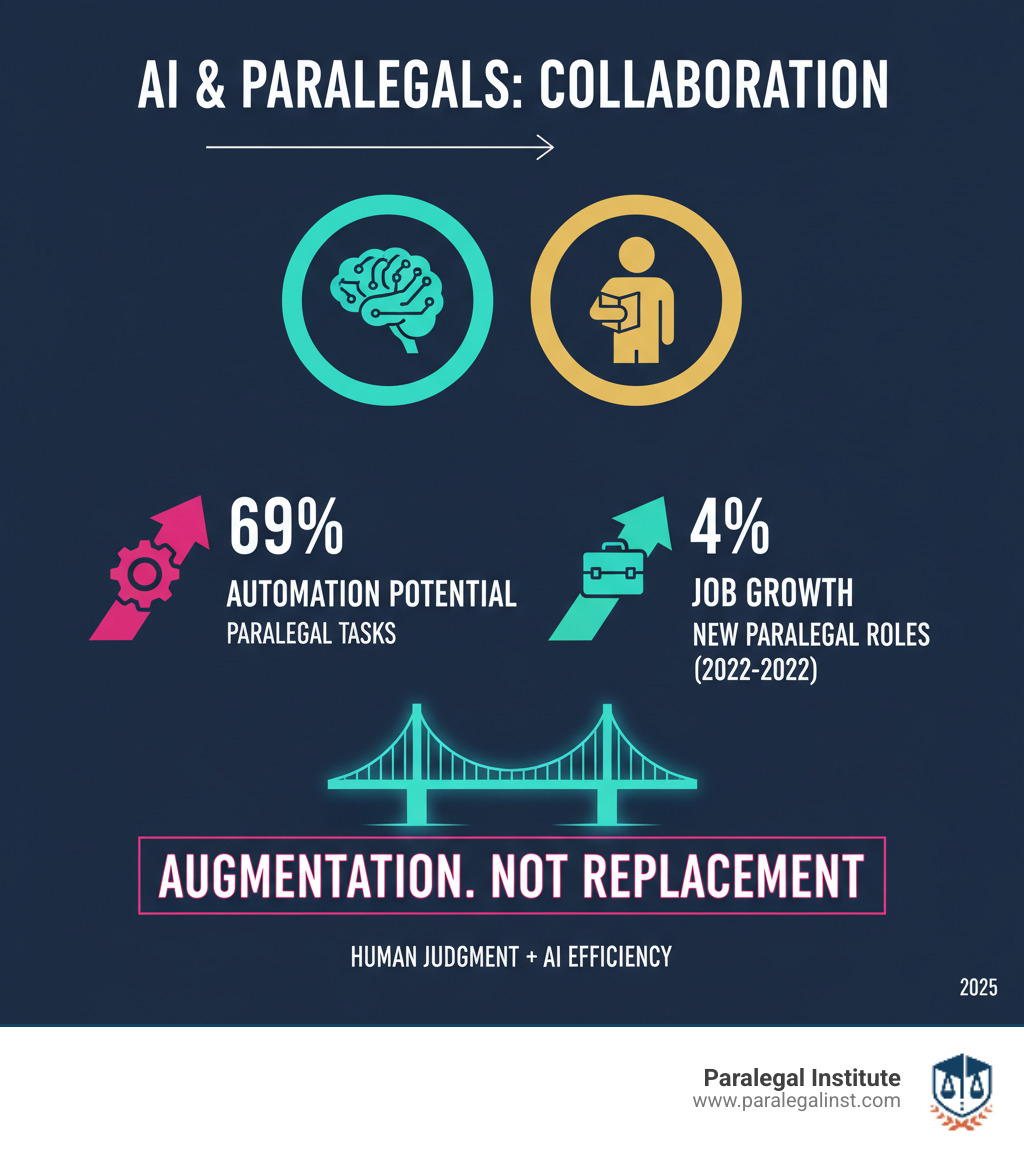
- 69% of paralegal billable work could be automated by AI
- Paralegal employment is projected to change little from 2025 to 2035, with about 40,800 openings a year
- AI will augment, not replace paralegals according to legal experts
- Human skills remain irreplaceable for client interaction and complex judgment
The legal industry is buzzing with anxiety about artificial intelligence. Headlines scream about robots replacing lawyers and paralegals. But the reality is far more nuanced than the fear-mongering suggests.
The real story isn't about replacement - it's about collaboration.
While AI can process documents faster than any human, it can't comfort a worried client or make ethical judgments in complex cases. The paralegals who will thrive are those who learn to work with AI, not against it.
AI tools are already streamlining legal research and document review. But they're also generating fake case citations and missing crucial context. The future belongs to paralegals who can harness AI's power while providing the human oversight it desperately needs.
I'm Matthew Pfau, owner of a law firm where I hire and train numerous paralegals daily. My experience has shown me that the question "will AI take over paralegal jobs" misses the point - the real opportunity lies in becoming an AI-savvy paralegal who can bridge technology and human judgment.
The Robot's Best Tricks: What AI Can Do (and Why It's Not Enough)
Here's what might surprise you: AI really can handle a massive chunk of paralegal work. Some reports suggest that up to 69% of hourly billable tasks could potentially be automated. That's a big number - but before you start updating your resume, let's look at what AI actually does well (and where it falls flat on its digital face).
AI truly shines when it comes to document review and e-discovery. Picture this: you need to comb through millions of emails and documents to find smoking gun evidence. While a human team might take months, AI can scan through everything in hours, spotting patterns and flagging relevant information with impressive speed.
Data analysis is another AI superpower. AI systems are quite adept at processing massive amounts of data and turning it into digestible insights. What used to take days of number-crunching now happens in minutes.
Then there's legal research- AI can pull relevant case law and statutes from vast databases faster than you can say "precedent." It's like having a research assistant who never sleeps and never gets tired of digging through legal texts.
Contract analysis is where AI really shows off. JP Morgan's COIN program famously automated 360,000 hours of contract review work in mere seconds. AI can spot inconsistencies, highlight risky clauses, and even draft basic contract language.
Don't forget the administrative grunt work- scheduling court dates, organizing case files, and managing documents. AI handles these tasks without complaint (mostly because it can't complain).
For students looking to understand these tools better, our Best Tools and Resources for Paralegal Students provides excellent guidance on navigating this tech-driven landscape.
AI's Limitations: The Ghost in the Machine
But here's where things get interesting - and why the question "will AI take over paralegal jobs" isn't as straightforward as it seems. AI has some pretty spectacular failure modes that would make any lawyer break out in a cold sweat.
The biggest problem? AI hallucinations- and no, that's not as fun as it sounds. AI sometimes just makes stuff up, creating fake case citations that look completely legitimate. Two lawyers learned the limitations of AI the hard way when they submitted a brief full of ChatGPT's fictional cases to federal court. The judge was not amused.
Context is everything in law- and AI often misses the bigger picture. It can't grasp the subtle differences between similar cases or understand the historical context that shapes legal interpretation. When a client asks about their "unique situation," AI might miss the nuances that make all the difference.
Ethical judgment is another blind spot. AI learns from data, which means it can perpetuate biases present in that data. It can't make moral decisions or steer the ethical gray areas that paralegals face daily.
Most importantly, AI lacks emotional intelligence. It can't read between the lines of what a client is really asking, or understand when someone needs reassurance rather than just legal facts.
The bottom line? AI is incredibly powerful, but it's like a sports car without a driver - impressive capabilities, but it needs human oversight to avoid crashing into things. Every AI output requires a skilled human to verify, contextualize, and ensure it actually makes sense in the real world.
The Human's Winning Hand: Where Paralegals Outshine AI
Here's the truth about will AI take over paralegal jobs: While robots excel at processing data, they're absolutely terrible at being human. And in the legal world, being human isn't just an advantage - it's essential.

Think about what happens when a client walks into a law office. They're not just bringing documents and facts - they're bringing fears, hopes, confusion, and often desperation. This is where paralegals truly shine, using skills that no algorithm can replicate.
Critical thinking and strategic planning set human paralegals apart from even the smartest AI systems. When reviewing a case file, experienced paralegals don't just process information - they understand it. They spot patterns, identify missing pieces, and ask the right questions. They can look at a stack of documents and think, "Wait, something doesn't add up here."
Empathy and genuine client communication create the foundation of trust that every legal case needs. Paralegals often serve as the human face of the legal team, explaining complex procedures in plain English and providing reassurance during stressful times. They build relationships that make clients feel heard and understood.
Ethical judgment guides every decision paralegals make. The legal field operates within a complex framework of professional rules and moral considerations. Paralegals steer these waters daily, making judgment calls that protect both clients and the integrity of the legal system. AI might follow programmed rules, but it can't grapple with the gray areas where most real legal work happens.
Adaptability and creative problem-solving allow paralegals to handle the unexpected twists that characterize legal work. Every case is different, and experienced paralegals develop an intuition for finding solutions that go beyond standard procedures. They think on their feet and adjust their approach based on new information or changing circumstances.
The courtroom environment particularly highlights these human strengths. From organizing trial exhibits to supporting attorneys during hearings, paralegals provide hands-on assistance that requires quick thinking, anticipation, and seamless human interaction.
Our The Paralegal Hub offers deeper insights into developing these essential human skills that keep paralegals irreplaceable in an AI-driven world.
Why a Robot Can't Handle a Crying Client
Picture this scenario: A client calls the office, voice shaking, barely able to explain their situation through tears. They're facing a custody battle, or their business is being sued, or they're dealing with a loved one's estate. Now imagine trying to hand that phone call over to a chatbot.
It sounds absurd because it is. This is where the human element becomes not just valuable, but absolutely critical.
Emotional intelligence allows paralegals to read between the lines of what clients are saying. They can hear the worry in someone's voice, sense when a client is holding back important information, and provide the kind of reassurance that builds trust. This isn't about following a script - it's about genuine human connection.
Nuanced communication and interpersonal skills enable paralegals to translate complex legal concepts into language that makes sense to worried clients. They can explain the same information differently depending on who they're talking to, adjusting their approach based on the client's background, emotional state, and level of understanding.
Contextual understanding comes from human experience and intuition. While AI processes data points, paralegals understand the human story behind those data points. They recognize how a client's personal history, family dynamics, or financial situation might impact their case strategy.
Relationship management requires the kind of social intelligence that develops through years of human interaction. Paralegals coordinate with multiple parties - clients, opposing counsel, court staff, witnesses - managing personalities and keeping everyone on the same page. They know when to be firm, when to be diplomatic, and when to simply listen.
These relationship-building skills become even more important as AI handles routine tasks. When technology takes care of document processing and basic research, paralegals can focus more on what they do best - connecting with people and providing the human touch that makes legal services truly effective.
Understanding AI Adoption in the legal field reveals a clear pattern: the most successful implementations use AI to handle repetitive tasks while freeing up paralegals to do more of the uniquely human work that clients truly value.
So, Will AI Take Over Paralegal Jobs? The Expert Verdict
Here's the truth that might surprise you: will AI take over paralegal jobs isn't really the right question anymore. The experts have weighed in, and their verdict is clear - we're looking at partnership, not replacement.
Many remember the 1990s when people panicked about computers wiping out legal jobs. Spoiler alert: it didn't happen. Experts don't expect AI to have the immediate, disruptive impact that fearmongers predict either.
But let's be honest about the numbers, because they tell a complex story. The U.S. Bureau of Labor Statistics shows little or no change in paralegal employment from 2025 to 2035, with about 40,800 openings a year, mostly from turnover. Yet a 2023 report noted that legal services lost 4,200 jobs in August 2023 alone.
Goldman Sachs threw another curveball, suggesting generative AI could replace up to 44% of the legal profession. These conflicting statistics might seem scary, but they actually highlight something important: we're not seeing job disappearance, we're witnessing job evolution.
The bottom line? The future belongs to the AI-savvy paralegal. For those planning their career path, Career Paralegal Education has never been more crucial.
How AI is Reshaping the Paralegal Role, Not Erasing It
Think back to the 1980s when word processors replaced typewriters. People predicted secretaries would vanish. Instead, they evolved into administrative professionals with expanded responsibilities and higher value to their organizations.
The same change is happening with paralegals, and it's actually exciting.
AI excels at the repetitive, data-heavy tasks that used to eat up hours of a paralegal's day. Document review, data entry, basic legal research - these are becoming AI's domain. But here's the kicker: this isn't eliminating the paralegal role, it's elevating it.
Instead of spending hours on mundane tasks, paralegals are moving into strategic, high-value work. Complex analysis, strategic input, and client-focused activities that require human judgment are becoming the new normal.
A fascinating new skill is emerging called "prompt engineering"- the art of crafting precise instructions for AI tools to get the most accurate results. This requires deep understanding of both legal concepts and AI capabilities. It's like being a translator between human needs and machine capabilities.
The paralegal's role is also expanding into AI oversight and review. When AI generates drafts and summaries, someone needs to check them for accuracy, context, and ethical compliance. That someone is the paralegal - now liftd from data entry clerk to quality control specialist.
Technology becomes a tool, not a master. The successful paralegal learns to collaborate with AI systems, fine-tuning them for specific legal tasks. They know how to ask the right questions, interpret AI answers, and integrate them into the legal workflow.
This evolution makes the paralegal role more dynamic and intellectually stimulating than ever.
The Future Outlook: Will AI take over paralegal jobs in the long run?
Let's address the elephant in the room. Even if AI isn't replacing paralegals now, will AI take over paralegal jobs eventually? The long-term outlook is actually quite optimistic for those who accept change.
Most experts agree that total replacement is highly unlikely. Why? Because AI lacks something fundamental: consciousness, empathy, and moral reasoning. These aren't nice-to-haves in legal work - they're absolutely essential.
The "human-in-the-loop" model will remain central to legal work. AI can process information brilliantly, but it can't comfort a worried client, make ethical judgments, or steer the complex human dynamics of legal cases.
Here's what the future actually looks like:
Increased demand for AI-fluent paralegals is already happening. Law firms actively seek candidates who combine strong legal skills with technological fluency. These paralegals understand AI's capabilities and limitations while excelling at the people skills that machines can't replicate.
Evolving responsibilities mean paralegals are taking on higher-level work. Complex data analysis, strategic case support, and even contributing to custom AI legal tool development are becoming part of the job description. As AI makes legal teams faster and more productive, paralegals move up the value chain.
New specialized roles are emerging, just as computers created IT jobs that didn't exist before. Think "Legal AI Specialist" or "E-Discovery AI Analyst" - roles focused on managing and troubleshooting AI systems within legal contexts.
Strategic advisory roles are expanding as AI handles the heavy lifting in research and document review. Paralegals gain time to provide strategic input to attorneys, oversee AI-powered research, and focus on developing unique skills that view AI as an ally rather than a threat.
The future isn't about obsolescence - it's about evolution and growth for paralegals who adapt and learn alongside advancing technology.
How to Be the Last One Standing: Upskilling for the AI Era
The real question isn't will AI take over paralegal jobs- it's how can you become the paralegal every law firm desperately wants to hire? The answer is surprisingly straightforward: accept the technology that's reshaping our profession.

Think about it this way: when calculators became common, accountants didn't disappear. Instead, they focused on higher-level analysis and strategy. The same change is happening in the legal field right now.
You don't need to become a computer programmer or tech genius. You simply need to learn how to work with AI tools as a legal professional. This means understanding how to use AI for tasks like document review and data analysis while knowing exactly when human judgment is essential.
The paralegals who are thriving right now are those who stay curious about AI developments. They watch training videos, attend workshops, and actively seek out learning opportunities. Our Top Resources for Paralegal Education can help you find the right path forward.
Why upskilling is the answer to "will ai take over paralegal jobs"
Here's the secret that successful paralegals already know: upskilling isn't just about job security - it's about becoming indispensable. When you master both traditional paralegal skills and modern AI tools, you become the person law firms can't function without.
The future-proof paralegal excels in four key areas. AI proficiency and prompting means knowing how to communicate effectively with AI tools. It's like learning a new language - once you understand how to ask the right questions, AI becomes an incredibly powerful assistant. You'll learn to craft instructions that get accurate legal information and help prioritize your daily tasks.
Advanced data analysis skills help you make sense of what AI finds. While the computer can process thousands of documents, you're the one who spots the important patterns and explains what they mean. This human insight is what turns raw data into winning legal strategies.
Strategic client management becomes even more valuable as AI handles routine tasks. Your ability to communicate with worried clients, solve complex problems, and think critically can't be replicated by any machine. These soft skills - empathy, collaboration, and conflict management - are your competitive advantage.
Ethical oversight and AI review is perhaps the most crucial skill of all. Remember those lawyers who got in trouble for submitting fake case citations generated by AI? That won't happen when you're on the team. You'll be the expert who reviews AI outputs, catches potential biases, and ensures everything meets ethical guidelines.
For those just starting their journey, learning how to become a paralegal online provides the foundation you need to build these advanced skills.
Practical Steps to Future-Proof Your Paralegal Career
Ready to transform your career? Here's your roadmap to becoming an AI-savvy paralegal that law firms will fight over.
Start by monitoring legal tech news regularly. Subscribe to industry publications and attend local legal technology events. When new AI tools emerge, you'll be among the first to understand their potential impact. This knowledge makes you valuable in planning meetings and strategic discussions.
Master the art of prompt writing- it's like learning to give perfect instructions to a very literal assistant. The better you get at crafting clear, specific prompts, the more useful AI becomes. This skill alone can dramatically increase your productivity and accuracy.
Understand AI limitations inside and out. Know exactly when AI might hallucinate fake information or miss important context. This expertise makes you the trusted reviewer who prevents costly mistakes. You'll be the person attorneys rely on to verify AI outputs.
Seek practical, hands-on training whenever possible. A quality program will give you real experience with AI tools in actual legal scenarios. This isn't theoretical knowledge - it's practical skills you can use immediately.
Consider a comprehensive paralegal training program that prepares you for today's legal environment. Our 15-week program combines traditional paralegal skills with modern legal technology training. You'll learn from practicing legal professionals who understand exactly what today's law firms need.
Never stop strengthening your human skills. While AI handles data processing, your communication abilities, critical thinking, and problem-solving skills become more valuable than ever. These are the qualities that build client trust and support successful legal teams.
The paralegals who follow this path aren't just surviving the AI revolution - they're leading it. They're the ones getting promoted, earning higher salaries, and finding their work more interesting than ever before.
Conclusion: The Job Goes to the One Who Buys the AI a Drink
So, when AI and a paralegal walk into a bar, who leaves with a job? The punchline, as we've finded, isn't about one replacing the other. It's about the paralegal who understands that the AI is buying the first round because it's thrilled to have a competent human partner.
The conversation around will AI take over paralegal jobs often misses the fundamental truth we've uncovered throughout this exploration. AI isn't a competitor lurking in the shadows, ready to steal your career. Instead, it's a powerful assistant – think of it as the world's most efficient intern who never needs coffee breaks but desperately needs supervision.
While AI can process documents at lightning speed and crunch data like a mathematical wizard, it fundamentally lacks the human judgment, empathy, critical thinking, and ethical compass that define what makes a great paralegal. Remember those fake case citations that landed lawyers in hot water? That's AI without human oversight – impressive but potentially disastrous.
The real winners in this technological revolution will be those paralegals who accept collaboration over competition. The future belongs to professionals who understand AI's capabilities and limitations, then strategically integrate these tools into their workflow. By developing skills in AI proficiency, advanced data analysis, and improved client communication, paralegals can liberate themselves from tedious tasks and lift their contributions to the strategic, human-centered aspects of legal practice.
This isn't about working harder – it's about working smarter. The paralegal who masters AI becomes not just valuable, but truly indispensable. They transform potential threats into unprecedented opportunities, becoming the bridge between cutting-edge technology and the human heart of justice.
At The Paralegal Institute, we're committed to preparing students for this tech-driven legal landscape. Our 15-week paralegal training program focuses on practical, hands-on training that ensures graduates aren't just ready for today's legal challenges, but equipped to master tomorrow's technologies. We believe in creating professionals who can steer both traditional legal principles and modern AI tools with equal confidence.
The job, it turns out, goes to the paralegal who knows that the future is about synergy. It belongs to those who aren't afraid to buy their AI assistant a drink after a productive day of collaborative legal work – because they know that together, they're unstoppable.
Learn more about AI's role in the paralegal profession and find how you can become an indispensable part of the legal team of the future.