
Understanding What You'll Really Pay for Paralegal Education
The cost of paralegal program options varies widely across the United States. To make a smart investment in your future, look beyond the advertised tuition and understand the complete financial picture.
Key factors that affect your total investment:
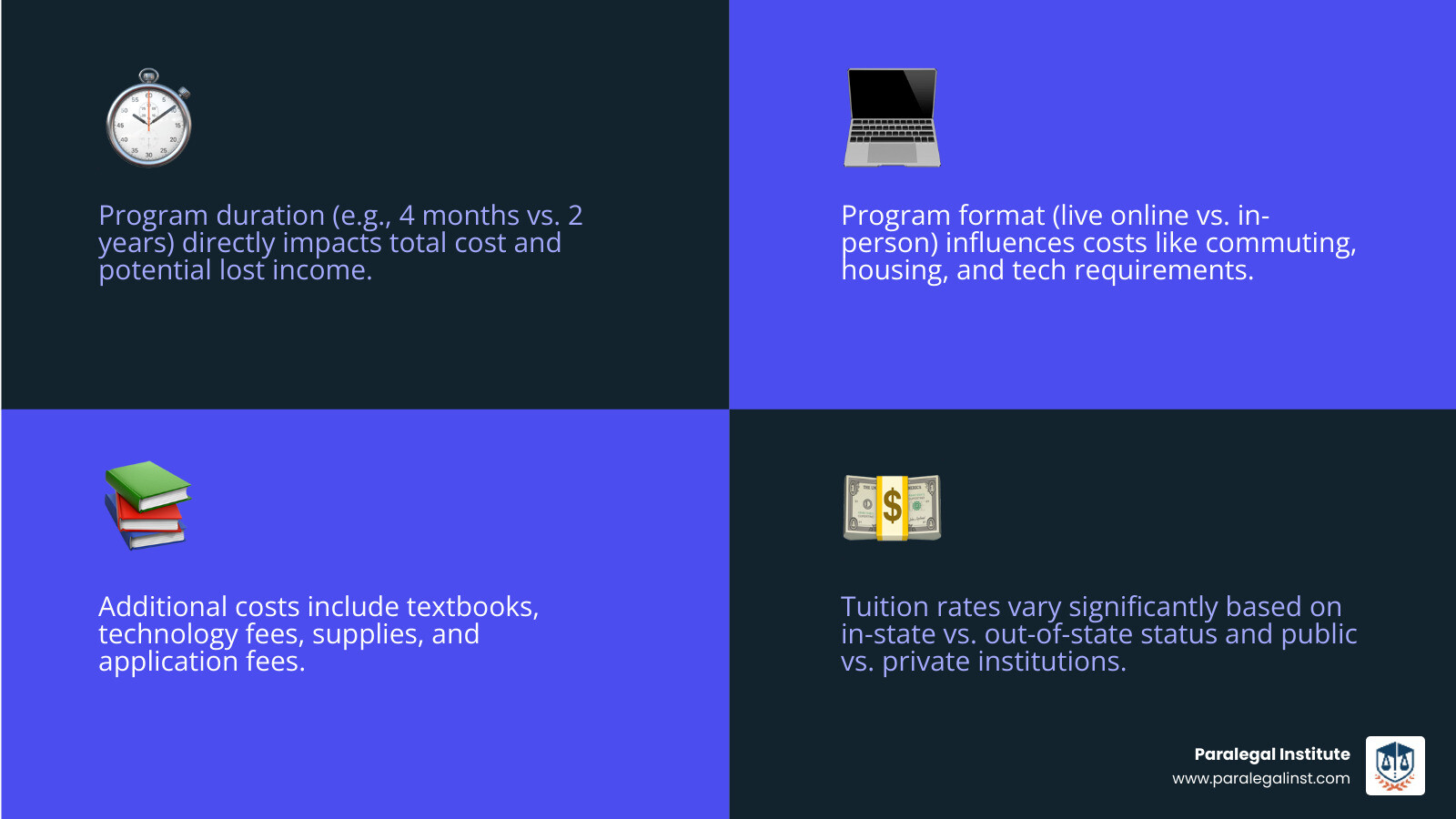
- Program duration (from a few months to two years)
- Format (live online vs. in-person)
- Additional costs (books, technology fees, supplies)
- In-state vs. out-of-state tuition rates for some institutions
Choosing a paralegal program is about more than comparing initial price points. The true cost includes books, technology fees, lost income while studying, and opportunity costs. A program that seems less expensive upfront might take longer to complete, delaying your entry into the workforce and costing you significant potential earnings.
Many prospective students focus solely on the advertised price without considering the complete financial picture. The right program balances affordability with quality training that prepares you for immediate employment. Understanding the full scope of costs helps you make a smarter decision about your legal career path.
I'm Matthew Pfau, a practicing attorney who owns a law firm and teaches paralegal courses at Paralegal Institute. Through years of hiring and training paralegals, I've seen how understanding the true cost of paralegal program options helps students make informed decisions that launch successful legal careers.
Understanding the Full Cost of a Paralegal Program
When you're researching the cost of paralegal program options, it's tempting to look at the tuition number and call it a day. I get it—we all want to know the bottom line. But here's the truth: that tuition figure is just the starting point of your financial investment. To make a truly informed decision about your legal education, you need to see the complete picture, including all those extras that can sneak up on you if you're not prepared.

Let's talk about what actually goes into the total cost of your paralegal education. Yes, tuition is the biggest piece—it covers your instruction and access to the program. For focused programs like ours at Paralegal Institute, tuition represents the core investment in your legal education. For longer programs, that tuition component grows proportionally with the extended timeline.
But tuition is never the whole story. Technology fees are increasingly common, especially in programs that provide access to professional legal research databases. These tools are essential for modern legal work, so consider this fee an investment in learning the same systems you'll use every day as a paralegal. Most programs also have a fee for processing your application —it's usually non-refundable and covers administrative costs.
Then there are books and supplies. Some programs include digital materials in their tuition, while others require you to purchase textbooks, legal dictionaries, and other classroom essentials separately. These costs can add up, so it's worth asking upfront what's included and what's not. You might also encounter fees for graduation when you complete your program, along with student activity fees at traditional colleges, even if you're studying primarily online.
When you add all these components together, you get a much clearer sense of your true investment. A shorter program might have a lower initial cost than a longer program, but you still need to factor in those additional expenses. Similarly, a two-year program will accumulate more in fees and materials simply because you're enrolled longer. Understanding this complete financial picture means no surprises down the road—just a clear path forward to your paralegal career. For more details about what to expect, our guide on Common Questions About Paralegal Programs can help.
Key Factors in the Cost of a Paralegal Program
The cost of paralegal program options varies dramatically based on several key factors, and understanding these differences helps you make the smartest choice for your situation. There's no universal "right" program—what matters is finding the path that aligns with your career goals, timeline, and budget.
Program duration and type is probably the biggest factor affecting your total cost. Focused programs like our 15-week program at Paralegal Institute are designed to get you job-ready quickly. They focus exclusively on practical legal skills without the general education courses required in longer, more general programs. This focused approach means a lower overall investment and a faster path to earning a professional income. Our Paralegal Program Types: The Ultimate Guide explores these differences in depth.
Longer programs, on the other hand, typically take two years to complete. While they provide a broader educational foundation, that extended timeline means higher overall costs, more fees, and more semesters of textbook purchases. You're also spending two years in school instead of working in your new career—which brings us to a crucial but often overlooked consideration.
Opportunity cost is the income you're not earning while you're in school. Every additional month in a classroom is a month you could be working as a paralegal, building experience, and earning a paycheck. An accelerated program like ours gets you into the workforce faster, effectively reducing your overall financial burden even if the per-week cost seems comparable to longer programs.
If you're looking at traditional colleges, the in-state versus out-of-state tuition difference can be dramatic. Public institutions often charge significantly more for students from other states. This distinction typically applies to programs at community colleges and state universities. Specialized programs like ours usually have one tuition rate regardless of where you live, which simplifies your planning.
The public versus private institution choice also affects cost. Public colleges generally offer lower tuition rates, especially for state residents, but their programs often take longer to complete. Private institutions may have higher tuition but can provide more specialized, career-focused training in less time. At Paralegal Institute, we've designed our program to deliver that focused, practical training without the extended timelines and accumulated costs of traditional educational paths.
Comparing the Cost of a Paralegal Program: Live Online vs. In-Person at Paralegal Institute
The format you choose—live online or in-person—can significantly impact the cost of paralegal program attendance, especially when you factor in all those costs beyond tuition. At Paralegal Institute, we offer both options because we know different students have different needs, and each format has its own financial considerations.
Our in-person classes in Las Vegas provide the traditional classroom experience with direct face-to-face interaction. There's real value in being physically present with your instructors and classmates, and many students thrive in that structured environment. You also get immediate immersion in the local legal community, which can be valuable for networking.
But in-person attendance does come with additional expenses. Commuting costs add up quickly—gas, parking fees, or public transportation fares become daily expenses over your 15-week program. If you don't live near our campus, you might face housing considerations, whether that means relocating or spending more time and money traveling. The cost of living in Las Vegas itself affects your daily expenses while you're attending classes.
Our live online instruction eliminates most of these extra costs while maintaining the interactive quality that makes learning effective. You're not watching pre-recorded videos alone—you're attending real classes in real time with live instructors and classmates. The key word is "live." You can ask questions, participate in discussions, and get immediate feedback, just like in a physical classroom.
The financial benefits of our online format are substantial. You save money on commuting —no gas, no parking, no bus fare. You can attend from anywhere, so there's no need to relocate or pay higher rent near a campus. The flexibility of learning from home also makes it easier to maintain part-time work or manage family responsibilities, which helps offset the impact on your income during the program.
You will need reliable technology for our online program—a decent computer and stable internet connection are essential. Most people already have these, but it's worth factoring in if you need to upgrade your equipment. The investment is typically far less than months of commuting and other campus-related expenses.
Whether you choose our live online format or in-person classes, you're getting the same high-quality legal education from practicing attorneys. The decision comes down to your personal learning style, life circumstances, and budget. Both paths lead to the same outcome: a practical, job-ready paralegal education. To learn more about the convenience and effectiveness of remote learning, check out our insights on How to Complete Your Paralegal Program Online.
How Program Type Dictates Your Timeline and Budget
The length of your paralegal program is one of the biggest factors in your total financial investment. And here's something many prospective students don't initially consider: it's not just about what you pay in tuition. It's also about what you don't earn while you're sitting in class instead of working as a paralegal.

Think about it this way: if you spend two years in a longer program, you're investing two full years of your life in the classroom. That means two years of paying tuition, buying textbooks, covering student fees, and managing all your regular living expenses. Your rent doesn't stop. Your car payment doesn't pause. Your grocery bill keeps coming.
But the real cost? Those two years represent time you could have been earning a professional income as a paralegal. That's the opportunity cost we talked about earlier, and it adds up fast. While you're still studying general education requirements alongside your legal coursework, someone who chose an accelerated path is already working in a law firm, gaining experience, and building their career.
Now consider a different approach. Our accelerated paralegal program at Paralegal Institute takes just 15 weeks. That's about three and a half months from start to finish. You're learning the same practical, job-ready skills you need to succeed as a paralegal, but you're doing it in a fraction of the time.
The financial advantages are clear. Your total tuition investment is lower because the program is shorter. You spend less on books and supplies because you're not enrolled for multiple semesters. And most importantly, you start earning a professional income much, much sooner.
Let's paint a picture: while someone in a two-year program is still halfway through their first year of general education classes, you've already completed your program, landed a paralegal position, and started earning. You're building real-world experience in an actual law firm while they're still working through their coursework.
This faster career entry creates what we call a quicker return on investment. The income you earn in those extra months of employment can offset a substantial portion of your education costs. You're not just reducing your upfront investment—you're actively earning income that makes your education pay for itself faster.
At Paralegal Institute, we designed our program specifically for career-focused adults who understand that time matters. Our instructors are all practicing attorneys who teach you the practical skills you need from day one. No filler courses. No unnecessary delays. Just focused, hands-on legal training that prepares you for immediate workforce entry.
The choice between program lengths isn't just about education—it's about smart financial planning and career strategy. When you factor in the true cost of paralegal program options, including both what you pay and what you could be earning, the accelerated path makes compelling sense. Learn more about how quickly you can launch your career with our Accelerated Paralegal Programs.
Smart Strategies for Funding Your Paralegal Education
Investing in your paralegal education is a meaningful step toward a rewarding career, and we understand that managing the financial side of that decision matters. The good news? There are several practical ways to make the cost of paralegal program options more manageable and accessible.

Let's start with payment plans, which are often the most straightforward solution. At Paralegal Institute, we recognize that paying for your entire education upfront isn't realistic for most working adults. That's why we offer flexible payment plans that break down your total investment into manageable installments. Instead of facing one large initial payment, you can spread your payments over time, making it much easier to fit your education into your current budget. When you're comparing programs, always ask about their payment plan structures—the terms can vary significantly between institutions.
If you're currently employed, don't overlook employer tuition assistance. Many companies, especially larger corporations and those in the legal sector, offer education benefits to support employee development. These programs can cover a substantial portion of your tuition, sometimes even the entire cost, particularly if your paralegal training aligns with your current role or future advancement within the company. It's worth having a conversation with your human resources department to explore what's available. This benefit often goes unused simply because employees don't know it exists.
For some students, private loans can help bridge the gap. While our accelerated program doesn't typically qualify for federal financial aid (that's generally reserved for longer programs), private educational loans from banks and credit unions remain an option. These loans are based on your credit history, so terms and eligibility will vary from person to person. If you're considering this route, take time to compare interest rates and repayment terms from multiple lenders to find the best fit for your situation.
Scholarships and grants represent funding that doesn't need to be repaid, making them incredibly valuable when you can find them. While these opportunities are more common for longer programs, they do exist for focused, accelerated programs as well. Look into scholarships offered by local legal associations, community foundations, and professional organizations in your area. In Las Vegas, for example, local bar associations and community groups sometimes offer support for aspiring legal professionals. It takes some research, but the payoff can be significant.
For those who have served in the military, veterans' benefits can provide substantial educational support. The GI Bill and other military education programs may cover your tuition and related expenses. If you're a veteran or military spouse, these benefits can make your paralegal education extremely affordable or even completely covered. We encourage you to thoroughly investigate what you're entitled to—these are benefits you've earned through your service.
At Paralegal Institute, we're committed to making our 15-week accelerated program accessible to career-focused adults. We encourage you to reach out and discuss your financial situation with us directly. We can walk you through our payment options and help you identify resources that might support your educational journey. Our goal is to remove financial barriers so you can focus on what matters most: gaining the practical skills you need for immediate workforce entry. For additional guidance on planning your paralegal education, explore our Top Resources for Paralegal Education.
Evaluating Value: Why the Lowest Price Isn't Always the Best Deal
When you're comparing the cost of a paralegal program, I understand the temptation to simply choose the cheapest option. But here's what I've learned from years of practicing law and teaching paralegals: the lowest price rarely equals the best value, especially when your professional future is on the line.
Think about it this way—would you hire the cheapest attorney to handle your most important legal matter? Probably not. The same logic applies to your education. A program might have a slightly lower tuition, but if it doesn't prepare you for the actual demands of working in a law office, you've wasted both your money and your time.
The true measure of value is simple: How well does this program prepare you to succeed on day one of your paralegal career?
What makes a paralegal program truly valuable? At Paralegal Institute, we've built our entire approach around the elements that actually matter in the legal field.
First and foremost is instructor quality. Our courses are designed and taught by practicing attorneys and paralegals —not just educators with legal backgrounds, but professionals actively working in the legal system right now. I bring my daily experiences from my law firm directly into the classroom. When I teach about findy procedures or client communication, I'm sharing what I did that very week, not what I read in a textbook years ago. This real-world connection is invaluable, and it's something you simply cannot get from programs taught by instructors who aren't actively practicing law.
The difference between practical skills and theoretical knowledge is where many programs fall short. Understanding legal theory has its place, but law firms need paralegals who can actually do the work. We focus on hands-on legal training that mirrors what you'll do in your first job—drafting pleadings, conducting legal research using real databases, organizing case files, and preparing documents for court. Our students learn by doing, not just by reading about it. This is the kind of training that makes employers say "yes" when they review your application.
Career readiness is built into every aspect of our program. We're not just teaching you to pass a test; we're preparing you to be a valuable asset to a legal team from your very first day on the job. The skills you develop in our 15-week program are the exact skills that practicing paralegals use every single day. When you complete our program, you're not just educated—you're employable.
The return on investment is where this all comes together. The U.S. Bureau of Labor Statistics consistently shows a strong outlook for paralegals and legal assistants, which you can verify at the Paralegals and Legal Assistants Outlook from the BLS. But landing one of those positions requires more than just having a credential—it requires having the right training. Our accelerated format means you're entering this growing field faster, starting to earn sooner, and quickly recouping your educational investment.
I've seen too many graduates from other programs struggle to find employment because they simply weren't prepared for the realities of legal practice. They saved money upfront but spent months searching for jobs or needed additional training before they could be productive employees. That's not a good deal—that's a false economy.
When you're evaluating programs, look beyond the price tag. Ask yourself: Who's teaching these courses? Are they currently practicing law? Consider what skills you'll actually develop and how quickly you can enter the workforce. An accelerated program like our 15-week program isn't just about speed—it's about efficiency and effectiveness. You're not cutting corners; you're cutting out the unnecessary parts that don't contribute to your career readiness.
Quality instruction from practicing attorneys, practical hands-on training, and an efficient path to employment—these are the factors that create real value in a paralegal program. Our focus at Paralegal Institute is preparing you for the career you want, not just handing you a piece of paper. To understand more about what paralegals actually do in their daily work, check out our guide on the critical role paralegals play in law firms.
The smartest investment isn't always the cheapest one—it's the one that delivers the best results for your career and your future.
Conclusion
Choosing the right paralegal program is one of the most important professional decisions you'll make, and we hope this guide has given you clarity on the real cost of paralegal program options. It's not just about comparing tuition numbers—it's about understanding the complete financial picture, from fees and books to the often-overlooked opportunity cost of time away from earning a professional salary.
We've walked through how program duration dramatically affects your total investment. While a two-year program might seem like a comprehensive choice, its extended timeline means higher overall costs and, more significantly, delayed entry into your new career. Every month you spend in school is a month you're not earning as a working paralegal. That's why an accelerated Paralegal Studies Program offers such a compelling alternative—it gets you career-ready in just 15 weeks, allowing you to start building your professional life and recouping your educational investment quickly.
The value of your paralegal education isn't measured by its price tag alone. It's measured by the practical skills you gain, the quality of instruction you receive, and how prepared you are to contribute from day one in a real legal environment. At Paralegal Institute, we've built our entire program around these principles. Our courses are designed and taught by practicing attorneys who bring current, real-world legal experience into every lesson. Whether you choose our live online format or our in-person classes in Las Vegas, NV, you'll receive the same hands-on legal training that makes our graduates immediately valuable to employers.
We're proud of what we've created—a program that respects your time, fits your budget, and prepares you thoroughly for the rewarding work ahead. The legal field needs skilled, confident paralegals, and the career outlook continues to be strong. If you're ready to make a smart investment in your future, we'd love to help you get started.
To understand more about what you'll actually be doing in your new career and why your training matters so much, take a moment to explore the critical role paralegals play in law firms. Your journey to a meaningful legal career starts with choosing the right program—and we're here to make that choice clear, accessible, and exciting.