
Why Paralegals Are Exploring New Career Directions
A paralegal career transition can take many forms—whether you're moving from a legal assistant role into full paralegal work, shifting from another profession into the legal field, or leveraging your paralegal skills to explore new opportunities within or beyond traditional law firms. Here’s what you need to know.
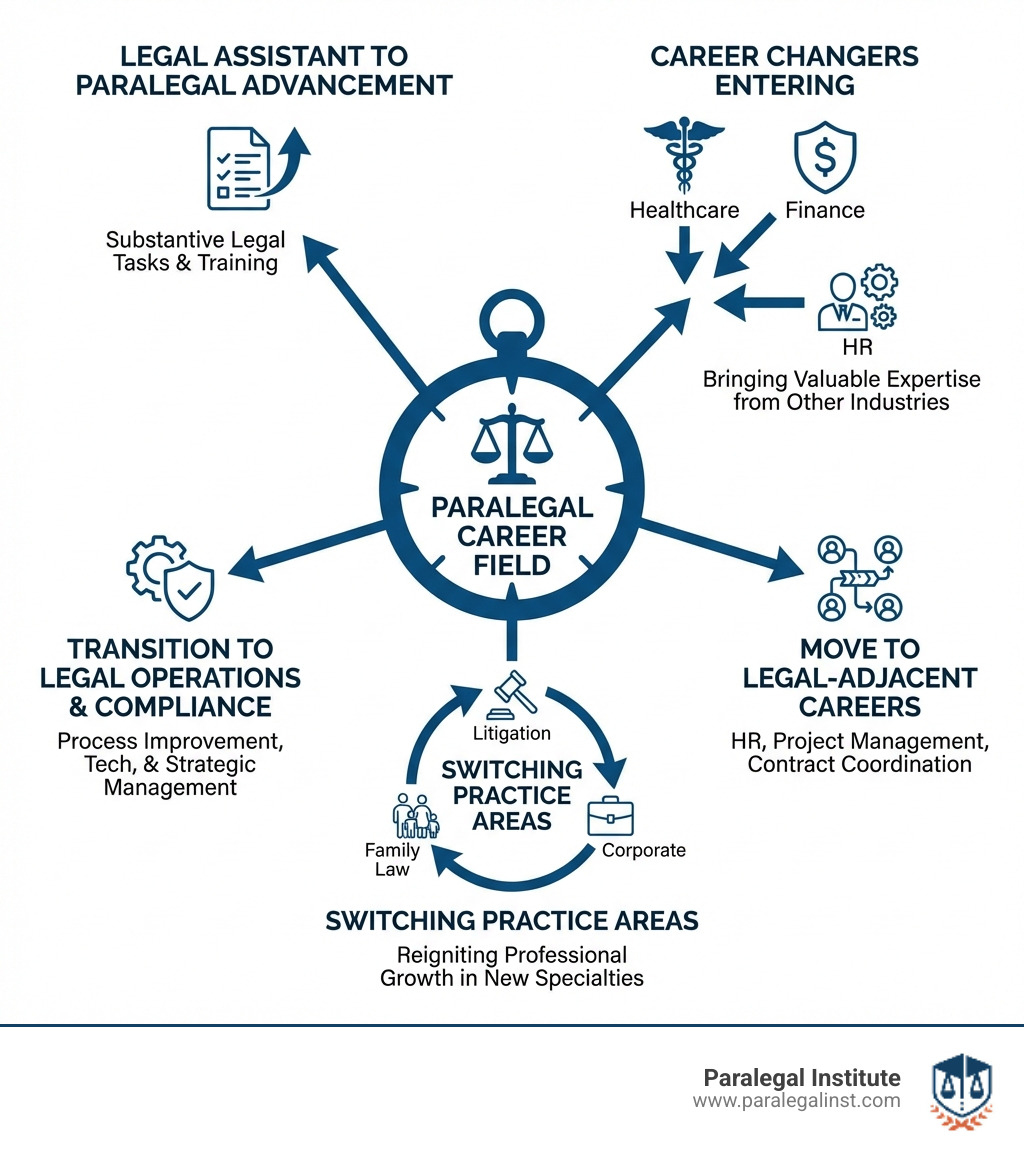
Common Paralegal Career Transition Paths:
- Legal Assistant to Paralegal- Advance from administrative work to substantive legal tasks through training
- Career Changers Entering the Field- Professionals from healthcare, finance, HR, and other industries bringing valuable expertise to paralegal roles
- Paralegals Moving to Legal Operations- Transitioning from casework to process improvement, technology adoption, and strategic legal support
- Exploring Legal-Adjacent Careers- Moving into compliance support, contract administration, project coordination, or human resources support
- Switching Practice Areas- Changing from one legal specialty to another to reignite professional growth
The legal profession is evolving rapidly. Paralegals with strong organizational skills, attention to detail, and legal knowledge are well-positioned for diverse opportunities.
Many paralegals experience burnout from high-stress environments, limited career progression, or lack of challenge after mastering their current roles. Others recognize that their transferable skills—legal research, document drafting, discovery support, document management, client communication, and regulatory awareness—can open doors to new career paths.
Whether you're feeling stuck in your current position, seeking better work-life balance, or simply ready for a new challenge, understanding your options is the first step toward a successful career transition.
I’m Matthew Pfau, a practicing U.S. attorney who owns a law firm and teaches paralegal courses at the Paralegal Institute. Throughout my career hiring and training paralegals, I’ve seen countless successful paralegal career transitions —from legal assistants advancing into substantive paralegal roles to professionals from other industries bringing valuable real-world experience into legal support work. With practical training and the right approach, you can build a career that fits your goals—inside a law firm, in a corporate legal department, or in a legal-adjacent role.
Recognizing the Need for a Paralegal Career Transition

Deciding to make a move isn't always easy, but often your mind and body give you clear signals before your resume does. We frequently see students at the Paralegal Institute who have reached a "plateau." They love the law, but their current environment is no longer serving their growth.
One of the primary drivers for a paralegal career transition is signs of burnout. This isn't just "having a bad day." True burnout manifests as persistent fatigue that sleep doesn't fix, a loss of motivation both at work and at home, and even physical symptoms like a weakened immune system or insomnia. If you find yourself feeling anxious every Sunday night about returning to the office, it is a significant indicator that something needs to change.
Career stagnation is another major factor. Many professionals reach a point where they are no longer being challenged. If you’ve mastered every filing system and drafted every type of motion your firm handles, you might feel a lack of professional "fuel." We provide Paralegal Career Advice to help individuals identify if they simply need a new firm or a complete shift in direction.
Finally, work-life balance and mental health support are becoming non-negotiable. In high-pressure litigation firms, the "always-on" culture can lead to professional fatigue. If your current employer doesn't provide access to mental health support or respect your time off, it might be time to look for a role that values your well-being as much as your billable hours.
Expanding Your Paralegal Career: New Directions Within the Legal Field
Many paralegals think their only options are “Law Firm A” or “Law Firm B.” In reality, the skills you’ve developed are in demand across corporate settings and specialized legal environments. If you want to Advance Paralegal Career Online, consider these practical directions:
- Legal Operations: Focus on the business side of legal services—process improvement, budgeting support, and workflow strategy.
- Compliance Support: Help regulated organizations track obligations, maintain policies, and reduce regulatory risk.
- Contract Administration: Support contract drafting, review, organization, and lifecycle tracking—often with more predictable deadlines than litigation.
- Project Coordination: Coordinate deadlines, tasks, and deliverables across matters so attorneys can stay focused on legal analysis and advocacy.
- Human Resources Support: Apply your legal knowledge to HR processes involving workplace policies, investigations, and employment-related documentation.
- Real Estate and Title Industry: Use transactional experience to support closings, title review, and document-heavy real estate matters.
Strategic Steps for a Successful Paralegal Career Transition
Making the jump requires a plan. We often see legal assistants who want to move into substantive paralegal work. The first step is understanding the difference between administrative tasks and substantive legal work.
| Administrative Tasks (Legal Assistant) | Substantive Legal Work (Paralegal) |
|---|---|
| Answering phones and scheduling | Conducting legal research |
| Filing and basic data entry | Drafting motions and pleadings |
| Organizing travel and expenses | Supporting discovery and trial preparation |
| Basic client intake | Analyzing case facts and evidence |
To successfully navigate this Legal Secretary vs Paralegal divide, you must highlight your transferable skills. These include your ability to organize complex data, communicate professionally, and solve problems under deadlines.
Once you have identified your skills, focus on internal advocacy. Speak to your current employer about taking on more substantive tasks. If that isn’t an option, build your resume for a lateral move. Our guide on Transition to Work After Paralegal Training emphasizes that a focused job-search plan—and a portfolio that shows practical skills—can help you transition faster.
Why Practical, Live Instruction Matters
A major advantage in today’s job market is training that mirrors real legal work. At the Paralegal Institute, our classes are taught through live instruction online(real-time, with an instructor) and in-person classes. This format matters because you can ask questions as you learn, get immediate feedback, and build confidence with the same types of tasks you’ll perform in a legal job.
Compared to longer traditional paths that may include extra general education requirements, an accelerated program focused on practical paralegal skills can be the more career-ready and cost-effective choice for adults who want to enter the legal field sooner.
Navigating the Move into the Legal Field
We see many students who are coming into the legal field from other careers. This is often a smart move because your prior work experience can become a competitive advantage in legal support roles. A paralegal career transition into the legal field is often faster than people think when you choose practical training.
A Paralegal Certificate Program Prepares You for Legal Work by taking your existing skills and applying a legal lens to them. For example, if you have a healthcare background, you may be a strong fit for personal injury or medical malpractice casework. If you come from finance, you may adapt quickly to corporate, transactional, or bankruptcy-related matters.
The key is Identifying Paralegal Programs for Your Career Goals. Many adults don’t need a multi-year degree path to get started. A practical, accelerated program can focus on the tasks you’ll be expected to handle on Day 1.
Education Options for a Paralegal Career Transition
When it comes to education, you have choices. Some traditional programs can take years and include general education requirements you may already have. At the Paralegal Institute, we focus on an accelerated path designed for working adults.
If you are wondering What Training Is Required to Be a Paralegal, the answer depends on your goals and the roles you’re targeting. For many students, a paralegal certificate is the most efficient route because it is skills-focused and career-oriented. Our program is designed to help you Become a Paralegal Fast through 15 weeks of live instruction —available online (live, real-time instruction) and in-person. This real-time interaction is crucial because it allows you to ask questions, practice the work, and get feedback from practicing attorneys (like me), not just watch recordings.
Leveraging Prior Professional Experience
Your past career isn’t a reset button—it’s a foundation. When Building Professional Portfolio During Paralegal Training, include examples of how your previous expertise connects to legal work:
- Healthcare Professionals: Familiarity with medical records and terminology supports personal injury and medical malpractice matters.
- Finance/Accounting: Comfort with financial statements can help in corporate and bankruptcy-related work.
- HR Professionals: Experience with workplace investigations and policies aligns naturally with employment-related matters.
- Teachers: Strong research, writing, and communication skills translate well to trial preparation and client communication.
If you’re serious about moving quickly, prioritize training that is practical, instructor-led, and designed to get you career-ready—then present your previous experience as proof you can handle responsibility in a legal environment.
Frequently Asked Questions
What are the main signs that indicate it's time for a career change?
The most common signs include persistent physical and mental exhaustion (burnout), feeling a lack of challenge in your daily tasks, and a desire for better work-life balance. If you’ve mastered your current role and there’s no room for advancement, it’s a strong sign it may be time for a paralegal career transition.
How can I move from a legal assistant role to a full paralegal position?
Start by volunteering for substantive tasks like legal research, drafting basic documents, and supporting discovery. Pursuing a formal paralegal certificate is often the fastest way to gain the job-ready skills employers expect. You should also update your resume to highlight the legal tasks you are already performing, even if your title hasn’t changed yet.
Is a paralegal certificate sufficient for a career transition?
For many adults, yes—especially if you already have a degree in another field or professional experience. A skills-focused certificate program can be a faster, more practical path than longer traditional alternatives, because it concentrates on real-world legal tasks and prepares you to enter the workforce sooner.
Conclusion
A paralegal career transition is a powerful way to take control of your professional future. Whether you are moving up from an assistant role, pivoting from a different industry, or exploring legal operations, the opportunities are vast.
At the Paralegal Institute, we provide a career-ready path through live instruction and practical legal skills. Our 15-week program is designed for adults who want an accelerated entry into the legal field without the time and expense of traditional multi-year programs. By focusing on real-world training taught by practicing attorneys, we ensure our students are ready to hit the ground running in Las Vegas or beyond.
If you're ready to stop feeling stuck and start your next chapter, consider Unlocking your future with a Paralegal Certificate. Your "Act II" is waiting.