
Why Law Office Internships Are Your Gateway to Legal Careers
Law office internships offer aspiring legal professionals hands-on experience in the field while building essential skills and professional networks. These opportunities range from paid positions at district attorney's offices earning competitive hourly wages to volunteer roles that provide academic credit and real-world exposure to the legal system.
Quick Overview of Law Office Internship Options:
- Paid Internships: District attorney offices, state bars, and some private firms offering competitive hourly wages
- Volunteer Positions: Federal agencies (DOJ, EEOC), non-profits, public defender offices
- Duration: Typically 5-10 weeks, with flexible part-time or full-time schedules
- Eligibility: High school students through recent graduates of legal programs
- Common Tasks: Legal research, drafting memos, case file management, court observation
Each year, over 1,800 volunteer legal interns serve in Justice components and U.S. Attorneys' Offices throughout the country. These positions provide exposure to everything from criminal prosecution and civil litigation to municipal law and business legal services.
The application process typically requires a resume, cover letter, and writing sample, with deadlines varying by season. Spring applications often close in November, summer positions in March, and fall internships in April.
I'm Matthew Pfau, and through owning a medium-sized law firm that regularly hires paralegals, I've seen how law office internships serve as crucial stepping stones into successful legal careers. My experience training paralegals and teaching at UNLV has shown me that the right internship can transform classroom knowledge into practical skills that employers value.
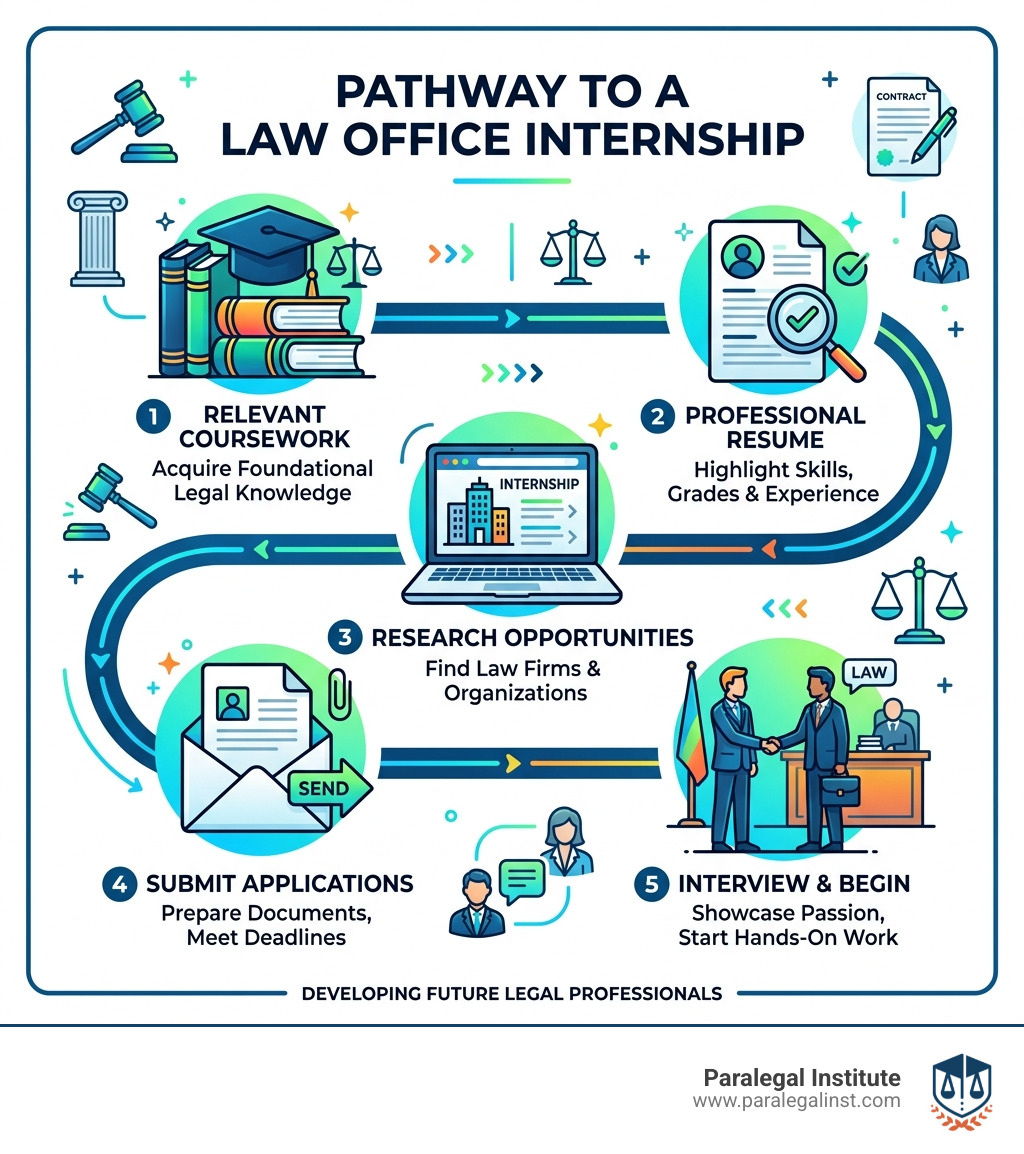
Navigating the World of Law Office Internships
The legal world can feel overwhelming when you're first starting out. With so many different types of law firms, government agencies, and practice areas, where do you even begin? The good news is that law office internships offer something for everyone, regardless of where you are in your educational journey.
Let's break down who can intern, what you might earn, and the different legal specialties you can explore. By the end of this section, you'll have a clear roadmap for finding the perfect internship match.
Who Can Intern? From High School to Paralegal Students
One of the best things about law office internships is how welcoming they are to students at all levels. You don't need to be a lawyer to get your foot in the door - in fact, many successful paralegals start building their careers much earlier.
High school students can find specialized programs designed just for them. Some business law firms create 4-6 week programs that give teenagers a real taste of legal work. These aren't just coffee-fetching gigs either. You might rotate through different departments, shadow attorneys, and learn about corporate operations. It's like getting a sneak peek at your potential future career before you even commit to a specific educational path. For students considering legal careers early, you can find more info on high school legal internships that offer these valuable experiences.
Students enrolled in paralegal programs have even more opportunities waiting for them. Programs like the 15-week paralegal program at the Paralegal Institute prepare students with job-ready skills that make them attractive intern candidates. These internships let you apply everything you've learned about legal research, writing, and case management in a real office setting.
Some government offices, like the San Francisco City Attorney's Office, run dedicated paralegal internship programs. These positions pair you with experienced paralegal mentors who show you the ropes of local government legal work - stuff you just can't learn from textbooks alone. To explore what's available in your area, check out our comprehensive guide on paralegal internship opportunities.
Even recent graduates of paralegal programs can benefit from internships. Maybe you want to specialize in a particular area of law, or you're looking to gain extra experience before landing your first full-time position. These internships can be the perfect bridge between education and career.
Finding Paid vs. Unpaid Law Office Internships
Let's talk money - because we all have bills to pay. Law office internships come in both paid and unpaid varieties, and each has its own advantages.
Paid internships are the golden ticket that every student hopes to find. Government entities often offer competitive hourly wages- some District Attorney offices and State Bar programs offer competitive hourly wages. These positions usually require a serious time commitment (sometimes up to 40 hours per week), but they show that your work has real value.
Unpaid volunteer roles might not pay the bills, but they often provide access to prestigious organizations that would otherwise be out of reach. Federal agencies like the Department of Justice host over 1,800 volunteer legal interns every year. While your bank account won't grow, your resume definitely will.
The silver lining with unpaid internships is academic credit. Most schools will let you earn credits for these experiences, which means you're still making progress toward graduation. Some institutions even offer school-sponsored stipends or public interest fellowships that provide financial support for students doing unpaid public service work.
Your career services office can help you steer these options and figure out how to make unpaid internships work within your budget and academic plan.
Internships by Practice Area
The legal field is like a buffet - there's something for every taste. Law office internships span virtually every area of law you can imagine.
Criminal prosecution offers an intense look at the justice system. In District Attorney offices, you might assist with plea negotiations, draft motions, review evidence, and observe trials. It's work that gives you a front-row seat to how justice gets served.
Public defense provides the other side of the criminal justice coin, focusing on protecting defendants' constitutional rights. These internships involve client interviews, case investigation, and developing defense strategies.
Municipal law internships, like those at the San Francisco City Attorney's Office, immerse you in local government work. You'll see how cities handle everything from policy advice to civil litigation. Plus, you might attend public meetings and observe how local government actually functions.
Civil litigation and business law internships in private firms offer exposure to the corporate world. You'll work on active cases, conduct research, and learn how businesses steer legal challenges.
Non-profit advocacy lets you work on mission-driven legal issues. Organizations like California Lawyers for the Arts offer internships where you help artists with copyright, trademark, and contract disputes. It's legal work with a creative twist.
Arts and entertainment law provides a unique blend of creativity and legal expertise, while employment law internships at agencies like the EEOC let you work on workplace discrimination cases and federal anti-discrimination law enforcement.
No matter what type of law interests you most, there's likely a law office internship that can give you hands-on experience in that field. The key is matching your interests with the right opportunity.
The Hunt: How to Find and Apply for Internships
Ready to turn your legal dreams into reality? Finding and landing the perfect law office internship might feel a bit overwhelming at first, but think of it as your first real legal case - with the right strategy and preparation, you'll crack it! This section provides a roadmap for securing a position that could launch your entire career.
The Application Process for Law Office Internships
Here's the thing about law office internships- timing really is everything. Legal employers plan way ahead, so you'll need to think like they do. Most organizations follow predictable cycles that might surprise you with how early they start recruiting.
Spring internships(running January through April) often have application deadlines as early as November of the previous year. Summer positions- the most popular choice - typically close their applications between November and February, with some EEOC programs having firm deadlines like February 8th. Fall internships usually wrap up their application process by March or April.
Some larger government offices, like the Attorney General's office, accept applications year-round on a rolling basis. But here's a pro tip: "rolling basis" doesn't mean "take your time." It means the earlier you apply, the better your chances.
When it comes to what you'll actually need to submit, most law office internships ask for similar documents. Your cover letter is your chance to shine - it's where you explain why you're passionate about that specific organization and how your skills match what they need. Generic cover letters are easy to spot, so take the time to customize each one.
Your resume should highlight your relevant coursework, especially if you're completing a paralegal program. Employers want to see that you're building job-ready skills. Don't forget to include any volunteer work or part-time jobs that show responsibility and reliability.
Many positions require a writing sample- this is your moment to prove you can think like a legal professional. It could be a memo you wrote during your paralegal training, a research paper, or even a brief you drafted for class. Choose something that shows off both your research skills and your ability to communicate clearly.
You'll also need transcripts(usually unofficial copies work fine for the initial application) and sometimes specific application forms. Government agencies especially love their forms, so be prepared to fill out detailed applications beyond just submitting your resume.
The legal field values precision above almost everything else, so triple-check every document. A typo in your application materials sends the wrong message about your attention to detail. If you're working on building a strong application package, our guide on Building Professional Portfolio During Paralegal Training can help you showcase your abilities effectively.
How to Be a Competitive Applicant
Landing a great law office internship isn't just about meeting the minimum requirements - it's about standing out from the crowd. The good news? You don't need years of experience to be competitive. You just need to demonstrate the right qualities.
Strong communication skills top every employer's wish list. Can you explain complex ideas in simple terms? Can you write a memo that actually makes sense? Your cover letter and writing sample will do most of the talking here, but don't underestimate the power of a well-structured, error-free application.
Legal work is all about solving puzzles, so analytical abilities matter tremendously. Employers want interns who can look at a messy situation and identify the real issues. This skill develops through practice - the kind you get in hands-on paralegal training where you work through real scenarios.
Research skills might not sound exciting, but they're absolutely crucial. Legal professionals spend a huge chunk of their time digging through statutes, cases, and regulations. If you can steer legal databases efficiently and find relevant information quickly, you're already ahead of many applicants.
Here's something that might surprise you: attention to detail can make or break your application. In law, small mistakes can have big consequences. Employers notice when your application is perfectly formatted and error-free - it tells them you understand what the legal profession demands.
For government positions and nonprofit work, demonstrated interest in public service can set you apart. This doesn't mean you need to have volunteered at every charity in town. It could be as simple as taking relevant courses, volunteering for community events, or writing about social justice issues.
Relevant coursework shows you're serious about your legal education. If you're completing a paralegal program, highlight specific skills you've learned that match the internship requirements. Employers love seeing candidates who can hit the ground running.
Finally, don't overlook the power of networking. This doesn't mean you need to schmooze at fancy events (though those can help). Start simple - connect with legal professionals on LinkedIn, attend local bar association events, or ask for informational interviews. Sometimes the best opportunities come through relationships rather than formal applications.
Every legal professional started somewhere. The combination of solid preparation, genuine enthusiasm, and the practical skills you're building through your paralegal studies can make you a surprisingly strong candidate, even without years of experience.
A Day in the Life: What to Expect as a Legal Intern
So, you've landed the internship – congratulations! Now comes the exciting part: finding what your days will actually look like. Every law office internship has its own personality, shaped by the firm's culture, the practice area you're diving into, and your specific role. But here's the thing – there are common experiences that bind most legal interns together, creating a shared foundation of learning and growth.
Think of your internship as a bridge between classroom theory and real-world practice. You'll finally get to see how those legal concepts you've been studying actually play out in daily legal work. It's both thrilling and a little nerve-wracking, but that's exactly what makes it so valuable.

Common Responsibilities and Duties
Your daily responsibilities will vary depending on whether you're a high school student getting your first taste of legal work or a paralegal student ready to apply your training. But regardless of your background, you'll be contributing to real cases and meaningful work from day one.
Legal research and writing will likely become your bread and butter. You'll spend time digging into statutes, hunting down case precedents, and exploring legal doctrines that apply to current cases. This isn't just busy work – your research directly supports the attorneys' strategies and arguments. Based on what you find, you'll often draft memos summarizing your findings or even contribute sections to briefs. Students in paralegal programs can apply the research techniques they've mastered in their coursework.
Drafting memos and motions becomes a regular part of your routine. You'll prepare internal memos that outline legal arguments or summarize complex factual situations for the attorneys. These documents help the legal team stay organized and informed about case developments. More advanced interns might draft motions and responses for criminal cases or civil litigation matters.
Case file management might sound mundane, but it's absolutely crucial to a law office's success. You'll help organize both physical and electronic case files, making sure every document is properly categorized and easy to find when needed. This includes reviewing and organizing case evidence, preparing discovery materials, and setting up efficient workflows for contract management. It's detail-oriented work that teaches you how legal cases are built from the ground up.
Don't be surprised if some of your time involves administrative duties, especially if you're a high school or early-stage student intern. Tasks like answering phones, filing documents, scanning, photocopying, and data entry might seem basic, but they're essential to keeping the office running smoothly. Plus, these duties give you insight into how a law office operates behind the scenes.
One of the most exciting opportunities is attending client meetings. You might sit in on sessions where attorneys gather facts, discuss legal strategies, or update clients on case progress. For interns at non-profit legal aid organizations, this could mean interviewing clients to understand their situations and gather crucial details for their cases. These experiences teach you about client communication and the human side of legal work.
Observing court hearings and depositions offers an unparalleled learning experience. You'll see legal theories come to life in courtrooms, witness the dynamics between opposing counsel, and observe how judges handle different types of cases. Whether it's trials, hearings, public meetings, or depositions, these observations help you understand how the legal system actually functions in practice.
Assisting with trial preparation can involve everything from assembling evidence notebooks and organizing transcripts to preparing trial binders and researching potential expert witnesses. This work gives you a behind-the-scenes look at how major cases are built and presented.
If you're interning with a government office or public interest organization, you might spend time assisting constituents who need legal guidance or resources. This could involve helping people steer legal processes or connecting them with appropriate services.
Some internships even offer opportunities for writing articles and contributing to publications on specific legal topics. You might help create content for firm newsletters, educational materials, or legal publications.
For a more comprehensive look at what legal interns do day-to-day, you can explore More on typical intern duties.
The Role of Mentorship and Professional Development
Here's where law office internships truly shine – in the mentorship and professional development opportunities that can shape your entire career trajectory. This isn't just about completing tasks; it's about growing as a future legal professional under the guidance of experienced practitioners.
You'll never be left to figure things out alone. Most interns work directly under supervising attorneys in law firms or government agencies, or with dedicated paralegal mentors if you're a paralegal student. These mentors become your professional guides, sharing insights from years of practice, answering your countless questions, and providing professional feedback on your work. The San Francisco City Attorney's Office, for example, assigns specific Intern Coordinators who ensure you receive ongoing feedback and support throughout your internship.
This personalized coaching is invaluable for developing your skills and understanding the subtle nuances of legal practice. Your mentor will help you refine your research techniques, improve your writing style, and develop the critical thinking skills that successful legal professionals need.
Many organizations go beyond basic supervision to offer structured professional development programs. The State Bar's internship program provides personalized coaching, mentoring sessions, and specialized workshops custom to student needs. Interns often participate in development and wellness sessions, meet with executive staff, and join virtual events with other interns. These programs help you develop not just legal knowledge, but also essential soft skills like communication, time management, and presentation abilities.
Networking events are another huge benefit of internships. You'll meet attorneys, partners, paralegals, and even clients – connections that can prove instrumental for future job opportunities and long-term career growth. The legal profession thrives on relationships, and your internship provides the perfect platform to start building your professional network.
For students in paralegal programs, this hands-on mentorship perfectly complements intensive coursework. It's your chance to apply everything you've learned while receiving guidance from seasoned professionals. This combination of theoretical knowledge and practical application, supported by our focus on Hands-On Legal Training, ensures you're well-prepared to make the most of these valuable mentorship opportunities and contribute meaningfully from your very first day.
Where Will You Work? Comparing Legal Employers
The legal profession is a vast ecosystem, with different types of employers offering distinct work environments, opportunities, and challenges. When considering law office internships, understanding these differences is key to finding a placement that truly aligns with your career goals and personal preferences.

Government, Private Firms, and Non-Profits
Picture this: you're choosing between three very different neighborhoods to live in. Each has its own personality, culture, and lifestyle. That's exactly what it's like when you're considering law office internships across different types of employers.
Government agencies like the District Attorney's office, Department of Justice, or EEOC offer a unique public service focus. These internships immerse you in work that directly impacts communities and upholds justice. You'll dive into criminal prosecution cases, investigate employment discrimination, or help draft policies that affect thousands of people. The work environment tends to be more structured, with clear procedures and hierarchies. Many government internships offer competitive compensation, with some DA offices and State Bar programs offering attractive hourly wages. The pace might be steadier than private practice, giving you time to really understand each case. However, you'll also encounter the reality of government bureaucracy, which can sometimes slow decision-making but teaches valuable lessons about working within established systems.
Private law firms present a completely different world. Here, the focus shifts to serving individual clients and businesses, often with a strong emphasis on billable hours and profitability. The work environment can be more and competitive, with longer hours and higher pressure. You might work on complex business transactions, civil litigation, or specialized areas like entertainment law. While many private firm internships are unpaid, the experience can be incredibly valuable for understanding how legal services operate as a business. You'll witness client relationships up close, see how firms market their services, and understand the financial realities of legal practice.
Non-profit organizations like Legal Aid societies or California Lawyers for the Arts offer mission-driven experiences that focus on serving underserved populations or specific causes. These internships often provide the most hands-on client interaction, as resources are typically limited and every team member plays a crucial role. You might help low-income families steer housing disputes, assist artists with copyright issues, or work on advocacy campaigns for social justice causes. While compensation is often limited or non-existent, the personal satisfaction and real-world impact can be tremendous. The work environment is usually collaborative and purpose-driven, though resources may be stretched thin.
Understanding The Role of Paralegals in Law Firms can help you better appreciate how your internship experience might translate to future career opportunities in any of these settings.
How Your Experience Will Differ
The day-to-day reality of your internship will vary dramatically depending on where you land. Think of it as the difference between working in a busy restaurant, a corporate boardroom, or a community center - same basic skills, completely different atmospheres.
In government settings, you'll experience the satisfaction of public service firsthand. Your research might help prosecutors build cases that protect victims, or assist in investigations that ensure workplace fairness. The bureaucratic environment teaches patience and attention to protocol, valuable skills in any legal setting. You'll likely have more predictable hours and clearer guidelines about your role and responsibilities. The downside? Sometimes the pace can feel slow, and you might encounter frustrating red tape.
Private firms expose you to the business side of law in ways that other settings simply can't match. You'll see how attorneys market their services, manage client relationships for profitability, and make strategic business decisions. The billable hour culture means efficiency and time management become crucial skills. You might work longer hours, but you'll also see how successful legal practices operate and potentially earn higher compensation. The pressure can be intense, but it prepares you for the realities of private practice.
Non-profit environments offer perhaps the most direct connection between your work and its impact on real people's lives. You'll likely have more responsibility earlier on, simply because these organizations operate with leaner staff. The collaborative atmosphere means your voice might be heard more readily, and you'll see projects through from start to finish. While the pay may be lower, the personal satisfaction of helping others can be incredibly rewarding.
Each environment shapes different aspects of your professional development. Government work builds your understanding of legal systems and public policy. Private firms teach business acumen and client service. Non-profits develop your advocacy skills and social awareness.
No matter which path you choose for your law office internship, the experience will be invaluable in shaping your future legal career. The key is finding the environment that matches your values, interests, and career goals.