
The Fastest Way Into a Legal Career
How to get a paralegal job without experience is more achievable than most people think. Here's a quick overview of the key steps:
- Earn a paralegal certificate through a practical, attorney-taught program
- Start in a stepping-stone role such as file clerk, legal secretary, or office assistant
- Volunteer at legal aid clinics or pro bono programs to build real-world skills
- Tailor your resume to highlight transferable skills and legal coursework
- Network actively through LinkedIn, paralegal associations, and alumni connections
- Target the right employers — small law firms are especially open to training new hires
- Apply boldly — many entry-level roles are designed for candidates with 0–2 years of experience
You don't need years of law school. You don't need a corner office connection. What you do need is a clear plan — and the right training to back it up.
The legal field is growing fast. The Bureau of Labor Statistics projects paralegal employment to grow faster than the average for all occupations. Law firms increasingly rely on paralegals to handle research, drafting, and client communication — and they need people who can do the work , not just recite theory.
Still, many aspiring paralegals hit the same wall: employers want experience, but you can't get experience without a job. It's a frustrating cycle — but it's one you can break.
I'm Matthew Pfau, a practicing attorney who owns and operates a law firm where I hire and train paralegals directly. That experience inspired me to build the curriculum at Paralegal Institute, where I teach aspiring paralegals the practical skills attorneys actually need. I've seen what it takes to land a paralegal job without experience — and this guide will walk you through exactly how to do it.
Can You Really Get a Paralegal Job with No Experience?
We hear this question every single day: "Is it actually possible to get hired if I’ve never stepped foot in a law firm?" The short answer is a resounding yes. In fact, is paralegal an entry level job is one of the most common things people search for when looking to change careers.
The truth is that the legal industry is currently facing a significant talent shortage. Attorneys are busier than ever, and they are looking for reliable, sharp individuals who can help manage the heavy lifting of case preparation. While some "Big Law" firms might look for years of experience, many smaller firms and solo practitioners are more than happy to provide attorney-led training to someone who shows initiative and has the right foundational knowledge.
Landing a paralegal job without experience often starts by looking at the role as a ladder. You might not start as a Senior Litigation Paralegal on day one, but you can certainly secure an entry-level position that bridges the gap between administrative support and substantive legal work. These roles are specifically designed for people with 0–2 years of experience. Employers in these scenarios often value a fresh perspective and a strong work ethic over a decade of "old school" habits.
Essential Steps for How to Get a Paralegal Job Without Experience
If you are starting from zero, you need a strategy that proves to a hiring attorney that you won't be a liability. Attorneys are risk-averse by nature; they want to know that if they hand you a file, you won't miss a deadline or accidentally delete a pleading.

The most effective way to build this trust is through entry level paralegal training that focuses on what we call "the big three": legal research, document drafting, and case management. When you can walk into an interview and speak confidently about how to navigate a court docket or how to format a motion, you stop being a "beginner" and start being an asset.
Knowing how to get paralegal job opportunities involves more than just clicking "Apply" on a job board. It requires a proactive approach to building a portfolio of skills. At the Paralegal Institute, we focus on these practicalities because we know that an attorney doesn't want to explain what a "discovery request" is for the tenth time—they want you to draft it.
Start with Strategic Entry-Level Roles
Sometimes the front door is locked, but the side window is wide open. If you’re struggling to find a title that says "Paralegal," look for stepping-stone roles. These positions get you inside the law firm environment where you can observe the "language" of law and prove your value.
Common entry-level roles include:
- File Clerk: You’ll handle the organization of physical and digital files. It sounds basic, but you’ll learn exactly how a case is built from the ground up.
- Legal Secretary: This role often involves heavy scheduling and client communication. It’s a fantastic way to learn the administrative side of a law practice.
- Office Assistant or Runner: Runners literally go to the courthouse to file documents. You’ll meet court clerks and learn the physical layout of the legal system.
For those in our local area, checking out an entry level paralegal Las Vegas guide can help you identify which local firms are known for promoting from within. Many of the most successful paralegals I know started as receptionists and were promoted to a full entry level paralegal job within six months because they showed they could handle the pressure.
How to Get a Paralegal Job Without Experience by Volunteering
If you have the time, volunteering is the "secret weapon" of the job search. Legal aid clinics and pro bono programs are almost always understaffed and overwhelmed. They welcome help with open arms, even from those who are still learning.
By volunteering at a legal aid center or a courthouse help desk, you gain something that money can't buy: a reference from a practicing attorney. When a hiring manager sees that you’ve spent your weekends helping people navigate domestic relations forms or housing disputes, it proves two things: you have a passion for the law, and you’ve actually handled legal paperwork. This real-world exposure is often the tipping point that gets an inexperienced candidate hired over someone with a generic degree.
Mastering the Job Search and Application Process
When you are applying for a job without a long history in the field, your resume has to work twice as hard. You cannot rely on a list of past legal employers, so you must rely on your competencies.
Instead of just listing your past jobs at a retail store or a restaurant, use action verbs that translate to the legal world. Did you manage a busy schedule? That’s "calendar management." Did you handle difficult customers? That’s "client relations and conflict resolution." Did you have to follow strict company policies? That’s "regulatory compliance."
A successful paralegal job search requires you to highlight your paralegal certificate at the very top. This shows the employer that you have invested in yourself and have the foundational knowledge required for the role. We always recommend that our students prep for first job as a paralegal by creating a "skills portfolio"—a collection of redacted drafts or research memos they produced during their training to show they can actually do the work.
How to Get a Paralegal Job Without Experience Using LinkedIn
In 2026, your LinkedIn profile is just as important as your resume. Attorneys use LinkedIn to vet candidates before they even call them for an interview. To stand out, you should:
- Optimize your headline: Don’t just put "Student." Use "Aspiring Paralegal | Paralegal Certificate Candidate | Skilled in Legal Research & Drafting."
- Connect with local professionals: Reach out to paralegals at firms where you’d like to work. Ask for a 15-minute "informational interview" to learn about their career path.
- Join groups: Participate in local legal associations and alumni groups.
Interestingly, LinkedIn is also the primary hub for finding remote entry level paralegal jobs. Many modern firms, especially those focusing on document review or intake, are moving toward remote models that are perfect for those just starting out.
Targeting the Right Practice Areas
Not all legal specialties are created equal when it comes to hiring beginners. Some fields are highly technical and require years of niche knowledge, while others are more "process-driven" and beginner-friendly.
- Family Law: High volume and very document-heavy. Firms are often looking for organized individuals to help with the constant flow of filings.
- Personal Injury: This is a great place to start because much of the work involves gathering medical records and communicating with insurance companies—skills that can be taught quickly.
- Corporate Law: If you have a background in business or finance, an entry level corporate paralegal role might be your best bet. These firms value attention to detail and professional communication above all else.
Searching specifically for entry level corporate paralegal jobs can often yield higher starting opportunities for those coming from a corporate background in another industry.
Why Practical Training Beats a Four-Year Degree
Many people assume they need a four-year degree in "Legal Studies" to become a paralegal. In reality, a four-year degree is often filled with theoretical history and political science classes that don't actually teach you how to file a lawsuit in a local court.
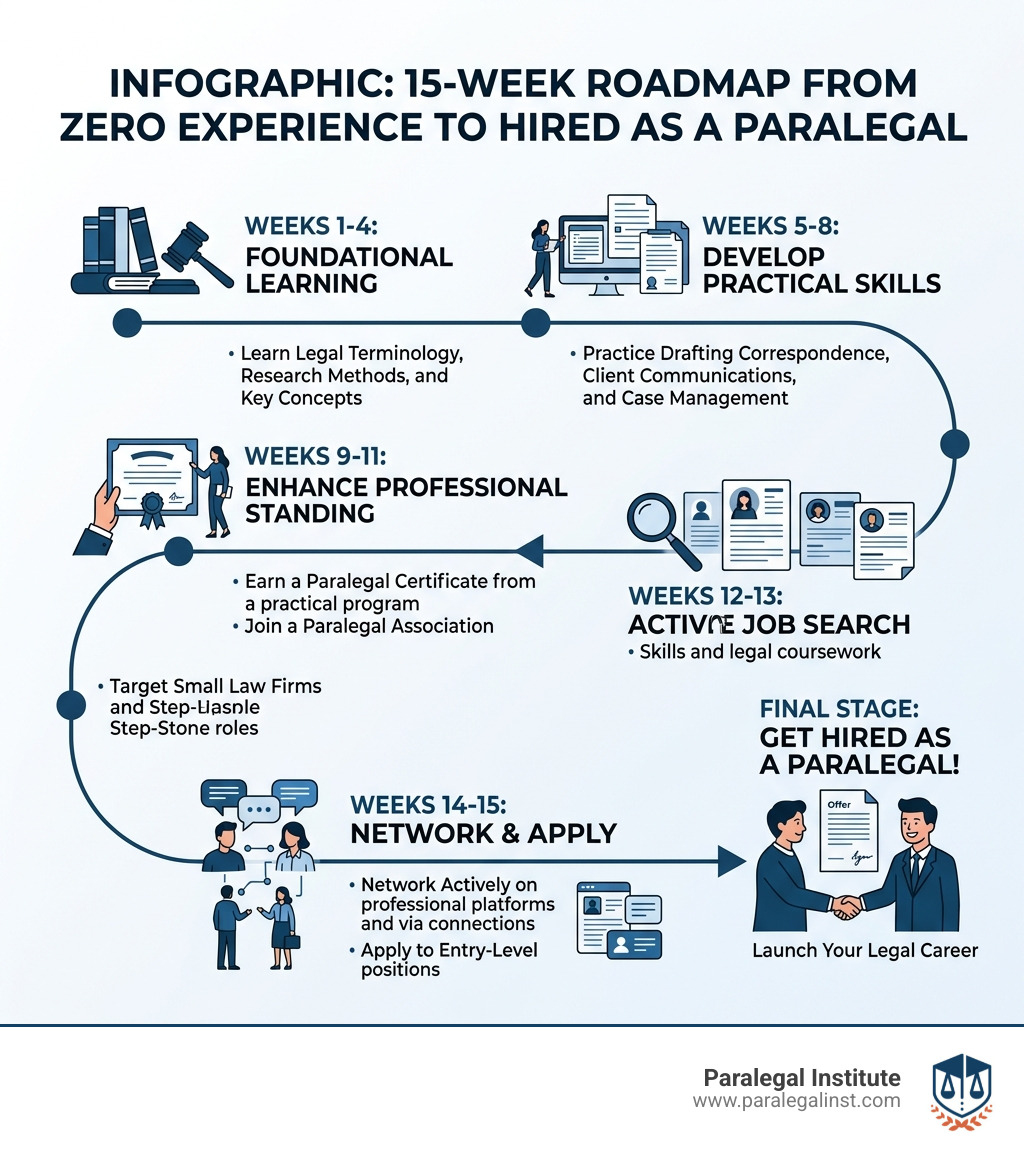
At the Paralegal Institute, we believe in an accelerated, practical path. Why spend four years—and a small fortune—learning the theory of law when you can spend 15 weeks learning the practice of law?

| Feature | 15-Week Certificate (Paralegal Institute) | 4-Year Degree (Traditional University) |
|---|---|---|
| Time to Completion | 15 Weeks | 4 Years |
| Instructors | Practicing Attorneys | Academic Professors |
| Curriculum Focus | Practical Skills (Drafting, Filing, Research) | Theoretical Theory & General Education |
| Cost-Effectiveness | High | Low |
The how hard is it to get entry level paralegal job question often comes down to this: would an attorney rather hire someone who knows the history of the Supreme Court, or someone who knows how to format a subpoena? Most attorneys will pick the latter every single time. Our live instruction ensures you are learning in real-time from people who are actually in the trenches.
Frequently Asked Questions about Starting a Paralegal Career
Starting a new career can feel like navigating a maze. Here are some of the most common concerns we hear from beginners.
Do I need a college degree to become a paralegal?
In most states, there is no legal requirement for a specific degree to work as a paralegal. While some large firms might prefer a bachelor's degree, a specialized paralegal certificate is often more than enough to get your foot in the door, especially if you have prior work experience in another field. The legal profession is results-oriented; if you can prove you are competent and reliable, the degree matters much less than the certificate.
How long does it take to be job-ready?
With our accelerated program, you can be job-ready in just 15 weeks. We strip away the "fluff" and focus entirely on the skills you will use on your first day at a law firm. This includes mastering legal research platforms, understanding court rules, and learning how to communicate professionally with clients and opposing counsel.
What skills do attorneys value most in beginners?
Attorneys value three things above all else: attention to detail, reliability, and communication. We can teach you the law, but we can't teach you to double-check your typos. If you can show an attorney that you are organized and that you won't let anything fall through the cracks, you are already ahead of 90% of the competition.
For those looking for flexibility, there are even remote paralegal no experience opportunities that focus on digital document management and intake, allowing you to start your career from the comfort of your home.
Conclusion
Breaking into the legal field doesn't have to be a multi-year ordeal. By focusing on practical skills, leveraging your existing strengths, and choosing a training path designed for the real world, you can transition into this rewarding profession faster than you ever imagined.
At the Paralegal Institute, we are committed to helping you bridge the gap between "no experience" and "hired." Our 15-week certificate program is taught by practicing attorneys who know exactly what the market demands in 2026. Whether you choose our in-person classes or our live online instruction, you'll be getting the hands-on training you need to succeed.
Stop wondering how to get a paralegal job without experience and start building the skills that make experience irrelevant. Your new career is just 15 weeks away.