Why a Personal Injury Paralegal Job Could Be Your Fastest Path Into Law
A personal injury paralegal job puts you at the center of some of the most meaningful legal work there is — helping real people recover after accidents, injuries, and life-changing events.
If you want a quick answer on what this career involves, here it is:
| What You Need to Know | Quick Answer |
|---|---|
| What you'll do | Manage case files, draft legal documents, organize medical records, support attorneys through litigation |
| Where you'll work | Plaintiff law firms, insurance defense firms, corporate legal departments |
| Key skills needed | Medical terminology, communication, legal software, organization |
| Typical education path | Paralegal certificate program (no law degree required) |
| Job outlook | Projected to grow much faster than average through 2033 |
The demand for personal injury paralegals is growing fast. Law firms need skilled support staff who can hit the ground running — managing everything from client intake to trial prep, often all before lunch.
This is also one of the most accessible entry points into the legal field. You don't need years of expensive schooling. What you do need is the right training, the right skills, and a clear understanding of what employers are actually looking for.
I'm Matthew Pfau, a practicing personal injury attorney who owns and operates a law firm where I hire and train paralegals directly — and that hands-on experience with the personal injury paralegal job market is exactly what shaped the curriculum at Paralegal Institute.
Core Responsibilities of a Personal Injury Paralegal Job

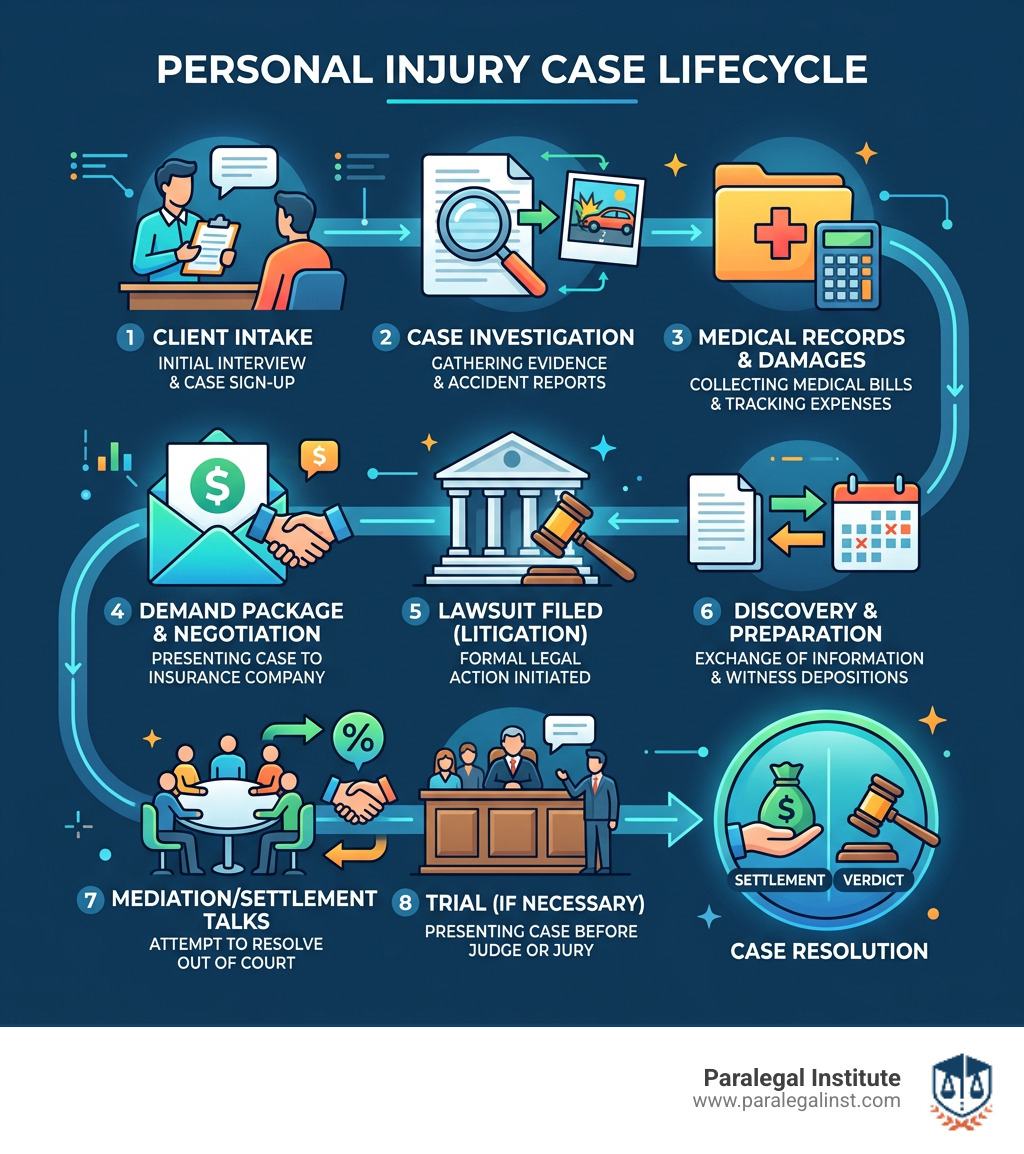
When you step into a personal injury paralegal job, you aren't just filing papers. You are the engine that keeps the case moving. Attorneys rely on us to handle the heavy lifting of case management so they can focus on legal strategy and courtroom arguments.
The personal injury paralegal job description is diverse. On any given day, we might start by conducting a client intake interview, move on to drafting a complaint, and end the day by organizing a massive stack of medical records. Our goal is to ensure that every file is "trial-ready" at all times.
Key duties include:
- Case Management: Keeping track of deadlines, statutes of limitations, and court dates.
- Client Intake: Being the first point of contact for a person who has just been through a traumatic accident.
- Legal Drafting: Preparing pleadings, motions, and discovery requests under attorney supervision.
- Discovery Process: Gathering the evidence needed to prove the case.
For a deeper dive into these tasks, check out our complete guide to personal injury paralegals or explore specific personal injury paralegal duties.
Plaintiff vs. Defense Side Roles
In personal injury, you generally work on one of two sides: the plaintiff (the person injured) or the defense (the person or company accused of causing the injury, often represented by an insurance company).
On the plaintiff side, our focus is on client advocacy. We spend a lot of time helping clients navigate their medical treatment and building a "demand package" to show the insurance company exactly why our client deserves a high settlement. We investigate liability—proving the other guy was at fault—and document every penny of the client's losses.
On the defense side, the role shifts toward protecting the client from excessive claims. Defense paralegals spend more time reviewing police reports and witness statements to find holes in the plaintiff's story. They also determine insurance coverage limits and coordinate with insurance adjusters. Regardless of the side, the question of can a paralegal do personal injury is answered with a resounding yes; they are the backbone of both types of firms.
Mastering Medical Records in a Personal Injury Paralegal Job
You’ll often hear me tell my students that in this field, you’ll read more MRIs than motions. A huge part of a personal injury paralegal job involves mastering medical records. We have to order records from hospitals, follow up with providers who are slow to respond, and ensure everything is handled in strict compliance with HIPAA laws.
We create medical chronologies —summaries that tell the story of the client’s injury from the moment of the accident through their final physical therapy session. We also use treatment trackers to make sure we don't miss a single bill. Understanding medical terminology is vital; you need to know the difference between a fracture (Fx) and a diagnosis (Dx), and recognize when a client has reached Maximum Medical Improvement (MMI).
Essential Skills and Knowledge for Success
To thrive in a personal injury paralegal job, you need a specific toolkit. It’s not just about knowing the law; it’s about being an investigator, a communicator, and a master of organization.
Our checklist for personal injury cases often includes:
- Investigative Skills: Can you track down a witness or find the right person at an insurance company?
- Trial Preparation: Organizing exhibits, preparing witness lists, and ensuring the "war room" is ready for the big day.
- Empathy: You are dealing with people in pain. Strong communication and a calm demeanor go a long way.
- Time Management: With discovery deadlines usually hitting at the 30-day mark, your calendar is your best friend.
If you want to stand out, learning how to be a top-tier personal injury paralegal means being proactive. Don't wait for the attorney to ask for a document—have it ready before they even know they need it.
Navigating the Discovery Process
Discovery is the "fact-finding" phase of a lawsuit, and it is where most of our work happens. We handle interrogatories(written questions), requests for production(asking for documents like photos or repair bills), and subpoenas to get records from third parties.
We also coordinate the logistics of the case. This means scheduling depositions, ordering court reporters, and ensuring the attorney has a clean folder of evidence ready for every hearing. In a busy Las Vegas firm, managing a high-volume caseload requires a level of accuracy that only comes from focused, practical training.
Education and Training for Your Personal Injury Paralegal Job
How do you actually get one of these jobs? While some states don't strictly require a degree, most law firms in places like Las Vegas, NV, won't look at a resume that doesn't show formal training.
The traditional route involves lengthy university programs, but many adults find that they don't have the time or resources for that. That’s why we focus on a 100% live, 15-week paralegal certificate program. Our goal is to give you the practical skills you need to walk into a law firm on Monday morning and know exactly what to do.
When you're looking at how to become a personal injury paralegal, focus on programs that teach you how to actually draft a complaint or summarize a medical record, rather than just memorizing legal theory. You should also look at personal injury paralegal resume examples to see how to highlight your new skills to employers.
Choosing the Right Training Program
The best training is live instruction. At Paralegal Institute, our classes are taught by practicing legal professionals—people like me who are in the trenches every day. This means you get real-world application, not just textbook definitions.
An accelerated curriculum is often superior for career-focused adults because it gets you into the workforce faster. We don't believe in "filler" classes. We focus on what you need to know for your personal injury paralegal job, from legal research to case strategy. You can find more details in our guide to personal injury courses.
Career Outlook and Job Market Demand
The job market for paralegals is incredibly strong. According to the Bureau of Labor Statistics, employment in this field is projected to grow much faster than the average for all professions through 2033. Law firms are increasingly hiring paralegals to perform tasks that were once handled by more expensive junior associates.
In high-growth areas like Las Vegas, the demand for specialists in personal injury, medical malpractice, and wrongful death cases is particularly high. This demand leads to excellent career advancement opportunities. You might start as a junior paralegal and work your way up to a senior litigation manager or a firm administrator.
Typical Workday and Environment
What does a day in the life look like?
- Morning: Check the case management dashboard for expiring statutes or court deadlines.
- Mid-morning: Draft a set of discovery requests for a new car accident case.
- Lunch: Quick check-in with a client to update them on their settlement status.
- Afternoon: Review a 500-page medical file for a slip-and-fall case and create a summary.
- Late Afternoon: File a motion with the court and coordinate a deposition for next week.
It’s , it requires high professionalism, and it’s never boring.
Frequently Asked Questions about Personal Injury Paralegal Jobs
What does a Paralegal Institute certificate provide for your career?
Our certificate provides the educational credentials employers look for, but more importantly, it provides job readiness. We focus on real-world legal training so you have the practical skills to handle a caseload from day one. It is a faster, more affordable pathway to career entry compared to traditional multi-year programs.
Do I need a medical background to work in personal injury law?
No, you don’t need to be a nurse or a doctor. However, you do need to be comfortable with medical terminology and record review. We teach you the basics of injury impact and how to read specialized medical documents as part of our curriculum. Most of the nuanced medical knowledge is learned on the job as you handle different types of cases.
How long does it take to become a personal injury paralegal?
With an accelerated program like ours, you can be ready for the workforce in just 15 weeks. This timeline allows for rapid skill acquisition and a much faster transition into your new career than traditional multi-year college programs.
Conclusion
Landing a personal injury paralegal job is about more than just having a passion for justice; it's about having the right training to be an asset to a legal team. By choosing a path that emphasizes live instruction and practical legal education, you can jumpstart your career in a fraction of the time.
At Paralegal Institute, we are dedicated to helping you reach that goal through our career-ready curriculum. If you're ready to move from the sidelines into the heart of the legal world, start your legal career training with us today.