Why a Paralegal Certificate is Your Fastest Path to a Legal Career
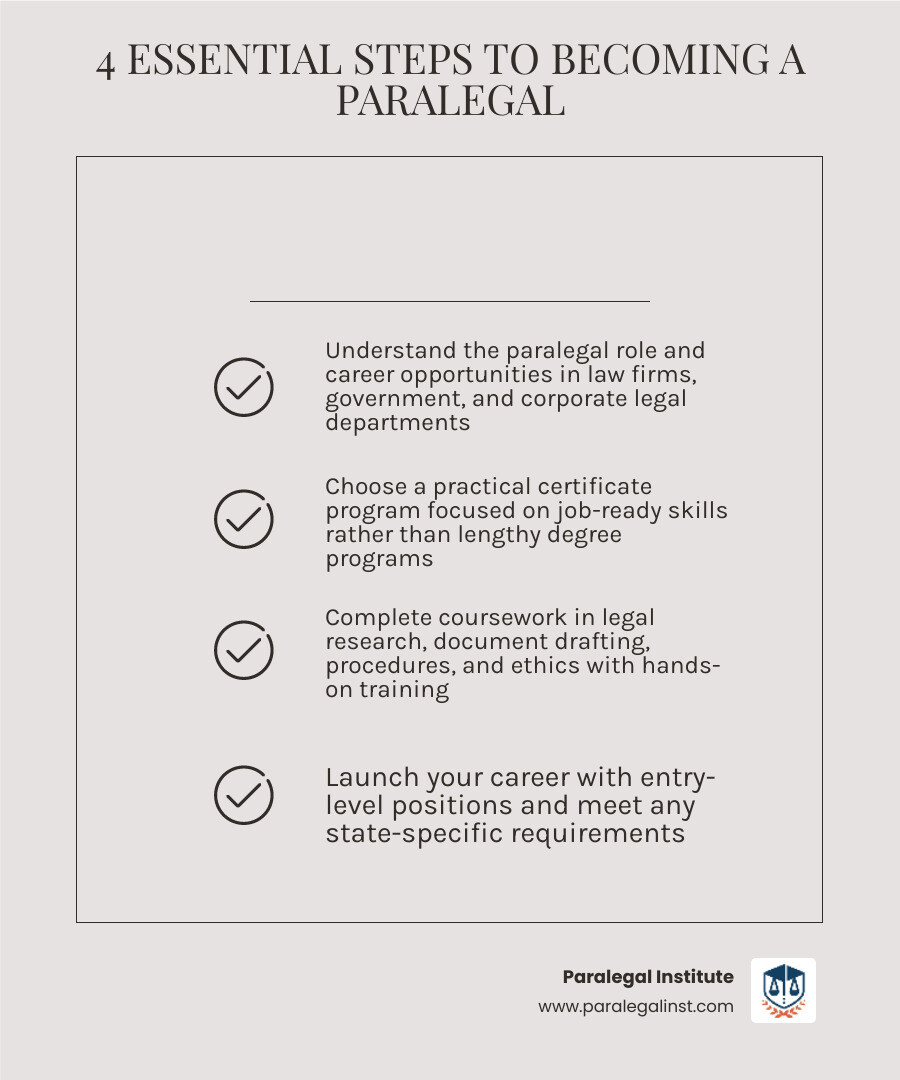
Learning how to get a certificate in paralegal studies is simpler than you might think. The path involves understanding the paralegal role, choosing a practical certificate program, completing focused coursework, and launching your career. A paralegal certificate offers the fastest route into the legal profession because, unlike other lengthy educational paths, it focuses exclusively on job-ready skills like legal research, document preparation, and case management.
The legal field offers stable careers in private law firms, corporate legal departments, and government agencies. Certificate programs typically take less than a year, with flexible online and evening options to fit your schedule. The curriculum covers essential areas like torts, contracts, and civil procedure, providing hands-on experience through mock trials and practical exercises.
I'm Matt Pfau, a practicing attorney who has hired and trained numerous paralegals. My experience inspired me to develop practical training programs, and I now teach aspiring paralegals how to get a certificate in paralegal studies at Paralegal Institute. Let me walk you through each step of this rewarding career path.
Step 1: Understanding the Paralegal Role and Career Path

Before you learn how to get a certificate in paralegal studies, it's crucial to understand the role. Paralegals perform substantive legal work under attorney supervision, handling real legal tasks that require skill and judgment. They are not just administrative support; they are essential members of the legal team.
The demand for skilled paralegals is strong across private law firms, corporate legal departments, and government agencies. This variety gives you career options upon graduation. Our training at the Paralegal Institute focuses on the practical skills employers in these diverse environments are seeking. For more details, explore the Role of Paralegals in Law Firms and what to expect in an Entry Level Paralegal Job.
What Does a Paralegal Do?
A paralegal's day is varied and intellectually engaging. Key responsibilities include conducting client interviews, performing legal research, and drafting legal documents like pleadings, motions, and contracts. Precision and a strong grasp of legal terminology are essential.
Paralegals are also vital to the discovery process, where they organize documents, prepare interrogatories, and manage the exchange of information between parties. Casework is another critical function, involving tracking deadlines, maintaining client files, and ensuring procedural rules are met. For trial, paralegals assist with trial preparation by organizing exhibits and summarizing testimony. This work directly impacts the outcome of legal matters, and at the Paralegal Institute, we provide the hands-on experience to ensure you are prepared for these responsibilities.
Where Can a Paralegal Work?
A paralegal certificate opens doors to a wide range of workplaces. Private law firms, from small practices to large litigation firms, are the most common employers. Corporate legal departments hire paralegals to manage contracts, ensure regulatory compliance, and handle intellectual property. You can learn more about these roles in Entry Level Corporate Paralegal Jobs.
Government offices at all levels employ paralegals in prosecutors' offices, public defenders' offices, and administrative agencies. Non-profit organizations, such as legal aid societies, also rely on paralegals to serve their communities. Other opportunities exist in real estate, banking, and consulting. Our training provides universally applicable skills, preparing you for success no matter which path you choose. For a look at a popular specialization, see our Personal Injury Paralegal Complete Guide.
Step 2: Choosing the Right Educational Path: Paralegal Certificate for Fast, Practical Training
When launching a legal career, your educational choice is critical. While you'll find various educational paths, my experience hiring paralegals has shown that a paralegal certificate is the smartest, fastest route to a real legal career.
This is especially true for career changers or anyone wanting to enter the workforce quickly. A certificate program concentrates exclusively on the legal skills employers need now: legal research, document drafting, case management, and courtroom procedures. You avoid years of general education courses that are irrelevant to your job.
The advantages are clear: you complete your training in months, not years, start earning sooner, and make a lower financial investment. Most importantly, you graduate genuinely job-ready. For a detailed comparison, our Paralegal Certificate vs. Other Educational Paths: The Ultimate Guide breaks down each path. You can also weigh the Pros and Cons of Paralegal Certificate Programs.
Why the Paralegal Institute Certificate is the Fastest Path to Your Career
Time matters. You want practical training that gets you working as quickly as possible without sacrificing quality. That's what we've built at the Paralegal Institute. Our certificate program is designed by practicing attorneys who know what law firms need. I teach these courses myself, alongside other legal professionals, focusing on real-world skills that make you valuable to employers.
Our program offers faster entry to the workforce through a focused curriculum that cuts out unnecessary courses. Here’s how how to get a certificate in paralegal studies at the Paralegal Institute compares to other traditional routes:
| Feature | Paralegal Institute Certificate | Other Traditional Programs |
|---|---|---|
| Time to Completion | Months (Accelerated) | Years |
| Curriculum Focus | Practical, job-ready skills | Mix of general education & legal theory |
| Career Readiness | High (Immediate workforce entry) | Varies (May need additional training) |
| Investment | Lower | Higher |
The difference is clear. Our certificate focuses exclusively on legal training, so you're not paying for courses that don't advance your paralegal career. We offer both online classes with live instruction and in-person training, providing flexibility with the real-time interaction you need. Our Accelerated Paralegal Certificate Programs are structured to help you Become a Paralegal Fast and graduate with the confidence to handle real legal work.
Step 3: How to Get a Certificate in Paralegal Studies: The Application and Curriculum

Now, let's cover the actual process of how to get a certificate in paralegal studies. It's more straightforward than you might expect. Our program is designed to be accessible, welcoming motivated individuals without unnecessary barriers.
You don't need prior legal education to start. A high school diploma or its equivalent is the primary requirement. We believe your motivation matters more than your academic history and have trained successful paralegals from all walks of life. Our admissions team will walk you through the process and help you determine if our program aligns with your goals. For more guidance, explore Identifying Paralegal Programs for Your Career Goals.
What to Expect in Your Paralegal Studies Curriculum
Our curriculum is designed by practicing legal professionals to teach you the skills you'll use on day one. You'll learn substantive law(torts, contracts, family law), procedural law(the steps of a lawsuit), and legal ethics to protect yourself and your clients. The training is practical. You'll gain hands-on experience in legal document drafting, preparing the complaints, motions, and answers that drive litigation. You'll master the discovery process, learning to manage interrogatories and document requests. Finally, you'll develop skills in casework management and trial preparation, ensuring you can support your legal team from start to finish. This comprehensive approach ensures you are ready for the demands of a modern law office. For more on this, see Improving Your Legal Writing Skills in Paralegal Courses and an overview of Legal Topics Covered: Paralegal Certificate.
Live Instruction and Practical Training: The Paralegal Institute Advantage
Legal work requires critical thinking and real-time problem-solving, which is why our program is built around live instruction and hands-on training. Unlike programs that rely on pre-recorded videos, our online classes with live instruction allow you to engage with me and other practicing attorneys in real time. You can ask questions, participate in discussions, and get immediate feedback.
For those who prefer a traditional setting, our in-person classes in Las Vegas, NV, offer the same direct engagement. Both formats include practical exercises like mock trials and real-world case studies to build your confidence. Your instructors are experienced legal professionals who share insights from their active cases, preparing you for the realities of the job. This is genuine Hands-On Legal Training that makes you job-ready upon graduation. If you're considering the online format, this guide can help: Is Online Paralegal Training Right For You?. Our approach delivers on our promise: live instruction, practical training, an accelerated path, and an affordable investment in your future.
Step 4: Launching Your Career After Graduation

Earning your paralegal certificate is the starting line for your legal career. Our program doesn't just teach you how to get a certificate in paralegal studies —it prepares you to confidently enter the professional world. BLS projects little or no change in paralegal employment from 2025 to 2035, but still expects about 40,800 openings a year, mostly as people retire or change careers ( BLS).
How to get a certificate in paralegal studies and land your first job
Landing your first position requires showcasing the practical abilities you've gained. Start building your professional portfolio during your coursework with the legal documents and research memos you create. When creating job site profiles, emphasize your hands-on training and skills in legal research, document drafting, and casework. During interview preparation, you can confidently discuss the mock trials and real-world scenarios from your training, setting you apart from candidates with purely academic backgrounds. Our resources on How to Get Paralegal Job and how to Prep for First Job as a Paralegal offer more detailed guidance.
Meeting State Requirements with Your Paralegal Certificate
Understanding state-specific regulations is an important part of your career. While there is no national paralegal license, some states have specific educational or registration guidelines. It's wise to review your state's official requirements to understand the rules in your jurisdiction. This ensures you practice confidently and ethically from the start.
Optional credentials can also improve your resume, and your paralegal certificate provides the foundational knowledge to pursue them. The legal field is always evolving, so continuing education is key to long-term success. Many of our graduates pursue Continued Learning After Paralegal Certificate to deepen their expertise. Your certificate is the credential that launches your career and provides the foundation for future growth.
Frequently Asked Questions about Paralegal Certificates
You likely have questions about how to get a certificate in paralegal studies, and we're here to provide clear, straightforward answers. These are the most common concerns we hear from prospective students considering their path into the legal profession.
How long does it take to get a paralegal certificate?
The time it takes to earn a paralegal certificate varies depending on the program you choose. Some traditional certificate programs can stretch anywhere from several months to over a year, particularly if you're studying part-time while managing other commitments.
At Paralegal Institute, we've designed our program with your time in mind. Our accelerated paralegal certificate program takes just 15 weeks to complete. This means you can be career-ready and entering the workforce in less than four months. Compare that to other educational programs that can take years to complete, and the advantage is clear.
This accelerated format doesn't mean we skip essential content. Instead, we've eliminated unnecessary coursework and general education requirements that don't directly contribute to your success as a paralegal. Every week of our program is focused on building the practical skills law firms need today. You'll spend less time in the classroom and more time applying what you've learned in a professional setting.
For more information on our accelerated approach, explore our Accelerated Paralegal Certificate Programs and learn how you can Become a Paralegal Fast.
Do I need a prior college degree to get a paralegal certificate?
This is one of the most frequent questions we receive, and the answer is refreshingly simple: No, you do not need a prior college degree to earn a paralegal certificate. Most programs, including ours at Paralegal Institute, require a high school diploma or its equivalent at a minimum.
This accessibility is what makes paralegal certificate programs such an excellent choice for a wide range of individuals. Whether you're a recent high school graduate exploring career options, a career changer seeking a new professional direction, or someone who started college but didn't complete a degree, this path is open to you.
We've trained successful paralegals from diverse backgrounds—military veterans transitioning to civilian careers, professionals seeking more meaningful work, and individuals looking to enter the legal field without spending years and significant resources on a traditional degree. Your prior academic background matters far less than your commitment to learning practical legal skills and your dedication to the profession.
Our program focuses on providing you with the hands-on training and substantive legal knowledge you need for immediate employment. While some students do have prior college experience, it's certainly not a requirement for success in our program or in your future paralegal career. For a detailed look at this pathway, read our guide on Paralegal Certificate No Degree: Best Path.
What is the difference between a paralegal and a legal assistant?
While people sometimes use these terms interchangeably, there's an important distinction between a paralegal and a legal assistant. Understanding this difference helps clarify what you'll be prepared to do after earning your paralegal certificate.
A paralegal performs substantive legal work under an attorney's supervision. This means you're directly involved in the legal process itself, not just supporting it administratively. As a paralegal, you'll conduct legal research and analyze case law, draft legal documents like pleadings and motions, interview clients and witnesses, manage the discovery process, and assist with trial preparation. You're actively contributing to case strategy and legal outcomes. Because this work requires specialized legal knowledge and skills, paralegals' time is often billable to clients—meaning law firms can charge for the work you do, which makes you a valuable revenue-generating member of the team.
A legal assistant, by contrast, typically handles administrative and clerical tasks. While these responsibilities are essential to keeping a law office running smoothly, they don't involve substantive legal analysis or decision-making. A legal assistant might schedule appointments and manage calendars, handle correspondence and maintain files, answer phones and greet clients, process billing, and organize office operations. These tasks support the legal team but don't directly contribute to the legal work itself.
The key distinction comes down to this: paralegals perform substantive, billable legal tasks that require legal training, while legal assistants handle administrative functions that keep the office organized. Our paralegal certificate program prepares you for the more advanced role, training you to take on responsibilities that directly impact legal cases and client outcomes. You'll graduate ready to contribute meaningfully to legal work from your very first day on the job.
Conclusion
You now have a complete roadmap for how to get a certificate in paralegal studies. It's an accessible path for anyone with the determination to build a career in the legal field. The key is choosing an accelerated program that focuses on practical skills.
Today's legal employers need professionals who can contribute immediately. That's what our 15-week program delivers: practical skills taught by practicing legal professionals through live instruction. You'll learn legal research, document drafting, and case management through hands-on training, not pre-recorded videos.
When you complete your certificate at Paralegal Institute, you gain the confidence and readiness that comes from practicing real legal tasks. Whether you choose our online program with live instruction or our in-person classes, you'll receive a quality education designed for immediate workforce entry.
The legal profession offers stability, intellectual challenge, and the satisfaction of helping people. As a paralegal, you'll play a vital, respected role in the justice system. The demand for well-trained paralegals continues to grow, and our program prepares you to meet that demand.
Are you ready to start this journey? Explore our Paralegal Studies Certificate program and find how quickly you can turn your career goals into reality.