
Why Practice Is Key to Acing Your Paralegal Program Exams
A paralegal practice exam is a simulated test that helps you prepare for your paralegal program assessments. It tests your knowledge of legal concepts, procedures, and skills before you sit for the real exam.
Key Benefits of Paralegal Practice Exams:
- Identify Knowledge Gaps- Find which legal topics you need to study more
- Build Confidence- Reduce test anxiety by familiarizing yourself with exam formats
- Simulate Real Conditions- Practice time management and test-taking strategies
- Track Progress- Measure improvement over time and focus your study efforts
- Master Key Concepts- Test yourself on civil litigation, contracts, legal research, and professional ethics
Exams are not just about memorizing answers; they help you understand how to apply legal principles like the IRAC method and demonstrate critical thinking under pressure. They reveal exactly where you stand, showing which areas need more attention and which concepts you've mastered.
I'm Matthew Pfau, owner of Paralegal Institute and a practicing attorney who has hired and trained numerous paralegals. My experience shows that students who consistently use paralegal practice exam resources are better prepared for their program assessments and future legal careers.
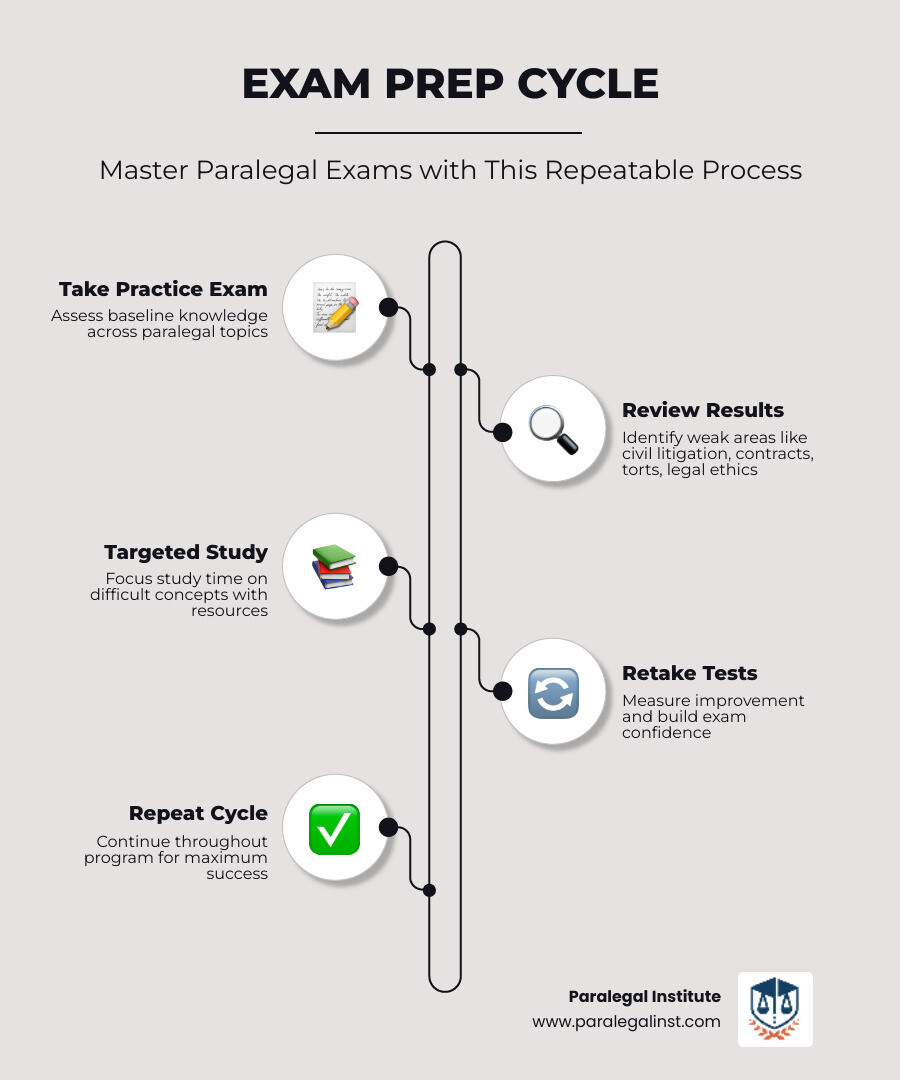
Exam anxiety is common, but a solid practice strategy can transform apprehension into assurance. Mastering exam techniques is as crucial as mastering the legal material itself. Our goal is to equip you with knowledge and confidence. If you struggle with test-day jitters, explore strategies for Dealing with Exam Anxiety in Paralegal Schools.
What to Expect: A Breakdown of Typical Paralegal Exams

A paralegal practice exam gives you an insider's look at what assessments feel like, so there are no surprises on test day. Paralegal exams typically come in three main formats, each testing different aspects of your legal knowledge.
Common Exam Formats
- Multiple-choice questions present a legal scenario and ask you to pick the best answer. They test your ability to identify correct legal terms, choose proper procedural steps, or apply a rule to specific facts, ensuring you truly understand concepts beyond simple memorization.
- Written assignments demonstrate your ability to use what you've learned. You might draft a client memo, write part of a pleading, or analyze a legal issue. These assignments mirror the work you'll do in your paralegal career.
Core Knowledge Areas
A paralegal practice exam will cover essential areas every paralegal must master. Understanding the US Legal System is your foundation, including court structures and sources of law.
- Civil litigation is a major focus, covering the entire journey of a lawsuit. Expect questions on jurisdiction, key Federal Rules of Civil Procedure like Rule 26(findy) or Rule 33(interrogatories), and the preponderance of the evidence standard.
- Contracts questions will test your knowledge of formation, validity, breach, and remedies.
- Professional ethics is a critical topic, covering guidelines on the unauthorized practice of law, attorney-client privilege, and professional integrity.
- Torts cover civil wrongs like negligence, intentional torts, and product liability.
- Legal research skills are fundamental, so you'll be expected to know how to find and analyze case law and statutes.
Depending on your program, you may also see questions on corporate law, criminal procedure, or estate planning.
Key Concepts Tested
Certain terms appear regularly on paralegal exams:
- Statute of limitations: The deadline for filing a legal claim.
- Stare decisis: The principle that courts follow precedents from earlier cases to ensure consistency.
- Service of process: The formal procedure for notifying a defendant they are being sued.
- Pleadings: Formal written documents (complaint, answer) where parties state their claims and defenses.
- Deposition: Sworn testimony taken out of court before trial to gather evidence.
- Litigation process: How a case proceeds from filing to final determination.
- IRAC method:(Issue, Rule, Application, Conclusion) A framework for analyzing legal problems.
The more you understand these concepts, the more confident you'll feel. Our programs at Paralegal Institute cover all these areas, ensuring you're ready to Prepare for Paralegal Program Exams and succeed.
The Complete Guide to Using a Paralegal Practice Exam
Think of a paralegal practice exam as your personal training ground. How you strategically use practice exams can be the difference between success and struggling.
Creating a Study Schedule
Break down overwhelming legal concepts by setting realistic goals. Our 15-week paralegal program delivers material in digestible portions, providing a natural structure for your studies.
Consistency beats cramming. Dedicate specific blocks of time each week for review and practice. Also, use spaced repetition, a powerful learning technique. Instead of cramming, you revisit topics at increasing intervals (e.g., one day, one week, two weeks later) to cement information into your long-term memory. Research on Improving Students' Learning With Effective Learning Techniques shows this method produces lasting results. Finally, schedule your practice exams like the real thing—mark them on your calendar and treat them as dress rehearsals.
Analyzing Your Paralegal Practice Exam Results
Taking the exam is only half the battle; the real learning happens when you analyze your results. Focus on your weak areas by examining every question you missed or hesitated on. Each mistake highlights exactly what needs more attention.
Use the detailed answer explanations that come with quality practice exams. Read them even for questions you got right to gain deeper insight into the legal reasoning. Track your progress over time by noting your scores and problem topics. This data reveals patterns and tells you where to invest your study energy. Once you've identified weak spots, prioritize those difficult topics in your study plan.
Essential Resources and Strategies for Success

Additional Study Aids
Mixing study methods is key. Practice questions and flashcards are game-changers for learning legal terminology. The Paralegal Institute provides these tools, designed for our curriculum, to help you master terms like "Deposition" or "Ex Parte." A solid legal dictionary is also essential for clarifying precise definitions. For complex cases, case briefs and summaries distill lengthy opinions into core legal principles.
Study Groups
Learning with others can accelerate your progress. A study group offers different perspectives and provides accountability. Explaining a concept to someone else forces you to understand it deeply, not just memorize it. Mock discussions on hypothetical scenarios are also excellent preparation for essay questions.
Test-Taking Strategies
Smart techniques can boost your score. For essays, use the IRAC method(Issue, Rule, Application, Conclusion) to structure your analysis. Read questions carefully, paying attention to words like "always" or "except." Trust your instincts when answering, and only change an answer if you have a clear, logical reason. Finally, apply the time management skills you honed during your paralegal practice exam sessions. If a question stumps you, make an educated guess and move on.
The Benefits of Paralegal Training
This preparation opens doors to a rewarding career. Completing a paralegal program signals to employers that you are serious and prepared, improving your career opportunities in law firms, corporate legal departments, and government agencies.
You'll gain improved skills that employers need. Our 15-week program focuses on hands-on training in legal research, document drafting, and case management, taught by practicing legal professionals. This emphasis on workforce readiness means you gain targeted skills to contribute from day one. We're committed to helping you Excel in Paralegal Training Programs and turn your goals into reality.
Frequently Asked Questions About Paralegal Exams
Here are answers to common questions from aspiring paralegals about their studies and career path.
What is the primary role of a paralegal in a legal setting?
Paralegals are the backbone of a legal team, handling essential tasks that allow attorneys to focus on strategy and court representation. Working under an attorney's supervision, your primary mission is assisting attorneys in nearly every aspect of legal work. Key responsibilities include:
- Drafting documents: Preparing pleadings, motions, contracts, and client correspondence.
- Legal research: Investigating case law, statutes, and regulations to build strong arguments.
- Client communication: Gathering information, answering procedural questions, and providing case updates (without giving legal advice).
- Case management: Tracking deadlines and organizing case files to ensure nothing falls through the cracks.
Paralegals cannot set legal fees or represent clients in court, but within these boundaries, the career is intellectually challenging and vital to the justice system.
What happens if I fail an exam in my paralegal program?
Failing an exam is not the end of the world; how you respond is what matters. A failed exam is an opportunity to approach the material differently.
Seeking academic support is crucial. Our instructors are practicing legal professionals who can offer guidance and help you develop better study strategies. Asking for help is a sign of strength. Use your exam results as a diagnostic tool by reviewing course materials related to the questions you missed to pinpoint knowledge gaps.
This experience reinforces the importance of preparation and using tools like a paralegal practice exam from the start. A setback can build the resilience and study skills needed for a successful career.
How is paralegal training different from other legal credentials?
A paralegal program is your express lane into the legal profession. Unlike a multi-year law degree (Juris Doctor) that prepares you to be an attorney, a paralegal program provides focused training on the specific skills needed to be a paralegal.
The timeline is a major advantage. Our accelerated program takes just 15 weeks, meaning you can enter the workforce in under four months. This path is ideal for career-changers and motivated individuals.
The curriculum emphasizes practical skills. Our hands-on courses, taught by practicing legal professionals, focus on doing rather than just knowing. You'll draft documents, conduct research, and practice case management. This makes the training a direct career entry point. It's a complete credential that qualifies you for immediate employment, as employers know graduates have the job-ready skills their teams need. For more insights, explore our Common Questions About Paralegal Programs.
Conclusion: Turn Your Practice into a Paralegal Career
Our 15-week paralegal program is designed to get you ready for the real world of legal work, fast. The hands-on curriculum is taught by practicing legal professionals who focus on the practical skills you'll use from day one. We prepare you not just to pass exams, but to thrive in your paralegal career.
The journey to becoming a professional paralegal is challenging but incredibly rewarding. Every practice question and mock exam brings you closer to a career where you can make a real difference.
Ready to take the next step? We're here to help. Explore our Paralegal Exam Practice Questions and see how our program can turn your commitment into a successful paralegal career.