Why Mastering Paralegal Interview Tips Is Your Fast Track to Getting Hired
Paralegal interview tips can make the difference between landing your dream legal job and watching another candidate get the offer. The interview is your courtroom. Your preparation is your case brief. And the verdict—whether you get hired—depends entirely on how well you perform.
Here are the essential paralegal interview tips to succeed:
- Research the firm thoroughly- Know their practice areas, key attorneys, and recent cases
- Project confidence- Use strong body language, maintain eye contact, and speak clearly
- Prepare for common questions- Practice answers about your motivation, skills, and career goals
- Use the STAR method- Structure behavioral answers with Situation, Task, Action, Result
- Demonstrate technical skills- Discuss your experience with legal research tools and case management
- Show organizational prowess- Explain how you manage multiple deadlines and priorities
- Ask thoughtful questions- Inquire about firm culture, success metrics, and growth opportunities
- Follow up professionally- Send a thank-you note reaffirming your interest
BLS projects little or no change in paralegal employment from 2025 to 2035, but still expects about 40,800 openings a year, mostly as people retire or change careers ( BLS). That means real opportunities, but also competition. You need to stand out.
Most candidates show up unprepared. They answer questions generically. They fail to demonstrate the specific skills law firms need. They don't understand what interviewers are really asking. And they lose the job to someone who does.
This guide gives you the insider knowledge to avoid those mistakes. You'll learn exactly how to prepare, what to say, and how to demonstrate that you're ready to contribute from day one.
I'm Matthew Pfau, a practicing attorney who hires and trains paralegals at my law firm and teaches paralegal courses at Paralegal Institute. I've conducted hundreds of paralegal interviews and know exactly what separates candidates who get hired from those who don't—and I'm sharing my best paralegal interview tips with you here.
Let's break down the four phases of interview success so you can turn your next interview into a job offer.
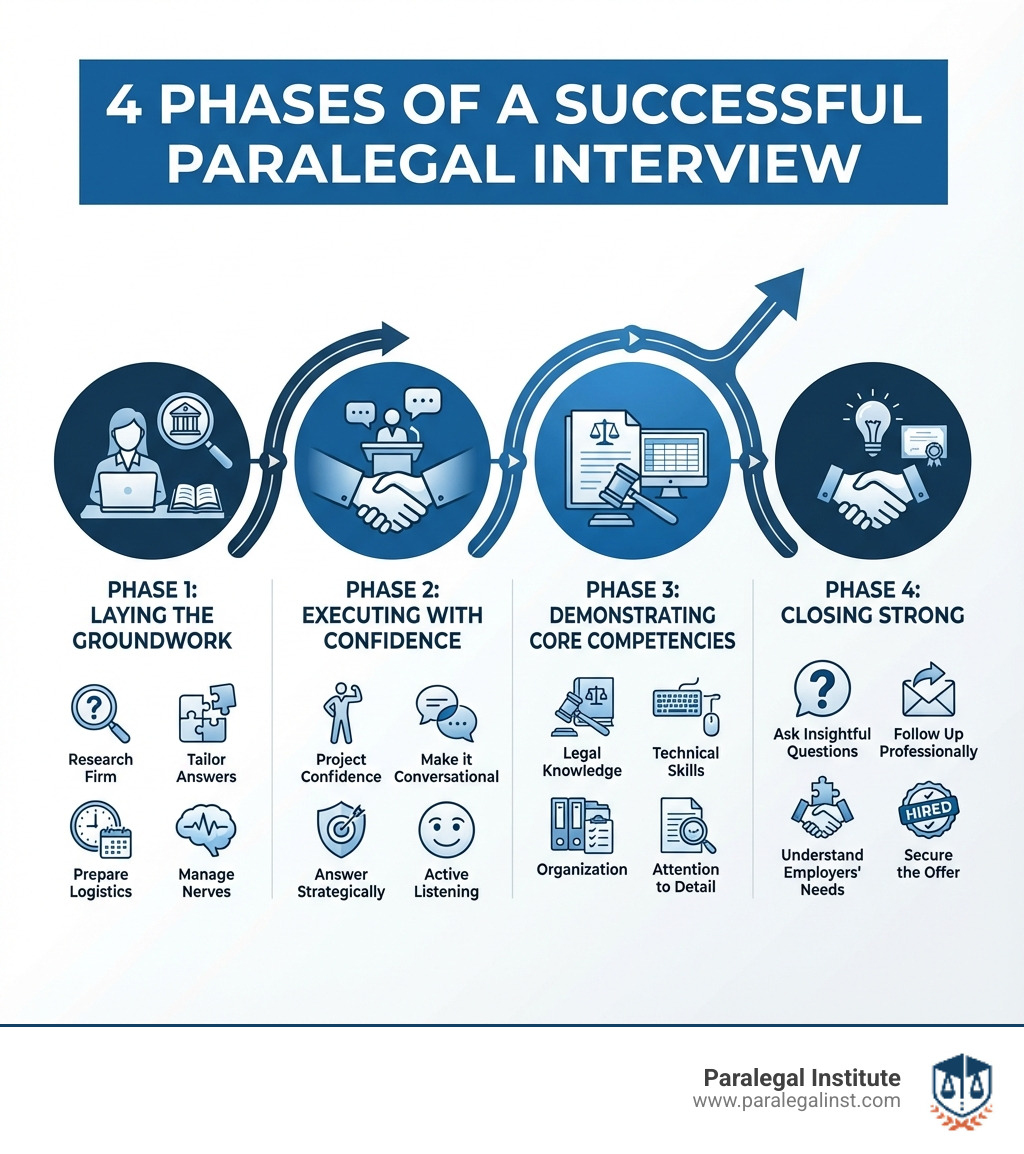
Phase 1: Laying the Groundwork for Success
Before you step into the interview, your success hinges on preparation. Think of it as the discovery phase of a legal case; the more thoroughly you investigate, the stronger your position.

Our first set of paralegal interview tips focuses on this crucial preparatory phase.
Researching the Firm
This is a requirement. Candidates who haven't done their homework make a poor impression. Dive deep into the firm's:
- Practice Areas: What kind of law do they specialize in? If it's personal injury, understand the basics. If it's corporate law, know the terminology.
- Key Attorneys: Look up the attorneys you'll be interviewing with. Understanding their backgrounds and specializations helps you tailor your responses.
- Firm Culture: Is the environment collaborative or independent? Check their website and social media for clues to determine if it's a good fit.
The goal is to show you want this paralegal job, not just any job. For more guidance, read our article on How to Get Paralegal Job.
Tailoring Your Answers
Use your research to customize your responses. Connect your skills directly to the firm's needs.
- Align Your Skills: Review the job description line by line. For each requirement, prepare a specific example from your experience that demonstrates that skill.
- Highlight Relevant Experience: If the firm specializes in litigation, emphasize your experience with discovery and trial preparation. If it's transactional, highlight contract review or due diligence work.
Logistical Preparation
Don't let small mishaps derail your interview. Project professionalism by handling the details.
- Confirm Details: Double-check the date, time, and location (or video link). If it's in person in Las Vegas, NV, consider a practice commute.
- Plan Your Attire: The legal field is conservative. A professional suit is always a safe bet.
- Prepare Your Portfolio: Organize redacted work samples (drafts, memos, summaries) in a binder. Bring extra copies of your resume.
For those preparing for their first paralegal role, our guide on Prep for First Job as a Paralegal offers more in-depth advice.
Managing Nerves
It's normal to feel nervous. The key is to manage that adrenaline. To burn off excess energy and clear your head, try walking briskly around the block before the interview. A final review of your resume and research notes can also boost your confidence, as knowing you've prepared thoroughly is a great way to calm pre-interview jitters. For additional strategies, you can also review general job-interview advice, such as the guidance in this interview tips article.
Foundational Paralegal Interview Tips: Preparing for Common Questions
Now, let's address the questions you're most likely to encounter. Preparing thoughtful answers to these is one of the most impactful paralegal interview tips we can offer.
"Why this firm?" This tests your research and interest. Talk about specific cases, practice areas, or values you admire about the firm. For instance, if you're interviewing with a firm in Las Vegas, NV, known for its litigation department, mention your interest in complex trial preparation.
"Why do you want to be a paralegal?" Tell your story. Did a personal experience spark your interest in law? Do you enjoy supporting attorneys and contributing to the administration of justice? Connect your passion to the role's practical aspects. For more insights, explore our Paralegal Career Advice.
"What are your long-term goals?" and "Are you planning to apply to law school?" Be honest, but reassure the firm of your commitment to the paralegal profession. If law school is a distant goal, frame it as a long-term aspiration while emphasizing your dedication to excelling as a paralegal now. We look for individuals who see the paralegal role as a career, not just a stepping stone.
"What are your strengths and weaknesses?" For strengths, highlight relevant skills: attention to detail, research, communication, and organization. For weaknesses, choose one that isn't critical and explain your plan for improvement. For example, "I can be a perfectionist, which sometimes slows me down. I'm working on this by setting time limits for tasks to ensure efficiency without sacrificing quality."
"What would you consider your biggest accomplishment at your last job?" Choose an accomplishment that demonstrates a key paralegal skill and quantify it if possible. Did you streamline a process or help win a case with diligent research? Use the STAR method to structure your answer.
"How do you handle stress?" The legal field is demanding. We want to know you have healthy coping mechanisms. Talk about your ability to prioritize, stay organized, and maintain a solution-focused approach.
Reviewing Your Resume, Explaining Job History, and Addressing Gaps Be ready to walk through your resume, explaining any career transitions or gaps positively. Focus on what you learned and how each experience prepared you for this role. Avoid speaking negatively about past employers.
Phase 2: Executing a Confident Interview
You've done your homework. Now it's time to perform. How you present yourself is just as important as what you say. Our next set of paralegal interview tips focuses on making a powerful impression during the conversation.
Projecting Confidence
Confidence is a game-changer. It tells us you'll be capable of tackling challenges and communicating effectively in the workplace.
- Body Language: Sit up straight, maintain an open posture, and avoid fidgeting. A firm handshake (if in-person) conveys assurance.
- Eye Contact: Maintain steady, comfortable eye contact to show engagement and sincerity.
- Clear Speech: Speak clearly and at a steady pace. Enthusiasm for the role will naturally shine through.
- Enthusiasm: Show genuine interest in the opportunity. A positive attitude is contagious and tells us you'd be a great fit for our team.
To understand why confidence matters so much in professional settings, it can help to look at broader workplace guidance, such as the overview in this confidence article.
Making It a Conversation
The best interviews don't feel like an interrogation; they feel like a compelling conversation. This is a two-way street where you're also assessing if the firm is the right fit for you.
- Active Listening: Pay close attention to the interviewer's questions and comments. It shows respect and helps you tailor your answers.
- Building Rapport: Find common ground and let your personality show to create a more natural and memorable interaction.
- Asking Clarifying Questions: If a question is unclear, ask for clarification. It shows you're thoughtful and want to provide the best possible answer.
Answering General Questions
Here's how to approach common questions during the actual interview:
- "Tell me about yourself." Prepare a concise "elevator pitch" that highlights your relevant experience, skills, and why you're interested in this specific paralegal role. Connect it to the firm's practice areas and your career goals. This is your chance to set the stage for how you see your Role of Paralegals in Law Firms.
- "Why do you want to be a paralegal?" As discussed, weave a story. Express your passion for the legal field and your desire to contribute meaningfully.
Answering Behavioral Questions: More Paralegal Interview Tips
Behavioral questions reveal how you've handled past situations, which indicates future performance. This is where our next set of paralegal interview tips truly shines.
The STAR Method
This structured approach is your best friend for behavioral questions:
- Situation: Briefly describe the context.
- Task: Explain the goal or problem.
- Action: Detail the specific steps you took. This is where you highlight your skills.
- Result: Describe the outcome. What did you achieve? What did you learn?
You can see how STAR is used more broadly in hiring by looking at the general explanation of behavioral interviewing.
Handling Difficult Clients, Attorneys, or Coworkers The legal profession can be high-stress, and interpersonal challenges are inevitable. We need to know you can handle them professionally.
- Difficult People: Emphasize empathy, active listening, and professionalism. When discussing a conflict, describe how you approached the situation constructively, focusing on resolution and what you learned. Avoid negativity or blaming others.
Problem-Solving Examples and Analyzing Complex Issues Paralegals are critical thinkers. We want to see how you analyze and resolve issues.
- Provide an Example: Using the STAR method, describe a time you faced a complex problem. Explain how you analyzed the situation, conducted research, and contributed to a solution. For instance, "I once had to analyze conflicting case law. I systematically researched relevant statutes and prior rulings, synthesized the information into a concise memo, and presented my findings to the attorney, which helped them formulate a winning argument."
- Making Decisions: You'll often need to make informed decisions about prioritizing tasks or research. Describe your process for gathering information and consulting with superiors when necessary.
Handling Ethical Challenges and Confidential Information Integrity and discretion are non-negotiable in the legal field.
- Confidential Information: Explain your understanding of client confidentiality and how you ensure the secure handling of sensitive data.
- Ethical Challenges: If asked about an ethical dilemma, describe a situation where you upheld ethical principles. For example, "A client once asked me to withhold crucial information. I explained our ethical obligations and reported the situation to the supervising attorney, ensuring we maintained our professional integrity." This demonstrates a strong moral compass and understanding of legal ethics.
Phase 3: Demonstrating Your Core Competencies
This is where you showcase the practical skills that make you an invaluable asset. Our next set of paralegal interview tips focuses on how to articulate your abilities clearly and effectively.

Legal Knowledge
We expect a foundational understanding of the law and a commitment to continuous learning.
- Specific Practice Areas: Be ready to discuss any experience or strong interest in a particular area of law, like personal injury. This aligns well with roles like a Personal Injury Paralegal Job Description.
- Staying Current on Laws: Explain how you stay updated on legal changes, whether through legal publications or professional networks. This shows you're proactive.
For a broader overview of what paralegals do nationwide, you can also look at the general description of the role in the paralegal article.
Technical Skills
Technical proficiency is crucial in today's legal landscape.
- Legal Research Databases: Name the specific legal research databases you're proficient in and describe how you use them to conduct efficient research.
- Law Office Technology: Discuss your experience with case management systems and general office software. Emphasize your adaptability and eagerness to learn new technologies.
Organizational Skills
Paralegals are the organizational backbone of a legal practice. We need to know you can juggle multiple tasks smoothly.
- Prioritizing Tasks: Describe your system for managing your workload and prioritizing tasks based on urgency, especially when working for multiple attorneys.
- Handling Multiple Attorneys: Explain how you communicate with each attorney to understand their priorities and manage expectations. This demonstrates excellent time management. Being a good paralegal often means mastering this skill, as detailed in our guide on How to Be a Good Personal Injury Paralegal.
Attention to Detail
Accuracy is paramount; a single error can have significant consequences.
- Ensuring Accuracy: Describe your meticulous processes, such as using checklists or cross-referencing information to ensure your work is flawless.
- Managing Large Document Volumes: If you have experience with extensive discovery, explain how you organize and review large volumes of documents to extract key information.
Showcasing Your Practical Skills
Beyond knowing the law, we want to see that you can do the work. This section of paralegal interview tips focuses on demonstrating your hands-on capabilities.
Drafting Legal Documents
This is a core paralegal responsibility.
- Types of Documents: Be specific about what you've drafted, such as pleadings, motions, or contracts. If you’re an entry-level candidate, highlight experience from your Entry Level Paralegal Training, emphasizing practical assignments.
Legal Research Process
It's not just that you can do legal research, but how you do it.
- Synthesizing Information: Describe your methodical approach: how you identify key issues, locate sources, analyze information, and synthesize it into a clear memo for an attorney.
Communication and Leadership
Effective communication and initiative are vital.
- Interpersonal Skills: Explain how you communicate clearly and professionally with clients, attorneys, and other staff. Describe how you collaborate within a team.
- Initiative: Share examples of when you've taken initiative, such as mentoring a new team member or proposing a process improvement that increased efficiency.
Phase 4: Closing Strong and Following Up
You've presented your case, projected confidence, and demonstrated your skills. Now, let's nail the landing with our final set of paralegal interview tips to ensure you leave a lasting positive impression.
Asking the Interviewer Questions
This is your opportunity to show genuine interest and gather information to help you decide if the firm is the right fit. We expect thoughtful questions.
Here are 5 essential questions we recommend you ask your interviewer:
- "Can you describe a typical day for a paralegal in this firm, and how does the team structure support their work?" This shows you're thinking practically about the role.
- "What are the most common types of cases the firm handles, and what would be my role in supporting those cases?" This demonstrates your desire to align your skills with their needs.
- "How does the firm approach paralegal professional development and continuing legal education?" This highlights your commitment to growth and continuous learning.
- "What do you consider the most challenging aspect of this position, and how does the firm support its paralegals in overcoming that?" This shows foresight and a problem-solving mindset.
- "How has the firm adapted to recent changes in the legal industry, such as the use of new legal technology?" This indicates you're aware of industry trends and interested in innovation.
Post-Interview Follow-Up
Don't underestimate the power of a professional follow-up.
- Thank-You Note Etiquette: Send a personalized thank-you note or email within 24 hours of your interview. Reiterate your interest in the position and briefly mention something specific you discussed to show you were attentive. This small gesture can make you stand out.
- Reaffirming Interest: Use the thank-you note to briefly remind them why you're an excellent fit for the role and the firm.
Understanding Red Flags
From our perspective as hiring managers, there are certain things we actively look to avoid. Being aware of these can help you steer clear of common pitfalls.
- Lack of Attention to Detail: Errors in your resume or follow-up email are immediate red flags for a paralegal role.
- Poor Communication Skills: Mumbling, unclear answers, or an inability to articulate your thoughts effectively.
- Lack of Enthusiasm: A disengaged demeanor or generic answers that show no specific interest in our firm.
- Negativity: Speaking poorly about past employers, colleagues, or situations. This suggests you might not be a team player.
- Blaming Others: When discussing challenges, candidates who deflect blame rather than taking accountability and focusing on solutions are a concern.
By avoiding these red flags and focusing on the positive, you significantly increase your chances. Ready to start your search? Check out our Paralegal Job Search resources.
Conclusion: Turning Your Interview into a Job Offer
We've covered a lot of ground, but the core paralegal interview tips boil down to a few key strategies: thorough preparation, confident execution, clear demonstration of your skills, and professional follow-up. Mastering these will set you apart in a competitive job market.
The legal field demands professionals who are not just knowledgeable but also highly skilled in practical application. This is why the importance of practical training cannot be overstated. Employers, including our firm, value candidates who are job-ready and can contribute from day one. Our programs at Paralegal Institute are specifically designed to meet this need, focusing on Building Professional Portfolio During Paralegal Training that directly translates to the demands of a legal office.
At Paralegal Institute, we understand that aspiring paralegals are career-focused adults seeking an accelerated, affordable, and practical path into the legal field. Our advantage lies in our:
- Live Instruction: Whether online or in-person in Las Vegas, NV, our classes are taught by practicing legal professionals, ensuring real-time learning and direct interaction.
- Accelerated Curriculum: We offer a 15-week paralegal certificate program that gets you into the workforce faster than traditional alternatives.
- Real-World Legal Training: Our hands-on curriculum focuses on the practical skills employers are looking for, preparing you for immediate entry into the legal field.
- High Job Placement: Our focus on job-readiness means our graduates are highly sought after by law firms.
Your paralegal interview is your opportunity to demonstrate that you are not just capable, but exceptional. By applying these paralegal interview tips, you'll show us that you have the skills, the confidence, and the practical training to succeed.
Take the next step: If you're ready to gain the practical skills and confidence needed to ace your paralegal interviews and launch a successful legal career, we invite you to explore our programs. Learn more about our Nevada Paralegal Certificate program.