
Why Government Service Offers a Good Alternative Career Path for Paralegals
Paralegal government jobs offer something most private sector positions can't match: true job security, comprehensive benefits, and the chance to serve the public interest while building a stable, long-term career. In a government role, paralegals earn competitive salaries, enjoy an excellent work-life balance, and contribute to cases that directly impact their communities, all while being part of a system dedicated to justice and public welfare.
Top Benefits of Government Paralegal Positions
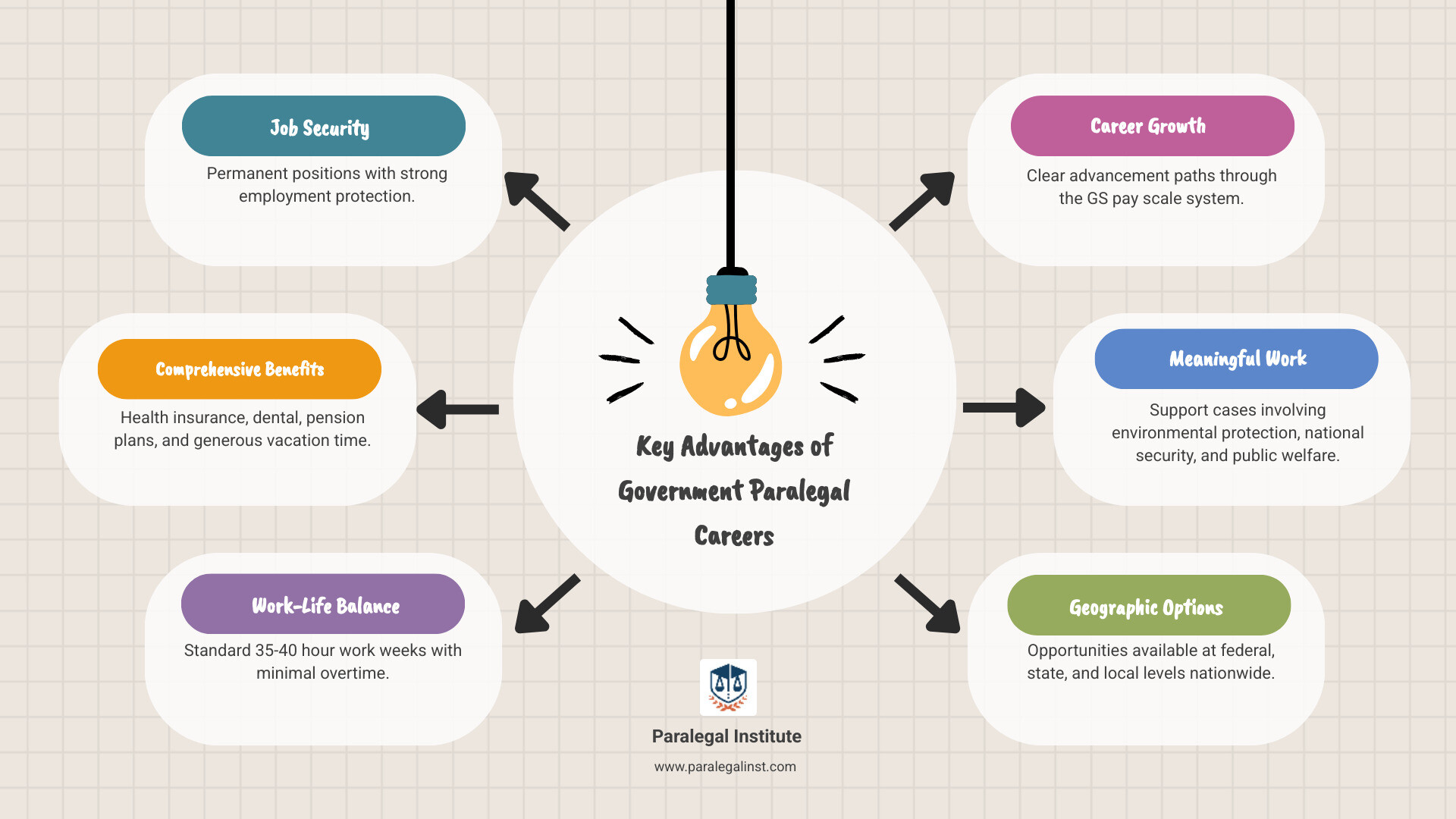
- Job Security: Government positions are known for their exceptional stability. Unlike the private sector, where employment can be subject to market fluctuations and firm profitability, permanent government roles come with strong civil service protections against arbitrary dismissal. This security allows you to plan your future with confidence, knowing your career is built on a solid foundation.
- Comprehensive Benefits: The benefits packages offered by federal, state, and local governments are often unparalleled. They typically include robust health and dental insurance plans, life insurance, and, most notably, defined-benefit pension plans that provide a reliable income stream in retirement. Add to that generous paid vacation time, sick leave, and federal holidays, and you have a benefits package designed for long-term well-being. You can learn more about federal benefits to see the full scope of what's offered.
- Work-Life Balance: If you're seeking a career that respects your personal time, government service is an ideal choice. Most positions operate on a standard 35-40 hour work week with minimal overtime. This stands in stark contrast to the high-pressure, billable-hour culture of many private law firms, allowing you to have a fulfilling career without sacrificing your life outside of work.
- Career Growth: Government agencies provide clear, structured pathways for career advancement. The General Schedule (GS) pay scale system outlines specific steps for promotion based on performance and experience. This transparency means you always know what is required to move to the next level, providing a predictable and rewarding career ladder.
- Meaningful Work: Perhaps the most compelling reason to choose a government paralegal career is the opportunity to do work that truly matters. You'll be on the front lines, supporting cases involving critical issues like environmental protection, national security, civil rights, and public welfare. Your efforts contribute directly to the greater good, making a tangible difference in society.
- Geographic Options: From busy federal offices in Washington D.C. to state agencies in your home capital or local municipal legal departments, government paralegal jobs are available nationwide. This geographic diversity provides incredible flexibility to build a career in a community that you love.
Government agencies at all levels are actively recruiting skilled paralegals for a wide variety of roles. The U.S. Department of Justice, the federal court system, the Department of Defense, and the Social Security Administration are just a few of the major federal employers that regularly post openings. At the state level, agencies handling everything from agriculture and transportation to taxation and insurance also rely on qualified paralegals. These positions involve in-depth legal research, precise document preparation, complex case management, and critical trial support—all performed in the service of the public.
Unlike private firms, which are fundamentally driven by billable hours and profit margins, government legal work centers on the principles of public service and justice. As a government paralegal, your focus will be on upholding the law and serving the community. You'll research statutes and analyze case law, draft detailed legal memoranda, compile extensive legislative histories, and support attorneys in administrative proceedings and court cases that protect citizens' rights and enforce vital regulations.
I'm Matthew Pfau, and my experience hiring and training paralegals for my law firm has given me deep insight into what makes candidates successful in paralegal government jobs. Through Paralegal Institute, I help aspiring legal professionals develop the practical skills needed to excel in public service roles.
The Role of a Government Paralegal: Duties and Specializations
Paralegal government jobs offer a unique opportunity to serve the public while building a rewarding legal career. Unlike private sector positions focused on profit, government paralegals work toward justice, public safety, and community welfare. Your daily efforts directly support attorneys and legal teams who protect citizens' rights, enforce regulations, and ensure government operations run smoothly.
Government paralegals handle diverse responsibilities that keep our legal system functioning effectively. Legal research forms the backbone of your work—you'll dive deep into statutes, case law, and regulations to support critical decisions. Case management keeps complex legal matters organized and moving forward. Document drafting ensures accurate legal paperwork reaches the right people at the right time. Trial preparation helps attorneys present their strongest case in court.
Every task you complete serves the public service mission. Whether you're researching environmental protection laws or supporting national security cases, your work impacts real people's lives. To learn more about the broader paralegal field and how government roles fit into the profession, visit The Paralegal Hub.
A Day in the Life: Core Responsibilities
What does a typical day look like in paralegal government jobs? Each morning brings new challenges and meaningful work that directly serves your community.
Legal research takes up a significant portion of your day. This is far more than simple searching; you'll be tasked with interpreting complex statutes, tracking down obscure legislative history to understand a law's intent, and analyzing judicial precedents to support legal arguments. One day you might be researching decades-old regulations for an environmental protection case, while the next you could be compiling a comprehensive history for a new policy initiative that will affect millions.
Cite checking keeps legal documents accurate and professional. This meticulous task is crucial for maintaining the integrity of all legal documents. You will verify every single citation and reference in briefs, motions, and other filings, ensuring they conform to strict court formatting requirements. This detail-oriented work is vital for preventing simple errors that could lead to costly delays or even jeopardize a case.
Drafting memoranda puts your research into action. Under the supervision of an attorney, you'll create internal memoranda, official correspondence, and sections of court filings. Your ability to write clearly and persuasively helps attorneys make informed decisions, build compelling arguments, and communicate effectively with other agencies and the public.
Case management keeps everything organized. Government cases can be incredibly complex, involving numerous parties, extensive evidence, and strict deadlines. As a paralegal, you are the organizational hub. You'll be responsible for compiling and organizing thousands of documents for findy and court proceedings, carefully tracking deadlines in a case management system, and maintaining comprehensive case files. Your organizational skills are what ensure that nothing critical falls through the cracks.
Supporting attorneys in hearings and trials gives you front-row seats to the legal process. This hands-on work can involve organizing and managing trial exhibits, operating courtroom technology, taking notes during proceedings, and helping attorneys prepare witnesses for testimony before administrative law judges or in federal courts.
Client liaison work connects you directly with the people your agency serves. In many government roles, you are a key point of contact for the public. You will respond to inquiries from citizens, gather information for cases, and help individuals and organizations steer complex legal and bureaucratic processes with clarity and compassion.
The practical skills needed for these responsibilities come from hands-on experience. Our programs focus on real-world training that prepares you for day-one success. Learn more about our approach through Hands-on Legal Training.
Government vs. Private Sector: Key Differences
Choosing between government and private sector paralegal work means weighing different priorities and work environments. Understanding these differences helps you make the right career choice.
| Criteria | Government Paralegal Roles | Private Sector Paralegal Roles |
|---|---|---|
| Case Types | Environmental law, regulatory compliance, public welfare | Corporate law, personal injury, business litigation |
| Salary & Benefits | Competitive salaries with excellent, comprehensive benefits packages | Potentially higher starting salaries but benefits can be less extensive |
| Career Path | Clear advancement through GS pay scale | Varied advancement opportunities, often less structured |
Job stability in government roles provides a level of peace of mind that the private sector rarely matches. As a public servant, you often benefit from civil service rules that protect against sudden layoffs, allowing for long-term career planning and financial security.
Work-life balance is a major advantage of government employment. You'll typically work a standard 35-40 hour week, which allows you to pursue hobbies, spend time with family, and avoid the burnout often associated with the relentless pressure of meeting billable hour quotas in private firms.
Scope of cases in government work often involves broader public impact. Instead of helping individual clients, you're supporting cases that protect entire communities or enforce important regulations that keep consumers safe or uphold civil rights.
Bureaucracy can slow decision-making in government agencies, but this structure is in place for a reason. The layers of review and procedure are designed to ensure fairness, accountability, and thoroughness. This deliberate process ensures that decisions are made carefully and in the public's best interest.
Public impact makes government work especially rewarding. Your efforts contribute to environmental protection, national security, public safety, and social justice initiatives that benefit everyone.
Finding Your Niche: Common Specializations
Paralegal government jobs span numerous specializations, each offering unique challenges and opportunities to serve the public.
Litigation support keeps you involved in courtroom proceedings. In this dynamic role, you are deeply involved in the entire lifecycle of a court case. You'll assist U.S. Attorneys or state prosecutors in preparing complex cases for trial, which includes managing massive document productions, organizing evidence, and helping to present compelling arguments that protect public interests in court.
Regulatory compliance focuses on ensuring businesses and individuals follow important rules. This specialization places you at the intersection of law and public policy. You'll work for agencies like the Environmental Protection Agency (EPA) or the Securities and Exchange Commission (SEC), helping to ensure that businesses and individuals adhere to critical rules that protect public health, financial markets, and safety.
Administrative law deals with government agency decisions and procedures. This field governs the actions of agencies themselves. As a paralegal, you might work for the Social Security Administration or a state licensing board, supporting administrative law judges during hearings and helping to guarantee fair and equitable treatment for all citizens interacting with the government.
Environmental law combines legal work with environmental protection. If you are passionate about protecting our natural resources, this specialization offers a direct way to make an impact. You could work for the Department of the Interior or a state environmental agency, researching the legal aspects of pollution cases or helping to enforce regulations that keep our air and water clean.
National security work involves protecting our country's interests. For those seeking a unique and challenging career, national security law offers a chance to serve at the highest levels. Working for agencies like the Department of Homeland Security (DHS) or the Department of Defense (DOD), you'll handle sensitive information and support cases vital to protecting our country's interests. These specialized roles often require extensive background checks and security clearances.
Each specialization requires a distinct set of skills and knowledge.